






Many students feel nervous when they think about the IELTS speaking test. They worry about forgetting words, making grammar mistakes, or running out of things to say. If you feel this way too, you are not alone. Thousands of test takers search for good IELTS speaking tips every single day because this part of the test feels different from reading or writing. You have to think and talk at the same time, in real time, with a stranger watching you and a clock quietly running in the background.
Here is something important to understand first. Good English in IELTS speaking is not about talking like a perfect textbook. The examiner is not looking for big, fancy words or flawless grammar. They want to see if you can share your ideas clearly and keep the conversation going naturally, almost like a normal chat with someone you just met. This is good news, because it means anyone can improve with the right practice, even if English is not their first language and even if they only have a few weeks before the test.
A lot of candidates make the mistake of thinking speaking skill only comes from knowing more grammar rules or harder words. In reality, the biggest score killers are usually simple things. Long pauses while thinking. Answers that are too short. Repeating the same three words again and again. Losing confidence after one small mistake. The good news is that every one of these problems can be fixed with focused practice, not talent.
The IELTS speaking test looks at four main things. These are fluency and coherence, vocabulary, grammar, and pronunciation. In this guide, we will walk through each one step by step. We will also cover common problems like hesitation, short answers, weak vocabulary, and nervousness. By the end, you will have simple, real IELTS speaking tips and tricks you can start using today, along with an IELTS preparation online plan and an IELTS speaking practice routine that fits into your daily life, even if you are busy with work or school.
How Is the IELTS Speaking Test Scored?
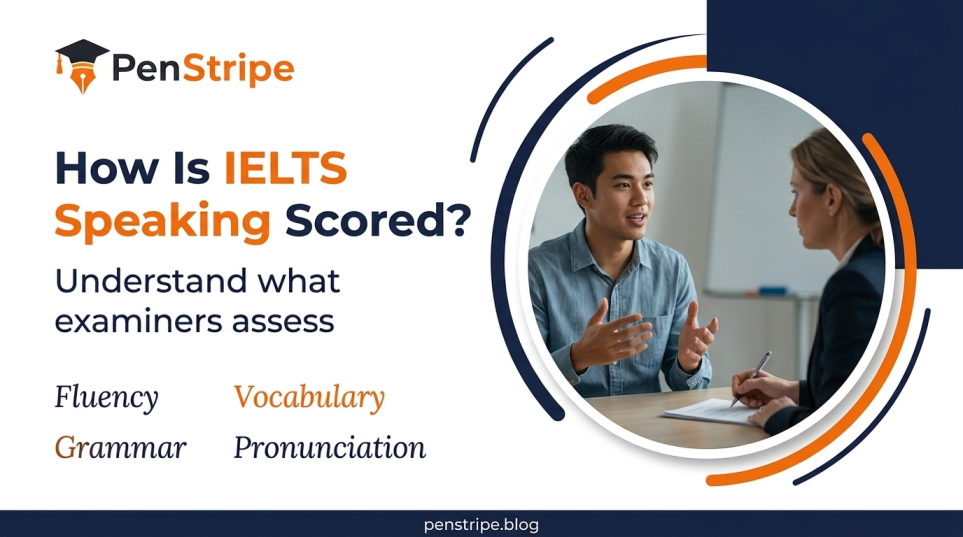
The examiner scores you using four parts, and each one is worth equal weight in your final speaking band. Knowing these parts helps you understand exactly what to practice instead of guessing.
Fluency and Coherence
This means how smoothly you speak and how well your ideas connect to each other. The examiner wants to hear you:
- Speak continuously without long, awkward pauses
- Organize your ideas in a clear, logical order
- Connect your sentences naturally, not like a list of separate facts
- Move from one idea to the next without losing the thread
You do not need to speak fast. Speed is not the same as fluency. What matters is that your speech flows smoothly, without stopping every few seconds to search for words or restart your sentence three times. A slower speaker who talks smoothly will usually score higher than a fast speaker who keeps stopping and starting.
Lexical Resource
This is your vocabulary range. The examiner checks if you can use a good variety of words correctly and naturally. Some helpful IELTS speaking vocabulary habits include:
- Using topic words that fit the question being asked
- Paraphrasing instead of repeating the same word over and over
- Avoiding very basic words like “good” or “nice” too many times
- Using idiomatic expressions naturally, without forcing them in
You do not need to use rare or complicated words to impress the examiner. In fact, using a hard word incorrectly can hurt your score more than using a simple word correctly. The goal is accuracy and range together, not just showing off vocabulary you memorized the night before.
Grammatical Range and Accuracy
This part looks at your sentence structures and how correctly you use them. You should try to mix simple sentences with more complex ones, such as sentences using “although,” “because,” “if,” or “which.” At the same time, keep your grammar mostly accurate. Small mistakes are completely normal, even for native speakers, and will not ruin your score on their own.
Grammatical range means variety. If every single sentence you say follows the exact same pattern, the examiner notices this and it limits your score, even if each sentence is grammatically correct.
Pronunciation
This is not about sounding British or American. It is about being clear and easy to understand for any listener. The examiner listens for:
- Clear pronunciation of individual sounds and words
- Correct word stress, meaning which part of the word you emphasize
- Natural sentence stress and rhythm
- Intonation that shows meaning, feeling, and emphasis
- Being understandable throughout the whole answer, not just at the start
Many candidates worry too much about sounding like a native speaker from a specific country. This is not the goal. The goal is simply to be understood clearly, from the first word to the last.
10 Practical IELTS Speaking Tips for a Higher Band Score

These are simple, real IELTS speaking tips and tricks you can start using right now, starting today, without needing any special books or expensive courses.
1. Speak English Every Day
Try to speak English for 10 to 20 minutes every day. This does not need to be a formal lesson. Talk about your daily routine, your opinions on something you saw online, or your plans for the weekend. Talk to yourself in your room if you have no partner available. Record yourself and listen back later.
This simple habit builds real confidence over time because your brain gets used to producing English sounds and sentences without long pauses. Just like a muscle, your speaking skill grows stronger the more you use it, and it gets weaker the more you avoid it.
2. Don’t Memorize Complete Answers
Memorized answers often sound stiff, unnatural, and rehearsed. Examiners are trained professionals who listen to hundreds of candidates, and they notice memorized speech almost immediately because the rhythm sounds different from normal conversation.
Instead of memorizing full answers word for word, learn useful ideas, structures, and phrases. Then practice using them flexibly to answer different types of questions. This way, even if the exact question is new to you, you already have the tools to build a natural answer on the spot.
3. Give Extended Answers
Never answer with just one short sentence, even for simple questions. A one-line answer does not give the examiner enough language to judge your fluency, vocabulary, or grammar properly.
Try this simple pattern: give your answer, give a reason, give an example, then give a result or extra detail. This Answer, Reason, Example, Result approach helps your answer grow naturally without sounding forced or robotic. For instance, if asked “Do you like reading books,” instead of saying just “Yes,” you could say you enjoy reading because it helps you relax after work, mention a specific book you recently finished, and explain how it changed the way you think about something.
4. Use Linking Words Naturally
Words like “actually,” “for example,” “in my opinion,” “however,” “as a result,” “on the other hand,” and “to be honest” help connect your ideas smoothly. These small words act like bridges between your thoughts, guiding the listener through your answer.
But be careful here. Using too many linking words in a row, one after another, can sound unnatural and mechanical, almost like you are reading from a checklist. Use them only when they truly fit the flow of your answer, the same way you would naturally use them if you were chatting with a friend.
5. Improve Your IELTS Speaking Vocabulary
Learn words by topic instead of learning random word lists that have no connection to each other. For example, if you are studying vocabulary for the topic of technology, learn words and phrases that specifically relate to devices, the internet, social media, and daily digital habits.
Also learn collocations, which are word pairs that go together naturally, such as “gain experience,” “make a decision,” or “reduce pollution.” Native speakers use these combinations automatically, and learning them makes your speech sound far more natural than memorizing single, isolated words.
Practice saying the same idea in different ways too. If you can only express one idea using one single sentence structure, your vocabulary score will stay limited no matter how many words you know.
6. Work on Pronunciation, Not Accent
You do not need a British or American accent to score well. Focus on being clear instead. Practice word stress, listen carefully to native speakers through podcasts or videos, and repeat what you hear out loud, matching their rhythm as closely as you can.
Record difficult words that you personally struggle with and check how they should sound using a dictionary app with audio. Repeat these words daily until they feel comfortable and automatic in your mouth.
7. Learn How to Handle Difficult Questions
Sometimes a question feels hard, confusing, or simply unexpected. This happens to almost every candidate at some point during the test. If this happens to you, you can:
- Politely ask the examiner to repeat the question if you genuinely did not hear it clearly
- Take a short, natural pause to think, using a filler phrase instead of silence
- Give an honest, simple answer, even if it is not your most exciting opinion
- Explain your reasoning briefly, so the examiner can hear your thought process
There is no rule that says you must have an amazing, unique opinion on every topic. A simple, honest answer explained clearly will always score better than a confusing, overly complicated one.
8. Practice IELTS Speaking Part 2 With a Timer
In the real test, you get 1 minute to prepare and 2 minutes to speak continuously on your cue card topic. Practice this exact timing at home using your phone timer. Organize your notes quickly during the one minute, and try to include past, present, and future details when they naturally fit the topic given to you.
Many candidates lose points simply because they stop talking after 60 or 70 seconds, well before the full two minutes are up. Practicing with a timer trains your brain to naturally stretch your answer to fill the required time.
9. Avoid Common Grammar Mistakes
Watch out for these common problems that appear again and again in candidate speech:
- Subject and verb not matching correctly
- Missing or wrong articles, meaning “a,” “an,” and “the”
- Wrong verb tense, especially mixing past and present incorrectly
- Wrong prepositions, such as “in,” “on,” and “at”
- Singular and plural noun mistakes
- Sentence formation that sounds translated directly from another language
Small mistakes here and there are completely normal and expected, even at high band levels. What matters is that these mistakes do not happen so often that they make your meaning unclear.
10. Stay Calm and Keep Speaking
If you make a mistake, do not panic and do not stop talking completely. You can correct yourself quickly and naturally, the same way native speakers do all the time in normal conversation, then simply keep going with your answer.
Stopping completely because of one small error hurts your fluency score far more than the original error itself. Self correction, when done smoothly, actually shows the examiner that you have good language awareness, which can work in your favor.
Read related guide IELTS speaking Band Score & Performance
IELTS Speaking Tips for Part 1
How to Answer Part 1 Questions
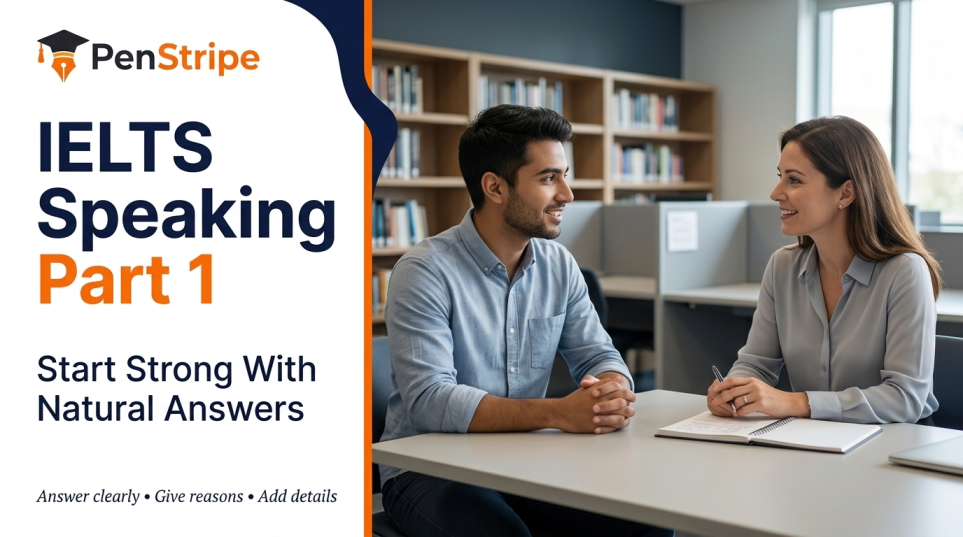
Answer the question directly first, then add one extra detail or reason to extend your response naturally. Keep your answer natural in length and tone, similar to how you would answer a friendly question from a new acquaintance. A good Part 1 answer usually takes about 15 to 20 seconds to say out loud, no longer.
Avoid rushing through your answer just to finish quickly. At the same time, avoid turning a simple Part 1 question into a long speech, since that is not what this section is designed for.
Common IELTS Speaking Part 1 Topics
Common IELTS speaking topics in Part 1 include everyday, familiar subjects such as:
- Hometown
- Family
- Work
- Studies
- Hobbies
- Food
- Technology
- Daily routine
- Weather
Since these topics are familiar to almost everyone, there is no excuse for giving a weak or empty answer. Prepare basic vocabulary and a few natural sentences for each of these common areas well before your test date.
Mistakes to Avoid in Part 1
Avoid these common errors that lower your score without you even realizing it:
- Giving one-word answers like “yes” or “no” without any extra detail
- Repeating the question back to the examiner word for word before answering
- Using memorized responses that sound rehearsed and unnatural
- Adding information that does not actually relate to the question being asked
IELTS Speaking Tips for Part 2
Understand the Cue Card Quickly
When you see your cue card, quickly identify the who, what, where, when, why, and how of the topic in front of you. This fast mental breakdown helps you plan a clear, organized answer within your limited preparation time.
How to Use Your One-Minute Preparation Time
Use your one minute wisely to write a simple note structure on your paper, not full sentences, just quick keywords to jog your memory later. A useful structure includes:
- Main idea
- Details
- Example
- Your feelings or opinion about it
Do not try to write full sentences during this minute, since there is simply not enough time. Keywords and short phrases work far better under this kind of time pressure.
How to Keep Speaking for Two Minutes
To fill two minutes naturally without running out of things to say, try to:
- Add background information about the topic
- Describe small, specific details rather than staying general
- Explain how you personally feel about the topic
- Give clear reasons for your feelings or opinions
- Mention what happened after the main event, if relevant
- Compare the past and the present related to your topic
What to Do If You Forget a Word
If you forget a specific word during the test, do not freeze up or go silent. You can paraphrase it by describing what it does, describe it using other simple words, give a related example instead, or simply use a simpler word that captures a similar meaning. The goal is to keep your speech flowing smoothly, since fluency matters more than finding one perfect word.
IELTS Speaking Tips for Part 3
Give developed answers.
Part 3 questions are more analytical and abstract compared to Parts 1 and 2. Use this simple pattern to build a strong answer: Give your opinion, explain your reasoning behind it, add a relevant example, then give a short conclusion that wraps up your point clearly.
Discuss Both Sides of an Issue
Many Part 3 questions ask about advantages and disadvantages, causes and effects, changes over time, or how individuals compare to society as a whole. Try to mention both sides of the issue briefly, even if you personally lean toward one particular opinion. This shows the examiner that you can think about a topic from multiple angles, which is a valuable skill at higher band levels.
Express Opinions Naturally
Useful phrases for expressing your opinion smoothly include:
- I would say that…
- From my perspective…
- I tend to think that…
- One possible reason is…
- This is mainly because…
Practicing these phrases until they feel automatic will help you sound confident and natural, even when discussing unfamiliar or challenging topics.
IELTS Speaking Fluency Tips for Candidates Who Hesitates?

If you often freeze up during speaking practice or during the real test, this section is written specifically for you.
Why Do IELTS Candidates Hesitate?
Common reasons for hesitation include fear of making mistakes in front of the examiner, translating sentences from your first language inside your head before speaking, limited vocabulary for certain topics, overthinking grammar rules while trying to speak, and simply not practicing enough out loud in daily life.
How to Reduce Hesitation
Try to think directly in English instead of translating from your native language first. This single change alone can dramatically reduce your pause time. Practice answering questions with a timer running to build comfort under pressure. Learn natural filler phrases to use instead of silence. Focus on learning flexible ideas rather than fixed scripts. Practice speaking without stopping, even if your grammar or word choice is not perfect during practice sessions.
Useful Natural Filler Phrases
- Well, I’d say…
- That’s an interesting question.
- Let me think about that for a moment.
- Actually, I think…
- From my experience…
These fillers help you sound natural and give your brain a few extra seconds to organize your thoughts while you think. But use them sparingly and only when genuinely needed, not in every single sentence, since overuse creates its own new problem.
IELTS Speaking Vocabulary Tips

Learn Vocabulary by Topic
Study words by topic areas like education, technology, environment, health, travel, work, society, and media. This approach makes it far easier to recall and use the right word at the right moment during your test, compared to studying random unrelated word lists.
Learn Collocations
Instead of memorizing single words in isolation, learn word pairs such as gain experience, pursue higher education, develop a skill, make a decision, and reduce pollution. These natural combinations sound far more fluent and native-like than single random words strung together.
Use Paraphrasing to Avoid Repetition
Try to express the same idea using a few different words and sentence structures. This shows the examiner that you have a genuinely flexible vocabulary, which is a key part of good IELTS speaking tips and word practice that many candidates overlook.
IELTS Speaking Pronunciation Tips
Focus on Being Understandable
You do not need a perfect native accent. You simply need clear, understandable speech that any listener could follow without difficulty.
Practice Word Stress
Every English word with more than one syllable has a stressed part, meaning one syllable is said slightly louder and longer than the others. Saying the stress in the wrong place can genuinely confuse listeners or even change the meaning of a word, so practice this carefully using audio examples.
Practice Sentence Stress
In full sentences, some words carry more importance and weight than others, usually the words that carry the main meaning. Practicing sentence stress makes your speech sound far more natural and less flat or robotic.
Improve Intonation
Your voice should rise and fall naturally throughout a sentence, just like in normal, relaxed conversation. Flat, monotone speech sounds less natural and can even make it harder for the examiner to follow your meaning clearly.
Record and Review Your Speech
Recording yourself is one of the best free tools available to any candidate. Listen back carefully and notice exactly what needs work, whether that is a specific sound, a stress pattern, or your overall rhythm.
Common IELTS Speaking Mistakes to Avoid
Here are mistakes that often quietly lower scores without candidates even realizing it:
- Memorizing full answers word for word
- Giving very short, underdeveloped answers
- Speaking too fast, which often leads to unclear pronunciation
- Speaking too slowly, which can hurt your fluency score
- Repeating the same vocabulary again and again throughout the test
- Using big or complicated words incorrectly just to sound impressive
- Ignoring pronunciation practice completely
- Giving answers that do not actually match the question asked
- Panicking after making one small mistake
- Overusing filler words until they become distracting
- Not developing Part 3 answers enough with reasoning and examples
- Worrying too much about perfect grammar instead of clear communication
Read about Ielts speaking fluency and answers
How to Practice IELTS Speaking at Home
You do not need an expensive classroom or private tutor to improve. Try these simple, effective methods on your own.
Use Your Phone to Record Yourself
Record short answers to practice questions and listen back carefully for mistakes, awkward pauses, and pronunciation issues you might not notice while actually speaking.
Practice With a Speaking Partner
Find a friend, classmate, family member, or an online language partner to practice real, natural conversations with regularly. Speaking with another person adds a level of realistic pressure that practicing alone cannot fully replicate.
Practice With Random Questions
Pick random topics from a question bank and answer them without any preparation time. This method builds real, spontaneous fluency rather than rehearsed, prepared speech.
Use a Two-Minute Speaking Challenge
Set a timer for two full minutes and speak continuously on any topic without stopping, even if you repeat an idea or pause briefly. This is one of the best IELTS speaking mock test style exercises you can do completely alone, and it directly mirrors the real Part 2 format.
Review Your Mistakes Weekly
Once a week, sit down and listen to your old recordings from that week. Take notes on repeated mistakes, whether they are grammar patterns, pronunciation issues, or vocabulary gaps, and focus your next week’s practice on fixing exactly those specific problems.
IELTS Speaking Tips to Reach Band 7

To reach Band 7, focus on consistent fluency throughout your whole test, well developed answers with reasons and examples, flexible vocabulary across different topics, better grammar range with mixed sentence structures, clear pronunciation, and natural, comfortable interaction with the examiner throughout the conversation.
What Band 7 Candidates Do Differently
They speak with noticeably fewer long pauses compared to lower scoring candidates. They use a wider vocabulary range without repeating the same basic words constantly. They naturally mix simple and complex sentences instead of relying on one repeated pattern. They also stay calm and keep speaking smoothly even when they make small mistakes, correcting themselves quickly without losing their flow.
IELTS Speaking Tips to Reach Band 8
Band 8 candidates show even greater flexibility in how they use language across all topics. They use precise, accurate vocabulary that fits each specific context perfectly. They speak with natural discourse markers, meaning their speech flows the way a native speaker’s naturally would. They show strong grammatical control with very few noticeable errors, and they can comfortably discuss unfamiliar or abstract topics without excessive hesitation, even topics they have never specifically prepared for in advance.
IELTS Speaking Practice Routine
Here is a simple, structured daily routine you can follow to build steady improvement over time.
- 15 minutes: Vocabulary practice focused on one specific topic
- 15 minutes: Part 1 style questions and short answer practice
- 15 minutes: Part 2 cue card practice using a real timer
- 15 minutes: Part 3 discussion questions with developed answers
- 10 minutes: Reviewing your recordings from that session
7-Day IELTS Speaking Practice Plan
- Day 1: Focus on Part 1 topics and basic everyday vocabulary
- Day 2: Practice Part 2 cue cards with a strict timer for realistic pressure
- Day 3: Practice Part 3 discussion answers with reasons and examples
- Day 4: Work specifically on pronunciation, word stress, and intonation
- Day 5: Complete a full mock speaking test covering all three parts together
- Day 6: Review your recordings from the week and fix repeated mistakes
- Day 7: Light, relaxed review practice before resting your voice and mind
Frequently Asked Questions About IELTS Speaking Tips
How can I improve my IELTS speaking quickly?
Practice speaking out loud every day and record yourself to catch and fix mistakes fast.
How can I speak English fluently in IELTS?
Think in English, avoid translating in your head, and practice full, developed answers instead of single words.
How can I get Band 7 in IELTS Speaking?
Focus on steady fluency, wider vocabulary, mixed grammar structures, and clear pronunciation throughout your answers.
Should I memorize IELTS speaking answers?
No, memorized answers usually sound stiff and unnatural to trained examiners listening carefully.
What should I do if I forget a word?
Describe it, paraphrase it, or simply use a simpler word that means something similar.
Final IELTS Speaking Tips
Remember this simple cycle: practice, record, review, correct, and repeat. This one habit, done consistently every single day, improves your speaking faster than almost anything else you could try, including expensive courses or complicated study materials.
You do not need perfect English to do well in this test, and you never will. You need to communicate your ideas clearly, extend your answers naturally using reasons and examples, use vocabulary flexibly across different topics, and stay calm and understandable, even when you feel nervous inside. Keep these IELTS speaking tips in mind, practice a little every single day using the routine above, and your confidence and your score will grow together, one small step at a time.