






Many students spend hours studying but still feel like they are not making enough progress. The problem is often not a lack of effort. It is the way they study.
If you want to learn how to study faster, the goal should not be to rush through your books. Instead, you need to use methods that help your brain understand, remember, and review information more efficiently.
Effective studying combines focused sessions, active learning, smart time management, and regular revision. Techniques such as active recall, spaced review, focused reading, and distraction control can help you cover more material without simply adding more hours to your schedule.
This guide explains 11 practical ways to study faster and remember more. You will also learn how to study faster for exams, what to do when you have only one hour, and how to make your study sessions more efficient.
1. Set a Clear Study Goal
One of the easiest ways to waste study time is to start without knowing exactly what you want to accomplish.
Before opening your textbook, define one specific target.
For example, instead of saying, “I will study biology,” set a goal such as:
“I will understand the three stages of cellular respiration and answer 15 practice questions.”
A specific goal gives your session direction. It also makes it easier to recognize when the task is complete.
Break Large Topics Into Smaller Tasks
Large chapters can feel overwhelming. Divide them into smaller sections based on concepts, headings, or learning objectives.
For example:
- Read one concept
- Create five questions
- Test yourself
- Review mistakes
- Move to the next concept
This approach prevents passive reading from taking up your entire study session.
Use a Simple Study Checklist
Create a short checklist before starting.
Your list might include:
- Read the lesson
- Highlight only key ideas
- Create recall questions
- Complete practice problems
- Review difficult points
A checklist reduces decision-making during your session and helps you stay focused.
2. Use Short Focused Study Sessions

Long study sessions are not automatically productive. If your attention drops after 30 or 40 minutes, continuing to stare at a page may produce very little learning.
Instead, divide your work into focused sessions.
Try the Focus-Review-Break Method
A simple structure is:
- Study with full attention.
- Take a short break.
- Return and recall what you learned.
- Continue with the next section.
The exact session length can vary. Some students prefer 25 minutes of work, while others can focus for 45 to 60 minutes.
The important part is maintaining genuine concentration.
Avoid Multitasking
Studying while checking messages, watching videos, or constantly switching between apps makes learning less efficient.
Keep only the materials you need on your desk. Put your phone away or activate a focus mode during the session.
3. Prioritize the Most Important Material
You do not always need to study every page with equal intensity.
When time is limited, identify the concepts that are most likely to matter.
Start With High-Value Topics
Look for:
- Learning objectives
- Topics emphasized by your teacher
- Concepts repeated in class
- Previous exam questions
- Important formulas
- Areas where you repeatedly make mistakes
This is especially useful when learning how to study fast in 1 hour for an exam.
Use the 80/20 Idea Carefully
The 80/20 principle can remind you that some topics have greater value than others. However, it does not mean you should ignore the rest of your syllabus.
Use it as a prioritization tool rather than a reason to skip essential material.
4. Practice Active Recall
Active recall is one of the most useful study techniques for learning efficiently.
Instead of repeatedly reading information, close the book and try to retrieve the answer from memory.
Turn Notes Into Questions
For example:
Instead of reading:
“Photosynthesis converts light energy into chemical energy.”
Ask yourself:
“What does photosynthesis do?”
Then answer without looking.
This forces your brain to retrieve information rather than simply recognize familiar words.
Test Yourself Before Looking at the Answer
Self-testing can reveal what you actually know.
Try:
- Flashcards
- Practice questions
- Blank-page recall
- Short quizzes
- Explaining a concept from memory
If you cannot answer, check the material and try again later.
5. Use Spaced Repetition
Studying something once does not guarantee that you will remember it later.
Spaced repetition means reviewing information at increasing intervals instead of cramming everything into one session.
Create a Simple Review Schedule
You could review new material:
- Later the same day
- The next day
- Several days later
- One week later
- Before the exam
The exact schedule can change depending on the subject and how difficult the material is.
Combine Spacing With Active Recall
The strongest approach is not simply rereading your notes several times.
Instead, ask yourself questions during each review.
For example:
“Can I explain this concept without looking at my notes?”
If yes, move forward. If not, review the weak area again.
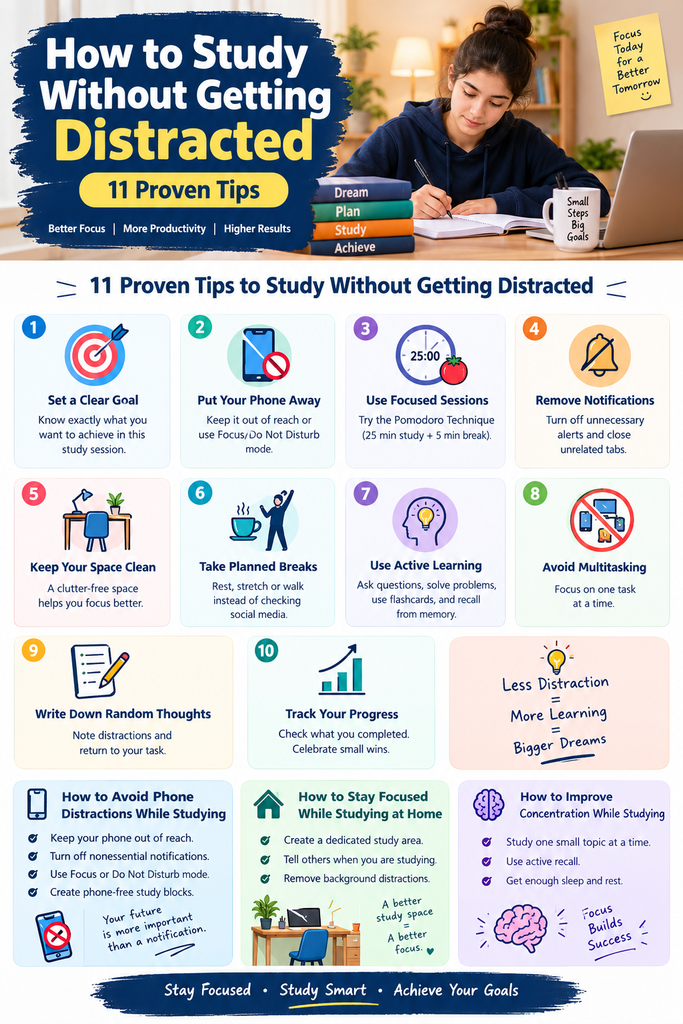
6. Remove Distractions
A distracted study session can take much longer than a focused one.
If you constantly switch between studying and entertainment, your attention keeps moving away from the task.
Control Your Phone
Before studying:
- Turn off unnecessary notifications.
- Put your phone away.
- Use website blockers if needed.
- Keep social media closed.
- Tell others you are studying.
Small environmental changes can make it easier to maintain concentration.
Create a Study-Friendly Environment
Keep your study area simple.
Have your:
- Textbook
- Notebook
- Pen
- Water
- Computer, if required
Everything else can stay away until you need it.
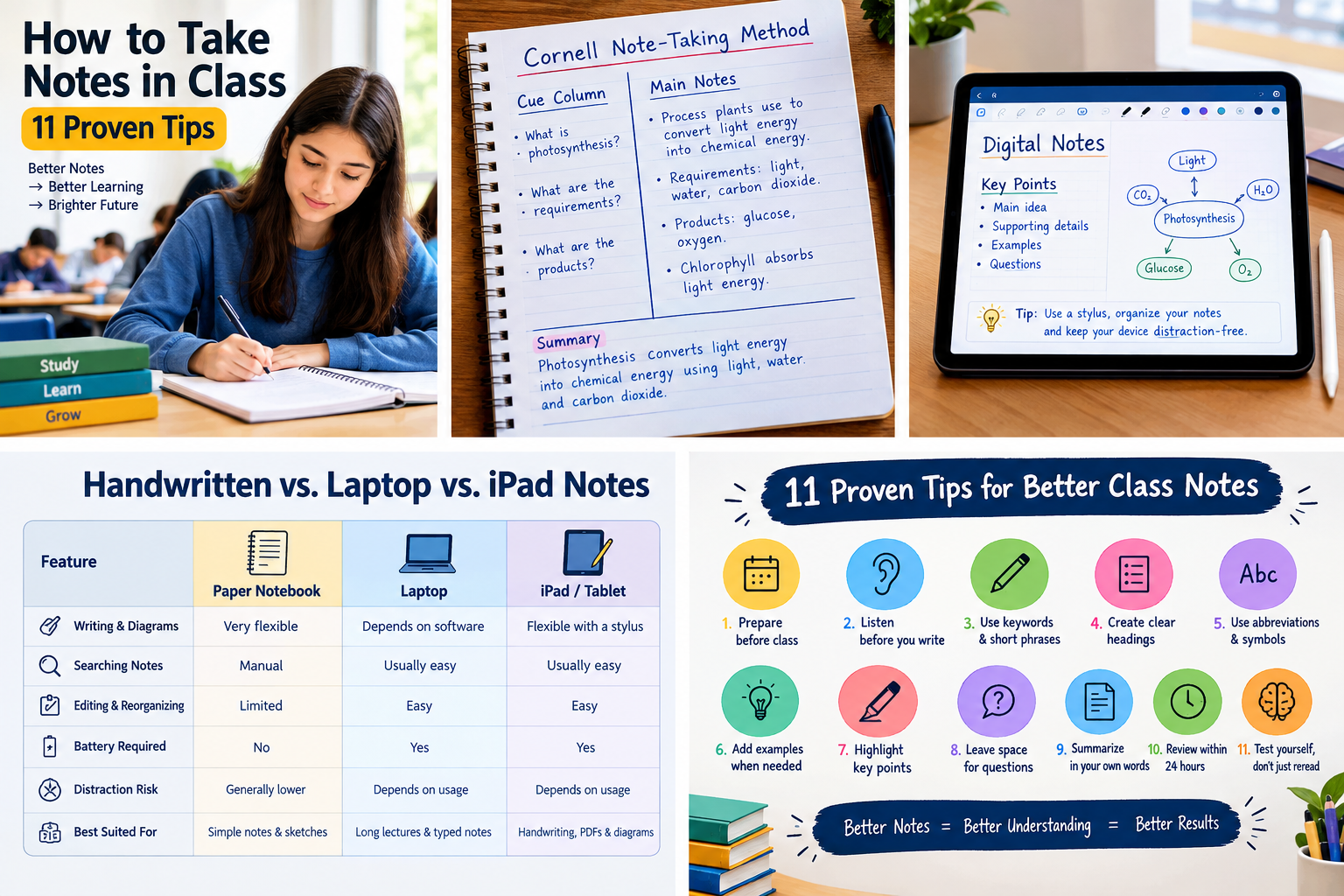
7. Take Smarter Notes

Writing everything down can slow you down without improving understanding.
Good notes should help you remember the important ideas later.
Focus on Ideas, Not Every Sentence
Instead of copying an entire paragraph, write:
- Main concept
- Important definition
- Formula
- Example
- Question you still have
This saves time and gives you useful material for revision.
Use the Feynman Technique
Try explaining a difficult concept in simple language as if you were teaching it to someone else.
If you cannot explain it clearly, you probably need to study that part again.
This technique can be especially useful for complex subjects.
8. Combine Reading With Practice
Reading alone can create a false feeling of understanding.
After learning a concept, use it.
Practice Immediately
For mathematics, solve problems.
For science, answer concept questions.
For history, explain causes and consequences.
For languages, use new vocabulary in sentences.
For professional subjects, complete realistic exercises.
The goal is to move from “I recognize this” to “I can use this.”
Use Mistakes as Feedback
Do not simply mark an answer wrong and move on.
Ask:
- Why did I make this mistake?
- What concept did I misunderstand?
- Was the problem caused by memory or reasoning?
- How can I avoid the same mistake?
Mistake analysis can make future study sessions more efficient.
9. Use Quick Revision Strategies
Quick revision is useful when you need to refresh material without rereading an entire chapter.
Try the One-Page Review
Create a single page containing:
- Key definitions
- Main concepts
- Important formulas
- Difficult facts
- Common mistakes
Use this page during later reviews.
Use Brain Dumps
Close your notes and write everything you remember about a topic.
Then compare your answer with your notes.
The missing information shows you exactly what needs more attention.
This is often more useful than highlighting another page.
10. Study Faster Without Forgetting
Studying faster only matters if you remember what you learned.
If you rush through material and forget most of it later, you have not really saved time.
Focus on Understanding First
Before memorizing a fact, understand what it means.
Ask:
“What does this mean?”
“Why does it happen?”
“How does it connect to what I already know?”
Understanding creates useful connections that make later recall easier.
Alternate Learning and Testing
A productive session can look like this:
Read → close the book → recall → practice → check mistakes → review.
This is more active than simply reading the same material repeatedly.
11. Build a Repeatable Study Routine
If every study session starts differently, you may waste time deciding what to do.
A repeatable routine removes that friction.
Use a Simple 60-Minute Routine
For example:
0–5 minutes: Set your goal and prepare materials.
5–25 minutes: Learn the most important concept.
25–30 minutes: Take a short break.
30–45 minutes: Practice or use active recall.
45–55 minutes: Review mistakes and weak areas.
55–60 minutes: Write a short summary and plan the next session.
You can adjust the timing based on your attention span and subject.
Track Your Progress
At the end of each session, record:
- What you completed
- What you remembered
- What you struggled with
- What you need to review next
This makes your next study session easier to start.
Study Method Comparison
| Study Method | Main Benefit | Best Use |
|---|---|---|
| Active Recall | Improves retrieval | Exams and memorization |
| Spaced Repetition | Supports long-term retention | Vocabulary and facts |
| Practice Questions | Builds application skills | Math, science, exams |
| Feynman Technique | Improves understanding | Difficult concepts |
| Focused Sessions | Reduces wasted time | Most subjects |
| Brain Dumps | Reveals knowledge gaps | Revision |
| Summaries | Organizes key ideas | Chapter review |
How to Study Faster for Exams
When an exam is approaching, avoid trying to reread everything from the beginning.
Start by identifying the highest-priority material.
Review your syllabus, class notes, previous tests, practice questions, and topics your teacher emphasized.
Then use active recall and practice questions to test yourself.
If you have limited time, focus on weak areas rather than repeatedly reviewing concepts you already know.
The goal is not to finish the most pages. The goal is to improve your exam readiness.
How to Study Faster in College
College students often have multiple subjects competing for their attention.
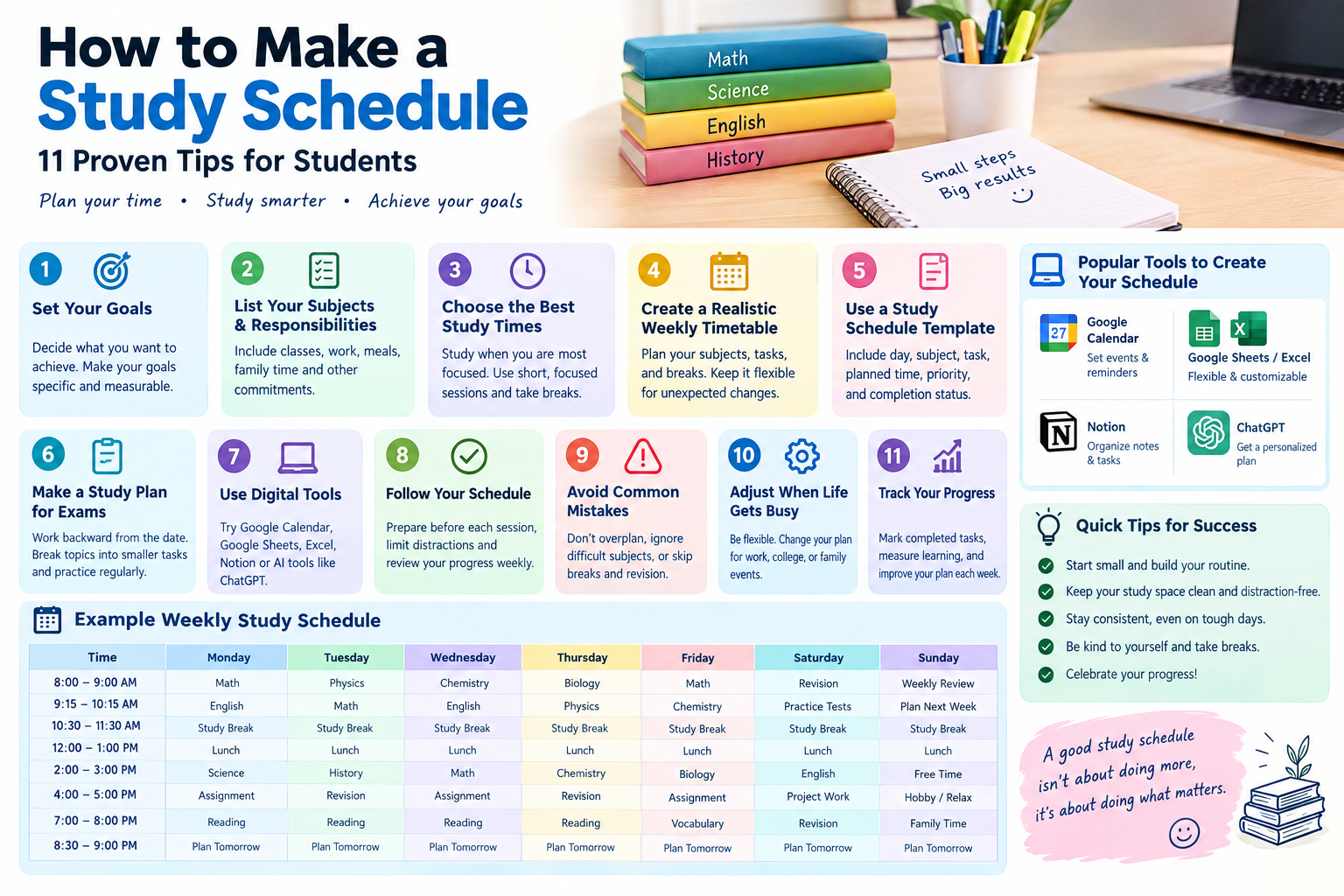
Create a weekly study schedule instead of waiting until the night before an exam.
Break assignments into smaller tasks and give difficult subjects more time.
Use active recall after lectures, review notes regularly, and complete practice problems before exams.
You can also combine related tasks. For example, review lecture notes while creating questions for your next study session.
Frequently Asked Questions
How do I increase my study speed?
Increase study speed by improving focus and using active learning rather than simply reading faster. Set a specific goal, remove distractions, prioritize important concepts, and use active recall. The aim is to learn more efficiently, not simply move through pages quickly.
How can I study fast in one hour for an exam?
Start by identifying the most important topics. Spend most of the hour testing yourself, solving practice questions, and reviewing mistakes. Avoid trying to read the entire textbook. Focus on high-value concepts and weak areas that are most likely to affect your performance.
How can I study faster without forgetting?
Use active recall and spaced repetition instead of relying on repeated reading. After learning a concept, close your notes and explain it from memory. Review it again later. This helps you balance study speed with long-term retention.
What are the best study techniques?
Useful study techniques include active recall, spaced repetition, practice testing, focused study sessions, the Feynman technique, and brain dumps. The best combination depends on your subject, learning goals, available time, and current level of understanding.
How can I study faster and remember more for exams?
Prioritize important topics, learn in focused sessions, test yourself frequently, and review difficult information over several days. Practice questions are especially useful because they show whether you can actually apply what you learned.
How can I become a top 1% student?
There is no single study trick that guarantees top performance. Strong students usually combine consistent study habits, effective time management, active learning, regular revision, healthy routines, and careful analysis of mistakes. Consistency over time matters more than occasional extreme study sessions.
Can I study effectively in seven days?
Yes, you can make meaningful progress in seven days by creating a focused plan. Identify your highest-priority topics, divide them across the week, use active recall and practice questions, and reserve the final days for revision and weak areas.
Should I study longer or study smarter?
Studying smarter should come first. Better methods can reduce wasted time and improve retention. However, difficult subjects may still require additional practice. The most effective approach combines efficient techniques with enough time to understand and practice the material.
Conclusion
Learning how to study faster is not about racing through textbooks or trying to memorize everything in one sitting. It is about making every minute of study more productive.
Start with a clear goal, remove distractions, prioritize important topics, and use active recall instead of depending on repeated reading. Add spaced repetition, practice questions, quick revision, and a consistent routine to strengthen your results.
If you have only one hour, focus on high-value topics and test yourself instead of trying to cover every page.
The best study system is one you can repeat consistently. Start with two or three techniques from this guide today, track what works, and gradually build a study routine that helps you learn faster and remember more penstripe.