










You sat through the lecture, filled three pages, and felt productive. Then exam week arrived, and your notes looked like a puzzle with half the pieces missing. Sound familiar? The problem usually is not how much you wrote. It is how you organized it.
Learning how to organize study notes is one of the fastest ways to study smarter. Good structure helps you find answers quickly, spot gaps in your knowledge, and review without rereading every page. It also makes recall easier, because organized information is easier for your brain to retrieve.
In this guide, you will learn a simple system that works for any class. We cover paper notebooks, laptops, Cornell notes, color coding, and the best way to organize notes on a computer. You will also get comparison tables, a weekly review routine, and clear answers to the questions students in the USA ask most. By the end, you will have a note system you can set up tonight and use all semester.
Why Organized Notes Matter

Notes are not a record of what your teacher said. They are a tool you will use later. If you cannot find and understand a note in under a minute, it is not doing its job.
Organized notes save study time
Students who dig through messy pages before every test lose hours they could spend practicing. A clear system turns review into a quick scan instead of a hunt. You see the main idea first, then the details.
Structure supports memory
Cognitive psychology research suggests that grouping related ideas and reviewing them repeatedly improves long-term retention. Notes that show relationships, such as cause and effect or steps in a process, give your brain hooks to hang facts on. A random list of facts gives it nothing to grab.
Organized notes reveal what you do not know
When a topic has a clear heading and a short summary, missing pieces stand out. An empty section is a signal to ask your teacher, check the textbook, or look up an example. Messy notes hide those gaps until the exam exposes them.
How to Organize Study Notes: The Core System

Whether you use a notebook or an app, the best systems follow the same four steps. Use them as your base, then adjust the tools to fit you.
Step 1: Capture with a consistent header
Start every page or file the same way. Write the course name, date, and topic at the top. Add a page number if you use paper. This tiny habit makes every note searchable and sortable later.
Example: Biology 101 | Oct 15 | Cell Respiration
Step 2: Use a simple hierarchy
Give your notes levels. The topic is the big heading. Subtopics sit under it. Details, examples, and formulas sit under those. Indent or number each level so your eyes can follow the logic.
For example:
- Cell Respiration
- Glycolysis
- Happens in the cytoplasm
- Splits glucose into two pyruvate molecules
- Krebs Cycle
- Happens in the mitochondria
- Glycolysis
Step 3: Mark what matters
Use a small set of symbols or colors, and stick to them. Too many colors create noise. Try this:
- A star for ideas likely to appear on a test
- A question mark for anything confusing
- A box around vocabulary and definitions
- One highlighter color for key examples
Step 4: Summarize and review
At the bottom of each page, write a two or three sentence summary in your own words. Then review within 24 hours. A quick look the next day does more for memory than a long session a week later. This step is the difference between notes you have and notes you actually know.
How to Organize Notes on Paper and in a Notebook
Handwriting still works well, especially for subjects with diagrams, equations, or many concepts. Many students like paper because it limits distractions.
How to organize notes in a notebook
Pick one notebook per class, or one binder with dividers. A binder gives you flexibility, since you can reorder pages and add handouts. A bound notebook keeps everything in order and makes it harder to lose pages.
Follow these habits:
- Number every page and keep a table of contents on the first two pages.
- Leave a one-inch margin on the left for keywords and questions.
- Start each new lecture on a fresh page.
- Leave blank space between topics so you can add details later.
How to organize notes on paper with a binder system
If you use loose-leaf paper, a binder with tabs makes organization easy. Create one tab for each unit or chapter. Put the syllabus and current assignments at the front, and keep a pocket for handouts.
A good tab layout for a semester course:
- Syllabus and schedule
- Unit 1 notes
- Unit 2 notes
- Unit 3 notes
- Practice problems
- Review sheets
How to organize notes for school across many classes
If you take six or seven classes, color helps. Assign one color to each subject and use it on the cover, tabs, and sticky notes. Math is blue, history is green, science is red. When you grab your bag in a rush, you will pull the right material in seconds.
Best Way to Organize Notes on a Computer

Typing is faster than writing, and digital notes are searchable. That makes laptops and tablets strong choices for note-heavy classes like history, psychology, or law.
Build a folder structure first
The best way to organize notes on a computer starts with folders, not apps. Use this pattern:
Semester > Course > Unit > Notes
For example: Fall 2026 > Psychology 101 > Unit 2 Memory > Lecture 5 Notes
Name files with the date first, written as year-month-day. A name like “2026-10-15 Memory Types” sorts itself in order.
Choose a note-taking app that matches your habits
Popular tools include Notion, OneNote, Evernote, Obsidian, Google Docs, and Apple Notes. Each handles organization differently.
- OneNote works like a digital binder with notebooks, sections, and pages. It suits students who like a paper-style layout.
- Notion is flexible and good for databases, linked notes, and study trackers.
- Obsidian links notes together, which helps you connect ideas across subjects.
- Google Docs is simple, free, and easy to share.
- Apple Notes is fast for quick capture on iPhone, iPad, and Mac.
Pick one app and stay with it for at least a semester. Switching tools often is a common way to lose track of old notes.
Use tags and search wisely
Tags help you find notes that live in different folders. Try tags such as exam, formula, unclear, and review. Before a test, search the tag “exam” to pull up every important page at once.
Back up your files. Cloud storage such as Google Drive, iCloud, or OneDrive protects you if your laptop breaks.
Cornell Notes and Other Note-Taking Formats
The format of note-taking you choose shapes how easy your notes are to review. Here are the most useful options.
How Cornell notes work
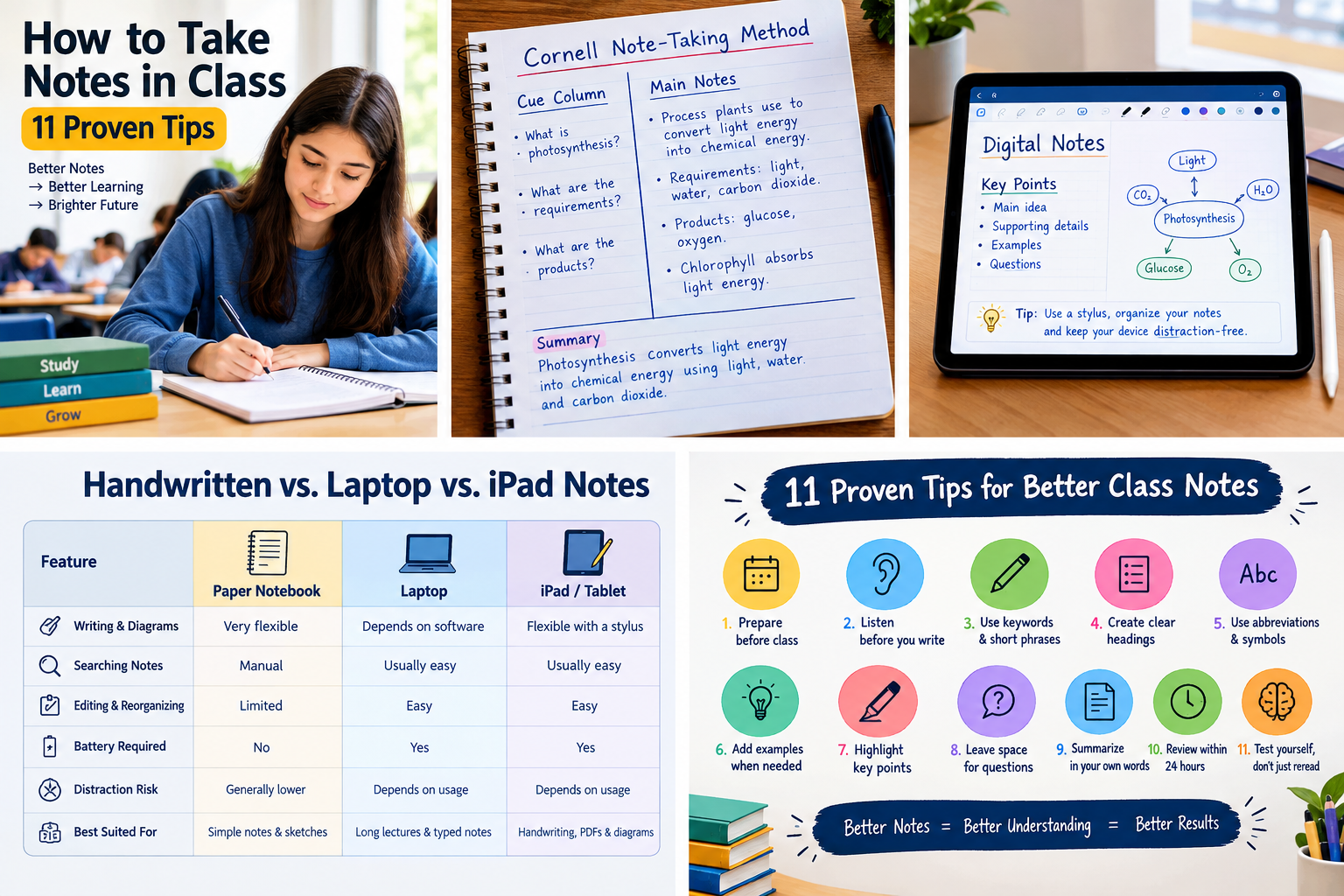
Cornell notes were developed by Walter Pauk at Cornell University. The page is divided into three areas: a narrow cue column on the left, a wide note-taking area on the right, and a summary section at the bottom.
How to use it:
- During class, write your main notes in the right column.
- After class, write keywords or questions in the left cue column.
- At the bottom, summarize the page in two or three sentences.
- To study, cover the right side and answer the cue questions from memory.
Cornell notes work well because the layout builds in active recall, which means testing yourself instead of rereading.
Outline method
The outline method uses headings and indented bullet points. It is clean, quick, and ideal when the teacher presents information in a clear order. It works less well for fast, unstructured lectures.
Mind maps
A mind map places the main idea in the center and branches out to related ideas. It helps with big-picture subjects like literature themes or historical causes. It uses more space, so it is better for review than for fast note-taking.
Charting method
Charts and tables work when you compare things, such as types of government, chemical reactions, or historical events. Columns hold categories, and rows hold the items.
Sentence method
The sentence method means writing each new idea on its own line. It is easy to do during a fast lecture. You can organize it later by adding headings and numbering.
How to Organize Notes by Subject and Study Goal
Different classes call for different structures. A single method rarely fits everything.
Math and science
Use numbered steps, worked examples, and boxed formulas. Write one sample problem per concept and note why each step works. Keep a formula sheet at the front of your notebook or in a pinned digital note.
History and social studies
Organize by timeline, cause and effect, or theme. A chart with columns for date, event, cause, and result works well. Add a short note on why each event mattered.
Languages
Split each page into vocabulary, grammar rules, and example sentences. Review vocabulary with flashcards, and keep grammar notes short and clear.
How to organize research notes
For papers and projects, use one note per source. Record the author, title, date, key points, direct quotes with page numbers, and your own thoughts. Label your own ideas clearly so you never confuse them with the source. This protects you from accidental plagiarism and makes citations easier.
How to organize Bible study notes
Many people use a simple structure for faith-based study: passage, context, key observations, meaning, and application. Write the verse reference at the top, note who is speaking and to whom, and finish with one personal takeaway. The same structure works for any text you study closely.
How to organise uni notes
College students, including those who use the British spelling “organise,” face long readings and fast lectures. Keep a master document per course. Add lecture notes, reading notes, and assignment feedback in one place. Once a week, merge the key points into a one-page summary for each topic.
Note Organization Methods Compared
| Method | Best For | Speed | Review Strength | Main Drawback |
|---|---|---|---|---|
| Cornell notes | Most classes, exam prep | Medium | Very high | Takes setup time |
| Outline | Structured lectures | Fast | High | Hard with unstructured talks |
| Mind map | Concepts and connections | Slow | High | Uses lots of space |
| Charting | Comparisons and data | Medium | High | Needs prepared columns |
| Sentence | Fast lectures | Very fast | Low until reorganized | Needs cleanup later |
| Digital folders and tags | Heavy note volume | Fast | High with search | Can be distracting |
If you are unsure where to start, begin with Cornell notes on paper or a digital Cornell template, then adjust.
Paper vs. digital notes
| Factor | Paper | Digital |
|---|---|---|
| Focus | Fewer distractions | Easier to get distracted |
| Searching | Manual | Instant |
| Speed | Slower | Faster |
| Editing | Messy | Easy |
| Backup | Easy to lose | Cloud backup |
| Cost | Low | Free to paid |
Many students use both: handwritten notes in class, then a typed summary for review.
A Weekly Routine to Keep Notes Organized
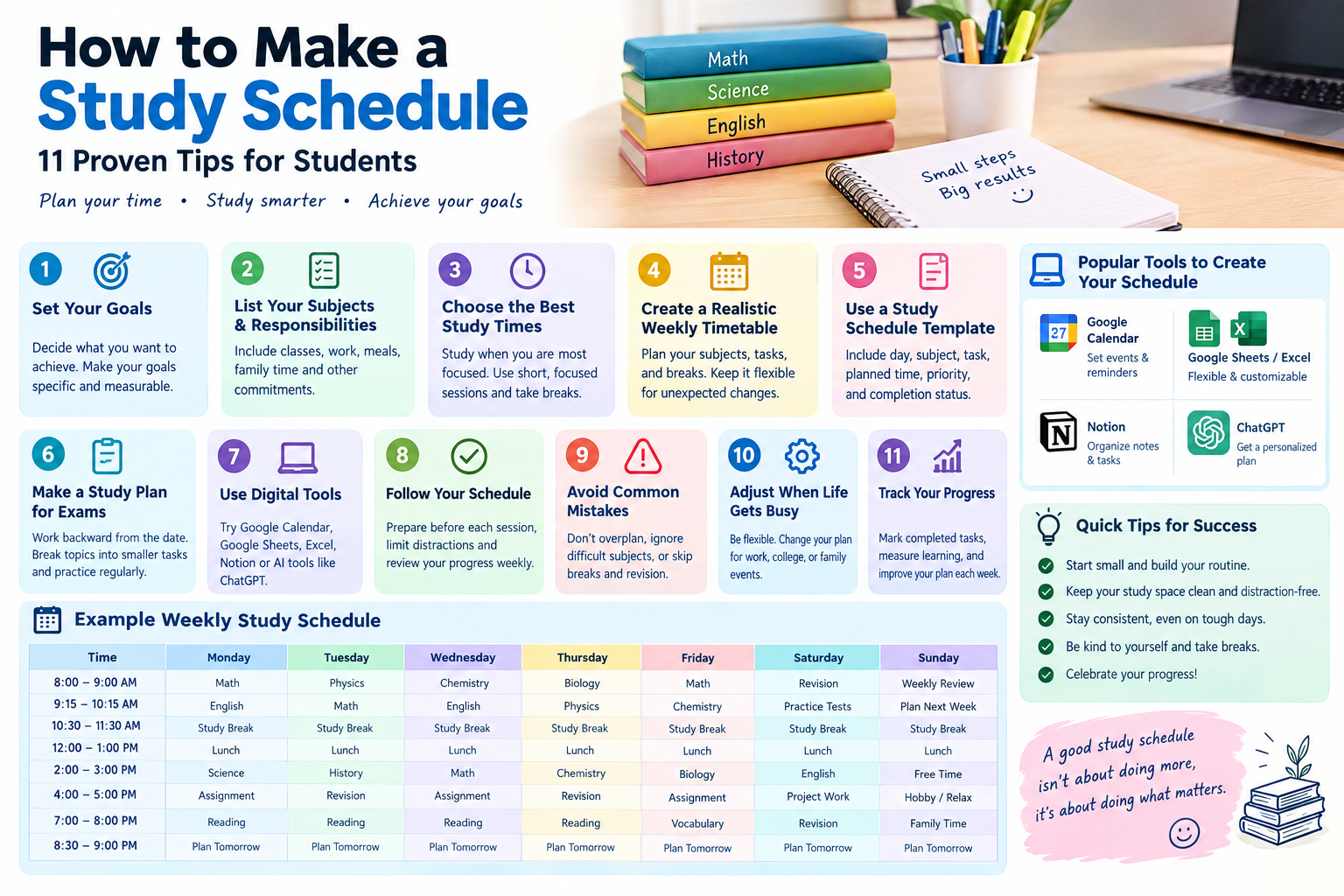
A system only works if you maintain it. Try this routine.
Daily (5 minutes)
Add keywords and a summary to today’s notes.
Weekly (30 minutes)
Clean up, merge, and create a one-page summary per subject.
Before exams (1 hour per subject)
Turn your notes into questions, flashcards, or a practice quiz.
Quick checklist for good notes
- Date, course, and topic at the top
- Clear headings and subheadings
- Key terms highlighted
- Questions marked
- A summary in your own words
- A review scheduled
What Students on Reddit Recommend
If you search for how to organize study notes reddit, a few themes repeat.
What the community agrees on
Students often recommend taking messy notes in class and cleaning them up afterward, using one app consistently, and focusing on active recall instead of pretty notes.
What they warn against
Many warn against spending hours rewriting notes with fancy colors. The takeaway is simple: a plain system you actually use beats a beautiful system you abandon.
Common Mistakes to Avoid
Copying everything word for word
You cannot keep up, and you will not understand it. Write ideas, not full sentences.
Over-decorating
Too many colors, stickers, and fonts waste time. Decoration is not studying.
Never reviewing
Notes you never look at are just storage. Schedule review time like any other task.
Mixing subjects in one place
Keep each course separate. A blended notebook makes studying slow and stressful.
FAQ
How do I organize study notes effectively?
Use a consistent header, a clear hierarchy of headings, and a short summary on every page. Mark key terms and questions, then review within 24 hours. Finally, group notes by course and unit so you can find any topic quickly. Consistency matters more than a perfect system.
What is the best way to organize notes for school?
The best way is one notebook or digital folder per class, with dated, titled pages and a table of contents. Add Cornell-style cue questions and a summary at the end of each page. Color-code subjects, and clean up your notes weekly so they stay useful all semester.
How do I organize notes on paper?
Number each page, keep a table of contents, and start each lecture on a new page. Use headings, indented bullets, and a left margin for keywords. A tabbed binder lets you reorder pages and keep handouts with the right unit, which makes review much faster.
What is the best way to organize notes on a computer?
Create folders by semester, course, and unit, and name files with the date first. Pick one app, such as OneNote, Notion, or Google Docs, and use tags for key topics. Back up everything to cloud storage so a broken laptop never costs you a semester of notes.
Are Cornell notes worth using?
Yes, for most students. Cornell notes combine note-taking, keywords, and a summary on one page, which builds in self-testing. They take a little longer to set up, but they make review faster and help you remember more. Try them for two weeks before deciding.
How often should I review my notes?
Review within 24 hours of class, then again weekly, and once more before exams. Short, repeated sessions work better than one long cram session. Even ten minutes after class helps you keep the material fresh and shows you what you still need to clarify.
Should I rewrite my notes?
Rewriting word for word is rarely worth the time. Instead, summarize each page, make flashcards, or turn headings into practice questions. These activities force you to think about the material, which strengthens memory far more than copying does.
How do I make organized study notes if I take fast, messy notes?
Take quick notes in class, then clean them up within a day. Add headings, fix unclear parts, and write a short summary. Leave space between topics while you write so you can add details later without starting over or recopying everything.
Conclusion
Knowing how to organize study notes does not require fancy tools or hours of rewriting. It comes down to a few habits: label every page, build a clear hierarchy, mark what matters, summarize in your own words, and review often. Choose a format that fits your class, whether that is Cornell notes, an outline, or a digital folder system, and give it a full semester.
Start small. Pick one class today, set up a clean page with a header and summary area, and use it in your next lecture. Then schedule a ten-minute review tomorrow. Small, steady steps will turn your notes into a study tool you can trust when exam week arrives penstripe.