






If you search “IELTS Speaking Preparation & Strategy” today, you will find dozens of pages listing generic tips like “speak slowly” or “use big words.” Most of them stop there. This guide goes further. It gives you a real, testable strategy built around how the exam is actually scored, plus sample answers, a study plan, and the exact mistakes that quietly cost candidates half a band score.
The IELTS Speaking test is a face-to-face interview with three parts, and Part 2 lasts three to four minutes including preparation time, while Part 3 runs four to five minutes and involves more abstract discussion. Knowing this structure changes how you prepare. Below, you will learn how each part is scored, how to build answers examiners actually reward, and how to avoid the traps that keep good English speakers stuck at Band 6.
How the IELTS Speaking Test Works
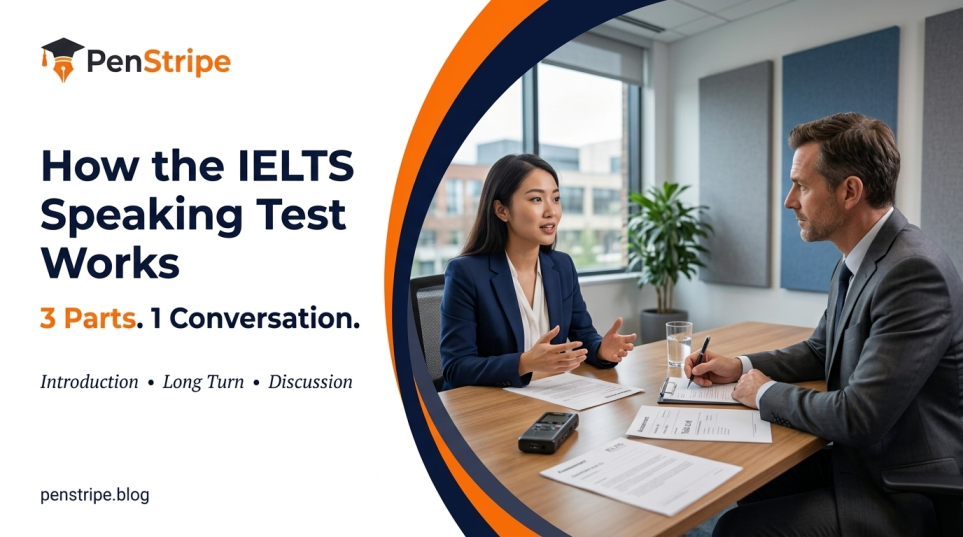
The Speaking test is a face-to-face interview lasting eleven to fourteen minutes, split into three parts. Part 1 covers familiar topics like your home, work, and daily habits. Part 2 hands you a cue card and asks you to speak alone for up to two minutes. Part 3 turns the same topic into a deeper conversation about opinions, causes, and comparisons.
Test Day Logistics
Your Speaking test can happen on the same day as Listening, Reading, and Writing, or it can be scheduled up to seven days before or after, depending on your test center. Bring your ID, arrive early, and expect the whole session to be recorded.
IELTS Speaking Preparation & Strategy PDF and Notes
Many candidates ask for an IELTS Speaking Preparation & Strategy PDF to study offline. If your prep course offers one, use it as a topic checklist, not a script. The biggest risk with any downloaded PDF is treating it like a set of answers to memorize instead of a framework to practice with your own voice.
The Four Scoring Criteria Explained
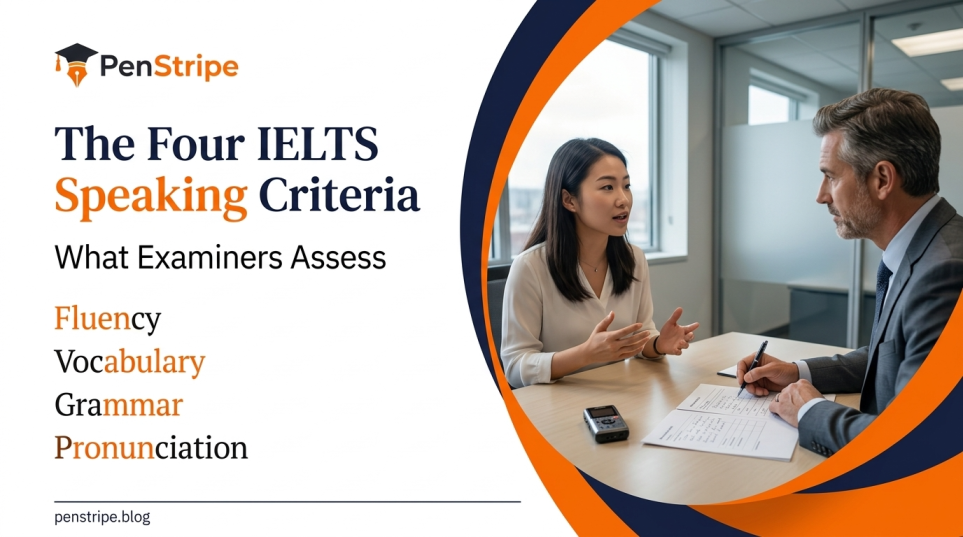
Examiners score you on four equal criteria: fluency and coherence, lexical resource, grammatical range and accuracy, and pronunciation. Each is worth 25 percent of your Speaking band, so weakness in one area caps your overall score even if the others are strong.
Fluency and Coherence
This measures how smoothly your ideas connect, not how fast you talk. Long pauses, restarting sentences, and losing your train of thought all lower this score.
Lexical Resource
This is vocabulary range and accuracy. Examiners want topic-specific words used correctly, plus the ability to paraphrase when you cannot recall an exact term.
Grammatical Range and Accuracy
You need a mix of simple and complex sentences with reasonably accurate grammar. Perfect grammar is not required; variety and control are.
Pronunciation
Clarity matters more than accent. Word stress, sentence rhythm, and intonation all affect whether the examiner can follow you without effort.
Part 1 Strategy: First Impressions Matter
Part 1 questions cover hometown, work, studies, hobbies, and similar everyday topics. The strategy here is simple: answer directly, then add one reason or detail. A one-word answer signals low fluency before you have said anything substantial.
Sample Question and Answer
Question: Do you enjoy cooking?
Weak answer: Not really.
Stronger answer: Not particularly, actually. I find it time-consuming after a full workday, so I usually rely on simple meals or order food instead. That said, I do enjoy baking on weekends when I have more time to relax.
Part 2 Strategy: The Long Turn
You get one minute to prepare and up to two minutes to speak on a cue card topic. This section rewards structure more than any other part of the test.
Building Your One-Minute Notes
Write four to five keywords, not full sentences. A useful structure covers what the topic is, when and where it happened, why it mattered, and how you felt about it.
IELTS Speaking Topics With Answers: A Sample Framework
Topic: Describe a skill you would like to learn.
Sample structure: Name the skill (coding), explain why it interests you (career growth), describe how you would learn it (online courses), and end with what it would change (more job opportunities). Practicing this four-part shape across different IELTS Speaking topics with answers builds a reusable mental template instead of memorized scripts.
Part 3 Strategy: Abstract Discussion
Part 3 questions connect to your Part 2 topic but push into opinions, comparisons, and predictions. This is where higher-band candidates separate themselves, since the questions demand analysis rather than personal description.
Answering With Depth
Use this pattern: state your opinion, explain your reasoning, give a concrete example, then add a brief conclusion. Avoid one-line answers here more than anywhere else in the test, since Part 3 specifically checks your ability to develop an argument.
IELTS Speaking Preparation & Strategy for Band 9

Band 9 is rare, and it is not about vocabulary size. It requires near-native flexibility across all four criteria at once, with almost no noticeable strain in producing language.
What Band 9 Candidates Do Differently
They use precise, natural vocabulary without ever appearing to search for words. Their grammar includes complex structures used accurately and without hesitation. Their pronunciation stays clear and natural even on unfamiliar topics, and their answers in Part 3 sound like genuine, spontaneous opinions rather than rehearsed talking points.
A Realistic Note on Band 9
Very few candidates need Band 9 for immigration or university requirements, which usually ask for Band 6.5 to 7.5. Chasing Band 9 as a study strategy often wastes time better spent solidifying Band 7 consistency across all three parts.
Read about Ielts speaking tips
Free vs Paid Preparation Resources
| Resource Type | Best For | Limitation |
| Free YouTube lessons | Learning the test format and criteria | Rarely gives personalized feedback |
| Free practice apps | Daily speaking habit and mock questions | Limited depth in Part 3 discussion |
| Paid tutoring or courses | Personalized correction and band estimation | Costs money and requires scheduling |
| Official IELTS mock tests | Realistic timing and question style | Limited number of free attempts |
IELTS Speaking Preparation & Strategy Free Options
You can build a strong foundation without spending money by recording yourself daily, using free official sample questions, and reviewing your recordings against the four scoring criteria above. Paid coaching becomes more useful once you already know your weak area and want targeted correction rather than general practice.
Common Mistakes That Lower Your Score
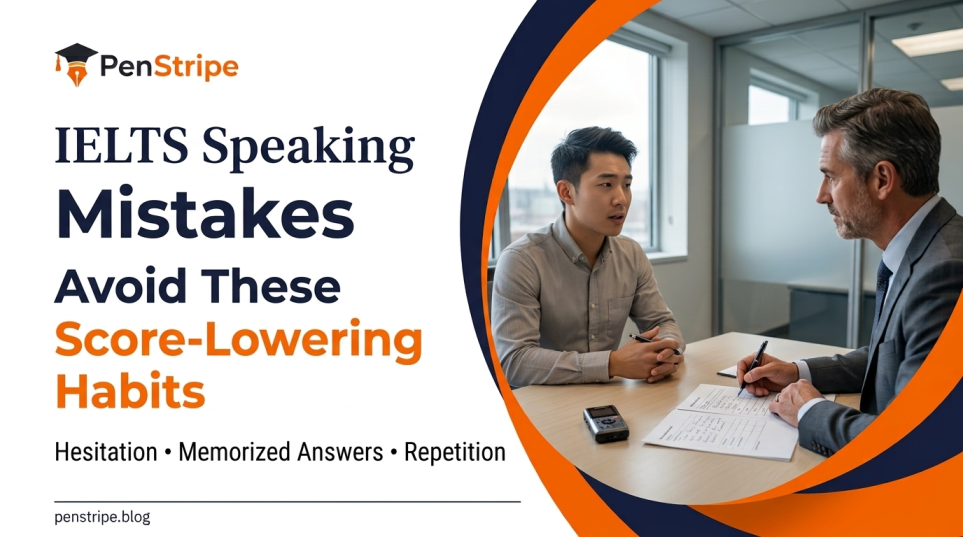
Memorizing full answers is the most damaging habit, since examiners are trained to detect unnatural rhythm and disconnected phrasing. Other frequent errors include giving one-sentence answers in Part 1, running out of things to say early in Part 2, avoiding both sides of an issue in Part 3, and stopping completely after a small grammar mistake instead of self-correcting and continuing.
FAQs
How long is the IELTS Speaking test?
The test lasts eleven to fourteen minutes total, covering all three parts in one continuous interview with a certified examiner.
Can I bring notes into the Speaking test?
No, except for the notes you write during your one-minute Part 2 preparation time, which you may glance at while speaking.
What is a good IELTS Speaking Preparation & Strategy sample I can practice with?
Use real cue cards and Part 3 questions from official sources, then apply the answer-reason-example-result structure to each one instead of memorizing full responses.
How is IELTS Speaking scored differently from Writing?
Speaking is scored live by the examiner during your interview using the same four-criteria approach, while Writing is assessed afterward on a separate written response.
Is IELTS Speaking Part 2 the hardest part?
Many candidates find it the most challenging, since speaking alone for up to two minutes with only one minute of preparation demands both structure and stamina.
Do I need Band 9 for university admission?
Most universities require Band 6.5 to 7.5 overall, so Band 9 is rarely necessary and should not be the default preparation target.
How many days before the test should I start preparing?
A focused four to six week plan is typically enough if you practice speaking daily and review recordings weekly for specific, correctable patterns.
Conclusion
A strong IELTS Speaking Preparation & Strategy is not about memorizing perfect answers. It is about understanding exactly what each of the four criteria rewards, then practicing with that structure in mind across Part 1, Part 2, and Part 3. Focus on extending your answers naturally, organizing your Part 2 long turn with simple notes, and developing real opinions for Part 3 discussion questions. Whether you use free daily practice or invest in paid coaching, consistency matters more than any single resource. Start recording yourself this week, compare your answers against the criteria above, and build your preparation around the gaps you actually find.