





Getting better grades is not simply about spending more hours with a textbook. Many students study for long periods but still struggle because they use ineffective methods, start assignments too late, or lose focus during class. The good news is that small changes in the way you study can make a meaningful difference.
If you are wondering how to get better grades, start by focusing on the habits that have the biggest effect on your academic performance. Clear goals, a realistic study schedule, active learning, effective note-taking, exam preparation, and consistent review can turn a disorganized routine into a much stronger system.
You also do not need to become the student who studies every waking hour. Instead, the goal is to make your study time more productive. Whether you are in middle school, high school, or college, the strategies below can help you understand difficult material, complete your work on time, prepare more effectively for tests, and become a more confident learner.
1. Set Clear Academic Goals

Improving your grades becomes easier when you know exactly what you are trying to improve. A vague goal such as “I want better grades” gives you little direction. A specific target gives you something measurable to work toward.
Set a Specific Grade Goal
Begin by looking at your current grades. Identify the subjects where you are performing well and the ones where you have room to improve.
For example, instead of saying:
“I need to do better in math.”
Set a measurable goal:
“I want to raise my math average from 72% to 82% by the end of the next grading period.”
This makes your goal easier to track and helps you decide what actions to take.
Use Short-Term and Long-Term Goals
Long-term goals can keep you motivated, but short-term goals make daily progress easier.
A long-term goal might be to improve your overall GPA. Short-term goals could include:
- Completing every assignment before its deadline
- Reviewing class notes for 20 minutes each evening
- Completing three practice problems after each math lesson
- Studying vocabulary several days before a quiz
Breaking a large goal into smaller actions prevents academic improvement from feeling overwhelming.
Track Your Progress
Keep a simple record of your grades, assignments, quiz scores, and areas that need improvement. When you receive a test back, do not only look at the score. Study your mistakes.
Ask yourself:
- Did I misunderstand the concept?
- Did I make a careless mistake?
- Did I run out of time?
- Did I fail to study that topic?
- Did I misunderstand the question?
This turns every assessment into feedback rather than simply a number.
2. Create a Realistic Study Schedule
A good study schedule does not need to fill your entire day. It needs to make your available time more organized.
Build a Weekly Study Routine
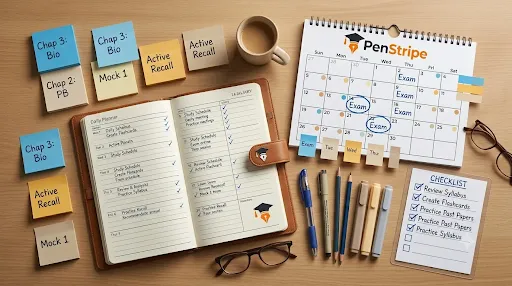
At the beginning of each week, list your classes, assignments, tests, activities, and other commitments. Then decide when you will study each subject.
For example:
| Time | Activity |
|---|---|
| 4:00–4:30 PM | Break and snack |
| 4:30–5:15 PM | Math homework |
| 5:15–5:25 PM | Break |
| 5:25–6:00 PM | Science review |
| 7:00–7:30 PM | Reading or vocabulary |
| 7:30–7:45 PM | Review tomorrow’s tasks |
Adjust the schedule according to your school day and personal responsibilities.
Prioritize Difficult Subjects
Do not automatically spend equal time on every subject. Give additional attention to courses or topics where you have the most difficulty.
If math requires more effort than English, for example, you might spend 45 minutes on math and 25 minutes reviewing English.
Your schedule should reflect your needs, not simply divide time equally.
Use Strategic Breaks
Long, uninterrupted study sessions can make it harder to maintain concentration. Short breaks give your brain an opportunity to reset.
One option is the Pomodoro approach: study for a focused period, take a short break, and repeat. After several sessions, take a longer break.
The exact timing is less important than maintaining focused work followed by intentional recovery.
Prevent Procrastination
When a task feels huge, starting can be the hardest part. Make it smaller.
Instead of writing “study biology” on your schedule, write:
- Review Chapter 4 notes.
- Make 10 flashcards.
- Answer five practice questions.
- Check mistakes.
Specific tasks are easier to begin than vague ones.
3. Use Effective Study Techniques

One of the biggest differences between struggling and successful students is often how they study rather than how long they study.
Practice Active Recall
Active recall means trying to retrieve information from memory instead of simply rereading it.
After studying a topic, close your book and ask yourself questions.
For example:
“What are the three main causes of the American Revolution?”
Try to answer without looking. Then check your answer.
This forces you to retrieve information and reveals what you actually remember.
Try Spaced Repetition
Instead of studying everything the night before an exam, review information across several days.
A simple pattern could look like:
- Day 1: Learn the material
- Day 2: Quick review
- Day 4: Practice recall
- Day 7: Review again
- Before the test: Final practice
Spreading review sessions across time can be more useful than repeatedly reading the same material in one sitting.
Use Practice Testing
Practice questions are particularly useful because they show whether you can actually apply what you learned.
Do not immediately look at the answer. Give yourself time to solve the problem independently.
For essay-based classes, practice explaining concepts in your own words. For math and science, solve problems without copying the example.
Make Flashcards Useful
Flashcards work best when they require you to recall information.
Weak card:
“Photosynthesis — definition.”
Better card:
“What process allows plants to convert light energy into chemical energy?”
Keep cards concise and separate complicated concepts into smaller questions.
4. Improve Your Note-Taking Skills
Your notes should help you understand and review information later. Writing down every word a teacher says is usually less useful than identifying the important ideas.
Identify Key Information
During class, pay attention when your teacher:
- Defines an important term
- Explains a difficult concept
- Gives an example
- Repeats an important point
- Announces material that may appear on an assessment
Organize your notes around concepts rather than trying to create a transcript.
Try the Cornell Note-Taking Method
The Cornell method divides a page into sections for notes, questions or keywords, and a summary.
After class, use the question section to create prompts based on your notes. Then write a short summary of the lesson.
This turns note-taking into a study resource rather than a collection of information.
Review Notes Regularly
Do not wait until exam week to open your notebook.
A quick review soon after class can help you identify confusing material while the lesson is still fresh. If something does not make sense, ask your teacher or find an appropriate learning resource.
5. Focus During Class
Your study routine starts before you open your textbook. Paying attention in class can reduce the amount of work you need to do later.
Minimize Distractions
Phones, social media, unrelated browser tabs, and constant notifications can interrupt concentration.
When appropriate, silence unnecessary notifications and keep your phone away from your immediate workspace.
For digital classes, close unrelated tabs and keep only the materials you need open.
Ask Questions
If you do not understand something, asking a question can prevent a small misunderstanding from becoming a major problem later.
You can ask:
“Could you explain that example another way?”
Or:
“Can you show us how you got from this step to the next?”
Questions are not a sign that you are a weak student. They are a practical part of learning.
Participate Actively
Listen carefully, take useful notes, answer questions, and participate when appropriate.
Active participation keeps your attention on the material and can help you notice gaps in your understanding.
6. Manage Homework and Assignments

Homework can have a major effect on academic performance, especially when assignments are completed consistently and thoughtfully.
Start Before the Deadline
Avoid making every assignment a last-minute task.
If an essay is due Friday, you might:
- Monday: Choose a topic
- Tuesday: Research and outline
- Wednesday: Write the first draft
- Thursday: Edit
- Friday: Submit
This approach gives you time to find and correct mistakes.
Break Large Projects Into Smaller Tasks
A large project can seem intimidating when viewed as one task.
Instead, divide it into research, outline, draft, revision, formatting, and final review.
Each completed step creates progress and reduces the pressure of a looming deadline.
Use an Assignment Checklist
A simple checklist can prevent avoidable mistakes.
Before submitting an assignment, check:
- Did I answer every part of the question?
- Did I follow the instructions?
- Did I meet the required length?
- Did I proofread my work?
- Did I include required sources?
- Did I submit the correct file?
Good organization can protect your grades from preventable errors.
7. Prepare Smarter for Exams
Strong exam preparation starts before the night before the test.
Start Preparing Early
If you know an exam is coming, begin reviewing several days ahead.
First identify the topics you need to know. Then spend more time on areas where your understanding is weakest.
This is usually more productive than repeatedly reviewing material you already know.
Use Practice Questions
Practice questions help you identify whether you can apply information independently.
After completing a practice set, review incorrect answers carefully. The goal is not merely to count your mistakes. Find out why each mistake happened.
Take a Practice Test
If possible, recreate exam conditions.
Put away your notes, set a reasonable time limit, and answer questions without assistance.
Afterward, review your performance and focus your final study sessions on weak areas.
Review Your Mistakes
Keep a “mistake list” before an important exam.
For each mistake, write:
- The question or topic
- Your incorrect approach
- The correct approach
- What you should remember next time
This can make your review sessions more targeted.
8. Ask for Academic Help
Trying to solve every academic problem alone can waste valuable time.
Talk to Your Teacher
Teachers can often clarify what you misunderstood and suggest resources or strategies.
Instead of saying, “I don’t understand anything,” identify the exact problem:
“I understand how to solve the first part, but I don’t understand why this formula is used in the second step.”
Specific questions usually lead to more useful answers.
Study With Classmates
A study group can be helpful when members actually prepare and stay focused.
Each person can explain a topic, create practice questions, or compare approaches to difficult problems.
However, a study group should support learning rather than become a social distraction.
Consider Tutoring
If you repeatedly struggle with a particular subject, tutoring may provide targeted support.
A tutor can help identify the exact skill gap and give you guided practice. The goal should be to help you understand the material independently, not simply complete your homework for you.
9. Build Healthy Study Habits
Academic performance depends on more than books and assignments. Your physical environment and daily routine can also affect how effectively you learn.
Protect Your Sleep
Staying awake extremely late to study can leave you tired when you need to concentrate.
Rather than making all-night studying your normal strategy, build a routine that gives you enough time to sleep and review material earlier.
Create a Better Study Environment
Choose a location where you can concentrate.
Keep frequently used materials nearby, remove unnecessary distractions, and make your workspace comfortable enough for focused work.
A consistent study location can also make it easier to transition into study mode.
Take Care of Your Body
Regular movement, balanced meals, hydration, and sufficient rest support your ability to stay focused throughout the school day.
You do not need an extreme fitness routine. Simple habits such as walking, stretching, and taking regular movement breaks can fit into a busy schedule.
10. Avoid Common Study Mistakes
Sometimes improving grades means stopping habits that waste your time.
Stop Relying on Last-Minute Cramming
Cramming may help you remember some information temporarily, but it can create unnecessary stress and leave little time to identify misunderstandings.
Start earlier and use shorter review sessions across several days.
Avoid Multitasking
Trying to study while watching videos, scrolling social media, and responding to messages divides your attention.
Give one academic task your full attention for a defined period. Then take a break before moving to something else.
Do Not Depend Only on Passive Reading
Reading the same chapter repeatedly can create the feeling that you know the material because it looks familiar.
Test yourself instead.
Close the book and explain the concept from memory. If you cannot, that topic deserves another review.
Do Not Ignore Difficult Topics
Students sometimes spend most of their study time reviewing material they already understand because it feels easier.
Instead, identify your weakest areas and give them deliberate practice.
11. Track Your Progress and Improve
Knowing how to get better grades is useful, but turning strategies into a repeatable system is what makes them practical.
Monitor Your Grades
Track major assignments, tests, quizzes, and projects. Look for patterns.
If your homework scores are strong but your tests are weak, your problem may be exam preparation rather than general effort.
If you consistently lose points on assignments, review the instructions and your submission process.
Identify Your Weak Subjects
Do not label yourself as “bad at math” or “bad at science.” Identify the specific skill that is causing difficulty.
For example:
“I struggle with algebraic equations.”
is more useful than:
“I am bad at math.”
The first statement gives you something specific to practice.
Adjust Your Strategy
If a study method is not helping, change it.
You might replace repeated reading with practice questions. You might review vocabulary with spaced repetition instead of studying everything the night before.
Effective students do not necessarily use one perfect method. They monitor what works and adapt.
Celebrate Small Improvements
Academic improvement can take time.
A higher quiz score, fewer careless mistakes, completing assignments earlier, or finally understanding a difficult concept are all signs of progress.
Focus on improving your process rather than comparing yourself constantly with other students.
Study Methods: Which One Should You Use?

Different methods work better for different tasks. Use the method that matches what you are trying to learn.
| Study Method | Best For | Main Advantage |
|---|---|---|
| Active Recall | Facts and concepts | Tests real memory |
| Spaced Repetition | Long-term learning | Encourages regular review |
| Practice Tests | Exams | Builds retrieval and test familiarity |
| Flashcards | Vocabulary and definitions | Quick self-testing |
| Cornell Notes | Lectures and reading | Organizes review material |
| Pomodoro | Focused study sessions | Creates structured work periods |
| Study Groups | Discussion and explanation | Allows peer learning |
The best approach is often a combination. For example, you could use Cornell notes during class, active recall after class, spaced repetition throughout the week, and practice tests before an exam.
A Simple 7-Day Plan to Improve Your Grades
If you are unsure where to begin, use this simple starting plan.
Day 1: Review your current grades and identify two subjects that need attention.
Day 2: Create a weekly study schedule and organize upcoming assignments.
Day 3: Try active recall instead of simply rereading your notes.
Day 4: Review difficult material using practice questions.
Day 5: Complete unfinished assignments and check upcoming deadlines.
Day 6: Take a short practice test in your weakest subject.
Day 7: Review your results and adjust your study plan for the following week.
Repeat the process. The goal is not perfection in one week. The goal is building a routine that becomes easier to maintain.
Frequently Asked Questions
How can I get better grades quickly?
The fastest practical approach is to identify where you are losing points and address those specific problems. Complete missing work, ask teachers about unclear material, improve test preparation, and replace passive studying with active recall and practice questions. Avoid expecting an overnight transformation; consistent changes are more reliable.
How do I improve my grade?
Start by checking your current grade and identifying which assignments, tests, or skills are lowering it. Ask your teacher what you can improve, prioritize upcoming high-value assignments, and create a focused study schedule. If late or missing work is affecting your grade, completing eligible assignments may be an important first step.
What is the best way to improve your grades?
The best approach combines consistent class participation, organized homework, effective study techniques, early exam preparation, and regular progress tracking. There is no single method that works perfectly for every student. Focus on the specific reason your grades are low and choose strategies that directly address it.
How can I be top 1 in class?
Being first in a class depends on many factors, including grading systems, course difficulty, and the performance of other students. Instead of focusing entirely on rank, aim for excellent academic habits: attend class consistently, understand concepts deeply, submit high-quality work, prepare early for exams, and learn from mistakes.
How many hours should a student study?
There is no universal number of study hours that guarantees better grades. The right amount depends on your courses, assignments, age, learning needs, and schedule. Focus on productive study rather than simply increasing hours. A shorter, distraction-free session using active learning can be more valuable than a long session of passive reading.
How can I improve my grades without studying all day?
Yes. Improving efficiency is often more useful than studying all day. Pay attention in class, complete assignments on time, use active recall, review material regularly, reduce distractions, and prepare for exams early. These habits can make your existing study time more productive without requiring an extreme schedule.
Why are my grades not improving?
Your grades may not improve if you are studying the wrong material, using passive methods, missing assignments, misunderstanding concepts, or struggling with test-taking skills. Review where you are losing points and look for patterns. Then change your strategy instead of simply adding more study hours.
Is a 2.7 GPA bad for a senior?
A 2.7 GPA is not a complete measure of a student’s ability or future potential. Its impact depends on the school, college requirements, intended program, and individual circumstances. A senior with a 2.7 GPA can still focus on improving current grades, completing strong applications where appropriate, and exploring colleges or programs that match their academic profile.
Conclusion
Learning how to get better grades is less about becoming a nonstop student and more about building a smarter academic system. Set clear goals, create a realistic schedule, pay attention in class, use active learning techniques, manage assignments carefully, and prepare for exams before the last minute.
Most importantly, identify what is actually holding you back. If you understand the material but lose points through careless mistakes, change your review process. If you struggle with concepts, ask for help. If missing assignments are hurting your average, improve your organization.
Start with one or two changes this week rather than trying to rebuild your entire routine overnight. Track your results, adjust your strategy, and keep improving. Consistent, focused effort can turn better study habits into stronger academic performance over time.