






Most guides on IELTS Speaking Fluency & Answers focus only on vocabulary lists or grammar rules. They miss the real problem most candidates face: knowing what to say but freezing when it’s time to say it. This guide fixes that gap. You will learn exactly how to structure answers so they never run dry, how to reduce hesitation without memorizing scripts, and how to build genuine speaking confidence that holds up under exam pressure. Fluency and coherence make up 25 percent of your Speaking band, and it is often the criterion candidates understand the least, even though it is one of the most fixable with the right practice approach.
What Fluency Really Means in IELTS Speaking

Fluency is not speed. A candidate who talks quickly but stumbles every few seconds scores lower than someone who speaks at a relaxed, steady pace with few interruptions. Coherence, the second half of this criterion, measures whether your ideas connect logically from one sentence to the next.
How to Speak English Fluently for IELTS
The fastest way to build fluency is daily speaking practice on random topics, not scripted ones. Set a timer for two minutes, pick a topic you did not prepare for, and speak without stopping, even if you repeat an idea or use simple words. This forces your brain to produce language in real time instead of recalling memorized lines, which is exactly what the exam demands.
Why Fluency Gets Confused With Speed
Many candidates believe faster speech signals higher ability. In reality, rushing often causes skipped words, unclear pronunciation, and more restarts. A steady pace with smooth connections between ideas will always outscore fast, choppy speech.
IELTS Speaking Hesitation Tips

Hesitation is the single biggest fluency killer, and it usually comes from one of a few specific causes rather than a general lack of English ability.
Why Candidates Hesitate
Most hesitation comes from translating in your head before speaking, searching for one perfect word instead of a good enough one, or overthinking grammar mid-sentence. Recognizing which of these applies to you makes it much easier to fix. You can read more about ILETS speaking tips.
Practical Fixes for Hesitation
Think in English rather than translating from your first language. Accept an imperfect word instead of pausing to search for the ideal one. Use natural thinking phrases like “that’s an interesting question” or “let me think about that for a moment” instead of staying silent. A short, natural pause filled with a real phrase sounds far better to an examiner than dead silence.
A Simple Daily Drill to Reduce Hesitation
Speak on one random topic for 60 seconds without stopping, even if you have to repeat a sentence. Do this five times a week. Over two to three weeks, most candidates notice a real drop in pause frequency because the brain adapts to producing continuous speech under light pressure.
How to Extend Answers in IELTS Speaking
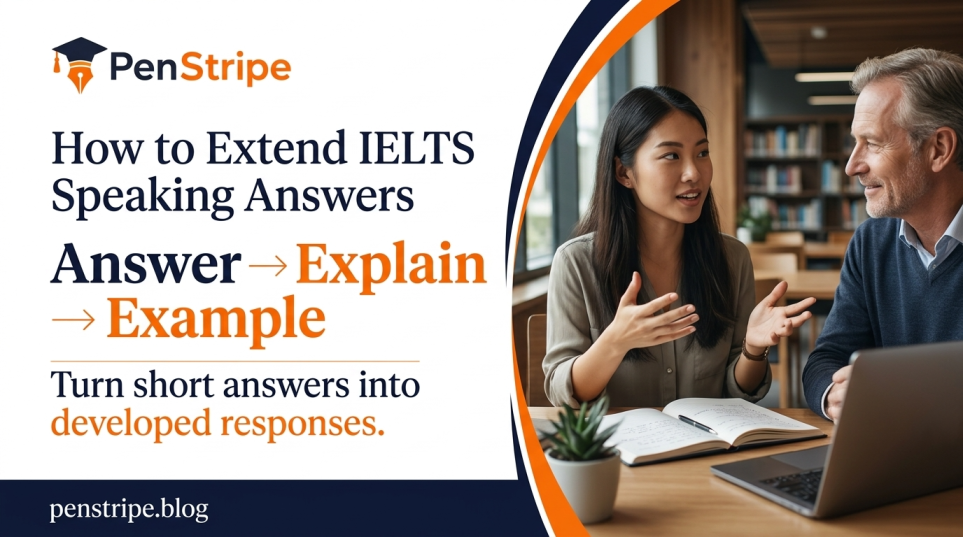
Short answers are the second most common fluency problem, especially in Part 1 and Part 2, where candidates often say less than the test actually requires.
IELTS Speaking Fluency & Answers Structure That Works
Use this four-part pattern for almost any question: give your answer, add a reason, give a specific example, then add a result or extra detail. This structure works across Part 1, Part 2, and Part 3 because it naturally produces two to four sentences instead of one.
Example of a Weak vs Extended Answer
Question: Do you like your job?
Weak answer: Yes, it’s fine.
Extended answer: Yes, I genuinely enjoy it, mainly because it involves a lot of creative problem solving. For example, last month I redesigned a process that saved my team several hours a week. That kind of result makes the work feel meaningful rather than routine.
Extending Part 2 Answers Without Running Out of Ideas
If you finish your two-minute cue card answer early, add background details, describe how you felt, mention what happened afterward, or compare the situation to a similar one in the past. These additions feel natural rather than forced, since they follow how people normally tell stories.
IELTS Speaking Vocabulary Tips
Vocabulary and fluency work together. Limited vocabulary is one of the main reasons candidates hesitate or give short answers in the first place.
Learn Words by Topic, Not by List
Study vocabulary connected to common IELTS Speaking topics such as work, technology, education, and the environment. Topic-based learning makes it far easier to recall the right word during a real answer than memorizing disconnected word lists.
Use Collocations Instead of Single Words
Native-sounding speech relies on natural word pairs, such as “gain experience,” “make a decision,” or “reduce pollution.” Learning these combinations improves your Lexical Resource score more than memorizing individual advanced words.
Practice Paraphrasing
If you forget a specific word mid-answer, describe it instead of stopping. Saying “the thing you use to remember appointments” instead of “planner” keeps your speech flowing and still communicates your meaning clearly.
How to Improve IELTS Speaking Confidence
Confidence and fluency reinforce each other. Nervous candidates tend to speak in shorter bursts, pause more, and second-guess correct answers.
Build Confidence Through Repetition, Not Perfection
Confidence comes from familiarity with the test format, not from having flawless English. The more mock questions you answer out loud, the less unfamiliar the real test feels, which directly reduces anxiety-driven hesitation.
Reframe Mistakes During Practice
Treat small errors as normal rather than something to fear. Native speakers self-correct constantly in real conversation. Practicing this mindset during preparation makes it much easier to recover smoothly from a slip during the actual exam instead of losing your flow.
Fluency vs Accuracy: What Matters More
| Focus Area | What Examiners Reward | What Hurts Your Score |
| Fluency | Steady flow, few long pauses, connected ideas | Frequent restarts, long silences |
| Accuracy | Reasonably correct grammar with natural variety | Obsessing over perfect grammar mid-sentence |
| Vocabulary | Topic-relevant words used correctly | Repeating the same basic words |
| Confidence | Calm, steady delivery even with small errors | Freezing after a single mistake |
IELTS Speaking Fluency & Answers PDF and Practice Resources
Many candidates search for an IELTS Speaking fluency and answers PDF to review offline. If you use one, treat it as a bank of question types and structures to practice with your own voice, not a script to recite. Pair it with the IELTS Speaking topics with answers you generate yourself using the four-part structure above, since answers in your own words train real fluency far better than memorized ones.
Read about IELTS speaking preparation and strategy
FAQs
What is a good IELTS Speaking fluency and answers sample I can practice with?
Pick any Part 1, Part 2, or Part 3 question, apply the answer-reason-example-result structure, and record yourself. Comparing your own recorded answers against this structure is more useful than reading someone else’s sample.
How can I stop pausing so much during IELTS Speaking?
Practice thinking in English daily, accept imperfect word choices instead of searching for the perfect one, and use natural thinking phrases instead of staying silent when you need a moment.
How can I reach Band 9 in fluency and answers?
Band 9 fluency means rare hesitation, natural idea development, and answers that sound spontaneous rather than rehearsed. This level usually comes from months of daily unscripted speaking practice, not memorization.
How many IELTS Speaking topics with answers should I practice?
Practicing 30 to 40 varied topics across all three parts is usually enough to build flexible, transferable answer structures rather than memorized responses tied to specific questions.
Is it bad to pause during IELTS Speaking?
Short, natural pauses are normal and expected. Long, frequent pauses that break the flow of your answer are what actually lower your fluency score.
Can I use the same vocabulary in every answer?
Repeating the same basic words across multiple answers limits your Lexical Resource score. Paraphrasing and using topic-specific vocabulary shows a wider range and scores higher.
Conclusion
Fluency in IELTS Speaking comes down to three things working together: a reliable answer structure, enough vocabulary to avoid getting stuck, and the confidence to keep speaking through small mistakes. Use the answer-reason-example-result pattern on every practice question, work on reducing hesitation with daily unscripted speaking, and build vocabulary by topic rather than random lists. Consistent practice using this approach turns fluency from a source of anxiety into your strongest scoring area. Start with five practice questions today and record yourself to hear the difference firsthand.