







Studying for hours without a clear plan can leave you feeling tired and unprepared. You might spend too much time on one subject, forget important assignments, or struggle to balance school with other responsibilities. A simple study schedule can help you organize your time and make steady progress without feeling overwhelmed.
Learning how to make a study schedule does not require special software or complicated planning methods. You only need to understand your goals, identify your available study time, and divide your tasks into manageable sessions. The best schedule is one that fits your daily routine and leaves room for breaks, rest, and unexpected changes.
In this guide, you will learn how to create a realistic study timetable, prepare for exams, and choose useful planning tools. You will also find a sample weekly schedule, a comparison of popular scheduling methods, and practical tips for students at home, in high school, and in college.
By the end, you will have a clear plan you can start using today.
1. Understand Your Study Goals Before Planning

Before creating a timetable, decide what you want to accomplish. Clear goals help you choose the right subjects, estimate the time required, and measure your progress.
Set Specific and Achievable Goals
Avoid vague goals such as “study science” or “prepare for college.” Instead, identify a task you can complete during a specific session.
For example:
- Review two biology chapters.
- Complete 15 algebra problems.
- Read 20 pages of a textbook.
- Write an outline for an English essay.
- Review vocabulary from the last three lessons.
Specific goals make it easier to begin studying because you already know what to do.
Identify Your Short-Term and Long-Term Goals
Short-term goals might include finishing homework, preparing for a quiz, or reviewing a difficult lesson. Long-term goals could involve improving your grades, passing a final examination, or meeting university admission requirements.
Write down both types of goals. Then break each long-term goal into smaller weekly tasks.
For example, a student preparing for a final biology exam could divide the syllabus into chapters and review two chapters each week. This approach prevents last-minute cramming.
Use Your Goals to Guide Your Schedule
Your study schedule should reflect your priorities rather than simply filling every available hour.
If mathematics is your weakest subject, give it more attention. If an assignment is due tomorrow, schedule it before less urgent activities.
A useful rule is to plan around deadlines, difficulty, and the amount of work required.
2. Track Your Available Study Time

A realistic timetable starts with understanding how you currently spend your day. Planning more hours than you actually have can quickly lead to frustration.
List Your Daily Responsibilities
Write down your fixed commitments, including classes, work, meals, transportation, family responsibilities, and sleep.
The remaining time shows when you can realistically study.
For example, a college student attending classes from 9 a.m. to 2 p.m. might have time for a short review session in the afternoon and a longer session after dinner.
Do not forget to include time for relaxation. A schedule that ignores your personal needs is difficult to maintain.
Find Your Most Productive Hours
Some students concentrate better in the morning, while others work more effectively in the afternoon or evening.
Notice when you feel most alert. Schedule difficult subjects during those periods and save simpler tasks for times when your energy is lower.
For instance, if you understand mathematics more easily in the morning, use that time for problem-solving instead of routine note organization.
Leave Room for Unexpected Changes
Avoid scheduling every minute of your day. Assignments may take longer than expected, and personal responsibilities can interrupt your plans.
Leave some flexible time between study sessions or reserve a short block each week for unfinished work.
This makes your timetable more practical and reduces the pressure to catch up whenever something changes.
3. Prioritize Subjects and Assignments

Not every subject requires the same amount of attention. Prioritizing your workload helps you use limited study time wisely.
Rank Tasks by Importance
Make a list of your current assignments, upcoming exams, and topics that need extra practice.
Then consider three factors:
- Urgency: How soon is the deadline?
- Difficulty: How challenging is the subject?
- Importance: How much does the task contribute to your learning or grade?
Tasks with approaching deadlines and difficult material usually deserve earlier attention.
Divide Large Tasks into Smaller Steps
Large assignments can feel intimidating when you place them on your schedule as a single task.
Instead of writing “complete research paper,” divide the work into smaller actions:
- Choose a topic.
- Find reliable sources.
- Prepare an outline.
- Write the first draft.
- Revise and proofread.
Give each step its own time slot. This creates a clear starting point and makes progress easier to track.
Balance Your Subjects Throughout the Week
Studying one subject for several hours every day may leave other subjects neglected.
Spread your workload across the week according to your needs. You might study mathematics on Monday, Wednesday, and Friday while reviewing biology and English on alternate days.
Include short review sessions for previously learned material. Regular practice helps you identify knowledge gaps before exams.
4. Create a Realistic Daily and Weekly Timetable
Once you understand your goals, available time, and priorities, you can build a practical study timetable.
Choose a Planning Period
A weekly schedule provides an overview of your workload, while a daily plan tells you exactly what to do next.
Start by planning one week at a time. Add fixed commitments first, followed by study sessions, breaks, and personal activities.
At the end of each day, check your progress and identify the tasks that need attention tomorrow.
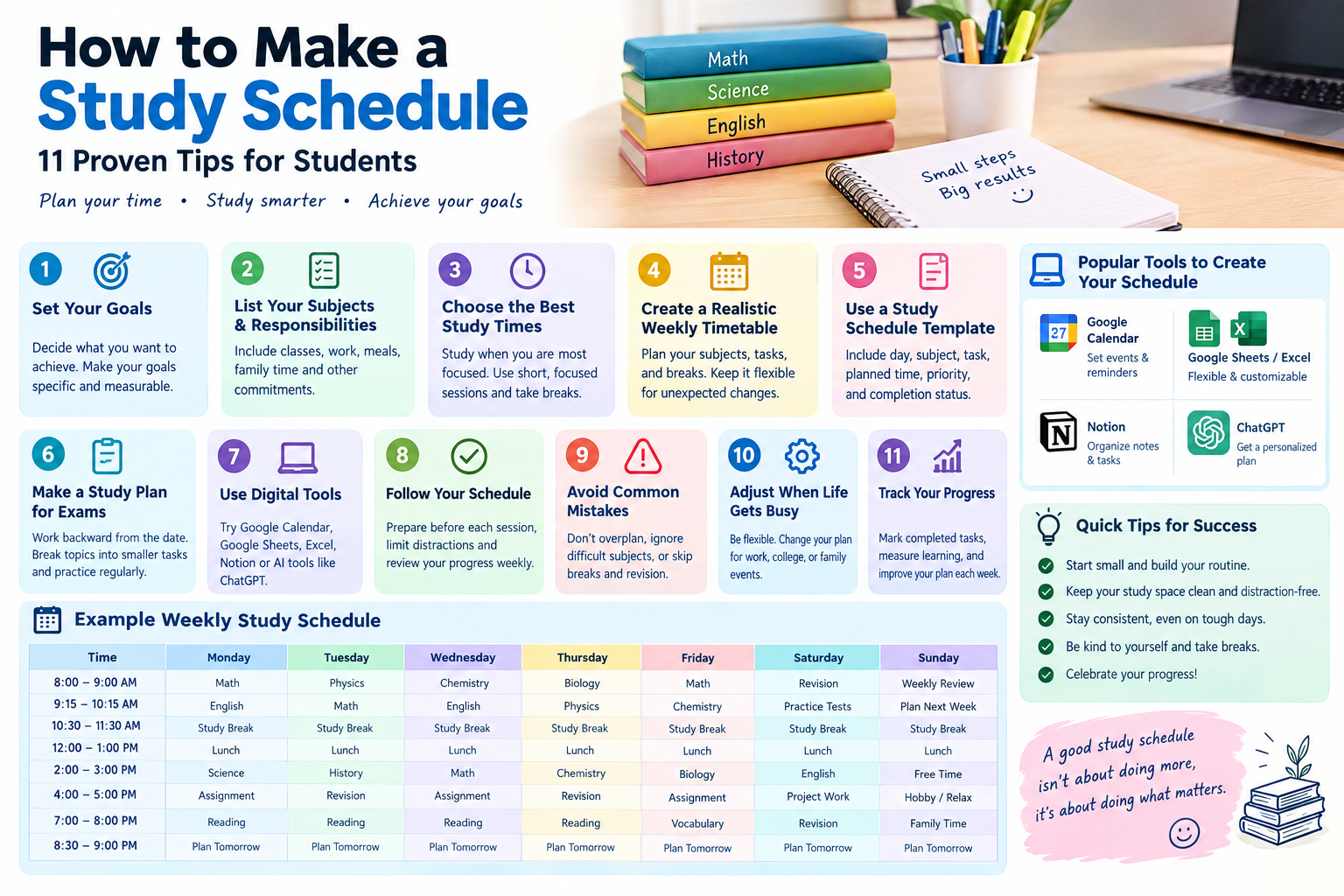
Example: Timetable for a Student at Home
The following example shows how a student studying at home might organize a weekday. Adjust the times to match your school hours, energy levels, and family responsibilities.
| Time | Activity |
| 8:00–8:30 a.m. | Breakfast and daily planning |
| 8:30–9:15 a.m. | Mathematics practice |
| 9:15–9:30 a.m. | Short break |
| 9:30–10:15 a.m. | Science revision |
| 10:15–10:30 a.m. | Break |
| 10:30–11:00 a.m. | Reading and note review |
| 11:00 a.m.–1:00 p.m. | Personal tasks and lunch |
| 1:00–1:45 p.m. | English or writing practice |
| 1:45–2:00 p.m. | Short break |
| 2:00–2:30 p.m. | Practice questions |
| Evening | Free time and optional light review |
This timetable is an example, not a requirement. Students with school classes, jobs, or other commitments can move the study blocks to more convenient hours.
Use Short, Focused Study Sessions
You do not always need to study for several hours without stopping.
Try studying for 25 minutes and resting for five minutes. After four focused sessions, take a longer break. If you prefer longer periods, experiment with 40–50 minutes of study followed by a short rest.
Choose a session length that helps you concentrate. The purpose of a study block is to complete meaningful work, not simply to watch the clock.
5. Choose the Best Study Schedule Format
The right format depends on your learning style, responsibilities, and preferred planning method.
Paper Planner or Notebook
A notebook is useful if you prefer writing tasks by hand. You can create a weekly timetable, check off completed work, and make changes whenever necessary.
The main advantage is simplicity. You do not need an internet connection or an account.
However, updating a handwritten schedule can take extra time if your plans change frequently.
Digital Study Schedule Template
A digital study schedule template allows you to organize tasks in a spreadsheet or planning application.
You can create columns for subjects, dates, deadlines, and completion status. A spreadsheet is especially useful when you want to repeat a weekly routine or rearrange study sessions quickly.
Choose a template with enough detail to guide you without making daily planning complicated.
Weekly Study Plan Comparison
| Planning Method | Best For | Main Advantage | Possible Limitation |
| Paper planner | Students who like handwriting | Simple and easy to customize | Manual changes |
| Google Calendar | Students with busy routines | Reminders and calendar events | Requires regular updates |
| Google Sheets | Students tracking several subjects | Flexible tables and checklists | Can become cluttered |
| Excel | Detailed weekly or monthly planning | Custom formatting and formulas | Some features require practice |
| Notion | Students managing notes and tasks together | Combines planning and study materials | Setup can take time |
Choose one main planning method first. Using too many tools can create extra work instead of saving time.
6. Use Digital Tools to Organize Your Schedule
Digital tools can make scheduling easier, particularly when you have multiple deadlines or changing commitments.
How to Make a Study Schedule on Google Calendar
Google Calendar lets you create study events and set reminders.
Follow these steps:
- Open Google Calendar.
- Select the date and time for a study session.
- Create an event with a clear title, such as “Biology Chapter 3 Review.”
- Set the start and end times.
- Add a reminder if needed.
- Repeat the process for other subjects and deadlines.
Use different calendar colors for classes, assignments, and personal activities if that helps you understand your week quickly.
How to Make a Study Schedule on Google Sheets or Excel
A spreadsheet works well for students who want a customizable timetable.
Create columns for the day, time, subject, task, and status. Then add your study sessions to the appropriate rows.
For example:
| Day | Subject | Task | Status |
| Monday | Mathematics | Solve 15 problems | Planned |
| Tuesday | Biology | Review Chapter 2 | Planned |
| Wednesday | English | Draft an essay | Planned |
| Thursday | Chemistry | Practice equations | Planned |
| Friday | Mathematics | Review mistakes | Planned |
Update the status after each session. You can use simple labels such as Planned, In Progress, and Completed.
How to Make a Study Schedule on Notion
Notion can combine your timetable, class notes, assignment lists, and revision tasks in one workspace.
Create a table with columns for the subject, task, deadline, priority, and status. Add a calendar view if you want to see when assignments are due.
Keep the system simple at first. A complicated dashboard is not necessary for effective studying.
How to Use ChatGPT or AI to Make a Study Schedule
An AI assistant can help you organize tasks into a draft timetable. However, the schedule should be based on your actual availability and academic requirements.
You can use a prompt like this:
“Create a weekly study schedule for a college student taking five subjects. I have classes from 9 a.m. to 2 p.m. on weekdays and can study for two hours each evening. Give extra time to mathematics and biology, include short breaks, and reserve Saturday for revision. Keep Sunday mostly free.”
Review the result before using it. Check that the times are realistic, all important subjects are included, and the plan allows enough rest.
AI can help organize your work, but you remain responsible for checking deadlines and course requirements.
7. Make a Study Plan for Exams
Exam preparation requires more than adding extra study hours. You need a plan that covers the syllabus, allows time for practice, and includes revision.
Start with the Exam Date
Write down each exam date and the subjects you need to prepare.
Work backward from each exam. If you have three weeks remaining, divide the available time among learning difficult topics, reviewing earlier material, and completing practice questions.
Begin with subjects that need the most attention rather than postponing them until the final days.
Divide the Syllabus into Topics
Break each subject into chapters or smaller topics. Assign each topic to a study session based on its difficulty and importance.
For example, if a biology exam covers six chapters, you might study two chapters during the first week, two during the second, and use the final week for mixed practice and revision.
Adjust the plan according to your actual syllabus and exam format.
Include Active Recall and Practice Questions
Reading notes repeatedly can create a feeling of familiarity without showing whether you can remember the material independently.
After studying a topic, close your notes and explain the main ideas from memory. Then answer practice questions and check your mistakes.
Return to difficult topics in later sessions. This gives you multiple opportunities to retrieve and strengthen what you have learned.
Sample Weekly Exam Study Plan
| Day | Main Task | Review Activity |
| Monday | Learn a difficult topic | Recall key definitions |
| Tuesday | Study the next topic | Answer practice questions |
| Wednesday | Review both topics | Correct mistakes |
| Thursday | Cover remaining material | Make short notes |
| Friday | Complete a practice test | Check incorrect answers |
| Saturday | Review weak areas | Repeat difficult questions |
| Sunday | Light revision or rest | Prepare for next week |
A plan like this can help you cover material gradually. If your exam is closer, prioritize the most important topics and the areas where you need the most improvement.
8. Build Effective Study Habits
A timetable works best when it supports effective learning habits. The goal is not simply to spend more time studying but to use each session well.
Prepare Your Study Space
Choose a reasonably quiet place with the books, notes, and supplies you need.
Keep your phone away from your desk if notifications interrupt your concentration. If you need your phone for a timer or study application, silence unnecessary alerts.
Before starting, write down the exact task you want to complete. This reduces the temptation to switch between unrelated activities.
Use Active Learning Techniques
Match your study method to the material.
For example, solve problems for mathematics, practice explaining concepts for science, and use vocabulary recall for language learning.
Useful techniques include:
- Active recall: Retrieve information from memory without looking at your notes.
- Spaced repetition: Review material across multiple sessions instead of studying it only once.
- Practice testing: Answer questions under conditions similar to the exam.
- Teach-back: Explain a concept in simple language as if teaching another person.
These methods help you identify what you understand and what still needs work.
Protect Sleep and Breaks
Avoid sacrificing sleep to follow an unrealistic timetable. Rest supports attention, memory, and your ability to learn.
Schedule meals, physical activity, and regular breaks alongside study sessions. If you feel exhausted, a shorter focused session may be more productive than forcing yourself through several unproductive hours.
Consistency matters more than maintaining a perfect schedule every day.
9. Avoid Common Scheduling Mistakes
Even a well-designed study plan can fail if it does not match your real life.
Planning Too Much Work
A schedule packed with continuous study sessions leaves little room for mistakes, interruptions, or rest.
Start with a manageable workload. Add more time only after you understand how long your tasks usually take.
Ignoring Difficult Subjects
Students sometimes spend extra time on familiar topics because they feel easier. However, this can leave important knowledge gaps unresolved.
Give challenging subjects dedicated sessions when your concentration is strongest. Break them into smaller tasks to make them easier to begin.
Skipping Revision
Finishing a chapter does not mean you will remember everything later.
Add short review sessions throughout the week. Revisit important concepts after an interval, test yourself, and focus on the questions you answer incorrectly.
Treating Every Change as Failure
Unexpected responsibilities may interrupt your timetable. That does not mean the whole plan has failed.
Move unfinished work to another suitable time and continue. A flexible schedule is more useful than a perfect schedule that becomes impossible to follow.
10. Adjust Your Schedule and Track Progress
Your first timetable is a starting point. Reviewing it regularly helps you discover what works and what needs improvement.
Check Your Progress Daily
At the end of each day, review the tasks you completed.
Ask yourself:
- Did I finish my most important task?
- Which subject needs more attention?
- Did I allow enough time for each activity?
- What should I change tomorrow?
Keep your review short. A few minutes of planning can help you begin the next day with a clear direction.
Review Your Weekly Results
At the end of the week, compare your planned tasks with your completed work.
If mathematics practice repeatedly takes longer than expected, increase the time allocated to it. If an evening session is difficult to maintain, try moving it to an earlier period.
Use your actual experience to improve the timetable instead of following unrealistic estimates.
Create a Schedule You Can Maintain
A successful schedule should support your academic goals without taking over your entire life.
Keep your main study blocks consistent when possible, but allow flexibility for assignments, family responsibilities, and rest.
You can also use a simple checklist to track progress:
- List the week’s assignments and exams.
- Choose the most important study tasks.
- Schedule realistic study sessions.
- Add breaks and personal responsibilities.
- Review completed work each evening.
- Adjust the timetable at the end of the week.
Once the routine becomes familiar, planning should take less time and studying should feel more organized.
11. Frequently Asked Questions
1. How do I make a study schedule for beginners?
Start by listing your subjects, assignments, and available study hours. Choose two or three manageable tasks for each day, schedule them around your existing responsibilities, and include short breaks. Review your progress every evening and adjust the next day’s plan when necessary.
2. What is the best study schedule for a student at home?
The best timetable fits the student’s schoolwork, family responsibilities, and most productive hours. A student at home might study difficult subjects in the morning, complete reading or assignments later, and use the evening for light revision. The exact hours should depend on the student’s daily routine.
3. How many hours should I study every day?
There is no single number that works for every student. Your ideal study time depends on your academic level, workload, deadlines, and concentration. Start with manageable sessions and increase them when needed. Focus on completing meaningful tasks rather than measuring success only by the number of hours studied.
4. How can I make a study schedule for exams?
List your exam dates and divide each syllabus into smaller topics. Schedule difficult material early, practice questions regularly, and reserve time for revision before each exam. Review your progress every few days so you can spend more time on weak areas and avoid leaving everything until the last minute.
5. Is Google Calendar or Google Sheets better for a study schedule?
Google Calendar is useful for scheduling study sessions, managing deadlines, and setting reminders. Google Sheets is better for building a customizable timetable and tracking completed tasks. Choose Calendar if timing is your main concern, or Sheets if you prefer organizing subjects and assignments in a table.
6. Can ChatGPT create a study schedule for me?
Yes. You can provide your subjects, available hours, exam dates, and priorities to generate a draft study plan. Check the result carefully before using it. Make sure it includes your actual commitments, allows enough rest, and follows your course deadlines.
7. How do I make a study schedule while working full-time?
Start with short study sessions before or after work, or use available weekend hours. Prioritize urgent assignments and difficult topics instead of trying to cover every subject daily. Keep your plan realistic, protect your sleep, and reserve some flexible time for unexpected work or personal responsibilities.
8. Should I follow the same study schedule every day?
You can keep a consistent daily routine while changing the subjects and tasks. A regular start time helps build a habit, but your workload may vary throughout the week. Use a weekly plan to balance subjects and adjust individual sessions when deadlines or priorities change.
Conclusion
Learning how to make a study schedule can help you organize your workload, prepare for exams, and build more consistent study habits. Start by identifying your goals, tracking your available time, and choosing the subjects that need the most attention. Then create a realistic timetable with focused sessions, regular breaks, and enough flexibility for daily responsibilities.
You do not need an expensive planner or a complicated digital system. A simple notebook, spreadsheet, or calendar can be enough to get started. The important part is using your schedule regularly and adjusting it when something does not work.
Take a few minutes today to write down your main study goals and plan your next three study sessions. Start small, track your progress, and build a routine that helps you learn with greater confidence penstripe.