







Studying for hours does not always mean learning more. You can spend an entire evening reading notes and still struggle to remember the material the next morning. The better approach is to improve how you use your study time.
If you want to know how to study faster, focus on active learning instead of simply spending more time with your books. Techniques such as active recall, spaced repetition, focused study sessions, practice testing, and distraction control can help you learn more efficiently.
The goal is not to rush through every chapter. It is to understand important ideas, remember them longer, and use your available time wisely.
This guide explains 11 practical ways to study faster and remember more. You will also learn how to prepare for exams, study effectively in a short period, avoid common mistakes, and build a simple study routine that works.
1. Set a Clear Study Goal

One of the easiest ways to waste study time is to start without knowing exactly what you want to accomplish.
Instead of saying, “I will study biology,” choose a specific target such as, “I will understand the three stages of cellular respiration and answer 15 practice questions.”
A clear goal gives your brain a specific task and makes it easier to measure progress.
Break Large Topics Into Small Tasks
Large chapters can feel overwhelming because they contain too much information.
Divide the material into smaller sections:
- Read one concept
- Write three key points
- Test yourself
- Review mistakes
- Move to the next concept
This approach helps you maintain momentum without trying to memorize an entire chapter at once.
Use a Short Study Checklist
Before starting, write down three to five tasks.
For example:
- Review lecture notes
- Learn 10 vocabulary terms
- Complete 15 practice questions
- Review incorrect answers
- Summarize the topic from memory
Once the list is complete, your study session has a clear finish line.
2. Use Active Recall to Study Faster
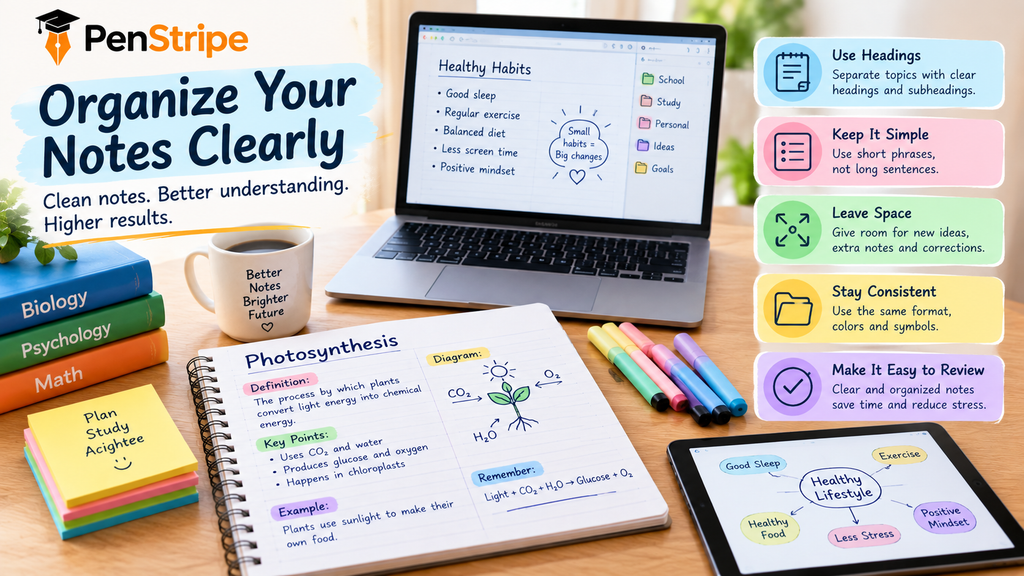
Active recall is one of the most useful techniques for learning information efficiently. Instead of repeatedly reading your notes, close the book and try to remember the information yourself.
For example, after reading about photosynthesis, ask:
“What are the main stages of photosynthesis?”
Try answering without looking at your notes. Then check your answer and correct anything you missed.
Turn Notes Into Questions
Questions make your study sessions more active.
Instead of writing:
“Photosynthesis converts light energy into chemical energy.”
Create a question:
“What does photosynthesis do?”
Then answer it from memory.
You can use this technique with flashcards, practice tests, notebooks, or digital study tools.
Test Yourself Before You Feel Ready
Do not wait until you have memorized everything before testing yourself.
Testing reveals what you actually know and what still needs work. Your mistakes also show you where to spend your next few minutes.
3. Study in Focused Time Blocks

Long study sessions can become less productive when concentration starts falling.
Try dividing your study time into focused blocks. A simple approach is:
25–50 minutes of focused study + 5–10 minutes of rest
The exact timing does not need to be the same for everyone. Choose a schedule that allows you to concentrate without becoming mentally exhausted.
Use One Task Per Session
Multitasking can make studying slower.
If you are studying chemistry, do not constantly switch between chemistry, social media, messages, and unrelated assignments.
Choose one task and give it your full attention.
Take Short Breaks
A short break can help you return with better attention.
During your break, stand up, drink water, stretch, or walk around. Avoid turning a five-minute break into 30 minutes of scrolling.
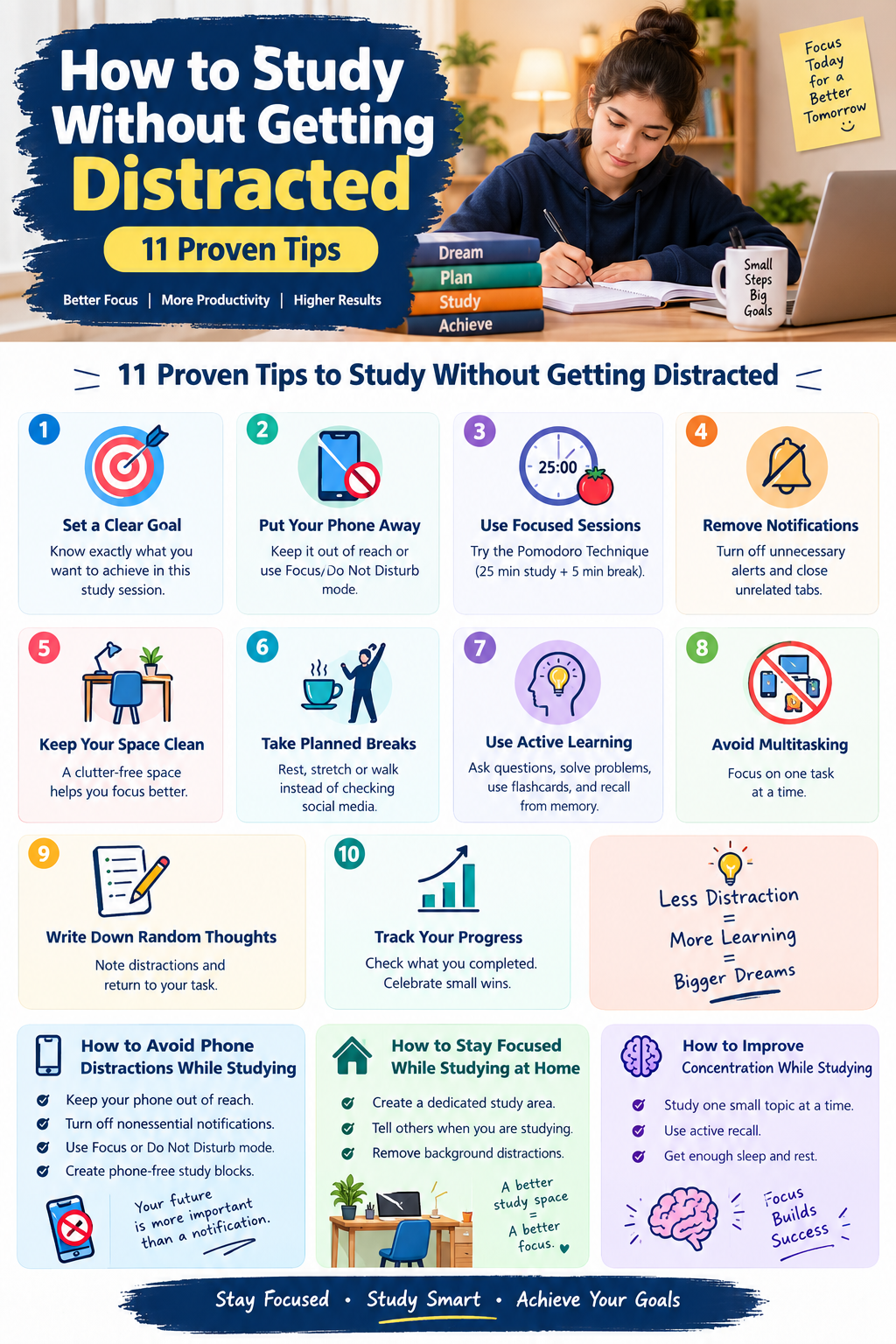
4. Remove Distractions
If your phone constantly interrupts your attention, even a good study method becomes less effective.
Before studying, make your environment easier to focus in.
Control Your Phone
Try one of these options:
- Put your phone in another room
- Turn on Do Not Disturb
- Disable unnecessary notifications
- Use an app blocker
- Keep only study-related apps open
The goal is not to eliminate technology. It is to prevent technology from controlling your attention.
Create a Simple Study Environment
Keep only the materials you need on your desk.
A useful setup might include:
- Your textbook
- Notebook
- Pen
- Water
- Calculator if needed
- Computer for study-related work
A clean environment reduces unnecessary decisions and makes it easier to begin.
5. Use the Feynman Technique
The Feynman Technique helps you identify gaps in your understanding.
The process is simple:
- Choose a topic.
- Explain it in simple language.
- Identify anything you cannot explain.
- Review that part.
- Explain it again without using complicated words.
Explain the Topic Like You Are Teaching Someone
Suppose you are studying supply and demand.
Instead of memorizing a definition, explain it as if you were teaching a younger student.
If your explanation becomes confusing, that may indicate that you need to review the concept.
This method is especially useful for subjects that require understanding rather than simple memorization.
6. Practice With Questions
Reading can create a feeling of familiarity without proving that you understand the material.
Practice questions provide stronger feedback.
Use Questions After Each Topic
After studying a section, answer several questions without checking your notes.
Then review your mistakes.
Ask yourself:
- Why was my answer wrong?
- What information did I miss?
- Did I misunderstand the concept?
- Can I explain the correct answer?
This turns mistakes into useful study material.
Keep an Error List
Create a small list of questions you answered incorrectly.
Review this list during your next study session.
Your weakest areas deserve more attention than topics you already understand.
7. Use Spaced Repetition
Trying to learn everything in one session is rarely the best strategy.
Spaced repetition means reviewing information at increasing intervals instead of repeatedly studying it in one sitting.
For example:
Day 1: Learn the material
Day 2: Quick recall review
Day 4: Test yourself again
Day 7: Review difficult points
Day 14: Test yourself again
The schedule can change depending on the subject and exam date.
Focus More on Difficult Information
Not every flashcard needs equal attention.
If you immediately remember a concept, move on.
If you repeatedly forget something, review it more often.
This makes your study time more efficient because you spend more time where it is actually needed.
8. Take Better Notes
Good notes are not a transcript of everything your teacher says.
They should help you understand and review important ideas quickly.
Write Ideas in Your Own Words
Instead of copying complete sentences, summarize the concept.
For example:
Original idea:
The process by which plants use light energy to produce chemical energy.
Your note:
Plants use light to make stored energy.
Simple notes are often easier to review later.
Use a Question-and-Answer Format
Divide your page into questions and answers.
For example:
Question: What is active recall?
Answer: A learning method where you retrieve information from memory instead of simply rereading it.
This makes your notes useful for future self-testing.
9. Prioritize High-Value Topics
You do not always need to spend the same amount of time on every part of a subject.
When an exam is approaching, identify topics that are:
- Frequently tested
- Difficult for you
- Important for understanding other concepts
- Included in the teacher’s review material
- Connected to previous assignments or exams
Use the 80/20 Idea Carefully
The 80/20 principle can encourage you to look for high-impact tasks, but it should not mean ignoring large parts of your syllabus.
Use it as a prioritization tool.
First master the most important concepts. Then fill the remaining gaps.
10. Combine Reading With Active Practice
One of the biggest study mistakes is spending too much time passively reading.
Reading is useful for learning new information, but it should not be the only activity.
Follow a Read-Test-Review Cycle
Try this simple process:
Read: Learn a small section.
Test: Close the material and recall the key ideas.
Review: Check what you missed.
Repeat: Move to the next section.
This cycle keeps your brain involved throughout the session.
Use Different Forms of Practice
Depending on the subject, you can:
- Solve math problems
- Write short explanations
- Draw diagrams
- Create flashcards
- Answer practice questions
- Teach the concept aloud
- Complete sample exams
The best method depends on what you need to do with the information later.
11. Review Before You Forget
A short review can be more useful than another long reading session.
At the end of your study session, spend a few minutes recalling the main ideas without looking at your notes.
Write down:
- Three things you learned
- Two things you need to review
- One question you still have
This gives you a simple plan for your next session.
Use Quick Revision Sessions
When time is limited, focus on active review rather than starting the entire chapter again.
Review:
- Important definitions
- Key concepts
- Formulas
- Common mistakes
- Practice questions
- Difficult areas
This can make limited study time much more productive.
How to Study Faster for Exams
When an exam is close, your strategy should change from general learning to targeted preparation.
Start by identifying the topics most likely to matter. Then test yourself on those areas instead of reading the entire textbook repeatedly.
A simple exam preparation cycle is:
Identify → Learn → Recall → Practice → Correct → Review
For example, if you have three hours available, you could spend the first hour learning difficult concepts, the second hour answering practice questions, and the final hour reviewing mistakes and weak areas.
Avoid spending the entire three hours highlighting or rereading.
How to Study Fast Without Forgetting
The fastest study method is not necessarily the one that gets you through the most pages.
It is the method that helps you retain useful information with fewer wasted repetitions.
To study faster without forgetting:
- Use active recall
- Review information over multiple days
- Practice with questions
- Explain difficult concepts simply
- Sleep properly
- Take focused breaks
- Remove distractions
- Concentrate on weak areas
If you learn something quickly but forget it the next day, you have not actually saved time.
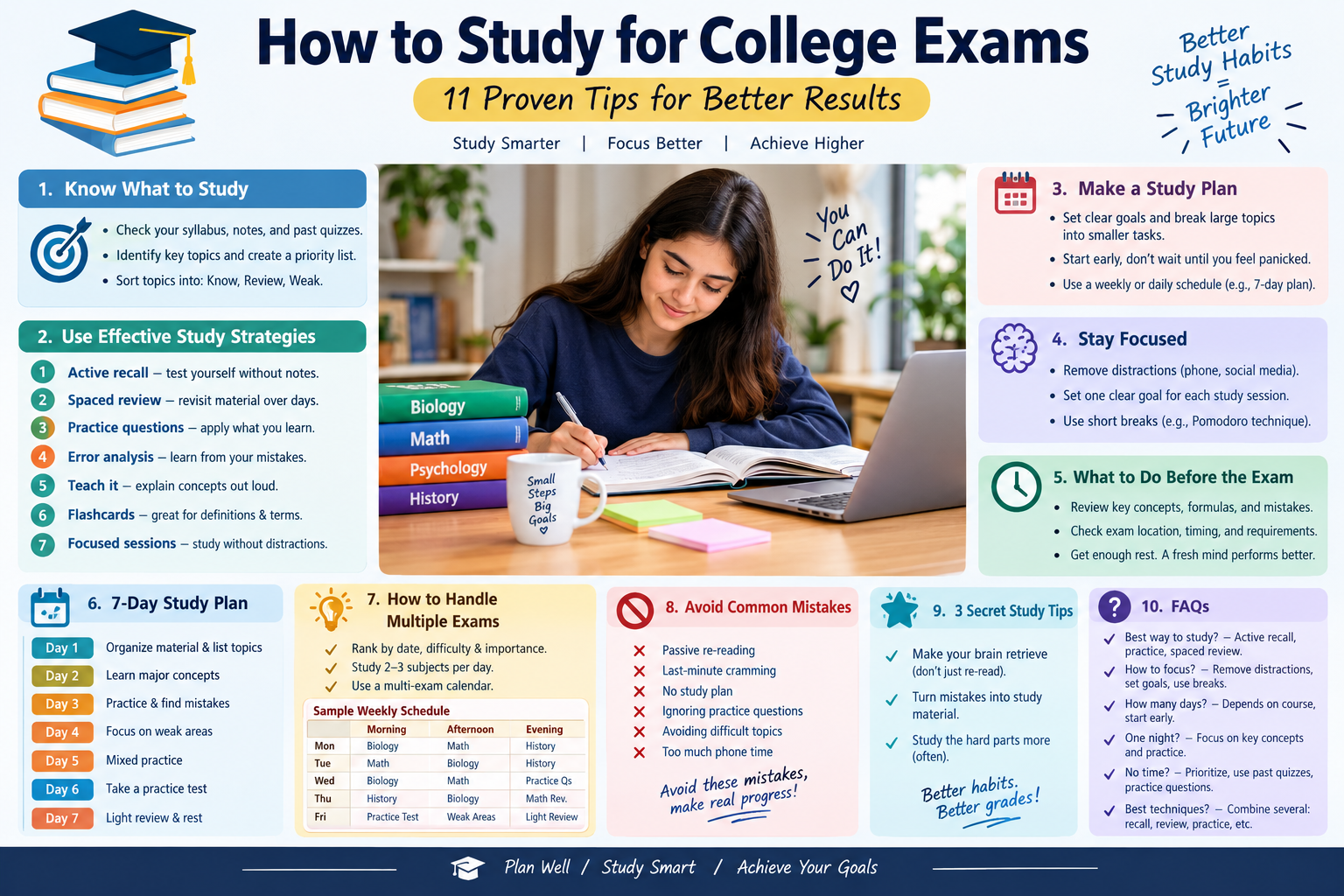
A Simple 60-Minute Study Plan
If you only have one hour, try this structure:
| Time | Activity |
|---|---|
| 0–5 minutes | Set your goal and prepare materials |
| 5–25 minutes | Learn the most important concepts |
| 25–30 minutes | Take a short break |
| 30–45 minutes | Use active recall and practice questions |
| 45–55 minutes | Correct mistakes |
| 55–60 minutes | Summarize and plan the next review |
This structure can be adjusted for different subjects and attention spans.
Study Method Comparison

| Study Method | Best For | Main Benefit | Common Problem |
|---|---|---|---|
| Active Recall | Facts and concepts | Strong retrieval practice | Feels difficult |
| Spaced Repetition | Long-term memory | Reduces cramming | Requires planning |
| Practice Tests | Exams | Reveals knowledge gaps | Can be stressful |
| Feynman Technique | Understanding | Exposes weak understanding | Takes effort |
| Rereading | Initial exposure | Easy to use | Can become passive |
| Highlighting | Identifying key points | Quick organization | Easy to overuse |
The most effective approach is often a combination of methods rather than relying on one technique.
People Also Ask
How can I increase my study speed?
Increase study speed by reducing distractions, setting specific goals, using active recall, and practicing instead of repeatedly rereading. Break large topics into smaller tasks and focus on one task at a time. Faster studying should mean learning efficiently, not simply reading more quickly.
What is the 1/3, 5/7 study method?
There is no single universally established learning method known as the “1/3, 5/7 study method.” Different online sources may use these numbers to describe different study schedules. Before following a specific formula, focus on evidence-based practices such as retrieval practice, spaced review, and practice testing.
How can I study faster without forgetting?
Use active recall and spaced repetition rather than relying mainly on rereading. Test yourself shortly after learning new material, review difficult information over several days, and practice using questions. Sleep and regular breaks also support effective learning and memory.
How can I study fast in one hour for an exam?
Start by choosing the most important topics. Spend about 20 minutes reviewing difficult concepts, 20 minutes answering practice questions, and 15 minutes correcting mistakes. Use the final few minutes to recall the key information without looking at your notes.
How can I become a top 1% student?
There is no single study trick that guarantees top performance. High achievement usually comes from consistent habits, effective learning methods, strong time management, regular practice, and correcting mistakes. Focus on understanding the material, testing yourself frequently, and improving weak areas instead of chasing a perfect study routine.
How can I study in seven days?
Start by dividing the syllabus into seven manageable sections and prioritize important or difficult topics. Use active recall every day, complete practice questions, and reserve time for cumulative review. The final day should focus on weak areas and practice rather than trying to learn everything from scratch.
Is it better to study longer or study smarter?
Studying smarter is usually more useful than simply studying longer. A focused session using active recall and practice questions can be more productive than several hours of distracted rereading. However, difficult subjects still require enough total study time, so efficiency and consistency should work together.
How many hours should a student study each day?
There is no universal number that works for every student. The right amount depends on the subject, academic level, workload, deadlines, and individual concentration. Instead of targeting a fixed number of hours, set specific learning goals and use focused sessions with regular breaks.
Conclusion
Learning how to study faster is less about rushing and more about eliminating wasted effort. Reading the same page repeatedly may feel productive, but active recall, practice questions, spaced repetition, and focused study sessions usually provide more useful feedback.
Start with one or two techniques instead of changing your entire routine overnight. Set a clear goal, remove distractions, study in focused blocks, test yourself, and review difficult information regularly.
If you have an exam coming soon, prioritize important topics and spend more time practicing than passively reading. Over time, these habits can help you learn more efficiently while making your study sessions easier to manage.
The best study routine is one you can use consistently. Start with your next study session and put these techniques into practice penstripe.