







Most candidates know their target band number, but few understand what actually separates a Band 6 answer from a Band 8 answer. IELTS Speaking Band Score & Performance is decided by four official criteria, each scored independently, and small shifts in delivery can move you a full band up or down. Examiners assess your speaking performance against fluency and coherence, lexical resource, grammatical range and accuracy, and pronunciation in a face-to-face interview with a qualified examiner. This guide breaks down exactly what each band level requires, using the official descriptors, so you know precisely what to fix rather than guessing.
How IELTS Speaking Band Score & Performance Is Calculated
The Four Assessment Criteria
Your Speaking results are given as band scores ranging from Band 0 to Band 9, based on four assessment criteria that are identical for both general training and academic tests. Each criterion contributes equally, meaning a weakness in one area, even with strength elsewhere, caps your overall speaking band.
Who Marks the Speaking Test
Your Speaking test is assessed by an expert examiner in a face-to-face interview, which helps ensure accuracy and fairness in the marks awarded. There is no computer scoring involved in the Speaking module itself, unlike parts of the written test.
IELTS Speaking Assessment Criteria Explained

Fluency and Coherence
This measures your ability to keep speaking, including how much you need to hesitate, self-correct, or repeat yourself, along with how coherently your words and ideas flow using connecting phrases. Long, frequent pauses and disorganized ideas both lower this score, even if your vocabulary is strong elsewhere.
Lexical Resource
This is your ability to choose the right words to express yourself clearly, including whether your vocabulary is understandable, appropriate, and relevant to the topic. Idiomatic language becomes more important at Band 7 and above, though this does not mean using rare words or memorized clichés. Examiners also look at your ability to paraphrase when you cannot recall the exact word or phrase you want.
Grammatical Range and Accuracy
This measures your ability to produce grammatically correct speech using both simple and complex sentence structures, while limiting common errors such as article, preposition, or subject-verb agreement mistakes.
Pronunciation
This assesses how easy you are to understand, based on the range of pronunciation features you use, including stress, intonation, and rhythm.
IELTS Speaking Band Score Chart
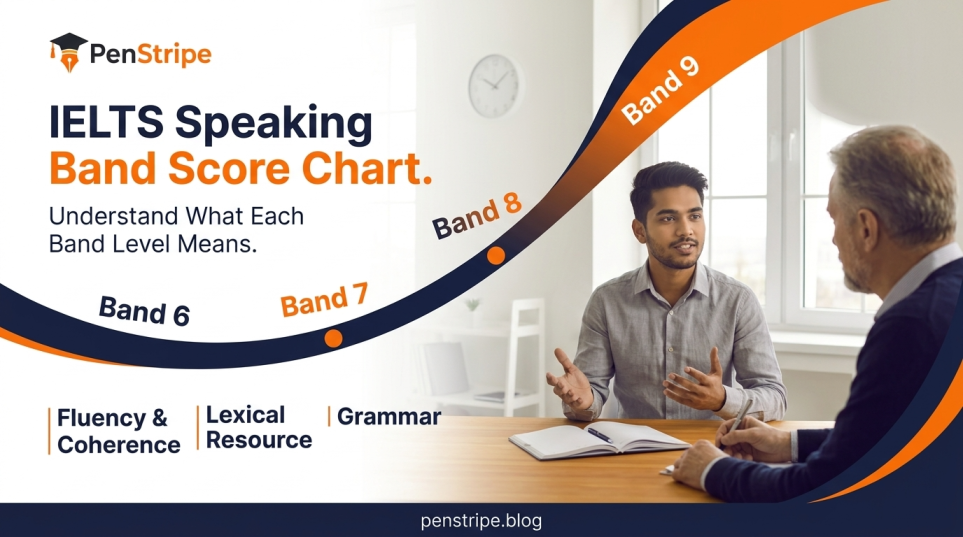
| Band | Fluency & Coherence | Lexical Resource | Grammar | Pronunciation |
| Band 9 | Speaks fluently with only rare repetition or self-correction; hesitation is content-related, not language-related | Uses vocabulary with full flexibility and precision on all topics | Uses a full range of structures naturally and accurately apart from slips | Effortless to understand throughout |
| Band 8 | Speaks fluently with only occasional repetition or self-correction | Uses a wide vocabulary resource flexibly, with occasional inaccuracies in idiomatic language | Uses a wide range of structures flexibly, with mostly error-free sentences | Easy to understand throughout; accent has minimal effect on clarity |
| Band 7 | Speaks at length without noticeable effort, though some hesitation or self-correction may appear | Uses vocabulary flexibly across topics, with some less common words and effective paraphrasing | Uses complex structures with some flexibility; frequently produces error-free sentences | Shows most Band 8 features but not consistently |
| Band 6 | Willing to speak at length, though may lose coherence at times due to repetition or hesitation | Wide enough vocabulary to discuss topics at length despite some inappropriacies | Mixes simple and complex structures with limited flexibility | Generally understood, though mispronunciation reduces clarity at times |
IELTS Speaking Band 7 Tips
What Band 7 Actually Requires
A Band 7 candidate speaks at length without noticeable effort or loss of coherence, though some language-related hesitation, repetition, or self-correction may still appear. This means occasional pauses are acceptable at Band 7. What matters is that they do not derail your overall coherence.
Practical Fixes to Reach Band 7
Focus on using a wider range of connectives beyond basic words like “and” or “but.” Band 7 also calls for some less common and idiomatic vocabulary along with effective paraphrasing when you cannot find the exact word. Practice explaining an idea two different ways in the same answer to build this flexibility naturally.
IELTS Speaking Band 8 Tips
What Separates Band 8 From Band 7
Band 8 speech is fluent with only occasional repetition or self-correction, and hesitation is usually about content rather than searching for language. Vocabulary becomes wider and more flexible, used to convey precise meaning, with idiomatic language used skillfully even if occasional inaccuracies appear.
Grammar and Pronunciation at Band 8
Band 8 grammar uses a wide range of structures flexibly, producing mostly error-free sentences with only occasional, non-systematic mistakes. Pronunciation at this level is easy to understand throughout, and any accent has minimal effect on how clearly you are understood. The key training focus here is precision, not just range.
IELTS Speaking Pronunciation Tips
Clarity Over Accent
Pronunciation is scored on how easy you are to understand and the range of features you use, including stress, intonation, and rhythm, not on sounding like a native speaker from a specific country.
Practical Pronunciation Practice
Record yourself weekly and compare your stress patterns to native audio. Focus on word stress in multi-syllable words and rising or falling intonation to signal whether a thought is finished. Small, consistent daily practice on these features moves your pronunciation band more reliably than occasional long study sessions.
IELTS Speaking Grammar Tips
Building Grammatical Range
Grammatical range and accuracy is scored on your ability to produce correct speech using both simple and complex sentence structures. Practice combining two simple sentences using words like “although,” “because,” or “which” to naturally add complexity without sounding forced.
Common Grammar Errors to Track
Common problem areas include articles, prepositions, and subject-verb agreement, and becoming aware of your personal error patterns helps you correct them before the test. Keep a short error log from your practice recordings and review it weekly.
IELTS Speaking Mistakes to Avoid
Memorizing full answers is the most damaging habit, since examiners quickly recognize rehearsed speech patterns. Giving one-word answers in Part 1, running out of content early in Part 2, and freezing completely after a small grammar mistake are all common issues that lower Fluency and Coherence specifically. Overusing advanced vocabulary incorrectly also hurts more than using simpler, accurate words.
How to Get a Higher IELTS Speaking Score
Target the Weakest Criterion First
Since all four criteria are weighted equally, identify which one is holding your score down the most. Record a full mock test, then score yourself against the descriptors above for each of the four areas separately.
Practice With Purpose, Not Just Volume
Speaking more without reviewing your recordings rarely raises your band score. Pair every practice session with a short review against the specific criterion you are targeting that week.
IELTS Speaking Band Score & Performance PDF and Sample Answers
Many candidates search for an IELTS Speaking band score & performance PDF or sample answers to compare their own responses against. Use official band descriptors, like the ones referenced above, as your benchmark rather than unofficial sample answers, since examiners score directly against these published criteria.
Read Related Articles
FAQs
What is a good IELTS What speaking band score & performance sample can I compare against?
Use the official band descriptors for each criterion and score your own recorded answers against them directly, rather than relying on unverified sample answers found online.
How is IELTS Speaking band score & performance different from Writing scoring?
Speaking is scored live by an examiner during your interview using the same four-criteria system, while Writing is assessed afterward on a submitted written response.
What is the fastest way to move from Band 6 to Band 7?
Focus on reducing language-related hesitation and adding a wider range of connectives and paraphrasing, since these are the main differences between the two band descriptors.
Does a strong accent lower my pronunciation score?
No, having an accent does not lower your score as long as it has minimal effect on how easily the examiner can understand you.
Can grammar mistakes still get me a high band score?
Yes, occasional slips are expected even at Band 9. What matters is that errors are rare and do not interfere with meaning.
How many bands can one mock test realistically improve?
Most candidates see gradual, half-band improvements over several weeks of targeted practice rather than large jumps from a single test.
Conclusion
Understanding IELTS Speaking Band Score & Performance means knowing exactly what each of the four criteria rewards at every level, not just memorizing a target number. Use the official band descriptors to score your own practice recordings honestly, focus your effort on your weakest criterion first, and build fluency, vocabulary, grammar, and pronunciation together rather than in isolation. Consistent, criteria-based practice is what actually moves your score, one focused session at a time.