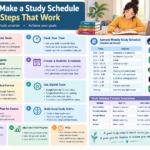







You have the notes, the textbook, and a looming exam date. What you don’t have is a clear way to turn all that material into something you can actually learn from. That’s where a study guide comes in. If you want to know how to make a study guide for an exam, the short answer is this: collect your course material, cut it down to the key ideas, organize it by topic, and turn it into questions you can test yourself on.
A good guide does more than shrink your notes. It shows you what you know, what you don’t, and where to spend your next hour. In this article, you’ll learn exactly how to build one, see a simple template you can copy, and compare the best study guide websites and tools. By the end, you’ll have a repeatable system that works for any subject, from biology to history.
What Is a Study Guide and Why Does It Work?

What Is a Study Guide?
A study guide is a condensed, organized summary of the material you need to know for an exam. It usually includes key terms, main concepts, formulas, examples, and practice questions. Think of it as a map of your course. It doesn’t replace the textbook, but it points you to the most important ideas.
Why the Psychology of Learning Favors Study Guides

The psychology of learning shows that how you study matters more than how long you study. A well-known 2013 review by Dunlosky and colleagues compared ten common study techniques. Practice testing and spaced practice earned the highest ratings for usefulness. Rereading and highlighting earned the lowest.
Rereading feels productive because the page looks familiar. But familiar is not the same as known. A study guide forces you to choose, rewrite, and quiz yourself, which are the habits that build real memory.
Study Guide vs. Study Plan
Students often mix these up. A study guide holds the content you need to learn. A study plan is the schedule that tells you when to learn it.
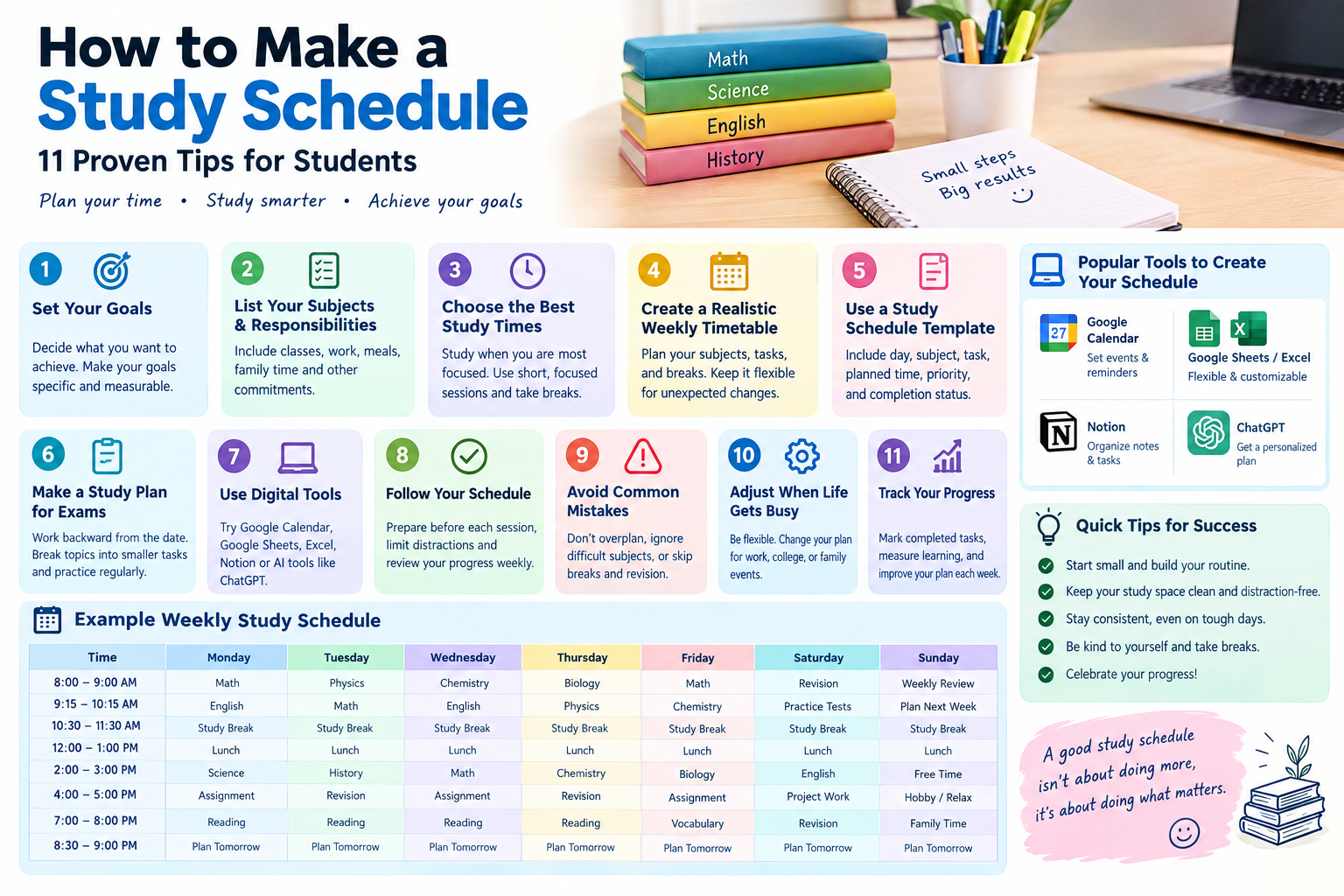
If you want to know how to write a study plan for college, work backward from your exam date. Split your guide into daily chunks, give harder topics more days, and keep the last two days for review only. You need both tools. The guide tells you what to study, and the plan tells you when.
How to Make a Study Guide for an Exam: 7 Steps

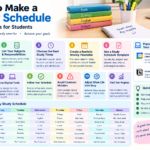
These seven steps answer the main question of this article. Follow them in order the first time, then adjust them to fit your style.
Gather and Sort Your Material (Steps 1 and 2)
Step 1: Collect everything the exam could cover. Pull together lecture notes, slides, textbook chapters, homework, old quizzes, and the syllabus. Check which topics carry the most weight. If your instructor shared a review sheet, use it as your outline.
Step 2: Sort the material into topics. Create one heading per unit or chapter, then list the subtopics under each. This is the skeleton of your guide. Seeing the whole course on one page also reveals gaps early, while you still have time to fix them.
Condense and Rewrite (Steps 3, 4, and 5)
Step 3: Pull out the essentials. For each topic, write down only what you must remember: definitions, formulas, dates, processes, and cause-and-effect links. Add one or two examples. A good rule is that each topic should fit on half a page. If it doesn’t, you’re copying instead of condensing.
Step 4: Rewrite everything in your own words. Explaining an idea in plain language is a quick test of whether you understand it. The Feynman technique is perfect here. Pretend you’re teaching the idea to a friend who has never heard of it. Wherever you stumble or reach for jargon, you’ve found a weak spot.
Step 5: Add visuals and memory aids. Use diagrams, timelines, comparison charts, and mnemonics. A nursing student might build a table comparing common medications. A history student might draw a timeline of events leading to a war. Keep it clean. If you use too many colors, everything looks equally important.
Test Yourself and Refine (Steps 6 and 7)
Step 6: Turn each section into questions. Under every topic, write three to five questions that could appear on the exam. Mix definitions, short answers, and problems. These questions turn a passive summary into an active study tool.
Step 7: Test, mark, and revise. Cover the answers and quiz yourself. Mark every question you missed, then update the guide. After a few rounds, your guide will lean toward your weakest areas, which is exactly where your time should go.
If you’ve seen online lists of “7 secret methods for studying,” they usually come down to these same ideas: condense, rewrite, visualize, and test yourself.
How to Create a Study Guide for Students by Subject
The right format depends on what the exam asks you to do. When you create a study guide for students in different courses, adjust the content like this.
Math and Science Exams
Focus on formulas, worked examples, and problem types. For every formula, note when to use it and add one solved example. Practice matters more than summary here, so fill at least half the guide with problems you have tried without help.
History and Humanities Exams

Organize around themes, causes and effects, and key figures instead of a plain list of dates. Add a short “so what?” line to each event that explains why it mattered. Essay exams reward arguments, so write two or three thesis statements you could defend.
Language and Vocabulary Exams
Build a term list with the word, a definition, and a sentence of your own. Group words by theme. Flashcards work especially well here because they support spaced repetition.
Study Guide Examples You Can Copy
Here are two short study guide examples to show the idea.
Biology example: “Cell division. Mitosis makes two identical cells for growth and repair. Meiosis makes four different cells for reproduction. Compare them in a two-column chart. Practice question: What is the key difference in how chromosomes line up in each process?”
History example: “Causes of World War I. Four main factors: alliances, militarism, imperialism, nationalism. So what? Together they turned a local conflict into a global war. Practice question: Which factor do you think mattered most, and why?”
Notice that both are short, written in plain language, atudy Guide Temnd end with a question.
Splate and Test Study Guide Template
A Simple Study Guide Template You Can Copy
You don’t need anything fancy. Use this layout for each unit, on paper or in a document.
Unit or chapter name:
Exam weight (high, medium, or low):
Key terms (term plus a one-line definition):
Main ideas (three to five bullets, in your own words):
Formulas or processes:
Example or case:
Practice questions (three to five):
Confidence level (1 to 5) and date reviewed:
The confidence score is the most overlooked part. It shows you at a glance where to spend tomorrow’s study session.
Where to Find Study Guide Templates Free PDF Options
If you want a ready-made layout, search for study guide templates free PDF on your school’s learning center website. Many universities publish printable worksheets. Google Docs and Microsoft Word also include free outline and planner templates.
A test study guide template usually adds two extras: a section for question types (multiple choice, short answer, essay) and a space to note any hints your instructor gave in class.
How to Create a Study Guide PDF
To create a study guide PDF, build your guide in Google Docs, Word, or Notion, then export it. In Google Docs, choose File, then Download, then PDF Document. In Word, choose Save As and select PDF.
A PDF keeps your formatting the same on every device. You can review it on your phone between classes or print it the night before the exam.
Best Study Guide Maker Tools and Study Guide Websites
Digital Tools Worth Trying
A good study guide maker saves time on formatting and quizzing, but the thinking still has to be yours. These are the most popular options.
Quizlet lets you build flashcard sets and study them in different modes, including learn and test modes. It also has a huge library of shared sets. Check any set for accuracy before you trust it.
Anki is a free flashcard app built on spaced repetition. It schedules each card shortly before you are likely to forget it.
Notion and Google Docs are great for building a full written guide with headings, tables, and checklists.
Among study guide websites, school learning centers and course pages are often the most reliable, because the material matches your actual syllabus.
Paper vs. Digital: Which Is Better?
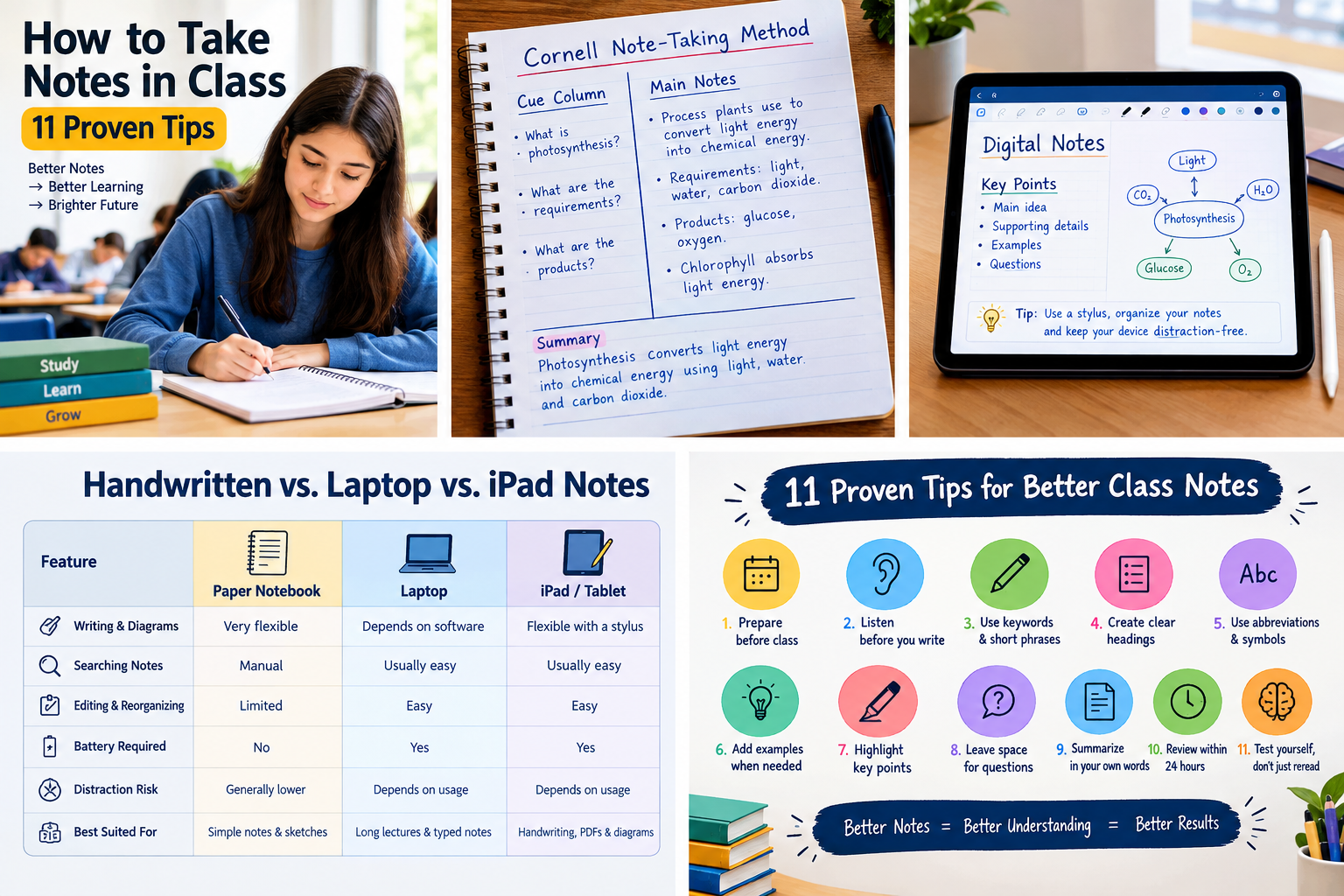
Neither wins outright. Handwriting slows you down in a helpful way, because you must decide what matters before you write it. Digital tools make editing, searching, and sharing easier. Many students do both: they write a first draft by hand, then move it into an app for flashcards and testing.
A Word of Caution on AI Tools
AI chatbots can turn your notes into practice questions in seconds. That’s useful, but always check the results against your textbook and lecture notes. AI can make mistakes, and a wrong fact in your guide is hard to unlearn later.
How to Study a Study Guide and Study Well for Exams
Building the guide is only half the job. Here is how to study a study guide so it pays off, and how to study well for exams in general.
Use Active Recall and Spaced Practice
Read a question, cover the answer, and say it aloud or write it down before you check. This is active recall. Then spread your sessions over several days. The forgetting curve, first described by Hermann Ebbinghaus, shows that we lose new information quickly unless we review it. Short, repeated reviews beat one long session.
Good study skills are mostly habits like these: start early, test yourself, and review in small doses.
Three “Secret” Study Tips That Actually Work
The “3 secret study tips” you see online are usually just proven basics. Here are three that hold up.
First, quiz yourself before you feel ready. Struggling to recall something strengthens memory more than reading it again. Second, teach the topic out loud, even to an empty room. Third, mix topics in one session instead of studying one subject for hours. Mixing feels harder, but it helps you tell similar ideas apart.
How to Study for Exams in One Night
Sometimes you have no choice. If you must study for exams in one night, don’t try to learn everything. Check the syllabus, pick the highest-weight topics, and write the key points on one or two pages. Quiz yourself on those pages, then sleep. Sleep helps your brain store what you just reviewed. This is a rescue plan, not a strategy, but it can help you pass an exam test when time is short.
Common Mistakes to Avoid
Copying the textbook word for word. This creates a long document, not a learning tool.
Making the guide too late. Start one to two weeks before the exam when you can.
Highlighting everything. If everything is marked, nothing stands out.
Skipping practice questions. Recognizing an answer is easier than producing one.
Ignoring weak topics. It’s tempting to review what you already know. Resist that urge.
Comparison Table: Study Guide Formats
Format | Best For | Strengths | Limits
Handwritten outline | Concept-heavy subjects | Slows you down to think, aids memory | Hard to edit or share
Digital doc or PDF | Any subject | Easy to edit, print, and share | Can turn into passive reading
Flashcards (Quizlet, Anki) | Vocabulary, definitions, facts | Built-in quizzing and spacing | Weak for complex essays
Mind map or diagram | Processes, systems, themes | Shows connections clearly | Can get cluttered
Practice question set | Math, science, problem-solving | Mirrors real exam conditions | Takes time to create
FAQ
What is the best way to make a study guide for an exam?
Start with the syllabus, sort your material into topics, and condense each topic into key terms, main ideas, and examples. Then add practice questions and test yourself. The best guides are short, written in your own words, and built for active recall rather than passive reading.
What should be included in a study guide?
Include key terms, definitions, formulas, main ideas, examples, and practice questions. Add a confidence rating for each topic so you know what to review next. Visuals such as charts, timelines, and diagrams help with complex material, as long as they stay simple and clear.
How long should a study guide be?
Aim for about one-fifth to one-third the length of your original notes. For most courses, that means a few pages per unit. If yours is longer, you are probably copying instead of condensing. A shorter guide is easier to review several times before the exam.
How do I prepare for an exam?
Start early, review the syllabus, and build a study guide for each unit. Then test yourself with practice questions and space your sessions over several days. Get enough sleep, especially the night before. Preparation works best when it combines a guide, a schedule, and regular self-testing.
Is Quizlet a good study guide maker?
Yes, it’s a convenient tool for flashcards and quick practice, especially for vocabulary and definitions. Check shared sets for errors, and consider writing your own cards, since creating them is part of the learning. It works best alongside a written guide, not as a replacement.
Can I make a study guide the night before an exam?
You can, but keep it focused. List the highest-weight topics, write the key points on one or two pages, and quiz yourself. Then sleep. A rested brain recalls information better than a tired one that crammed until dawn.
Are study guides better on paper or on a computer?
Both work. Paper encourages careful thinking as you write, while digital tools make editing and quizzing easier. Many students draft by hand, then move the content into an app for flashcards. Choose the format you will actually use every day.
What is the difference between a study guide and notes?
Notes record what happened in class or in your reading. A study guide selects the most important parts and reorganizes them for review. Notes are the raw material, and the guide is the finished tool you use to get ready for the test.
Conclusion
Knowing how to make a study guide for an exam comes down to a simple routine. Gather your material, sort it by topic, condense it in your own words, and turn it into questions you can test yourself on. Add visuals where they help, rate your confidence, and revise after every practice round.
Remember the key points: keep each section short, use a template to stay organized, choose the tool that fits your subject, and spend most of your time on active recall instead of rereading. Today, pick one upcoming exam, copy the template above, and fill in your first unit. That single page is the start of better grades and less stress.penstripe.