






Taking notes in class seems simple until your teacher explains three important ideas while you are still writing the first one. You may leave the classroom with several pages of notes but struggle to remember what the lesson actually meant. The problem is not always your writing speed. Often, it is the way you choose, organize, and review information.
Learning how to take notes in class effectively can help you understand lessons, prepare for exams, and spend less time searching through confusing pages. Instead of copying every word, you can learn to identify key ideas, record useful examples, and connect new information with what you already know.
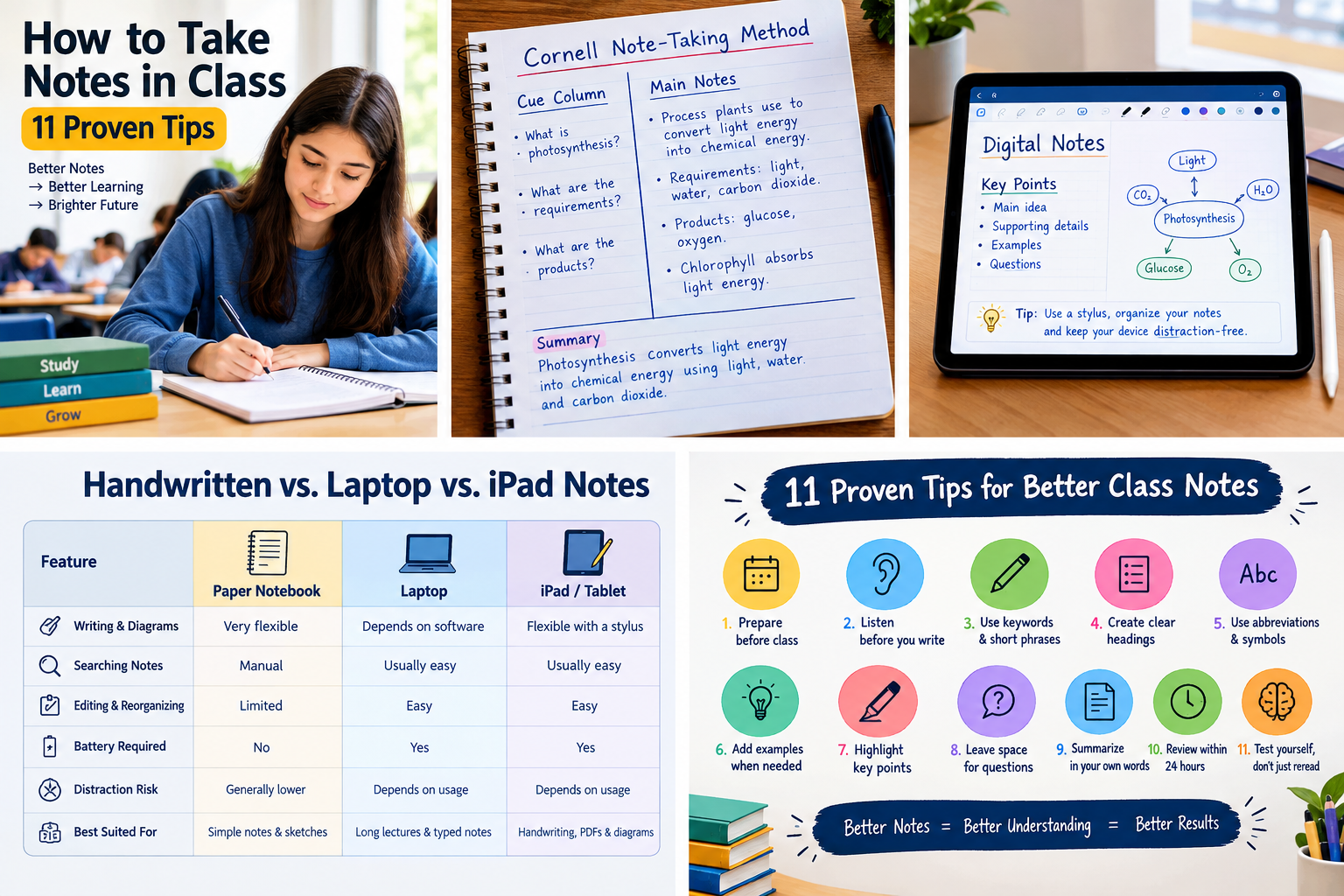
This guide explains 11 practical note-taking strategies for middle school, high school, and college students. You will discover five popular note-taking methods, learn the five R’s of note-taking, compare handwritten and digital notes, and explore tools such as Microsoft OneNote and the iPad. You will also find practical advice for staying focused, taking notes with ADHD, and using AI responsibly.
The goal is simple: create clear, useful notes that help you learn, not just fill a notebook.
1. Understand the Purpose of Effective Note-Taking
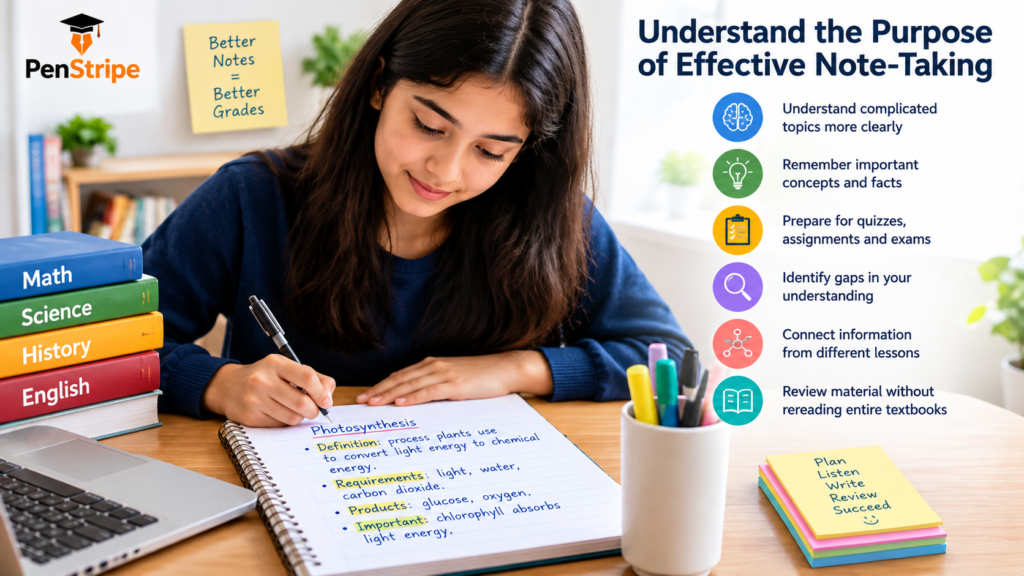
Effective note-taking means selecting and organizing important information so you can understand it, remember it, and use it later. Good notes capture the main ideas, supporting details, examples, and questions that help explain a lesson.
Why Is Taking Notes Important?
Taking notes gives you an active role in learning. Instead of listening passively, you identify important information and organize it in a way that makes sense to you.
Well-organized notes can help you:
- Understand complicated topics more clearly.
- Remember important definitions and concepts.
- Prepare for quizzes, assignments, and exams.
- Identify gaps in your understanding.
- Connect information from different lessons.
- Review material without rereading entire textbooks.
However, taking notes does not automatically guarantee better grades. The benefits depend on how carefully you select information and what you do with your notes afterward.
What Should You Write Down During Class?
Focus on information that explains the lesson’s main ideas. This usually includes definitions, important facts, formulas, examples, comparisons, and steps in a process.
For example, during a biology lesson about photosynthesis, you might record the following:
- Definition: The process plants use to convert light energy into chemical energy.
- Requirements: Light, water, and carbon dioxide.
- Products: Glucose and oxygen.
- Important detail: Chlorophyll absorbs light energy.
This short summary captures the essential concepts without copying an entire textbook paragraph.
Avoid the Trap of Writing Everything
Trying to record every sentence can prevent you from understanding the teacher’s explanation. You may also miss important connections between ideas.
A better approach is to listen first, identify the central point, and then write a short explanation. Use complete sentences when a concept is difficult, but use keywords and phrases for familiar information.
Remember that your notes should support learning. They do not need to reproduce the entire lesson.
2. Learn the 5 Best Methods of Note-Taking
Different subjects and teaching styles require different approaches. The five best methods of note-taking are the Cornell method, outline method, charting method, mind mapping, and sentence method.
What Is the Cornell Note-Taking Method?
The Cornell method divides a page into three sections: a main notes area, a narrow cue column, and a summary section at the bottom.

During class, write the main information in the notes area. After class, add questions or keywords in the cue column. Finish by summarizing the lesson in a few sentences.
This method works particularly well for lecture-based subjects because it combines note-taking with review and self-testing.
For example, your cue column might ask, “What causes photosynthesis?” You can cover the main notes and try answering from memory.
How Does the Outline Method Work?
The outline method organizes information using main headings, subheadings, and supporting details.
Example:
- Causes of climate change
- Greenhouse gas emissions
- Deforestation
- Industrial activities
- Effects
- Rising temperatures
- Changes in weather patterns
- Melting glaciers
This method is useful when a teacher explains a topic in a clear sequence. It also works well for history, literature, and social studies.
Its main limitation is that it can become difficult to follow when the lecture moves rapidly between unrelated topics.
When Should You Use Mind Mapping or Charting?
Mind mapping places the main topic in the center of a page and connects related ideas through branches. It is useful for brainstorming, understanding relationships, and reviewing interconnected concepts.
Charting arranges information into rows and columns. It is especially helpful when comparing several items.
For example, a history student could compare two historical periods using columns for dates, leaders, causes, and outcomes.
The sentence method is another option. Write each important point on a separate line, often using numbers. It can work well during fast lectures, although the notes may need reorganizing afterward.
Which Note-Taking Method Is Best for You?
| Method | Best use | Main advantage | Potential limitation |
|---|---|---|---|
| Cornell | Lectures and revision | Supports active recall | Requires follow-up work |
| Outline | Structured lessons | Easy to scan | Less flexible for rapid topic changes |
| Mind mapping | Connected ideas | Shows relationships | Can become crowded |
| Charting | Comparisons and facts | Makes differences clear | Needs a suitable structure |
| Sentence | Fast lectures | Captures many key points | May lack organization |
You do not need to use the same method for every subject. Start with one method and adjust it according to the lesson.
3. Follow 11 Proven Tips for Better Class Notes
A reliable note-taking routine combines preparation, careful listening, organization, and regular review. These strategies can help students at different educational levels.
1. Prepare Before Class Begins
Spend five to ten minutes reviewing the previous lesson or reading the assigned material. Familiarity with the topic helps you recognize important information when the teacher explains it.
Write down unfamiliar terms and questions before class. This gives you a clear purpose for listening.
2. Listen Before You Write
Avoid treating every spoken sentence as something you must copy. Listen for the main point, then record the information that explains or supports it.
Pay attention when the teacher repeats a concept, defines a term, demonstrates a formula, or explains why something matters.
3. Use Keywords and Short Phrases
Short phrases help you keep pace without losing important meaning.
Instead of writing, “The water cycle describes how water moves between Earth’s surface and the atmosphere,” you could write:
“Water cycle: continuous movement of water between Earth’s surface and atmosphere.”
Keep enough detail to understand the concept later.
4. Create Clear Headings and Subheadings
Write the lesson title at the top of the page. Use headings for major topics and smaller sections for supporting information.
This structure helps you find definitions, examples, and explanations quickly when preparing for an exam.
5. Use Abbreviations and Symbols
Create familiar shortcuts for frequently used words.
| Word or phrase | Shortcut |
|---|---|
| Because | b/c |
| For example | e.g. |
| Important | imp. |
| Increase | ↑ |
| Decrease | ↓ |
| Leads to | → |
Use only abbreviations you can understand later. Unfamiliar shortcuts can make revision more difficult.
6. Record Examples That Explain Difficult Ideas
Examples often make abstract information easier to understand. In mathematics, record a worked problem. In science, note an experiment. In literature, include a short explanation of how a character demonstrates a theme.
One good example can sometimes clarify a concept better than several lines of definition.
7. Highlight Only Essential Information
Use colors or underlining sparingly. You might choose one color for definitions and another for questions that need further review.
Highlighting everything removes the distinction between essential and supporting information. Write meaningful notes first and format them afterward.
8. Leave Space for Questions and Corrections
Leave blank lines between major topics or use the page margin for questions. This gives you room to add missing explanations and correct misunderstandings.
If a teacher explains something too quickly, write a question mark beside the relevant topic and return to it later.
9. Summarize the Lesson in Your Own Words
At the end of class, write two or three sentences explaining the main lesson. This helps you identify the most important ideas and check whether you understand them.
If you cannot explain a concept simply, revisit the relevant section or ask your teacher for clarification.
10. Review Notes Within 24 Hours
Read through your notes soon after class. Correct errors, fill in missing details, and identify anything you still do not understand.
Then close your notebook and recall the main points without looking. This turns a passive reading session into active practice.
11. Test Yourself Instead of Only Rereading
Convert headings into questions, create flashcards, or solve practice problems. Try answering before checking your notes.
For example, change the heading “Causes of World War I” into the question “What were the major causes of World War I?”
Retrieving information from memory helps you discover what you know and what needs further practice.
4. Adapt Your Note-Taking to Different Subjects
The best way to take notes depends partly on the information you are learning. A method that works for a history lecture may not be suitable for a mathematics demonstration.
How to Take Notes for Different Subjects
| Subject | Recommended approach | What to record |
|---|---|---|
| Mathematics | Worked examples and numbered steps | Formulas, calculations, and common errors |
| Science | Headings, diagrams, and process charts | Definitions, experiments, processes, and results |
| History | Timelines and comparison charts | Dates, events, causes, and consequences |
| English | Outline method and quotations | Themes, literary devices, arguments, and examples |
| Economics | Tables and concept maps | Definitions, relationships, graphs, and examples |
Adapt these methods to your teacher’s instructions and the requirements of your course.
How to Take Notes in Class for High School Students
High school students often move between several subjects in a single day. Use a separate notebook, folder, or digital section for each subject.
Write down homework instructions, assignment deadlines, and exam reminders in addition to lesson content. These details are easy to forget when they are mixed into ordinary notes.
After school, spend a short period reviewing the most difficult lesson rather than trying to rewrite every page.
How to Take Notes in Class for Middle School Students
Middle school students can begin with simple methods. Use clear headings, short bullet points, labeled diagrams, and a few familiar abbreviations.
For example, in a geography lesson, record the main definition, three key facts, and one example. Keep the page easy to read.
Building consistent habits at this stage makes it easier to handle longer lectures and more complex subjects later.
How to Take Notes in College
College lectures often cover more information in less time. Students may need to connect lecture material with assigned readings, research papers, and independent study.
Before class, review the topic and prepare a basic outline. During class, prioritize the lecturer’s explanations, important examples, and connections to course readings.
After class, organize incomplete notes and add questions. For technical subjects, include worked examples and the reasoning behind each step instead of recording only the final answer.
5. Choose Between Paper, Laptop, and iPad
Students often ask whether handwriting or digital note-taking is better. Both can be effective, and the right choice depends on the subject, your preferences, and your ability to stay focused.
Handwritten Notes vs. Laptop Notes

Handwritten notes make it easy to draw diagrams, sketch connections, and arrange information freely. Typing can be faster for some students and makes it easier to search, edit, and reorganize material.
A frequently cited study by Mueller and Oppenheimer, published in 2014, found that laptop note-takers tended to transcribe lectures more verbatim, while longhand note-takers often processed and summarized information more. The study does not establish that handwriting is always better for every student or situation.
| Feature | Paper notebook | Laptop | iPad or tablet |
|---|---|---|---|
| Writing and diagrams | Very flexible | Depends on software | Flexible with a stylus |
| Searching notes | Manual | Usually easy | Usually easy |
| Editing and reorganizing | Limited | Easy | Easy |
| Battery required | No | Yes | Yes |
| Distraction risk | Generally lower from apps | Depends on usage | Depends on usage |
| Best suited for | Simple notes and sketches | Long lectures and typed notes | Handwriting, PDFs, and diagrams |
Choose the option that helps you capture information accurately without distracting you from the lesson.
How to Take Notes in Class on an iPad
An iPad can combine handwritten notes, typed text, diagrams, and digital textbooks in one place.
To get started:
- Open a note-taking app before class.
- Create a notebook for the subject.
- Add the lesson title and date.
- Use a stylus for equations and diagrams if helpful.
- Import lecture slides or PDFs when permitted.
- Review and organize your notes after class.
Keep notifications off during lessons and check your school’s device policy. You do not need expensive accessories to take useful notes.
How to Use OneNote to Take Notes in Class
Microsoft OneNote allows students to organize notes into notebooks, sections, and pages. It can be useful when managing several classes or collecting lecture notes and study materials.
Create one notebook for school, then add a section for each subject. Give every page a clear title and date.
During class, record headings and key points. Afterward, add questions, summaries, and relevant material from your course resources. Available features vary by device, app version, and account.
6. Stay Focused and Handle Common Challenges
Even a good note-taking system becomes less effective when you are distracted, tired, or struggling to follow a lecture. Small changes to your routine can make it easier to pay attention.
How Can I Focus 100% on Studying?
Maintaining perfect focus for an entire study session is unrealistic for most people. Instead, aim to reduce distractions and return your attention to the task when it wanders.
Try these steps:
- Put your phone away or silence notifications.
- Choose a seat where you can hear and see the teacher clearly.
- Keep only the materials you need on your desk.
- Write down unrelated thoughts to revisit later.
- Break independent study into manageable sessions.
- Take short breaks when your attention begins to decline.
During class, follow the lesson’s structure and write down questions when you lose track. During revision, test yourself instead of reading the same information repeatedly.
How Do Students With ADHD Take Notes?
Students with ADHD may find it challenging to maintain attention, organize information, or write while listening. Helpful strategies vary from person to person, so there is no single method that works for everyone.
Consider using a preformatted note template, printed lecture slides, short headings, or a digital recorder when recording is permitted. Ask your teacher about guided notes, written instructions, or other appropriate accommodations.
It can also help to mark unclear sections immediately instead of trying to reconstruct an entire lecture later. Students who need additional support can work with a school disability services office or a qualified healthcare professional.
What Should You Do When the Teacher Speaks Too Quickly?
Do not abandon the lesson just to finish copying one sentence. Record the main keyword, write a brief reminder, and continue listening.
After class, compare your notes with permitted course materials or ask a classmate or teacher to clarify the missing information.
The aim is to understand the whole lesson, not to produce a perfect transcript.
7. Use Technology and AI to Improve Your Notes
Digital tools can make organizing and reviewing information easier. However, they work best when they support your own understanding instead of replacing it.
How to Use AI to Take Notes in Class
AI tools can help organize notes, explain difficult concepts, create practice questions, or summarize material you are allowed to share.
A practical workflow is:
- Take your own notes during class.
- Review them and correct obvious errors.
- Use an approved AI tool to organize the material or generate questions.
- Check the output against your textbook and teacher’s instructions.
- Test yourself without looking at the AI-generated answers.
For example, you could ask an AI tool to turn your biology notes into ten practice questions with answers in a separate section.
Do not assume an AI summary is accurate. AI systems can omit important details, misunderstand technical terms, or invent information. Avoid uploading confidential classroom material or personal information without permission.
Can AI Automatically Record and Summarize Lectures?
Some recording and transcription tools can turn spoken material into text and, in supported versions, generate summaries. Their accuracy depends on audio quality, accents, background noise, and the subject matter.
Before recording a lecture, obtain any required permission and follow your school’s policies and applicable laws. Do not record classmates or share their voices without appropriate authorization.
Automatic transcripts are best treated as a supplement to your own notes, not a guaranteed replacement for attending to the lesson.
How to Take Notes Faster From a Textbook or PDF
Textbook notes require a different approach from lecture notes because you can usually return to the source.
First, read the heading and introductory paragraph. Then identify the main claim, supporting evidence, important terms, and examples.
For a PDF, use search and annotation features when available. Write a short summary in your own words rather than copying whole paragraphs.
If you are learning how to make notes from a textbook, try this simple pattern for each section:
- Main idea
- Three important supporting points
- One example or explanation
- One question for review
This structure helps you create organized notes without rewriting the entire chapter.
8. Frequently Asked Questions
1. How to take good notes in class?
Good class notes capture the main ideas, important details, examples, and questions without copying every word. Listen carefully, use clear headings, and write in short phrases when possible. Review your notes soon after class and test yourself to identify missing information. Choose a method that suits the subject.
2. What are the 5 R’s of note-taking?
The five R’s are commonly described as Record, Reduce, Recite, Reflect, and Review. Record important information during class, reduce it to key ideas afterward, recite the concepts from memory, reflect on how they connect, and review them regularly. The exact wording and presentation can vary between educational resources.
3. How can I focus 100% on studying?
Perfect focus is not realistic for everyone, but you can improve concentration by removing distractions, setting a clear goal, and working in manageable sessions. Put your phone away, keep your study materials ready, and use active recall to stay engaged. Take breaks when needed and return to the task when your attention wanders.
4. How do ADHD students take notes in class?
Students with ADHD may benefit from guided notes, structured templates, printed slides, short keywords, or approved recording tools. Breaking information into sections can reduce the pressure of writing everything down. The most helpful approach depends on individual needs, and students may also request suitable educational accommodations.
5. What are the best note-taking methods for college students?
The Cornell method, outline method, charting method, mind mapping, and sentence method are useful options. Cornell notes support review, outlines organize structured lectures, and charts help compare information. College students should choose according to the subject, lecture style, and exam requirements rather than relying on one method for every class.
6. Is taking notes on an iPad better than using paper?
An iPad makes it easy to combine handwriting, typed text, PDFs, and searchable notes. Paper is simple and does not require a battery or apps. Neither option is automatically better for every learner. Choose the format that helps you understand the lesson, stay focused, and review information consistently.
7. Can AI take notes during class?
AI tools can transcribe lectures, summarize permitted recordings, and generate practice questions, depending on the tool and its features. However, transcription errors and inaccurate summaries are possible. Obtain permission before recording, check the results against trusted materials, and continue taking your own notes so you remain engaged with the lesson.
8. How can I take notes faster without missing important information?
Prepare by reviewing the topic before class, then use headings, keywords, familiar abbreviations, and short phrases. Focus on main ideas and record examples that explain difficult concepts. If you miss a detail, mark it for later rather than stopping the lesson. Fill gaps using approved course materials afterward.
Conclusion
Learning how to take notes in class is about more than writing quickly. It means identifying important information, organizing ideas clearly, and reviewing what you learn. The Cornell method, outline method, mind mapping, charting, and sentence method each offer useful ways to capture classroom information.
Start with one simple improvement: listen before writing, summarize the main ideas, or review your notes within 24 hours. Choose paper, a laptop, or an iPad according to your needs, and use technology or AI only when it supports your learning.
Most importantly, test your understanding instead of relying on rereading alone. Try these strategies in your next class and notice which ones help you remember more. Consistent, thoughtful practice can turn ordinary notes into a valuable tool for learning and exam preparation penstripe.