








You open your calendar and see it: exams start in seven days, and you have barely touched your notes. Your stomach drops. Before you panic, know this: a week is short, but it is not hopeless. Students who learn how to study for exams in one week often do better than students who spend a month rereading the same pages, because they study with a plan.
This guide gives you that plan. You will learn whether one week is enough, how to set up your days, and what to do on each of the seven days. You will also get proven methods for remembering what you study, ways to stay focused, and clear steps for tougher situations like several exams in a single week or a whole semester of material. Follow the plan, stay honest about your time, and you can walk into the exam room prepared.
Is 1 Week of Studying for the Exam Enough?

Short answer: for most exams, yes, one week can be enough to pass and often enough to score well, if you study the right material in the right way. It is rarely enough to master a subject you have ignored all term, and that is fine. Your goal this week is to earn the best grade possible from the time you have.
What Students on Reddit Ask: Is 1 Week Enough to Study for Exams?
Search for “is 1 week enough to study for exams reddit” and you will find the same pattern. Students who had some exposure to the course say yes. Students starting from zero on a heavy subject like organic chemistry or advanced math say it is tight. Both groups agree on one thing: how you spend the week matters more than how many hours you log. Aimless rereading fails. Focused practice works.
When One Week Works (and When It Doesn’t)
One week works well when:
- You attended most classes or have decent notes.
- The exam tests understanding of a defined syllabus.
- You can study three to six focused hours a day.
One week is risky when:
- The course is cumulative and builds on earlier topics you never learned.
- You are juggling several exams at once.
- The exam relies on long practical skills, like lab work or essay writing, that need repeated practice.
In the risky cases, you still have options. The plan below shows you how to prioritize.
Set a Realistic Goal Before Day One
Many students search “how to get 100% on a test?” The honest answer is that a perfect score depends on the exam, your starting point, and a bit of luck. A better target is to pass with confidence and aim for your best grade. If you want to know how to pass an exam test in a short window, focus on the topics that carry the most marks first. A solid 85 percent beats an exhausted attempt at 100 percent.
How to Set Up Your Week Before You Start

Spend the first hour planning. It feels like lost time, but it saves you from wasting the next six days.
Build Your Study Space for How to Study for Exams in One Week at Home
If you are studying at home, protect your environment. Choose one table, not your bed. Keep water, a notebook, and a timer within reach. Put your phone in another room or inside a bag. Tell the people you live with when you need quiet. A fixed spot trains your brain to switch into study mode faster.
Map the Syllabus and Rank Every Topic
Write down every topic the exam covers. Then label each one:
- A: High marks and you understand little of it.
- B: High marks and you know it partly.
- C: Low marks or you already know it well.
Study the A topics first, then B, then C. Check your course outline, teacher hints, and past papers to see which topics appear most often. This simple ranking is the biggest time-saver in the whole week.
How Many Hours Should You Study for a Test in High School?
There is no official rule, but a practical guide works well. A high school student can usually manage four to six focused hours a day during exam week, while a college student may handle five to seven. Split that time into blocks of 45 to 60 minutes with 10 minute breaks. Quality counts more than quantity. Three hours of active practice beat six hours of staring at a page.
How to Study for a Test by Yourself
Studying alone is perfectly fine if you add structure. Set a daily goal, such as “finish chapters 3 and 4 and answer 20 practice questions.” Check your work against answer keys. Explain topics out loud as if you were teaching a friend. If you get stuck on a concept, write the question down and look it up later instead of letting it eat your hour.
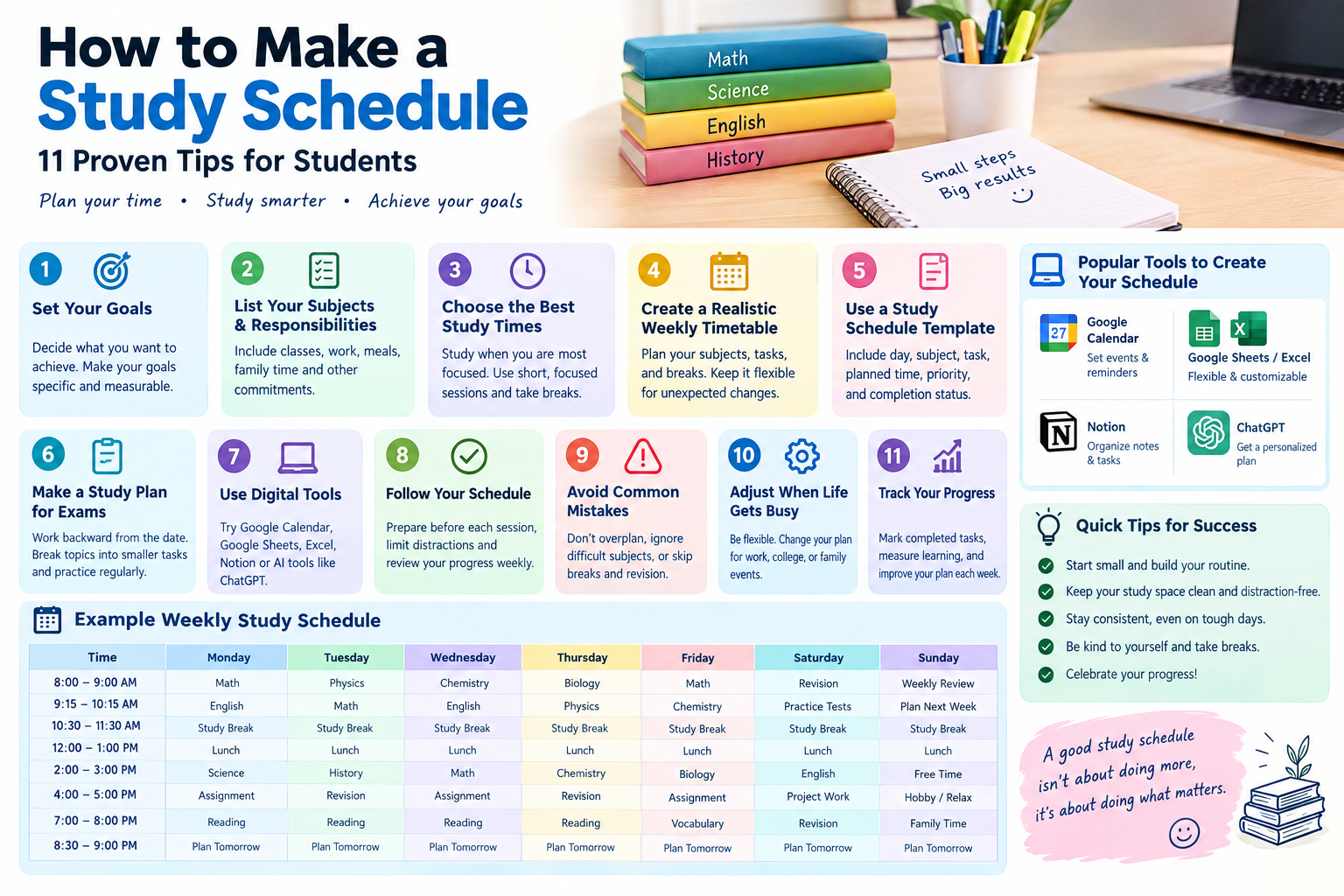
How to Study for Exams in 7 Days at Home: The Day-by-Day Plan
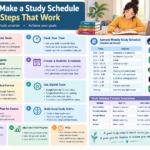
Here is a simple week you can adapt. Adjust the hours to your schedule, but keep the order.
Days 1 and 2: Learn the Core Material
Start with your A topics. Read your notes or textbook sections once, slowly, and create a one-page summary for each topic. Use short bullet points, formulas, definitions, and examples. Do not copy the book. Rewrite ideas in your own words. At the end of each day, close your notes and write down everything you remember.
Days 3 and 4: Practice and Fix Weak Spots
Now switch from reading to testing. Answer practice questions, past paper questions, or end-of-chapter problems. Mark your mistakes and write a short note on why you got each one wrong. Then study that gap directly. Move on to your B topics and repeat the same steps.
Days 5 and 6: Test Yourself Under Real Conditions
Sit a full practice paper with a timer, no notes, and no phone. Mark it, review your errors, and repeat for any weak sections. On Day 6, go through your one-page summaries and quickly cover your C topics. This is also the day to prepare what you need for the exam itself, such as pens, calculator, ID, and travel plans.
Day 7: Light Review and Rest

Do not cram new material. Spend one or two hours scanning your summaries and flashcards, then stop. Eat a proper meal, pack your bag, and go to bed early. Your brain stores what you learned while you sleep, so rest is part of studying.
Here is the week at a glance:
| Day | Main Focus | Suggested Hours |
|---|---|---|
| Day 1 | Plan and learn A topics | 4 to 6 |
| Day 2 | Learn A topics and summarize | 4 to 6 |
| Day 3 | Practice questions, start B topics | 4 to 6 |
| Day 4 | Fix weak spots, finish B topics | 4 to 6 |
| Day 5 | Full timed practice paper | 4 to 5 |
| Day 6 | Review summaries, cover C topics | 3 to 4 |
| Day 7 | Light review, rest, prepare | 1 to 2 |
What Is the Best Way to Study for Exams in a Week?
The best way to study for exams in a week is to replace passive reading with active methods. Research on learning techniques, including a well-known review by Dunlosky and colleagues, ranked practice testing and spaced practice among the most effective strategies. It ranked highlighting and rereading among the least effective.
Active Recall
Active recall means pulling information out of your memory instead of looking at it. Cover your notes and ask yourself a question. Write the answer from memory, then check it. This feels harder than rereading, and that difficulty is what builds memory.
Spaced Repetition Inside One Week
You do not need months for spacing to work. Review a topic on the day you learn it, again two days later, and once more before the exam. Flashcard apps can schedule this for you, or you can use a simple paper system with three piles.
How to Study for a Test and Remember It
If you want to know how to study for a test and remember what you learned, combine three habits. Test yourself often, explain ideas out loud, and connect new facts to things you already know. For lists and terms, use short stories or mental pictures. Review right before sleep, because that review tends to stick.
3 Secret Study Tips
These are not magic, but most students skip them:
- Teach it. Explain a topic to a friend, a family member, or an empty chair. Gaps show up quickly.
- Study your mistakes. Keep an error log. Your wrong answers show exactly where your marks are hiding.
- Start with the hard stuff. Do your hardest topic while your energy is highest, usually in the morning.
Here is how common methods compare:
| Method | Effort | Effectiveness | Best For |
|---|---|---|---|
| Rereading notes | Low | Low | Quick familiarity only |
| Highlighting | Low | Low | Marking key points before summarizing |
| Summary sheets | Medium | Medium | Organizing topics |
| Flashcards with recall | Medium | High | Definitions, formulas, vocabulary |
| Practice tests | High | High | Almost every exam |
| Teaching aloud | Medium | High | Understanding concepts |
How Can I Focus 100% on Studying?
Perfect focus is not realistic, but you can get close with the right habits. Here is how to focus on studying without burning out.
Use Timed Study Blocks
Try the Pomodoro method: 25 minutes of work, then a 5 minute break. After four rounds, take a longer 20 minute break. A timer gives your brain a clear finish line, which makes it easier to start.
Remove Distractions Before They Appear
Turn off notifications, close extra browser tabs, and keep your phone out of reach. If you must use a device, install a site blocker. Decide in advance when you will check messages, such as during breaks only.
Protect Your Sleep, Food, and Energy
Sleep is not a luxury during exam week. Teens generally need 8 to 10 hours and adults 7 to 9. Eat regular meals, drink water, and take a short walk each day. A tired brain learns slowly and forgets quickly.
How to Handle Tough Situations
Not every week looks the same. Here is how to adjust.
How to Study for 3 Exams in One Week
If you need to know how to study for 3 exams in one week, divide your time by exam difficulty and date, not equally. Study the earliest or hardest exam first, and rotate subjects each day so none go cold. The same method works for two exams, four exams, or even five exams in one week. For five, plan shorter blocks of 60 to 90 minutes per subject and rely heavily on summary sheets and flashcards.
How to Study a Whole Semester in One Week
To study a whole semester in one week, you cannot learn everything. Collect the syllabus, lecture slides, and past papers. Identify the big themes, then study the most tested ideas first. Use outlines, diagrams, and practice questions rather than reading every page. Accept that some small details will be left out.
How to Study for Board Exams in One Week
Board exams are broad, so focus on high-weight chapters and previous papers. Solve at least two or three past papers under timed conditions. Memorize formulas, key dates, and definitions using flashcards. Keep your plan realistic and avoid new reference books this late.
Exam in 3 Days or 1 Day Before: Emergency Plans
If you only have three days, skip the learning phase and go straight to your A topics, summary sheets, and practice questions. If you are wondering how to study for an exam one day before, or how to prepare for exams in one day, work in short cycles: skim, recall, test, review. Sleep at least six hours. Walking in rested beats staying up all night.
Frequently Asked Questions
Is 1 week of studying for the exam enough?
Yes, for many exams it is enough to pass and sometimes to score well. Success depends on your starting knowledge, the course difficulty, and how you study. Focus on high-mark topics, practice with past papers, and avoid passive rereading. For heavy, cumulative subjects, one week may only cover the basics.
What is the best way to study for exams in a week?
Use active recall, practice tests, and short daily review sessions. Rank topics by marks and difficulty, study the hardest first, and test yourself often. Create one-page summaries and review them each day. This combination builds memory faster than rereading or highlighting.
How many days should I start studying before an exam?
Ideally, start two to four weeks before. If you only have a week, begin today and follow a day-by-day plan. Early starts allow spaced review, but even short, focused preparation can help. The key is to start with a clear schedule rather than waiting for perfect conditions.
How many hours should you study for a test in high school?
Most high school students can handle four to six focused hours per day during exam week. Break the time into 45 to 60 minute blocks with short breaks. Adjust for your schedule and energy. Short, active sessions work better than long, tired ones.
How can I focus 100% on studying?
You cannot be perfectly focused all the time, but you can improve a lot. Use timed study blocks, silence your phone, and keep your workspace clear. Start with your hardest task and take breaks. Good sleep and regular meals also make concentration easier.
How to get 100% on a test?
There is no guaranteed method, but you can improve your chances. Learn the syllabus, practice with past papers, review mistakes, and sleep well. Read each question carefully during the exam and check your work if time allows. Aim for strong understanding, not perfection.
How to study for a test and remember what you learned?
Test yourself instead of rereading. Explain concepts out loud, use flashcards, and review at spaced intervals. Link new ideas to what you already know. Reviewing before sleep also helps your brain store information, which makes recall easier during the exam.
How to study for exams in 7 days at home?
Make a plan on Day 1, learn core topics on Days 1 and 2, practice on Days 3 and 4, take timed tests on Days 5 and 6, and rest on Day 7. Study in a quiet spot, remove distractions, and review your mistakes every day.
Conclusion
Learning how to study for exams in one week comes down to a few clear choices. Rank your topics, learn the highest-value material first, then practice with real questions and review your mistakes. Use active recall and spaced review, protect your sleep, and keep distractions away. Whether you are working alone, studying at home, or facing several exams, a simple plan beats panic every time.
Your next step is easy. Take ten minutes today, write down your syllabus, label each topic A, B, or C, and block out your seven days. Start with Day 1 right now, and trust the process penstripe.

One thought on “How to Study for Exams in One Week: 7-Day Plan”