





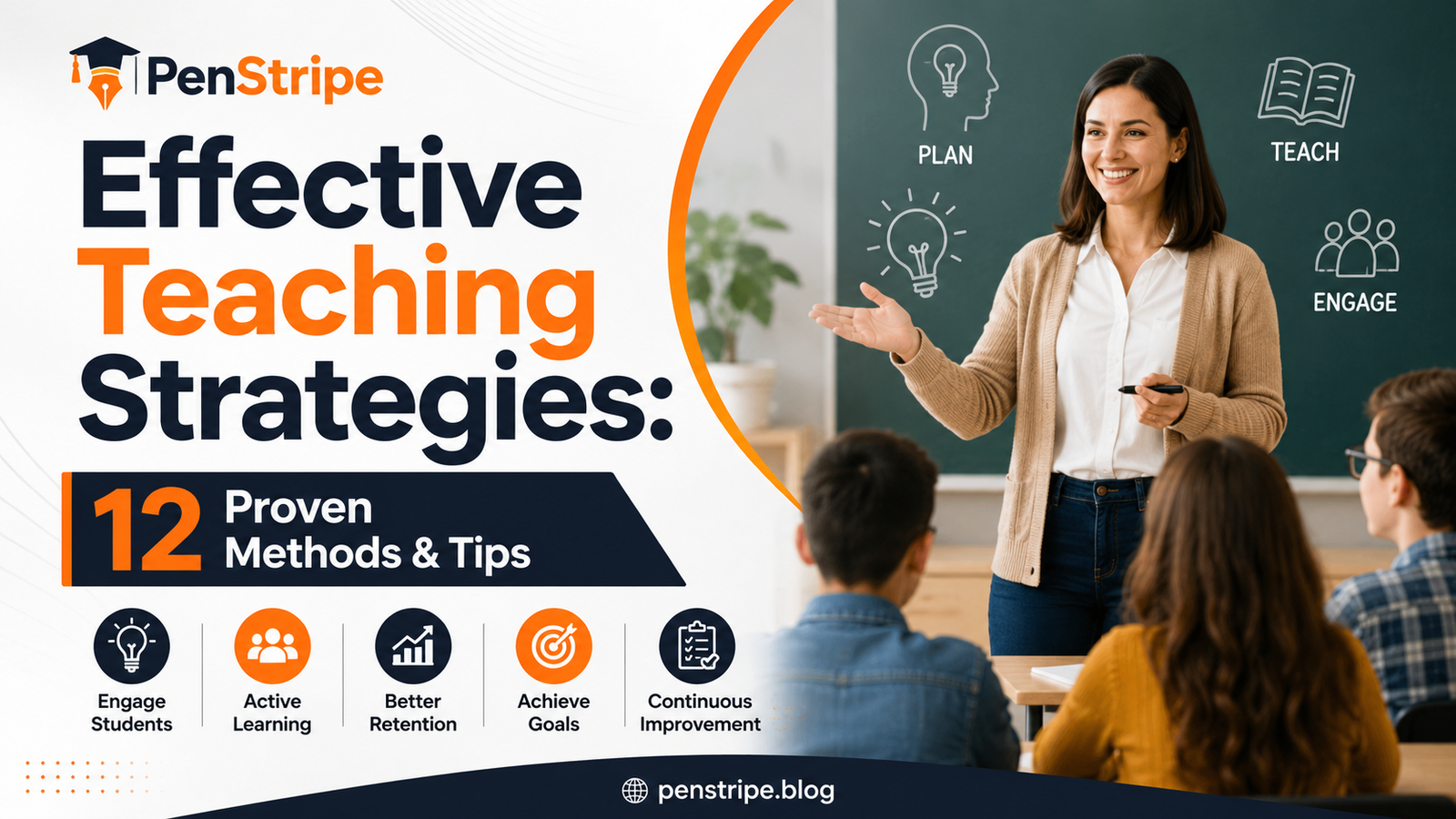
Every teacher has stood in front of a classroom and watched a lesson land perfectly with one group of students, only to see the same lesson fall flat with another. That gap is rarely about effort. It’s about strategy. Effective teaching strategies are the deliberate choices teachers make about how information is presented, how students engage with it, and how learning is checked and reinforced along the way.
Teaching strategies matter because they directly shape how much students understand, remember, and can apply. A brilliant lesson plan delivered with the wrong strategy for the room can lose students in minutes; the right strategy, matched to the content and the class, can turn a difficult topic into something students genuinely grasp.
Effective teaching draws on four connected layers: a broader teaching methodology (the philosophy behind instruction), specific teaching methods (how a lesson is delivered), classroom strategies (how learning is supported), and day-to-day techniques (the small, practical moves teachers use in the moment). This guide walks through what effective teaching strategies actually look like, why they matter, the most reliable strategies to use, and how to choose, apply, and measure them in a real classroom.
What Are Effective Teaching Strategies?
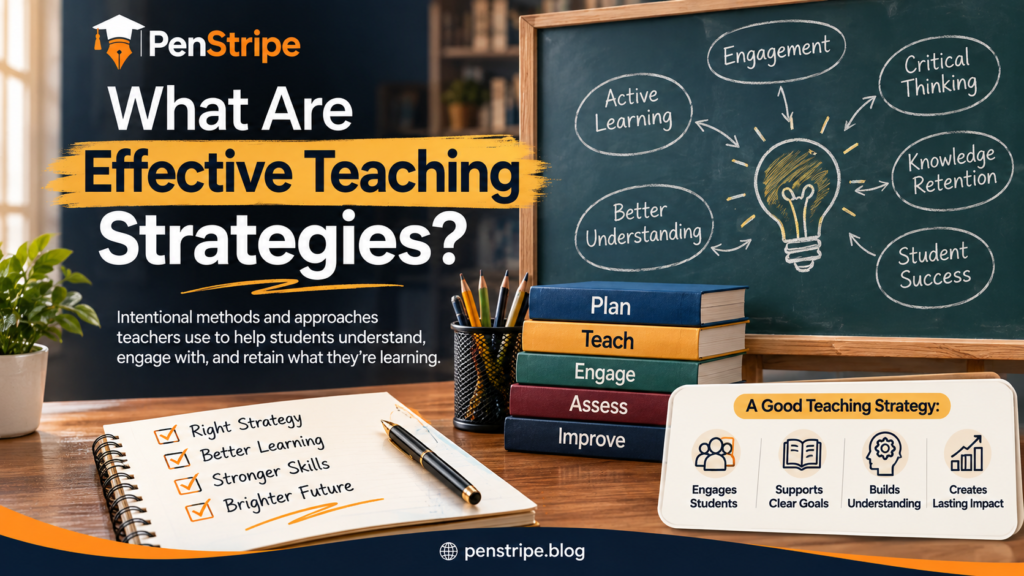
Effective teaching strategies are the intentional methods and approaches teachers use to help students understand, engage with, and retain what they’re learning. They are not a rigid script. Instead, they’re a toolkit, a set of approaches a teacher selects and adapts based on the lesson’s goals, the students in the room, and the subject being taught.
At their core, teaching strategies exist to support the learning process. They help translate a curriculum objective into something students can actually experience, practice, and remember. A well-chosen strategy doesn’t just deliver information; it creates the conditions for students to process that information actively rather than passively.
One of the most important things to understand about teaching strategies is that no single approach works for every classroom, every subject, or every student. A strategy that works beautifully for a hands-on science lesson may not translate well to a literature discussion. A technique that keeps ten-year-olds engaged may fall flat with teenagers. This is exactly why effective teachers build a repertoire of strategies rather than relying on one default approach and why adapting strategies to the specific mix of students, content, and learning objectives is a defining trait of strong teaching.
What Makes a Teaching Strategy Effective?
Not every strategy that looks good on paper actually works in practice. A handful of characteristics separate strategies that genuinely support learning from those that simply keep students occupied.
- Student engagement. Effective strategies pull students into the material rather than letting them sit passively at the edges of a lesson.
- Clear learning objectives. The strategy is chosen because it serves a specific goal, not because it’s familiar or easy to plan.
- Active participation. Students do something with the content — discuss it, apply it, question it, or create with it.
- Meaningful feedback. The strategy creates natural opportunities for students to learn what they’re doing well and what needs adjustment.
- Assessment and progress monitoring. Teachers can see, in real time or shortly after, whether the strategy is working.
- Adaptability. The strategy can flex for different ability levels, group sizes, and learning environments without losing its core value.
When a strategy checks these boxes, it tends to produce learning that sticks, not just activity that fills class time.
Why Are Effective Teaching Strategies Important?
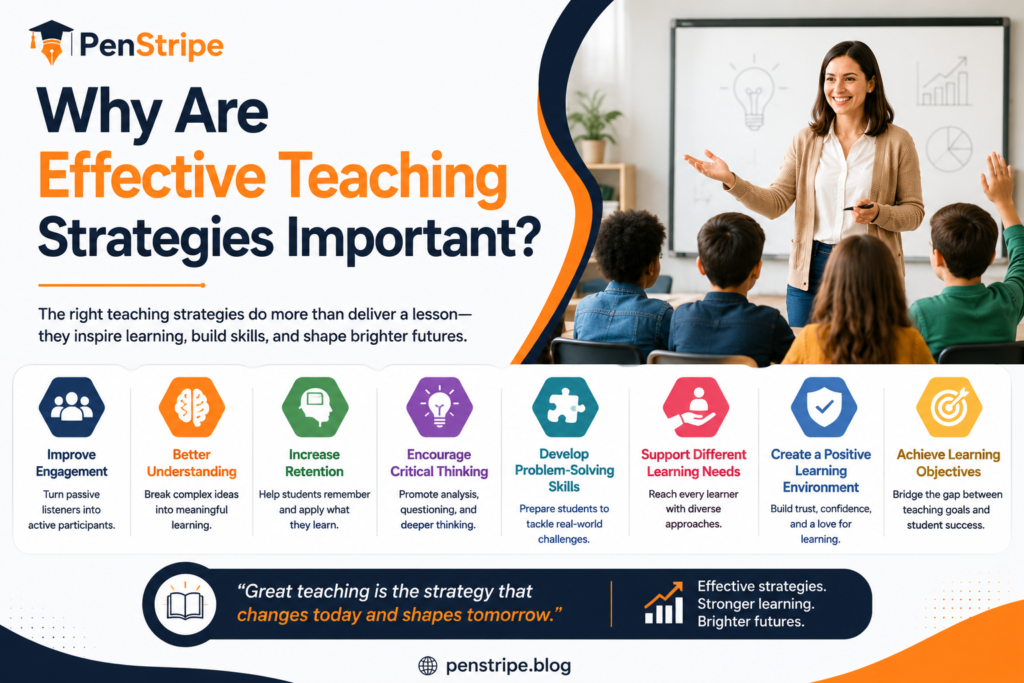
The strategies a teacher chooses shape far more than a single lesson. Over time, they influence how students feel about learning itself.
- Improve student engagement. The right strategy turns passive listening into active participation.
- Support better understanding. Well-matched strategies break down complex ideas into forms students can actually process.
- Increase knowledge retention. Strategies that involve practice, application, and repetition help information move from short-term to long-term memory.
- Encourage critical thinking. Strategies built around questioning, analysis, and problem-solving push students beyond memorization.
- Develop problem-solving skills. Real-world and inquiry-based strategies give students practice tackling ambiguous, multi-step problems.
- Support different learning needs. A varied strategy toolkit allows teachers to reach visual, auditory, kinesthetic, and mixed learners alike.
- Create a positive learning environment. Strategies that involve collaboration and constructive feedback tend to reduce anxiety and build classroom trust.
- Help teachers achieve learning objectives. Ultimately, strategy is the bridge between what a curriculum asks for and what students actually walk away knowing.
Teaching and Learning Methodology
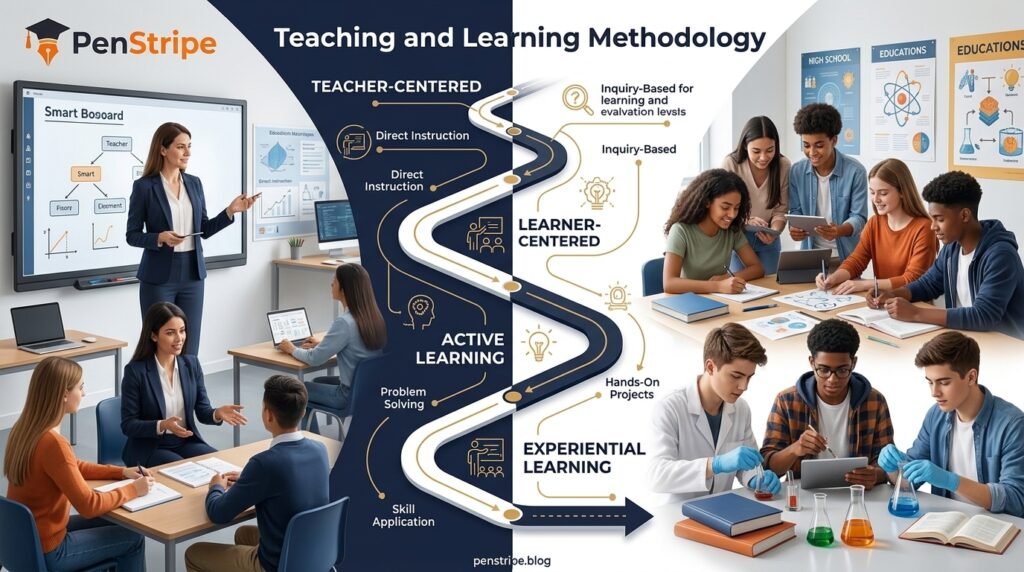
Before diving into specific strategies, it helps to understand the layer above them: methodology. “Teaching and learning methodology” refers to the broader philosophy or framework that shapes how instruction happens, the underlying approach a teacher or institution takes toward how learning occurs, not just the individual tools used to support it.
Teaching and learning are deeply connected. Methodology describes how a teacher believes students learn best, and that belief shapes every choice that follows, from lesson structure to assessment style. Broadly, methodologies fall along a spectrum between teacher-centered approaches, where the teacher is the primary source of information and direction, and learner-centered approaches, where students take a more active role in constructing their own understanding.
Active and experiential approaches, where students learn by doing rather than only listening, have become increasingly central to modern methodology, particularly as research continues to reinforce that learning by application tends to outperform learning by passive reception alone. Selecting a methodology isn’t a one-time decision; it should be guided by the learning goals of a course, the age and needs of the students, and the nature of the subject itself.
Different Teaching Methods
Sitting just below methodology are teaching methods, the specific delivery approaches a teacher uses to actually run a lesson. A teaching method is the “how” of instruction: the structural format a lesson takes.
It’s worth distinguishing a teaching method from a teaching strategy. A method is the overall delivery format (a lecture, a discussion, or a lab experiment), while a strategy is a more targeted technique used to support learning within or around that method (questioning, scaffolding, or formative checks). In other words, methods shape the container; strategies shape what happens inside it.
Some of the most common teaching methods include:
- Lecture / direct instruction: teacher-led explanation of content
- Discussion: structured conversation that builds understanding collaboratively
- Demonstration: showing a process, skill, or concept in action
- Inquiry-based learning: students investigate questions and draw conclusions
- Project-based learning: extended, applied work built around a real output
- Collaborative learning: students work together toward a shared goal
- Experiential learning: learning through direct, hands-on experience
Most effective teachers don’t rely on a single method. They combine several within a unit, perhaps opening with direct instruction, moving into collaborative discussion, and closing with a project, because different methods serve different parts of the learning process.
Teaching Strategies and Techniques
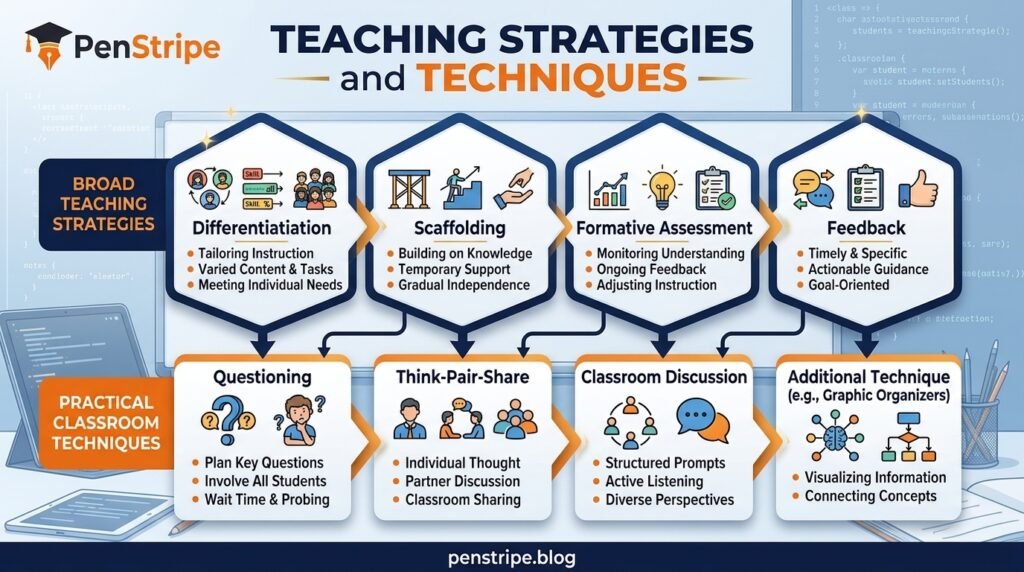
Within any teaching method, strategies and techniques are what actually make learning happen moment to moment. A teaching strategy is a deliberate approach used to support how students process and retain information. A technique is even more granular, a specific, practical action a teacher takes in the classroom to execute that strategy.
The distinction matters: a strategy might be “checking for understanding throughout a lesson,” while the technique used to do that could be a quick poll, a thumbs-up/thumbs-down check, or a one-minute written response. Strategies set the intention; techniques carry it out.
Common classroom strategies and techniques include:
- Questioning: using open-ended and probing questions to deepen thinking
- Scaffolding: breaking complex tasks into supported, incremental steps
- Differentiation: adjusting content, process, or output for different learners
- Feedback: giving students specific, actionable information about their work
- Formative assessment: checking understanding during, not just after, learning
- Think-pair-share: students think individually, discuss in pairs, then share with the class
- Classroom discussion: structured dialogue that surfaces and refines student thinking
12 Most Effective Teaching Strategies
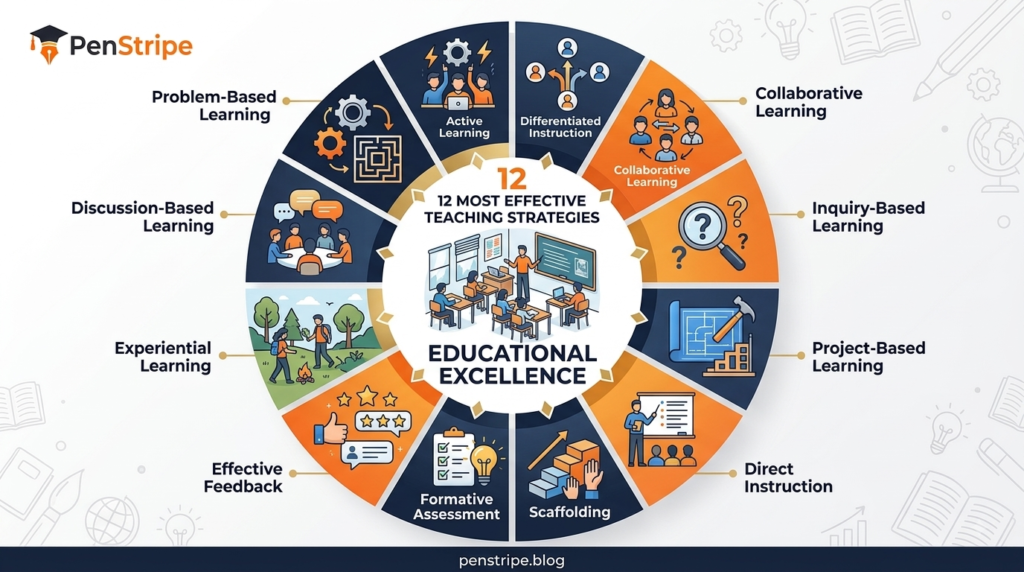
These twelve strategies form the core toolkit most educators return to again and again. Each one supports learning in a different way, and most classrooms benefit from a mix of several rather than reliance on just one.
1. Active Learning
Active learning shifts students from passive listeners to active participants. Instead of simply receiving information, students engage with it directly, through discussion, problem-solving, writing, or hands-on tasks. Examples include short in-class writing prompts, live polling, group problem-solving, peer teaching, and interactive demonstrations. Students remember far more of what they do than what they merely hear.
2. Differentiated Instruction
Differentiated instruction adapts teaching to the different readiness levels, interests, and learning profiles present in any classroom, adjusting along three dimensions: content (what students learn), process (how they engage with it), and assessment (how they demonstrate learning). This might look like tiered reading passages, varied task complexity, or flexible output formats for the same objective.
3. Collaborative Learning
Collaborative learning uses pair and group work to build understanding socially. Students explain ideas to each other, challenge each other’s thinking, and construct knowledge together. Explaining a concept to someone else is one of the fastest ways to solidify your own understanding of it. Group projects, peer review, and structured team tasks all fall under this strategy.
4. Inquiry-Based Learning
Inquiry-based learning starts with a question rather than an answer. Students investigate, gather evidence, and draw their own conclusions, with the teacher acting more as a guide than a source of direct answers, building curiosity and critical thinking by practicing the actual process of discovery.
5. Project-Based Learning
Project-based learning organizes instruction around an extended, meaningful project rather than isolated lessons. Students apply multiple skills toward a real, often open-ended, output. Because the learning is applied and purposeful, this tends to produce stronger retention and transfer of skills to new situations.
6. Direct Instruction
Direct instruction is structured, teacher-led explanation and demonstration. It remains one of the most efficient ways to introduce new or foundational content clearly and consistently, especially useful when students have little prior knowledge, when a concept requires precise step-by-step explanation, or when time is limited.
7. Scaffolding
Scaffolding breaks a complex skill or concept into smaller, manageable steps, with the teacher providing support that gradually decreases as students build competence. This might look like modeling a task first, guiding students through it together, then having them attempt it independently.
8. Formative Assessment
Formative assessment checks understanding during the learning process, not just at the end. Common tools include short quizzes, targeted questioning, classroom observation, and exit tickets, giving teachers real-time insight to adjust instruction before gaps widen.
9. Effective Feedback
Effective feedback is specific, timely, and actionable; it tells students not just what was wrong, but what to do about it. Rather than a general “good job,” it points to a specific strength to build on and a specific next step, giving students a clear path forward.
10. Experiential Learning
Experiential learning teaches through direct practice and experience rather than abstract explanation. Labs, simulations, role-play, fieldwork, and real-world tasks engage multiple senses and tend to produce deeper, more durable understanding.
11. Discussion-Based Learning
Discussion-based learning asks students to articulate, defend, and refine their own thinking out loud rather than simply receiving conclusions. Open-ended and higher-order questions are essential; they push students past recall and into analysis, evaluation, and synthesis.
12. Problem-Based Learning
Problem-based learning centers instruction around a real or realistic problem, often without a predetermined solution path. Students draw on multiple skills and pieces of knowledge simultaneously, practicing navigating ambiguity, much as they would outside the classroom.
How to Choose the Right Teaching Strategy
Consider the learning objective. Is the goal recall, skill-building, application, or critical thinking? Direct instruction suits recall goals; problem-based learning suits critical-thinking goals.
Consider your students. Age, ability level, prior knowledge, and specific learning needs all shape which strategies land well.
Consider the subject. Some subjects naturally suit certain strategies: lab-based experiential learning for science, discussion-based learning for literature.
Consider the learning environment. Classroom, online, hybrid, or one-on-one settings all change which strategies are practical.
Consider available resources. Time, technology, materials, and class size place real constraints on what’s feasible.
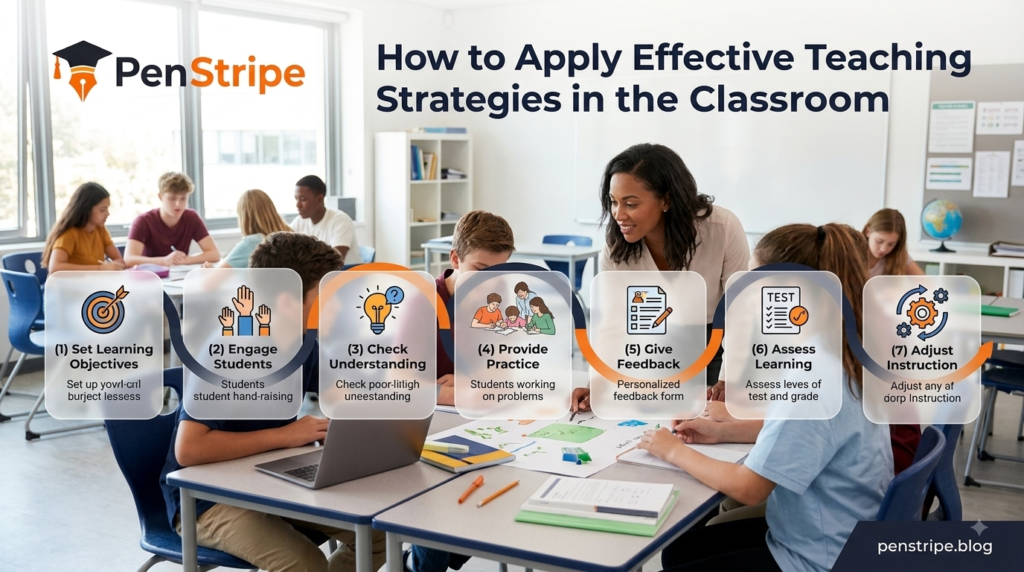
How to Apply Effective Teaching Strategies in the Classroom
- Set clear learning objectives: every strategy should serve a defined goal, not just fill time.
- Introduce the topic effectively: a strong hook sets the stage for whatever follows.
- Keep students actively involved: build in moments where students must respond or contribute.
- Use questions to check understanding: throughout the lesson, not just at the end.
- Provide examples and demonstrations: make abstract concepts tangible.
- Give students opportunities to practice: turn understanding into applied skill.
- Provide constructive feedback: help students correct course early.
- Assess student learning: confirm the strategy actually achieved its objective.
- Adjust instruction when necessary: adapt in real time based on how the lesson is landing.
Effective Teaching Strategies for Different Learning Needs
Strategies for young learners: visual resources, hands-on activities, and short interactive lessons.
Strategies for struggling students: scaffolding, additional guided practice, individual support.
Strategies for advanced students: enrichment, independent projects, and higher-order thinking tasks.
Strategies for online students: interactive lessons, digital collaboration tools, and regular assessment and feedback.
How Technology Can Support Effective Teaching
Technology doesn’t replace teaching strategy, but used well, it amplifies it. Interactive learning tools, digital presentations, and educational videos make abstract concepts more concrete. Online quizzes and learning management systems make formative assessment faster to track over time. Collaborative digital platforms extend group work beyond the physical classroom. The key is intentionality: technology should serve a specific learning purpose, not be used simply because it’s available.
How to Measure the Effectiveness of a Teaching Strategy
- Student achievement: are learning objectives being met?
- Student engagement: active participation or passive motion?
- Knowledge retention: does understanding persist days or weeks later?
- Classroom participation: is it broad or concentrated among a few?
- Quality of student work: has depth, accuracy, or creativity improved?
- Student feedback: what do students themselves say helped them?
- Teacher reflection: what would you adjust next time?
Common Challenges When Using Teaching Strategies
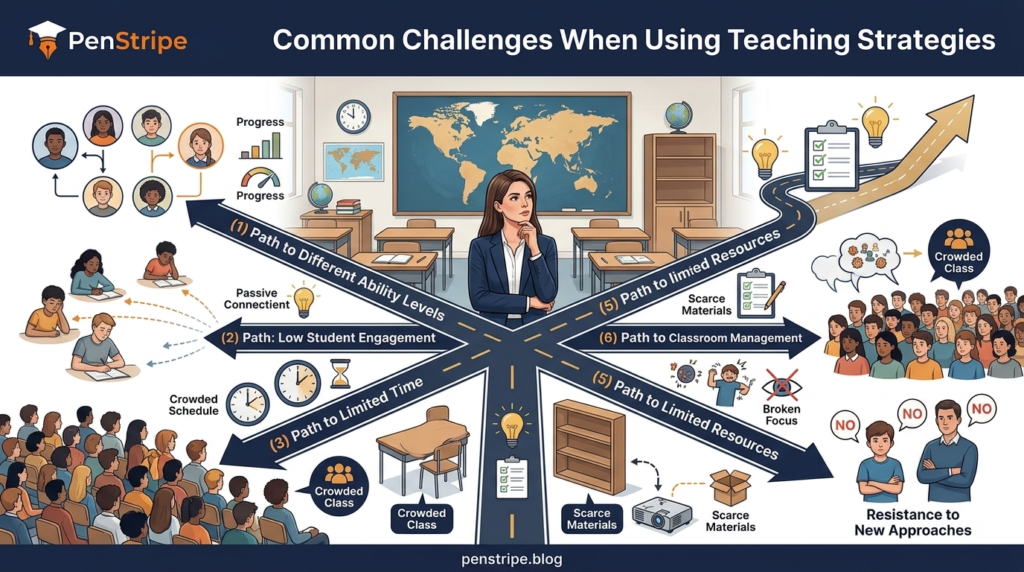
- Different ability levels → combine differentiation with flexible grouping.
- Low engagement → rotate strategies and build in frequent short active-learning moments.
- Limited time → prioritize strategies that double as assessment.
- Large class sizes → lean on structured group work and peer collaboration.
- Limited resources → favor low-tech, high-impact strategies like discussion and scaffolding.
- Classroom management → choose strategies with clear structure and defined roles.
- Resistance to new approaches → introduce gradually, explain the purpose, give it time.
Effective Teaching Strategies vs. Teaching Methods
| Teaching Strategies | Teaching Methods |
| Focus on how learning is supported | Focus on how instruction is delivered |
| Can include multiple techniques | Provides a broader instructional approach |
| Adaptable to different situations | Often defines the overall teaching approach |
| Examples: scaffolding, feedback | Examples: lecture, discussion, demonstration |
These aren’t competing concepts; they work together. Methodology sets the philosophy, methods define the delivery format, strategies support learning within that format, and techniques carry it out moment to moment.
Effective Teaching Strategies Checklist
- Define the learning objective
- Understand student needs
- Select an appropriate method
- Choose supporting strategies
- Keep students engaged
- Check understanding
- Provide feedback
- Assess learning
- Reflect and improve
Frequently Asked Questions
What are effective teaching strategies?
Intentional approaches teachers use to help students engage with, understand, and retain what they’re learning, chosen based on the lesson’s objective and students’ needs.
What are the most effective teaching strategies?
Active learning, differentiated instruction, collaborative learning, inquiry-based learning, scaffolding, and formative assessment, among others, benefit most classrooms from combining several.
What makes a teaching strategy effective?
It engages students actively, aligns with a clear objective, includes meaningful feedback, and adapts to different students and situations.
What is the difference between teaching methods and strategies?
A method is the overall delivery format (lecture, discussion); a strategy is a targeted approach supporting learning within that format.
What is teaching and learning methodology?
The broader philosophy shaping how instruction is approached, ranging from teacher-centered to learner-centered models.
How do teachers choose the right teaching strategy?
By weighing the learning objective, student needs, subject matter, environment, and available resources.
How can effective teaching strategies improve student learning?
They increase engagement, deepen understanding, improve retention, and build critical thinking and problem-solving skills.
What teaching strategies increase student engagement?
Active, collaborative, discussion-based, and inquiry-based learning, since they require participation rather than observation.
Conclusion
Effective teaching isn’t built on one universal method that works everywhere, for everyone, every time. It’s built on a teacher’s ability to read a room, understand a learning objective, and choose the right combination of methodology, method, strategy, and technique to fit the moment. Methodology sets the philosophy. Methods define the delivery. Strategies support the learning process. Techniques carry it out day by day. The most effective teachers keep evaluating what’s working, stay willing to adapt, and keep building a wider, more responsive toolkit over time.