





Every experienced teacher has a mental toolbox they reach into without even thinking about it: a question to re-engage a distracted student, a quick check to see who’s actually following along, a way to break down a concept that just isn’t landing. That toolbox is made up of teaching strategies and techniques, and building it deliberately, rather than by accident, is what separates good teaching from great teaching.
This guide breaks down exactly what teaching strategies and techniques are, how they differ, the most effective ones you can use starting tomorrow, and how to combine them into a system that actually works for your classroom. Whether you’re studying for a B.Ed exam, prepping a PPT for a training session, or simply trying to reach a class that’s losing interest, you’ll find clear, usable answers here.
What Are Teaching Strategies and Techniques?

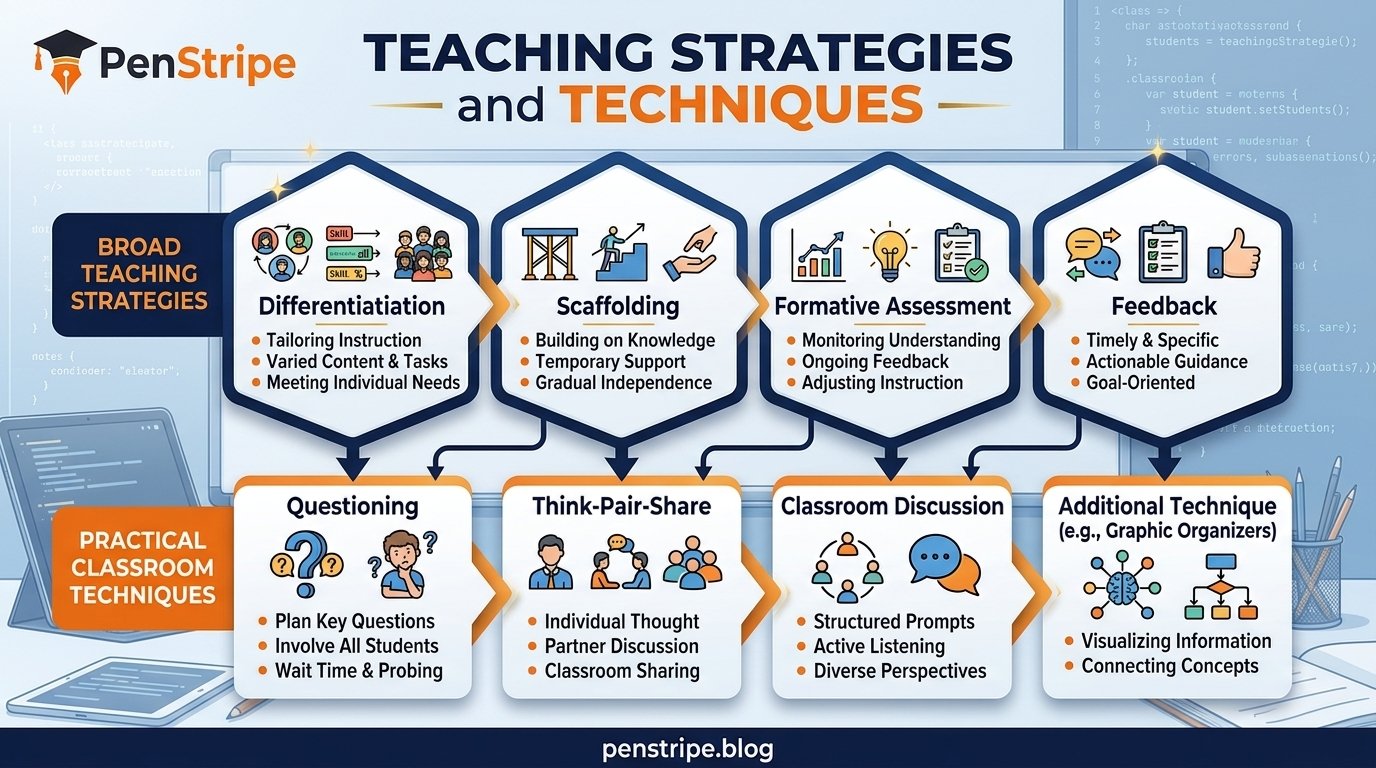
A teaching strategy is a deliberate, planned approach a teacher uses to support how students process, understand, and retain information. It’s the “what” and “why” behind an instructional choice.
A teaching technique is the specific, practical action used to carry that strategy out in real time. It’s the “how,” the exact move a teacher makes in the classroom.
Here’s a simple way to remember the difference: a strategy is the plan, a technique is the execution. If your strategy is “check for understanding throughout the lesson,” your technique might be a quick thumbs-up poll, a one-question exit ticket, or cold-calling a student to summarize.
Teaching Strategies vs. Teaching Techniques vs. Teaching Methods
| Term | Definition | Example |
| Method | The overall format used to deliver a lesson | Lecture, discussion, lab work |
| Strategy | A targeted approach to support learning | Scaffolding, differentiation, questioning |
| Technique | A specific action used to apply a strategy | Think-pair-share, exit ticket, cold call |
Methods shape the structure of a lesson. Strategies shape how learning is supported within that structure. Techniques are the individual tools that carry each strategy out. Confusing these three is one of the most common mistakes in teacher training material, and understanding the hierarchy makes lesson planning far more precise.
Why Teaching Strategies and Techniques Matter
Strategy and technique choice isn’t a minor detail. It has a measurable effect on classroom outcomes.
- They increase student engagement. The right technique turns a passive audience into active participants.
- They improve retention. Strategies built around practice and application help information move into long-term memory instead of fading after the test.
- They support diverse learners. A varied toolkit lets a teacher reach students with different ability levels, attention spans, and learning preferences in the same room.
- They make feedback loops possible. Many strategies exist specifically to give teachers real-time insight into whether students actually understand the material.
- They reduce classroom management issues. Well-structured strategies keep students purposefully occupied, which naturally reduces off-task behavior.
Research consistently backs this up. Students who are actively involved in a lesson, through questioning, discussion, or hands-on tasks, tend to retain material longer than students who only listen passively. This is the core reason active strategies dominate modern teacher training, including many of the “effective teaching strategies” frameworks now taught in B.Ed programs.
Effective Teaching Strategies Every Teacher Should Know

These strategies form the backbone of most classroom instruction, from primary school through university lecture halls.
1. Scaffolding
Breaking a complex task into smaller, supported steps, then gradually removing support as students gain confidence. Ideal for introducing new or difficult skills.
2. Differentiation
Adjusting content, process, or output based on individual student needs. This might mean offering tiered assignments or flexible formats for demonstrating understanding.
3. Formative Assessment
Checking understanding during instruction, not just after. This gives teachers the chance to correct misunderstandings before they compound.
4. Questioning
Using open-ended, higher-order questions to push students past recall and into analysis and reasoning.
5. Collaborative Learning
Structuring lessons around pair or group work so students build understanding socially, not just individually.
6. Feedback
Giving specific, actionable comments that tell students exactly what to keep doing and what to improve, rather than vague praise or criticism.
7. Metacognitive Strategies
Teaching students to think about their own thinking, plan their approach, monitor their progress, and evaluate their results.
Practical Teaching Techniques for the Classroom
If strategies are the plan, these techniques are the specific moves that bring them to life.
- Think-Pair-Share: Students think individually, discuss with a partner, then share with the class. Great for low-pressure participation.
- Exit Tickets: A one- or two-question written check at the end of class to confirm understanding before students leave.
- Cold Calling: Randomly calling on students, rather than only those who raise hands, to keep the whole class mentally engaged.
- Think-Aloud: The teacher verbalizes their thought process while solving a problem, modeling how an expert reasons through a task.
- Jigsaw Method: Students become “experts” on one part of a topic in small groups, then regroup to teach each other.
- Role Play: Students act out scenarios to explore concepts, decision-making, or perspectives, common in social studies, language, and health education.
- Case Studies: Students analyze real or realistic scenarios and defend a position with evidence, building critical thinking and communication skills.
- Gallery Walk: Student work is displayed around the room and classmates rotate through, giving feedback or discussing each piece.
How to Choose the Right Strategy or Technique
Not every strategy fits every lesson. Use these factors to guide your choice.
- Learning objective: Recall-based goals suit direct techniques like questioning; critical-thinking goals suit case studies or role play.
- Class size: Larger classes often benefit from structured techniques like think-pair-share, which give every student a role without requiring one-on-one time.
- Time available: Quick checks like exit tickets fit into any lesson; deeper strategies like the jigsaw method need more planning time.
- Student ability level: Struggling students often benefit most from scaffolding and think-aloud modeling; advanced students benefit from case studies and independent inquiry.
- Subject matter: Lab-based subjects lend themselves to demonstration and hands-on techniques; humanities subjects lend themselves to discussion and questioning.
Expert tip: Don’t judge a technique by how smoothly it runs, judge it by whether it actually reveals what students understand. A lively discussion that never surfaces misunderstanding hasn’t done its job as a strategy, even if it felt successful in the moment.
Common Mistakes When Using Teaching Strategies and Techniques
- Using one technique for every lesson. Repetition without variety leads to disengagement, even with a strategy that’s fundamentally sound.
- Skipping the “why.” A technique used without a clear underlying strategy becomes busywork instead of purposeful instruction.
- Ignoring feedback loops. Strategies like formative assessment only work if teachers actually act on what they reveal.
- Overcomplicating simple lessons. Not every objective needs an elaborate technique; sometimes a well-placed question is more effective than an entire activity.
Comparison Table: Popular Teaching Techniques at a Glance
| Technique | Best For | Time Needed |
| Think-Pair-Share | Building participation and confidence | Low |
| Exit Ticket | Quick formative assessment | Very low |
| Cold Calling | Keeping full-class attention | Very low |
| Jigsaw Method | Deep collaborative understanding | High |
| Case Study | Critical thinking and reasoning | Medium to high |
| Role Play | Perspective-taking and decision-making | Medium |
Frequently Asked Questions
What are teaching strategies and techniques?
Teaching strategies are deliberate approaches used to support how students learn, while techniques are the specific actions used to carry those strategies out in the classroom.
What is the difference between a teaching strategy and a teaching technique?
A strategy is the overall plan, such as checking understanding throughout a lesson, while a technique is the specific method used to do it, like an exit ticket or a quick poll.
What are the 5 methods of teaching?
The five most commonly taught methods are lecture, demonstration, discussion, inquiry-based, and collaborative, which range from fully teacher-led to fully student-led instruction.
What are the most effective teaching strategies?
Scaffolding, differentiation, formative assessment, questioning, collaborative learning, feedback, and metacognitive strategies are consistently ranked among the most effective across subjects and age groups.
Why is it important to use varied teaching strategies?
Varying strategies keeps students engaged, supports different learning needs and ability levels, and prevents the disengagement that comes from repetitive instruction.
Where can I find teaching strategies and techniques notes or a PPT for training?
Most teacher education programs and school districts provide official training materials covering strategy types and classroom application; check your institution’s resource library or professional development portal for accurate, up-to-date materials.
How do I choose the right teaching technique for my classroom?
Base your choice on the learning objective, class size, available time, student ability level, and subject matter, then match the technique to what you actually need students to demonstrate.
Can teaching strategies improve classroom management?
Yes. Well-structured strategies keep students purposefully engaged in a task, which naturally reduces the off-task behavior that often comes from unclear or passive instruction.
Conclusion
Teaching strategies and techniques are the working parts of great instruction, the plan and the execution that turn a lesson from something students sit through into something they actually learn from. The strongest teachers don’t rely on a single go-to move. They build a flexible toolkit, choose strategies based on the actual learning objective, and pair them with techniques that fit their students and their subject. Start small: pick one new technique from this guide, try it in your next lesson, and notice how your students respond.