



Teaching and learning methodology is the framework that decides whether a lesson actually works. It’s the difference between a class that watches the clock and one that leans in. Yet most teachers pick up methodology by trial and error, never learning the actual principles behind why some approaches succeed and others quietly fail.
This guide breaks down what teaching and learning methodology really means, how it’s different from a teaching method or strategy, the major types you’ll encounter in a classroom, and how to choose the right one for your students, your subject, and your goals. Whether you’re a new teacher building your first toolkit, a B.Ed student prepping for exams, or an instructional coach refining a program, you’ll walk away with a clear, practical understanding, not just theory.
What Is Teaching and Learning Methodology?
Teaching and learning methodology is the underlying philosophy and framework that shapes how instruction happens. It answers a bigger question than “what will I teach today?” It answers “how do I believe students learn, and how should that belief shape everything I do in the classroom?”
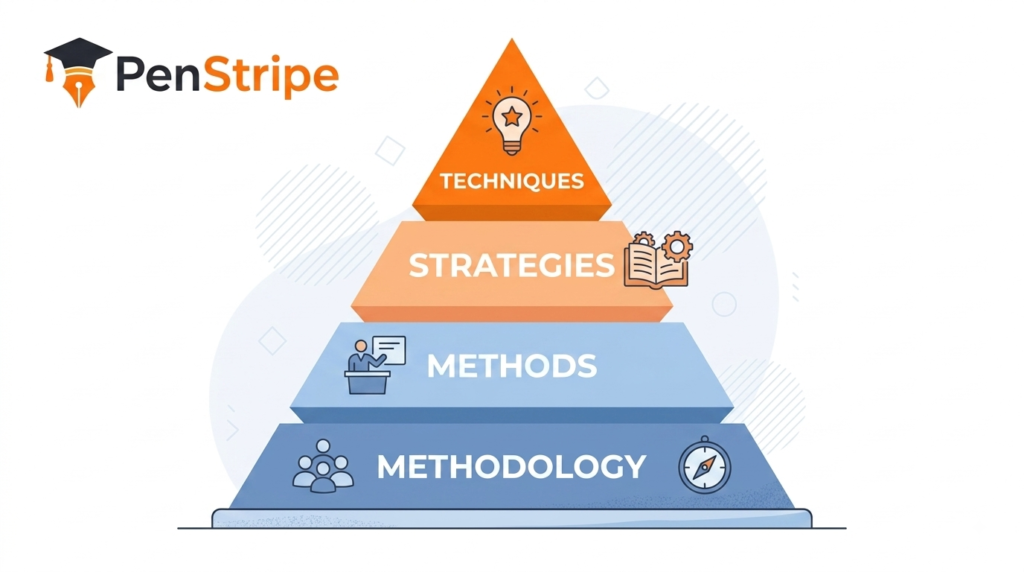
Methodology sits above methods, strategies, and techniques. Think of it as the foundation of a house: methods are the rooms, strategies are the furniture, and techniques are the small daily habits that make the house function. Get the foundation wrong, and no amount of clever furniture arranging fixes it.
Teaching and Learning Methodology vs. Teaching Methods vs. Teaching Strategies
This is one of the most confused areas in education terminology, and it’s exactly where most competing guides get vague. Here’s a clear breakdown.
| Term | What It Means | Example |
| Methodology | The overall philosophy of how learning happens | Learner-centered vs. teacher-centered approach |
| Method | The specific delivery format used in a lesson | Lecture, discussion, lab work |
| Strategy | A targeted approach used to support learning | Scaffolding, differentiation, questioning |
| Technique | A specific action used in the moment | Exit ticket, think-pair-share, cold call |
A methodology can host many methods. A method can use many strategies. A strategy is carried out through specific techniques. They’re layers, not synonyms, and understanding that hierarchy is the single most useful thing you can take from this article.
Learn complete guide of teaching strategies.
Why Teaching and Learning Methodology Matters
Methodology isn’t an academic exercise. It shapes real outcomes.
- It determines how students experience a subject. A methodology built around passive reception (sit, listen, memorize) produces a very different classroom than one built around active construction of knowledge.
- It shapes long-term retention. Methodologies that involve application and practice tend to produce understanding that lasts beyond a test date.
- It influences motivation. Learner-centered methodologies that give students agency tend to increase intrinsic motivation compared to purely instructor-driven models.
- It sets the tone for classroom culture. A collaborative, inquiry-driven methodology builds a very different classroom climate than a strict, lecture-only one.
- It affects equity. Methodologies that build in differentiation and flexibility tend to reach a wider range of learners than a one-size-fits-all approach.
Teacher-Centered vs. Learner-Centered Methodology

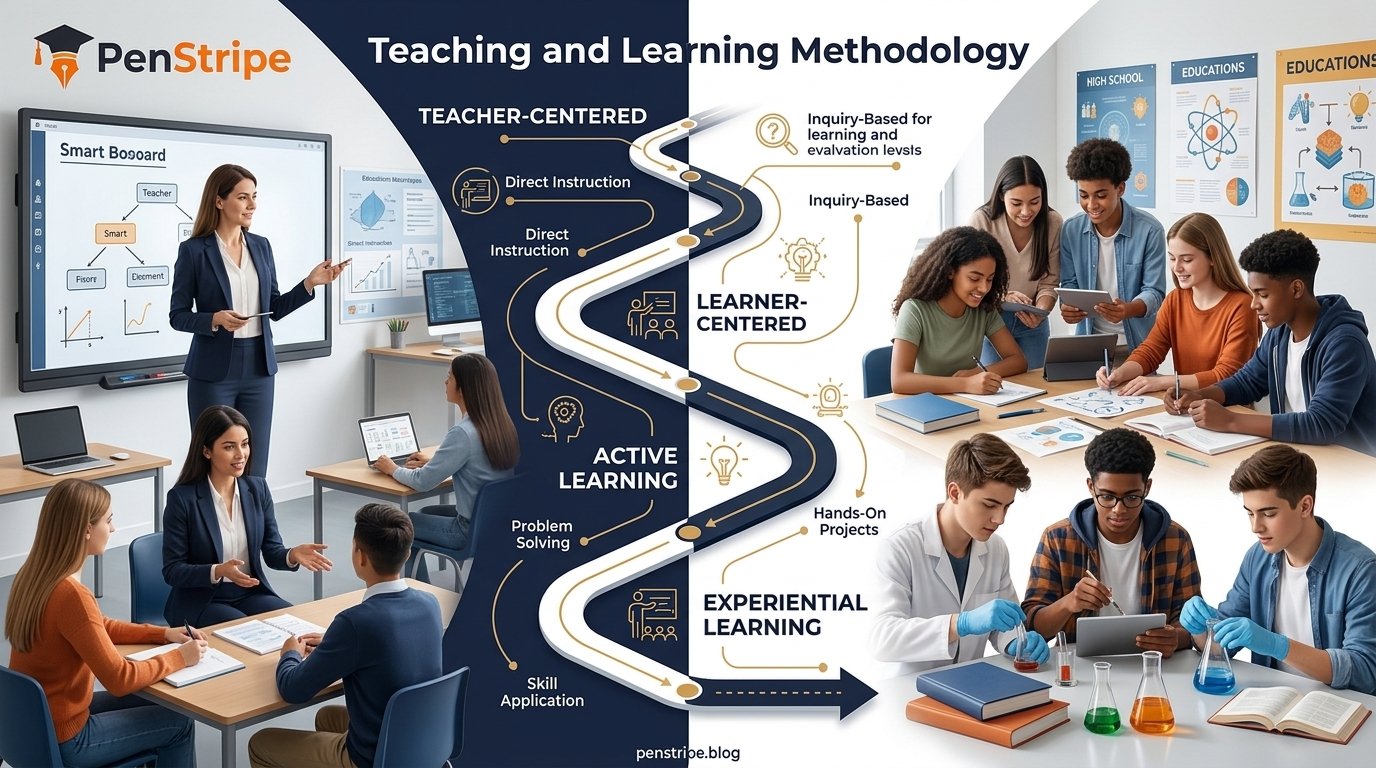
Nearly every teaching and learning methodology falls somewhere on a spectrum between two poles.
Teacher-Centered Methodology
In a teacher-centered approach, the instructor is the primary source of knowledge and direction. Lessons are structured around explanation, demonstration, and controlled practice.
Strengths: efficient for delivering foundational knowledge, easier to manage in large classes, provides clear structure for students who need it.
Limitations: can leave students passive, offers fewer opportunities for independent thinking, doesn’t always suit subjects that benefit from exploration.
Learner-Centered Methodology
In a learner-centered approach, students take a more active role in constructing their own understanding, often through inquiry, collaboration, or projects.
Strengths: builds critical thinking and independence, tends to increase engagement, better mirrors real-world problem-solving.
Limitations: requires more planning and classroom management skill, can be harder to implement in very large groups, needs stronger scaffolding for younger or less confident learners.
Expert insight: Most experienced teachers don’t pick one pole and stay there. They shift along the spectrum depending on the lesson’s objective, using a more teacher-centered approach to introduce brand-new content and then shifting to learner-centered as students build competence and can handle more independence.
What Are the 5 Methods of Teaching?
This is one of the most common questions students and new teachers search for, so it deserves a direct answer.
- Lecture Method: Direct, teacher-led explanation of content. Best for introducing new information efficiently.
- Demonstration Method: The teacher shows a process, skill, or experiment while students observe and then replicate it.
- Discussion Method: Structured conversation where students exchange ideas and build understanding collaboratively.
- Inquiry-Based Method: Students investigate a question or problem and construct their own conclusions with teacher guidance.
- Collaborative/Cooperative Method: Students work in pairs or groups toward a shared learning goal.
These five form the backbone of most teacher training programs, including many B.Ed curricula, because they cover the core range from fully teacher-directed to fully student-directed instruction.
What Are the 10 Methods of Teaching?
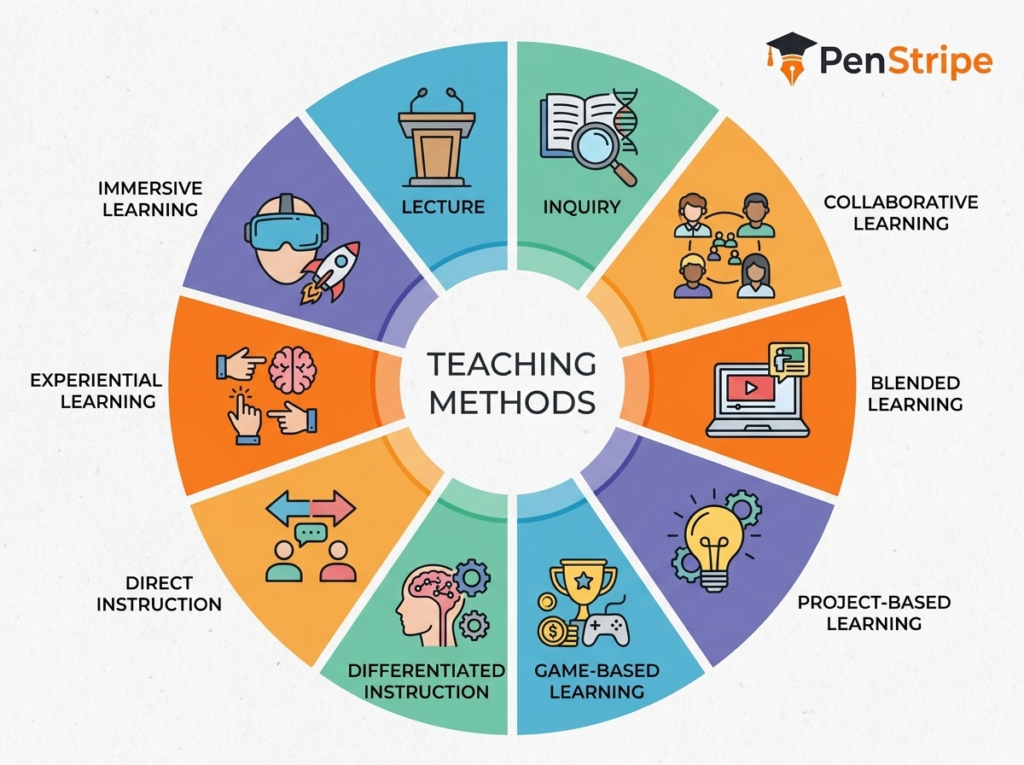
For a more complete picture, often requested by education students building study notes, here are ten methods commonly taught in teacher education programs:
- Lecture Method
- Demonstration Method
- Discussion Method
- Inquiry-Based Learning
- Project-Based Learning
- Collaborative Learning
- Problem-Based Learning
- Flipped Classroom
- Experiential Learning
- Blended Learning
Flipped classroom deserves a special note since it’s one of the most searched modern methods: students review core content (often video) at home, then use class time for applied practice, discussion, and problem-solving with the teacher present to guide them. It essentially reverses the traditional homework model.
Blended learning combines in-person instruction with online or digital components, giving students more control over pace while preserving face-to-face support.
Types of Teaching and Learning Methodology
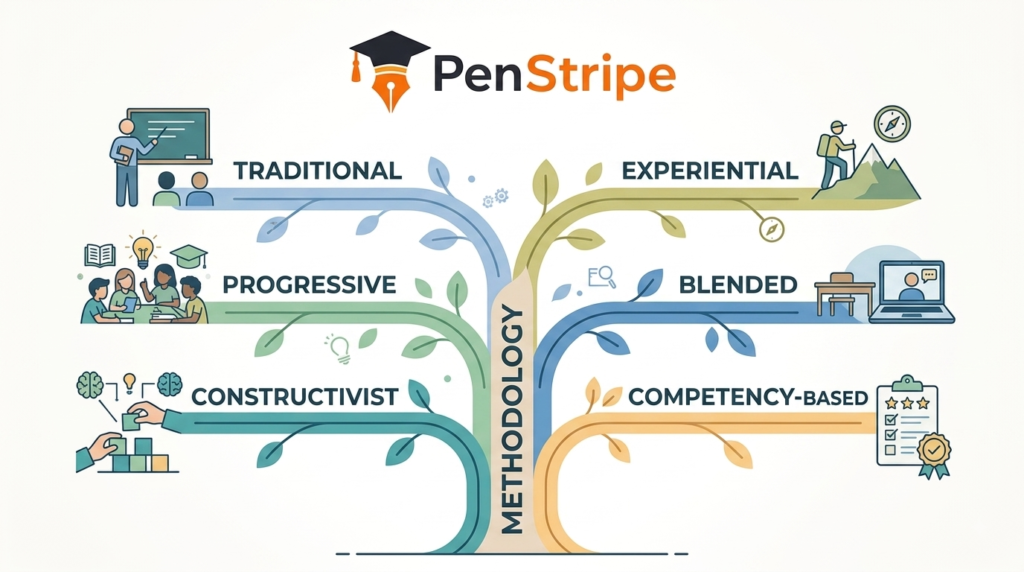
Beyond individual methods, it helps to understand methodology at a broader, philosophical level. These are the major “schools of thought” that inform classroom practice.
Traditional/Formal Methodology
Structured, teacher-directed, and often lecture-heavy. Emphasizes content delivery and controlled practice. Common in subjects requiring precise, sequential foundational knowledge, like early math instruction.
Progressive/Learner-Centered Methodology
Rooted in the idea that students learn best by doing. Prioritizes exploration, discussion, and hands-on experience over rote instruction.
Constructivist Methodology
Based on the theory that learners actively build their own understanding by connecting new information to prior knowledge, rather than absorbing it passively. Inquiry-based and problem-based learning both grow out of this tradition.
Experiential Methodology
Learning through direct experience: labs, simulations, real-world tasks, field work. Rooted in the principle that doing something builds deeper understanding than only hearing about it.
Blended/Technology-Enhanced Methodology
Combines traditional instruction with digital tools, platforms, and resources, giving students flexible access to content while preserving direct teacher support.
Competency-Based Methodology
Focuses on students demonstrating mastery of specific skills before advancing, rather than progressing purely by time spent in a course.
Teaching and Learning Methodology Example in Practice
Theory is easier to grasp with a real scenario. Here’s how methodology plays out across a single week of a high school biology unit on cell structure:
- Monday (teacher-centered/lecture): The teacher introduces new vocabulary and core concepts through direct instruction, since students have no prior exposure to the terms.
- Tuesday (demonstration): The teacher models how to use a microscope and identify cell structures before students try it themselves.
- Wednesday (collaborative/inquiry-based): Students work in small groups to compare plant and animal cells under the microscope and form their own hypotheses about function.
- Thursday (discussion): The class discusses findings, and the teacher asks probing questions to deepen analysis.
- Friday (project-based/formative assessment): Students build a labeled model or diagram demonstrating what they learned, and the teacher checks understanding through observation and questioning.
Notice that the methodology here shifts from teacher-centered to learner-centered as the week progresses, a common and effective pattern, since students need direct grounding before they can meaningfully explore on their own.
How to Choose the Right Teaching and Learning Methodology
Choosing a methodology isn’t about picking a “best” one. It’s about fit. Use this checklist:
- What’s the learning objective? Foundational knowledge often benefits from more teacher-centered approaches; critical thinking and application benefit from learner-centered ones.
- What’s the subject? Lab sciences suit experiential methodology; language acquisition often benefits from a blend of direct instruction and communicative practice.
- What’s the class size and setting? Large classes may need more structure; small groups can support more exploratory, learner-centered approaches.
- What’s the students’ prior knowledge? Less prior knowledge generally calls for more scaffolding and direct guidance.
- What resources are available? Technology-enhanced and blended methodologies require reliable access to digital tools.
Expert tip: Don’t diagnose your methodology by what you plan to do. Diagnose it by what students actually spend most of their time doing. A “discussion-based” lesson where the teacher talks 80% of the time is still functioning as teacher-centered, regardless of the label.
Common Mistakes When Applying Teaching Methodology
- Treating methodology as fixed. The strongest teachers move fluidly between teacher-centered and learner-centered approaches depending on the lesson, not a personal preference.
- Confusing activity with learning. Group work and hands-on tasks only support learning when they’re tied to a clear objective; busy isn’t the same as effective.
- Ignoring prior knowledge. A learner-centered, exploratory methodology can backfire if students don’t yet have the foundational knowledge to explore productively.
- Overloading one methodology across an entire unit. Even the best-fit methodology becomes less effective without variation; students disengage from repetition regardless of how sound the approach is.
Frequently Asked Questions
What is teaching and learning methodology?
It’s the underlying philosophy and framework that shapes how instruction is delivered, ranging from teacher-centered to learner-centered approaches, and it determines the methods and strategies used in the classroom.
What are the 5 methods of teaching?
The five most commonly taught methods are the lecture method, demonstration method, discussion method, inquiry-based method, and collaborative method, covering the range from teacher-led to student-led instruction.
What are the 10 methods of teaching?
A broader list includes lecture, demonstration, discussion, inquiry-based, project-based, collaborative, problem-based, flipped classroom, experiential, and blended learning methods.
What is the difference between a teaching method and a teaching strategy?
A method is the overall delivery format of a lesson, such as a lecture or discussion, while a strategy is a targeted approach used to support learning within that format, like scaffolding or questioning.
Is teacher-centered or learner-centered methodology better?
Neither is universally better. Teacher-centered methodology works well for introducing new content efficiently, while learner-centered methodology builds independence and critical thinking; most effective teaching blends both depending on the lesson goal.
Where can I find teaching and learning methodology notes or a PDF for B.Ed exams?
Most teacher education programs provide methodology notes covering method types, theoretical foundations, and classroom application; check your program’s official course materials or library resources for accurate, syllabus-aligned notes.
What is an example of teaching and learning methodology in a real classroom?
A common example is a unit that opens with teacher-led direct instruction to build foundational knowledge, then shifts into demonstration, collaborative inquiry, and project-based work as students gain confidence and independence.
How does technology fit into teaching and learning methodology?
Technology supports methodology through blended and technology-enhanced approaches, giving students flexible access to content while preserving direct teacher support, but it should always serve the methodology’s underlying learning goal, not replace it.
Conclusion
Teaching and learning methodology is the foundation everything else in a classroom is built on. It shapes which methods a teacher chooses, which strategies support them, and how students ultimately experience learning. The strongest teachers don’t lock into a single methodology. They understand the full spectrum, from teacher-centered to learner-centered, and move deliberately across it based on the objective, the subject, and the students in front of them. Start by identifying where your current teaching sits on that spectrum, then experiment with shifting one lesson this week toward a more learner-centered approach and notice the difference in engagement.