







Try this sometime: ask a room full of people “what are your ideas to improve schools?” and just watch what happens. Everybody nods along. Everybody agrees something needs to change. And then, somehow, the conversation just… fizzles. Usually because nobody wrote anything down, or the ideas that did come up were so vague “more engagement,” “better communication” that no one had a clue what to actually do on Monday morning.
I put this guide together to get past that stuck point. Maybe you’re a student trying to figure out what you can do to improve your education. Maybe you’re a teacher who’s sick of hearing “suggestions for school improvement” that never turn into anything. Or maybe you’re a parent who just wants a straight answer to “how to make school more better” instead of another form letter. Whoever you are, what follows is a working list the kind you could actually bring to a principal’s office or a PTA meeting and not get laughed out of the room.
Why School Improvement Matters Right Now
Let’s not sugarcoat it. Years after the pandemic turned everything upside down, plenty of students still haven’t caught up in some districts, kids are close to a full grade level behind in math, and reading isn’t much better. Teachers are running on empty in a way that actually shows up in the data: job satisfaction among educators sits well below the average for working adults in general. And when parents say their kids seem more anxious than they used to, they’re not imagining it. Survey after survey backs that up.
None of this means schools are beyond saving. It just means the playbook from a decade ago doesn’t really hold up anymore, and somebody’s got to write a new one. Here’s the part that should feel encouraging, though: most of the changes that actually move the needle don’t cost a fortune. They mostly just require someone willing to rethink how time, relationships, and communication work inside a building that already has most of what it needs it just isn’t being used well.
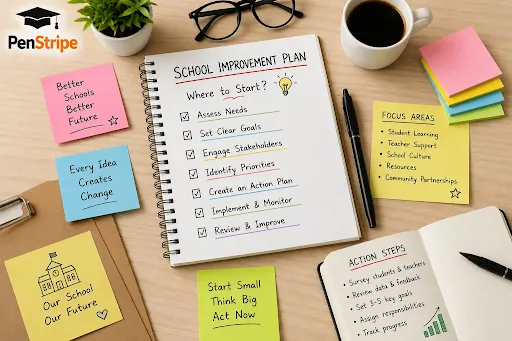
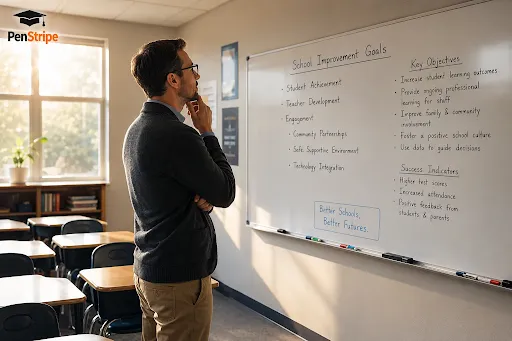
That’s basically what a school improvement plan (SIP) is. A document that names the weak spots, sets a handful of concrete goals, and lays out the steps to get there. And here’s the thing you don’t need “principal” or “superintendent” in your title to think this way. Students, teachers, and parents shape these plans just as much, arguably more.
Ideas to Improve Schools: Where to Start
Before getting into role-specific lists, it helps to know that almost every solid school improvement plan touches four areas:
- Academic instruction how content actually gets taught and tested
- School culture and environment whether the building feels safe and worth showing up to
- Communication how well information actually travels between staff, students, and families
- Wellbeing and attendance the basic conditions, physical and emotional, that make learning possible in the first place
Here’s what I’ve noticed, though: the best ideas usually live in the overlap between two of these, not neatly inside one box. Take project-based learning. On paper, it’s an academic strategy. In practice, it also boosts engagement that’s culture and cuts down on absences that’s attendance because kids actually want to show up when the work feels real.
Quick-Start Checklist
- Pick one measurable problem attendance, reading scores, bullying reports, whatever’s loudest right now
- Choose two or three ideas from this guide that go straight at that problem, not ten scattered ones
- Give each idea an actual owner. A real name, not “the team”
- Put a 90-day check-in on the calendar today, not “sometime this semester”
- Share the results out loud, even the messy, half-finished ones especially those, honestly
Creative Ideas to Improve Schools in the Classroom
Classroom-level changes are where students feel a difference fastest, sometimes within a week. These ideas to improve schools in the classroom hold up across elementary, middle, and high school, with a little tweaking for age.
Project-Based and Inquiry-Based Learning
Instead of memorizing facts for a Friday quiz, students work through something real designing a garden, investigating a local issue, building a model that actually functions. Teachers who make this switch tend to notice engagement jump almost right away, because the point of the work finally makes sense to the kids doing it. Picture a middle school science teacher trading a standard lab worksheet for a semester-long water-quality project on the creek behind the school. Suddenly it’s not busywork. It’s an investigation with a real answer waiting at the end.
Flexible Seating and Learning Spaces
Rows of desks facing a whiteboard aren’t sacred honestly, they never really were, they were just convenient. Standing desks, floor cushions, small collaboration pods… letting students pick a setup that actually helps them focus is one of the cheapest good ideas to improve schools on this whole list. Most of it just means rearranging furniture that’s probably already sitting in a storage closet somewhere.
Blended and Kinesthetic Learning
Pair digital tools with movement. Math problems solved by physically walking a number line. Vocabulary games built around motion instead of another stack of flashcards. This helps kids who genuinely can’t sit through a long lecture block, and it tends to work especially well for younger students and for those with attention-related learning differences.
Peer Tutoring and Cooperative Learning
Structured peer tutoring where a student strong in one subject mentors a classmate builds confidence on both ends of that pairing. It also frees teachers up to spend real one-on-one time with the students who need it most, instead of stretching thin across thirty kids at once and hoping everyone catches up eventually.
Student Ideas to Improve School
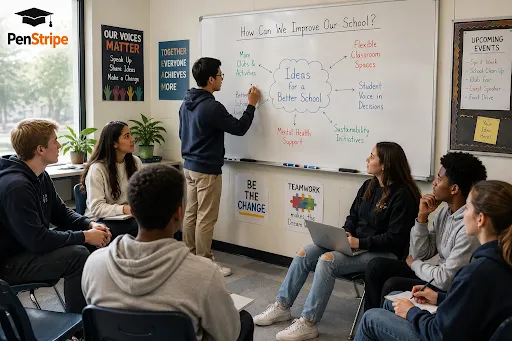
Students usually have the sharpest ideas in the whole building. Mostly because nobody bothers asking them directly. If you’re a student hunting for five ways to improve your school, or you keep wondering what you can suggest for the improvement of the school, this is your list.
- Push for a real student advisory council one that meets with administration monthly, with an actual agenda, not a symbolic seat nobody uses.
- Start a suggestion box, physical or digital, that someone in charge actually responds to in public. Even a quick update counts.
- Propose a peer mentorship program pairing upperclassmen with freshmen or new transfers who don’t know a single person yet.
- Ask for more elective variety coding, personal finance, culinary arts, entrepreneurship based on what students actually want, not what’s easiest to schedule.
- Organize a campus cleanup or beautification day. Costs almost nothing. Does more for school pride than people expect.
- Request a quiet study zone away from the cafeteria noise, for the students who need low-stimulation space to actually think straight.
- Advocate for later start times. The research here is pretty consistent teenagers do better with more sleep, and attendance tends to follow.
- Lead a kindness or anti-bullying campaign that students design and run themselves, instead of one handed down from the front office and forgotten by March.
What Can I Do to Improve My Education Personally?
Beyond the school-wide stuff, your own habits matter more than most people want to admit. Build a study routine you’ll actually stick to, instead of cramming the night before like it’s always worked out fine. Ask questions the second something’s unclear, rather than nodding along and hoping it’ll click later it usually doesn’t. Find one teacher willing to be a mentor. It’s rarer than it should be, and it genuinely changes things. None of this is glamorous, by the way. Reading an extra twenty minutes a day. Reviewing notes within 24 hours of a lesson. Small stuff like that adds up over a semester in a way that last-minute effort just can’t match.
Suggestions for School Improvement by Teachers
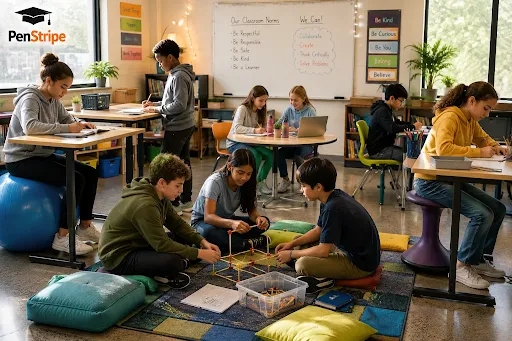
Teachers see the day-to-day friction up close, which is exactly why their suggestions for school improvement tend to be the most grounded and, frankly, the easiest to actually put into practice.
Reduce Non-Teaching Administrative Load
Ask almost any teacher what eats their time and paperwork comes up fast, usually followed by “duplicate data entry” muttered under their breath. Streamlining grading platforms, cutting overlapping communication tools, trimming meetings that could’ve been an email all of it hands teachers back hours they can pour straight into students instead.
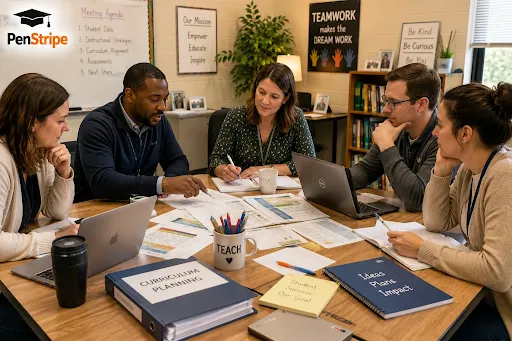
Build in Real Collaborative Planning Time
Protected, weekly time for teachers to plan across grade levels not just alone in their own classroom keeps curriculum consistent and catches gaps before they turn into real learning loss down the line.
Culturally Relevant and Inclusive Curriculum
Teachers who tie lessons back to their students’ own communities local examples, diverse authors, case studies that actually feel relevant to the kids in the room consistently see stronger engagement. This matters even more in schools with a wide mix of backgrounds.
Mentorship for New Teachers
Pairing brand-new hires with veteran teachers for their first couple of years cuts down on burnout and turnover. Worth remembering given how many teachers already say they’re unsatisfied with the job nationwide.
Data-Informed, Not Data-Driven, Instruction
Test scores matter, sure, nobody’s arguing that. But teachers routinely ask for room to use their own judgment instead of chasing a rigid, one-size-fits-all pacing guide that has no idea what’s actually happening in their classroom that week.
Suggestions for School Improvement by Parents
Parents see a school from an angle nobody inside the building really gets. Which is exactly why suggestions for school improvement by parents deserve an ongoing channel not a survey that goes out once a year and disappears into a drawer.
- Push for two-way communication apps instead of one-directional newsletters, so parents can actually reply instead of just receiving.
- Advocate for consistent homework policies across teachers in the same grade, so kids aren’t juggling five different sets of expectations at once.
- Volunteer for tutoring or classroom support, not just fundraising. Time is often worth more than another bake sale, if we’re being honest.
- Ask for grading rubrics upfront, before assignments are due, not after the grade’s already posted.
- Support flexible conference scheduling, including evening or virtual slots for families who can’t just take time off work.
- Help form a parent advisory committee with an actual seat at budget and policy conversations, not a mention buried in a newsletter.
Ideas to Improve School Environment and Culture
A school’s physical space and social atmosphere shape learning just as much as the curriculum, probably more if we’re honest about it. These ideas to improve schools environment focus on the spaces and relationships students move through every single day.
Physical Environment
- Brighten hallways and classrooms with natural light where it’s possible, student artwork where it isn’t
- Improve cafeteria food and the dining space itself, not just the nutrition label stuck on the side
- Keep restrooms and common areas actually maintained this shows up in student complaints way more often than people expect
- Add outdoor learning or recreation space, even a small one, for schools without much of a campus to work with
Social and Emotional Environment
- Launch short daily or weekly check-ins where students actually get to say how they’re doing
- Recognize positive behavior out loud, not just discipline the negative and move on
- Train staff in restorative practices resolving conflict through conversation first, instead of jumping straight to punishment
- Build a clear, consistently enforced anti-bullying policy that students genuinely trust, not just one printed neatly in the handbook
Ideas to Improve Mental Health in Schools
Given how many parents are now reporting anxiety and other mental health symptoms in their kids, ideas to improve mental health in schools need a real strategy, not one wellness week bolted onto the calendar and forgotten by October.
- Hire or contract more school counselors to bring down the student-to-counselor ratio, which in a lot of U.S. districts is still way above what’s recommended.
- Build in short mindfulness or breathing routines. Even five minutes at the start of class measurably lowers stress in the room small thing, real effect.
- Normalize mental health conversations through guest speakers, assemblies, or student-led peer support groups.
- Create a private, low-stigma referral process so a student can ask for help without a hall pass announcing it to the entire class.
- Train teachers to spot early warning signs of anxiety, depression, or burnout, and get students connected to support fast, before it snowballs into something bigger.
- Take a hard look at academic pressure homework load, testing frequency at the district level, not just classroom by classroom.
Ideas to Improve Attendance in Primary Schools (and Beyond)
Chronic absenteeism has turned into one of the most stubborn post-pandemic problems schools are dealing with. These ideas to improve attendance in primary schools work just as well in middle and high school, with small adjustments here and there.
Root-Cause Approach
Attendance problems are almost never just about motivation, whatever the assumption might be. Usually it’s transportation, undiagnosed anxiety, housing instability, or a kid who’s fallen so far behind that showing up just feels pointless. Effective ideas to improve attendance start by figuring out which of these is actually going on with which student, instead of slapping one blanket policy over everyone and calling it a fix.
Practical Strategies
- Send same-day attendance alerts instead of a weekly summary nobody reads in time to act on
- Assign attendance mentors or “success coaches” to chronically absent students
- Celebrate attendance milestones publicly, not just punish the absences after the fact
- Offer flexible make-up work for students facing genuine hardship at home
- Partner with local transportation or community groups to close actual transportation gaps, not just talk about them
Read more content on Penstripe
Comparison Table: Which Ideas Fit Your Role?
| Idea Category | Best For | Cost to Implement | Typical Time to See Results |
| Project-based learning | Teachers, curriculum leads | Low–Medium | 1 semester |
| Student advisory council | Students, administrators | Low | 2–3 months |
| Two-way communication apps | Parents, administrators | Low | Immediate–1 month |
| Mental health support expansion | Counselors, district leaders | Medium–High | 1–2 semesters |
| Attendance mentoring | Teachers, support staff | Low–Medium | 1 semester |
| Flexible seating / learning spaces | Teachers | Low | Immediate |
| Restorative discipline practices | Administrators, staff | Medium | 1–2 years |
Frequently Asked Questions
What are your ideas to improve schools? Start with project-based learning, a real student advisory council, expanded counseling support, and better two-way communication between families and staff. The ideas that actually stick target one specific, measurable problem rather than trying to fix everything at once.
What can you suggest for the improvement of the school? Communication and culture first, honestly. A consistent homework policy, transparent grading, a real channel for feedback from students and parents. None of it costs much, but it builds the trust that bigger academic reforms need to succeed later on.
How to make school more better? Pair small, fast wins flexible seating, attendance alerts with slower investments like counselor ratios and teacher mentorship. Give changes a full semester before judging them, and involve students directly instead of just deciding everything for them.
What can I do to improve my education as a student? Build a study routine that actually holds up, ask for help the moment you’re confused, and find one teacher willing to mentor you. Outside class, look for a club or council where you can propose real changes instead of waiting around for things to improve on their own.
What are creative ideas to improve schools that don’t cost much? Peer tutoring, a suggestion box with visible follow-through, campus beautification days, and daily check-in circles none of it takes much of a budget, but engagement and culture shift noticeably within a semester.
What are the best suggestions for school improvement by teachers? Cutting administrative busywork, protecting real collaborative planning time, and mentoring new teachers. These rank among the highest-impact ideas because they hand teachers back the time and energy to actually focus on students.
How can parents contribute suggestions for school improvement? Beyond fundraising, parents add the most value through consistent volunteering, joining advisory committees, and pushing for two-way communication instead of one-way newsletters that go straight to the recycling bin.
What ideas improve attendance in primary schools specifically? Same-day absence alerts, dedicated attendance mentors, and root-cause conversations with families tend to beat generic attendance policies, especially for younger kids, where transportation and health issues play a bigger role than motivation ever does.
Conclusion
Improving a school almost never comes down to one big fix. It’s a stack of small, well-aimed changes that slowly shift the whole culture over time. Students can push for peer mentorship and a quiet place to actually study. Teachers can fight for protected planning time and a curriculum that reflects the kids sitting in front of them. Parents can insist on real two-way communication instead of newsletters nobody opens. And every school, no matter the budget, can start treating mental health and attendance as root issues instead of side conversations mentioned once a year and then forgotten.
Nothing in this guide is theoretical. Every idea here is pulled from something already working in a real classroom or district somewhere. So pick two or three that fit your role and your school’s biggest pain point, put a 90-day check-in on the calendar, and actually start. Real school improvement rarely begins with a perfect plan. It begins with one idea, followed all the way through.