







Applying to college can feel like assembling a puzzle with a moving deadline. Between transcripts, test scores, essays, and recommendation letters, it’s easy to lose track of what’s due when. The good news: the college application process follows a predictable rhythm once you know the steps.
This guide walks you through the entire university application process from freshman year prep to enrollment day. You’ll learn when to start, how long each stage actually takes, what a complete checklist looks like, and how the process differs for international applicants. Whether you’re a junior just starting to research schools or a senior racing a January deadline, you’ll find a clear roadmap here, plus real examples and expert-backed tips that go beyond generic advice.
By the end, you’ll know exactly what to do next.
Click to read about college application tips.
What Is the College Application Process
The college application process is the sequence of steps a student completes to apply for admission to a university, from researching schools to submitting forms, essays, and supporting documents, through to receiving and accepting an offer of admission.
It typically involves five phases: research and school selection, standardized testing, building your application materials, submitting applications by each school’s deadline, and reviewing offers before enrolling. Most students spend 12 to 18 months moving through these phases, though the amount of hands-on work is concentrated into a few intense months during senior fall.
Why the Process Matters More Than Students Expect
Admissions offices aren’t just checking boxes. They’re building an incoming class with a mix of academic strengths, interests, and backgrounds. That means two students with identical GPAs can get very different outcomes depending on how well their application tells a coherent story.
Understanding the process isn’t just about meeting deadlines. It’s about presenting yourself accurately and strategically, so admissions officers see the full picture rather than a rushed, incomplete one.
Key Entities Involved
A few organizations show up repeatedly in any U.S. university application process: the Common Application (Common App), the Coalition App, individual college portals, the FAFSA and CSS Profile for financial aid, and the College Board or ACT for testing. Knowing which of these applies to your target schools early saves you from scrambling in the fall.
When to Start the College Recruiting Process
When to start the college recruiting process is one of the most searched questions among juniors and their parents, and the honest answer is: earlier than most students think, but not so early that it becomes stressful.
Freshman and Sophomore Year: Foundation Building
This is not the time to obsess over applications. It’s the time to build the record those applications will describe. Focus on taking challenging courses you can succeed in, joining a few extracurriculars you genuinely enjoy, and starting a simple list of activities and achievements as you go.
Junior Year: The Real Groundwork
Junior year is when the college application process actually begins in a practical sense. Start researching schools in the fall, take the PSAT, and plan your SAT or ACT testing schedule for winter and spring. By late spring, you should have a working list of 8 to 12 colleges spanning reach, target, and safety categories.
Expert insight: Counselors often see students make their college list based on name recognition alone. A stronger approach is to build the list around your intended major, campus size preference, and financial fit first, then layer in prestige.
Summer Before Senior Year: Application Season Prep
This is prime time to draft your Common App personal statement, request letters of recommendation, and finalize your college list. Students who start their essay in July or August, rather than October, consistently submit stronger, more polished writing because they aren’t rushing.
Senior Year: Execution
Fall of senior year is submission season. Early Decision and Early Action deadlines usually land between November 1 and November 15. Regular Decision deadlines cluster around January 1 to January 15. Rolling admission schools accept applications on an ongoing basis, often into spring.
U.S. College Application Timeline: Month by Month
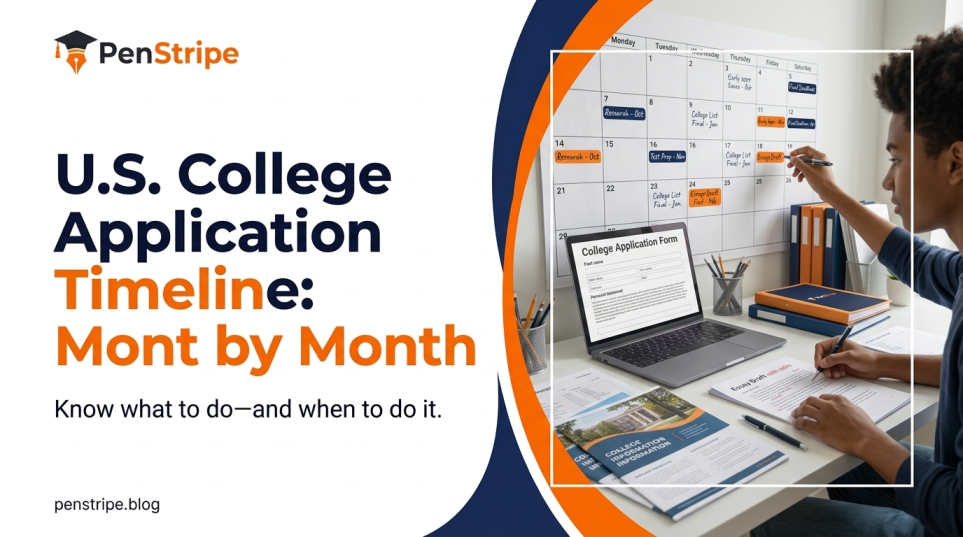
A clear college application timeline turns an overwhelming process into a series of manageable monthly tasks. Here’s how a typical senior year unfolds.
June Through August
Finalize your college list, draft your personal statement, request recommendation letters, and register for fall SAT or ACT dates if needed.
September Through November
Complete the Common App profile, start supplemental essays, confirm each school’s specific requirements, and submit Early Decision or Early Action applications, typically due November 1 to November 15.
December Through January
Receive early admission decisions. Submit Regular Decision applications, most commonly due January 1 to January 15. File the FAFSA, which opens October 1 for the following fall.
February Through May
Complete financial aid forms like the CSS Profile if required, receive Regular Decision results between mid-March and early April, compare financial aid offers, and submit your enrollment deposit by May 1, National College Decision Day.
How Long Does a College Application Take to Process

How long does a college application take to process is a two-part question, because “processing” means something different to the student filling it out than to the college reviewing it.
For the Applicant
Completing a single quality application, including essays and forms, generally takes 10 to 20 hours spread across several weeks. The Common App shares core information across all your schools, so each additional application after the first usually takes only 2 to 5 hours, mostly for school-specific supplemental essays.
For the College
Once submitted, colleges typically take 4 to 8 weeks to confirm your application is complete. Full review and decision release then takes an additional 4 to 12 weeks depending on the plan type. Early Decision and Early Action results usually arrive in December, about 4 to 6 weeks after the deadline. Regular Decision results typically arrive between mid-March and early April, roughly 10 to 14 weeks after submission.
Application volume has climbed sharply in recent years, which has stretched some review timelines. Common App logged a record 10.8 million first-year applications in the 2025-26 season, a 6% increase and the largest volume in the platform’s history. Much of that growth came from students applying to more schools individually rather than more students applying overall, with applicants submitting an average of 7.06 applications each, up from 4.73 a decade earlier. More applications per student means admissions offices are processing higher volumes even when their applicant pool hasn’t grown as fast.
College Application Process Checklist
A complete college application process checklist keeps you from missing a required piece at the worst possible moment. Use this as your master list.
Before You Apply
- College list finalized with reach, target, and safety schools
- FAFSA ID created (available starting in the fall of senior year)
- Standardized test scores sent, if required or optional-but-helpful
- High school transcript request submitted to your counselor
Core Application Materials
- Common App or Coalition App profile completed
- Personal statement drafted, revised, and proofread
- School-specific supplemental essays written
- Two to three letters of recommendation requested and confirmed
- Activities and honors list completed with specific details
- Application fee paid or fee waiver requested
Financial Aid Materials
- FAFSA submitted
- CSS Profile submitted, if required by your schools
- Any school-specific financial aid forms completed
Final Checks Before Submitting
- All sections reviewed for typos and formatting errors
- Deadlines confirmed for each individual school, not just the Common App default
- Confirmation email saved after each submission
How to Apply for College Admission Online: Step-by-Step

Knowing how to apply for college admission online removes a lot of the mystery from the process. Here’s the practical sequence most students follow.
Step 1: Choose Your Application Platform
Most students use the Common App, which is accepted by more than 1,000 colleges and lets you fill out core information once and send it to multiple schools. Some schools use the Coalition App instead, and a handful, including all University of California campuses, use their own separate application system.
Step 2: Create Your Account and Build Your Profile
Set up your account with accurate personal, academic, and family information. This section rarely changes once entered, so double-check spellings, addresses, and course history before moving forward.
Step 3: Add Schools and Review Requirements
Each school you add unlocks its own specific requirements, from supplemental essays to interview options. Review these carefully, because requirements vary significantly even among schools that share the same core application.
Step 4: Complete Writing Sections
The Common App personal statement asks you to pick one of seven prompts and write between 250 and 650 words. Most admissions readers respond best to essays that use close to the full word count, generally in the 550 to 650 word range, since shorter essays can feel underdeveloped.
Step 5: Submit and Confirm
Review every section one final time, submit, and pay the application fee or apply your fee waiver. Save the confirmation email as proof of submission, and check the portal a week later to confirm all materials, including recommendations and transcripts, arrived successfully.
U.S. College Application Process for International Students
The U.S. college application process for international students follows the same general structure as the domestic process, but with several additional steps that require extra lead time.
English Proficiency Testing
Most U.S. universities require TOEFL, IELTS, or Duolingo English Test scores from applicants whose first language isn’t English. Register for these exams at least two to three months before your earliest application deadline, since score reporting can take several weeks.
Credential Evaluation
International transcripts often need to be evaluated by a recognized credential evaluation service to translate foreign grading systems into U.S. equivalents. Start this process in the summer before senior year, as evaluations can take four to six weeks.
Financial Documentation and Visa Timeline
International students generally cannot access U.S. federal financial aid and must instead submit proof of funding, such as bank statements or an affidavit of support, to qualify for a student visa. Once accepted, you’ll receive an I-20 form and must apply for an F-1 student visa, a process that can take several weeks to a few months depending on your country and consulate wait times. Apply for your visa interview slot as soon as you receive your I-20.
Early Decision vs Early Action vs Regular Decision vs Rolling Admission
Choosing an application plan is a strategic decision, not just a timing preference. Here’s how the major plans compare.
| Application Plan | Commitment Level | Typical Deadline | Typical Decision Date | Best For |
| Early Decision | Binding, must attend if accepted | November 1–15 | Mid-December | Students certain of their first-choice school |
| Early Action | Non-binding | November 1–15 | Mid-December to January | Students who want an early read without commitment |
| Regular Decision | Non-binding | January 1–15 | March–April | Students still finalizing their list or test scores |
| Rolling Admission | Non-binding | Varies, often through spring | 4–8 weeks after submission | Students who value flexibility and faster answers |
Expert Insight on Choosing a Plan
Applying Early Decision can improve your odds at some schools, since committing signals strong intent, and highly selective colleges sometimes fill a substantial share of their class through that round. But ED also removes your ability to compare financial aid offers across schools, since you’re contractually bound to attend if admitted. If affording college is a real concern for your family, Early Action or Regular Decision preserves your negotiating power.
Common Mistakes That Slow Down or Sink Applications
Even strong students stumble on process details rather than content. Watch for these frequent errors.
Missing School-Specific Deadlines
The Common App shows one deadline by default, but individual colleges can set earlier or later dates for scholarships, honors programs, or specific majors.
Reusing One Essay Without Adapting It
A personal statement can be reused across schools, but supplemental essays need to reflect genuine, specific reasons for choosing that particular college.
Waiting Too Long to Request Recommendation Letters
Teachers and counselors need at least three to four weeks of notice, and asking in October for a November deadline puts unnecessary pressure on everyone involved.
Ignoring the FAFSA
Even students confident they won’t qualify for need-based aid should file it, since many merit scholarships and work-study programs require a FAFSA on file.
College Application Example: What a Strong Submission Looks Like

A well-built application tells one coherent story across multiple sections, rather than listing disconnected achievements. For example, a student interested in environmental science might show that focus through AP Environmental Science and Chemistry coursework, an internship with a local conservation group, a personal statement about a specific moment that sparked their interest, and a recommendation letter from a science teacher who can speak to their curiosity in the lab. Every section reinforces the same authentic narrative instead of trying to look impressive in every possible direction at once.
Frequently Asked Questions
When should I start the college application process?
Start meaningful groundwork in junior year, researching schools in the fall and testing in winter or spring. Begin drafting essays and finalizing your list the summer before senior year. Waiting until senior fall to start from scratch creates avoidable stress and weaker essays.
How many colleges should I apply to?
Most successful applicants submit between 6 and 10 applications, split across reach, target, and safety schools. Recent Common App data shows the national average applicant submits just over 7 applications, though this varies by student goals and financial need for backup options.
Is the Common App accepted everywhere?
No. The Common App is accepted by more than 1,000 colleges, but some schools, including the University of California system and MIT, use entirely separate applications. Always confirm which platform each school on your list requires.
What is the difference between Early Decision and Early Action?
Early Decision is binding: if accepted, you must withdraw all other applications and attend. Early Action is non-binding, giving you an early decision without any commitment. Both typically have November deadlines and December decision dates.
Do I need to submit SAT or ACT scores?
It depends on the school. Many colleges remain test-optional, but a growing number of selective schools, including several Ivy League institutions, have reinstated testing requirements. Check each school’s current policy directly, since these policies change year to year.
How much does it cost to apply to college?
Application fees typically range from $50 to $90 per school, though many colleges offer fee waivers for students with demonstrated financial need. The College Board and NACAC fee waiver programs can cover these costs for qualifying students.
What happens after I submit my application?
The college confirms your file is complete, typically within 4 to 8 weeks, then reviews it alongside other applicants in your pool. You’ll receive a decision through the admissions portal on the timeline associated with your application plan, whether Early Decision, Early Action, or Regular Decision.
Can international students use the same application process?
Largely yes, but international applicants also need English proficiency test scores, credential evaluations for foreign transcripts, and financial documentation to support a student visa. These extra steps require starting the process several months earlier than domestic applicants typically do.
Key Takeaways
The college application process rewards early planning far more than last-minute effort. Start building your foundation in junior year, use the summer before senior year to draft essays and gather recommendations, and track every deadline individually rather than relying on a single default date. Whether you’re applying Early Decision, Early Action, Regular Decision, or navigating the added steps of the international application process, the students who succeed are the ones who treat this as a months-long project, not a fall sprint.
Use the checklist in this guide as your working document, revisit your college application timeline monthly, and don’t hesitate to lean on your school counselor along the way. The path from application to acceptance letter is well-marked. You just need to walk it one step at a time.