




Teaching strategies for teachers are the specific, deliberate methods used to get information across, keep students engaged, and actually check whether it landed. They’re not the same thing as your curriculum. Your curriculum tells you what has to be covered by June. A teaching strategy is how you get there without losing half the room by October.
This guide walks through what teaching strategies actually are, the handful of core strategies most education programs teach, fifteen techniques you can try this week, and how those approaches shift depending on the subject or grade level you’re working with. We’ll also sort out a naming mix-up near the end — “Teaching Strategies” is also the name of an early-childhood software company, and if you searched for a login page, that’s probably what you’re after, not classroom methods
1. What Are Teaching Strategies, Really?

The Simple Definition
A teaching strategy is a deliberate way of helping students understand, practice, and hold onto new information. It shapes how you open a lesson, how students interact with the material, and how you find out whether the learning actually happened as opposed to just looking like it did.
Here’s a way to think about it. Your curriculum is the destination. The lesson plan is the route. The strategy is how you drive straight down the highway, or with a few detours that let students figure things out on their own.
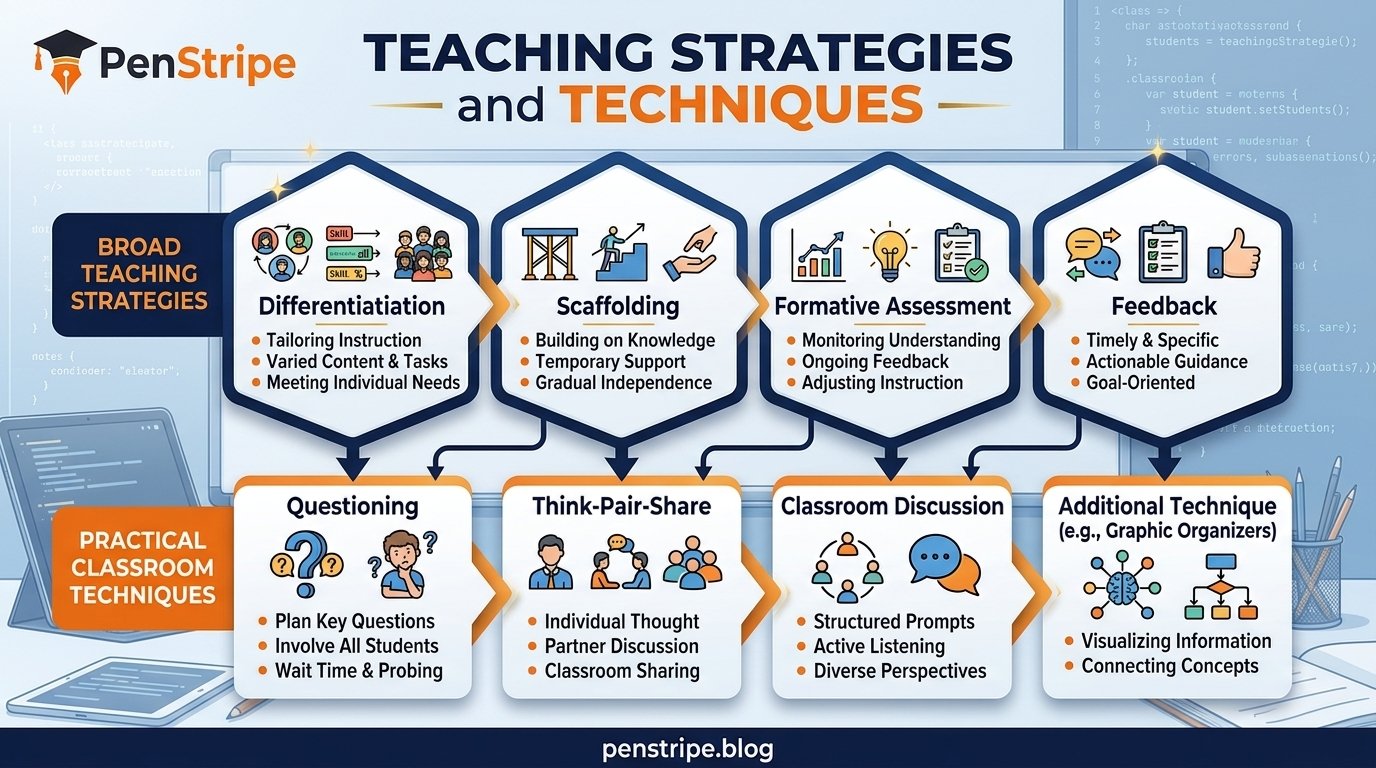
Most strategies fall into one of four buckets:
- Instructional strategies how you deliver content (direct instruction, modeling, mini-lectures)
- Engagement strategies how students interact with the material (discussion, group work, games)
- Assessment strategies how you measure whether it stuck (exit tickets, quick checks, rubrics)
- Management strategies the structure that makes the other three possible (routines, expectations, positive reinforcement)
Why This Actually Matters
Teachers who choose strategies on purpose instead of just repeating whatever their own teachers did to them tend to get better engagement and more consistent results across the whole class, not just with the kids who were going to get it anyway. This isn’t about being the fun teacher or the strict one. A soft-spoken, methodical teacher and a loud, animated one can both run a great classroom, as long as the strategy fits what the students in front of them actually need.
If there’s one rule worth remembering, it’s this: pick the strategy to match the goal, not your personal favorite. The technique that works beautifully for vocabulary drills can fall flat when you’re trying to teach persuasive writing.
Strategy, Method, or Technique?
People use these words like they’re interchangeable. They’re not quite:
- Method the big-picture philosophy (constructivist, behaviorist, and so on)
- Strategy your actual game plan for a lesson or unit (differentiated instruction, for example)
- Technique the small, specific move you use in the moment (cold-calling, think-pair-share)
A method is your overall approach to teaching. A strategy is a plan. A technique is a single tool you reach for mid-lesson.
2. The 5 (and 7) Core Teaching Strategies
So What’s the Best Teaching Strategy?
There’s no single strategy that wins every time anyone who tells you otherwise is probably selling something. But if you had to pick one, most instructional coaches would point to differentiated instruction. It flexes to fit the widest range of learners, because it doesn’t assume every student needs the same pace or format to get there. In practice, the strongest teachers rarely rely on just one strategy they combine two or three depending on what the lesson calls for.
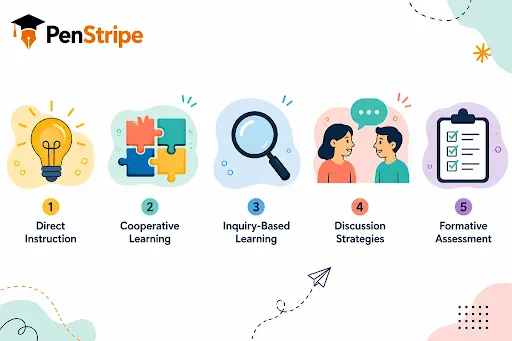
The 5 Teaching Strategies Most Often Cited
If you’re looking for a short list, these five cover the majority of classroom situations:
- Direct instruction you explain and model, then students practice
- Differentiated instruction adjusting content, pace, or output to fit different students
- Inquiry-based learning students explore a question and build their own understanding
- Collaborative learning students work together toward a shared goal
- Formative assessment quick, low-stakes checks that tell you what’s actually sinking in
And the 7 Methods of Teaching
Stretch that list to seven, and you’ll usually see these two added:
- Project-based learning an extended task that pulls together several skills at once
- Flipped classroom students get the content at home, then use class time to apply it with your support
Different textbooks slice this up slightly differently, but this seven-item version shows up in most U.S. teacher-prep programs.
If You’re New to the Classroom
New teachers usually do best leaning on direct instruction and formative assessment first. Both give you structure and quick feedback while you’re still building your classroom-management muscle. Inquiry-based and project-based approaches ask more of your management skills, so they tend to work better once you’ve got some reps in.
3. 15 Teaching Strategies You Can Use This Week
Instructional Strategies
1. Direct Instruction You model the skill, think out loud, and guide practice before handing it off. Good for anything foundational a new math procedure, a grammar rule, a lab safety protocol.
2. Differentiated Instruction Same content, different paths. Give three students the same reading, but let them respond in different formats a written paragraph, a graphic organizer, an oral summary.
3. Scaffolded Instruction Break a big task into smaller supported steps, then pull the support away as students get more confident. Works well for multi-step writing tasks or anything with a lot of moving parts.
4. Inquiry-Based Learning Students chase an open-ended question and land on their own conclusions, with you steering more than lecturing. This tends to shine in science and social studies.
5. Flipped Classroom Students get their first exposure to the material at home a video, a reading so class time can go toward practice, discussion, and one-on-one help.
Engagement Strategies
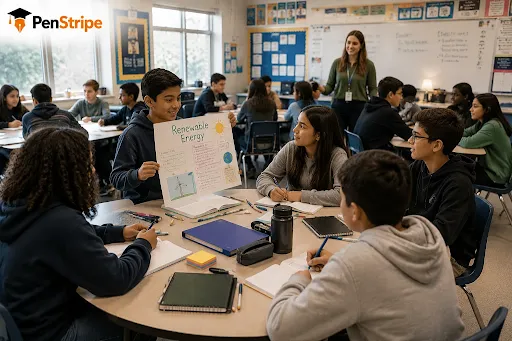
6. Collaborative / Group Learning Small groups working toward one goal. Assign roles up front, or you’ll end up with one kid doing the work and three watching.
7. Gamification Points, levels, or a little friendly competition layered onto a lesson. Especially good for review sessions that would otherwise feel like drudgery.
8. Think-Pair-Share Students think alone, talk it over with a partner, then share out. Cheap to run, and it pulls in the students who’d never raise a hand cold.
9. Project-Based Learning (PBL) A longer project tied to a real-world problem, ending in something students actually present or produce.
10. Socratic Seminar / Discussion-Based Learning Structured discussion built on open-ended questions. Builds the muscle of backing up an opinion with evidence, which, honestly, most adults could use more practice with too.
Assessment and Management Strategies
11. Formative Assessment Quick, low-stakes checks exit tickets, a show of hands, a one-question poll that tell you in the moment whether the lesson is landing.
12. Behavior Management Strategies Clear expectations, consistent routines, and positive reinforcement. This isn’t really about discipline in the punitive sense it’s about building a predictable environment where actual learning has room to happen.
13. Universal Design for Learning (UDL) Build flexibility into the lesson from the start instead of bolting accommodations on afterward. Multiple ways in, multiple ways to show what you know.
14. Social-Emotional Learning (SEL) Daily check-ins, community routines, explicit teaching of self-regulation. There’s solid research tying this to better academic outcomes and fewer disruptions it’s not just a soft skills add-on.
15. Technology-Enhanced Instruction Interactive whiteboards, response apps, adaptive practice tools. The upside isn’t the novelty it’s the real-time data you get on who’s actually following along.
Where Teachers Go Wrong With Strategies
A few traps worth watching for, even for teachers who’ve been at this a while:
- Leaning on one strategy for everything. Nothing works for every lesson goal, no matter how well it worked last week.
- Skipping the why. Students buy in more when they know the point of an activity, not just the steps.
- Mistaking busy for effective. Group work and games only help if they’re tied back to what students are supposed to learn.
- Ignoring what the formative data is telling you. If a strategy isn’t working, that’s information adjust mid-unit, don’t wait for the test to confirm it.
4. Strategies for Specific Subjects and Classrooms

English Teachers
English classrooms tend to do best with strategies that mix close reading and genuine response: Socratic seminars for discussing literature, mentor-text analysis for writing instruction, and reciprocal teaching where students take turns leading with predicting, questioning, clarifying, and summarizing to build reading comprehension.
Science Teachers
Science is a natural fit for inquiry-based learning and the 5E model (Engage, Explore, Explain, Elaborate, Evaluate). Hands-on labs, structured investigations, and error analysis having students figure out what went wrong in an experiment build content knowledge and scientific reasoning at the same time.
Diverse Classrooms
When you’ve got a wide range of learning needs, language backgrounds, and abilities in one room, three strategies do the most work:
- Universal Design for Learning (UDL) build in flexibility from day one
- Differentiated instruction adjust pace and complexity as needed
- Culturally responsive teaching connect the content to students’ actual identities and experiences
None of these are just for students with an IEP or a 504. They lift outcomes for everyone in the room while specifically supporting English language learners, neurodivergent students, and students with disabilities.
College and University Teachers
Higher ed instruction usually shifts toward strategies that build independent thinking seminar discussion, case studies, flipped classrooms that free up lecture time for application, research projects. There’s also more weight on peer review and self-assessment, since the whole point is preparing students to work independently once they leave the classroom.
Teaching Writing in the Age of AI
Writing instruction has genuinely changed. A few approaches that hold up well right now:
- Grading the process, not just the product drafts, outlines, and revisions matter as much as the final essay, because that’s where the actual thinking shows up
- Protected in-class writing time so you can see a student’s real, unassisted voice
- Teaching AI literacy directly showing students how to use it for brainstorming or feedback without letting it write for them
- Oral defense of writing asking a student to explain their choices out loud. Hard to fake if you didn’t write it.
5. Reflective Teaching: Getting Better, Not Just Busier

What It Actually Means
Reflective teaching is just the habit of looking honestly at your own lessons what worked, what didn’t, and why instead of running the same unit on autopilot year after year. It’s the difference between teaching the same lesson for ten years and teaching it well for ten years.
After a lesson, three questions tend to be worth asking:
- What did students actually learn, based on real evidence not just how the lesson felt in the room?
- What moment or move made the biggest difference?
- What would I change next time, and why?
Keeping a Teaching Strategies Journal
This doesn’t need to be fancy. After a lesson, jot down four things: the strategy you used, one thing that worked, one thing you’d change, and any reaction from students worth remembering.
Do that consistently for a semester and you end up with something more useful than any generic strategy list including this one. It’s a record of what actually works with your students, specifically.
6. Teaching Strategies GOLD, SmartTeach, and MyTeachingStrategies Not the Same Thing
Quick detour, because this trips a lot of people up. If you landed here searching Teaching Strategies login, MyTeachingStrategies, SmartTeach, or Teaching Strategies GOLD you’re probably not after classroom methods at all. You’re looking for a specific company’s software.
Teaching Strategies, LLC
Teaching Strategies, LLC is an early-childhood education company based in the Washington, D.C. area. It’s best known for two products: The Creative Curriculum and GOLD, an observation-based assessment system that tracks child development from birth through third grade.
What GOLD Actually Does
GOLD isn’t a one-time test. Teachers build evidence over time through observation, work samples, and conversations across 38 objectives covering the major areas of child development. It’s used across early-childhood programs, including Head Start and various state pre-K systems, and it can run with or without the company’s own curriculum.
SmartTeach and MyTeachingStrategies
MyTeachingStrategies® is the login portal for GOLD, The Creative Curriculum, and the rest of the company’s tools. SmartTeach™ is the customer-support portal for technical issues with those products.
Logging Into MyTeachingStrategies
- Go to the official Teaching Strategies website and find the login option
- Enter the username your program administrator gave you most accounts aren’t self-created
- Use forgot password if you’re locked out, or reach out to your administrator
- Still stuck? The company’s support line handles account recovery
No username yet? You’ll need to get one from your center or district administrator teachers generally can’t just sign themselves up.
One more thing worth saying plainly: if you came here for classroom instructional methods the material in Sections 1 through 5 GOLD and its login page aren’t what you need. That’s an assessment product built specifically for early-childhood programs.
7. Matching the Strategy to the Lesson
| Strategy | Best For | Grade Level | Example Use Case |
| Direct Instruction | Introducing new, foundational skills | All levels | Teaching a new math procedure |
| Differentiated Instruction | Mixed-ability classrooms | All levels | Same topic, tiered assignments |
| Inquiry-Based Learning | Building critical thinking | Elementary–College | Science investigations |
| Collaborative Learning | Social skills + peer learning | All levels | Group problem-solving |
| Project-Based Learning | Real-world application | Middle school–College | Semester-long research project |
| Flipped Classroom | Maximizing in-class application time | Secondary–College | Pre-recorded lecture + in-class practice |
| Formative Assessment | Real-time understanding checks | All levels | Exit tickets, quick polls |
Use it as a shortcut: find your learning goal in the Best For column, then double-check it actually suits your grade level before you build a lesson around it.
Read our latest article of Teaching Strategies
FAQ
What is the best teaching strategy in your teaching? There isn’t one that wins every time, but differentiated instruction is usually the most broadly useful because it adapts to different students’ needs instead of assuming one pace fits everyone. Most strong teachers blend two or three strategies direct instruction paired with formative assessment, say rather than betting on just one.
What are 5 teaching strategies? The five most commonly taught are direct instruction, differentiated instruction, inquiry-based learning, collaborative learning, and formative assessment. Between them, they cover introducing content, adapting it, deepening it, building social skills, and checking that it actually landed.
What are some teaching strategies for teachers new to the classroom? New teachers tend to do best starting with direct instruction and formative assessment both give you structure and fast feedback and adding inquiry-based or project-based work once classroom management feels more automatic.
What are the 7 methods of teaching? A common framework adds project-based learning and the flipped classroom to the five core strategies above, giving you: direct instruction, differentiated instruction, inquiry-based learning, collaborative learning, formative assessment, project-based learning, and flipped classroom.
Is there a list of teaching strategies PDF available? Plenty of university teaching centers and education departments publish free PDFs with strategy lists. You can also just save the 15-strategy breakdown in Section 3 of this guide as a quick reference.
What is Teaching Strategies GOLD, and is it the same as classroom teaching strategies? No different thing entirely. GOLD is early-childhood assessment software from Teaching Strategies, LLC, unrelated to general classroom methods. For instructional techniques, see Sections 1 through 5. For the software login, see Section 6.
How do I know which teaching strategy to use? Start with what you want students to be able to do by the end of the lesson, not with your favorite technique. Then pick the strategy that actually builds toward that outcome the table above is a decent starting point.
What’s the difference between a teaching strategy and a teaching method? A method is the broad philosophy behind your teaching (constructivist, behaviorist, and so on). A strategy is the practical plan you use within that method for a given lesson differentiated instruction or project-based learning, for instance.
Final Thoughts
Good teaching strategy isn’t about finding the one perfect method and sticking with it forever. It’s about building a toolkit and knowing which tool fits the moment. Start with the basics direct instruction for new material, differentiated instruction for mixed-ability groups, formative assessment to keep tabs on what’s actually sinking in then add collaborative and inquiry-based approaches as your classroom management gets more solid.
The strategies that end up mattering most won’t come from any list, including this one. They’ll be the ones you sharpen through actual reflection, lesson after lesson, based on what the students in front of you really need. So pick one thing from this guide, try it in your next class, and see what happens.