





How to Remember What You Study: 11 Proven Tips
Studying for hours does not always mean you will remember what you learned. You may read the same chapter several times, highlight important sentences, and still forget much of the material when you close the book. The problem is often not a lack of intelligence or effort. It is the way the information is being learned and reviewed.
If you want to know how to remember what you study, you need to move beyond passive reading. Your brain remembers information better when you actively retrieve it, connect it to things you already know, review it at the right time, and study with fewer distractions.
The good news is that these skills can be developed. You do not need to memorize everything in one sitting or study all night.
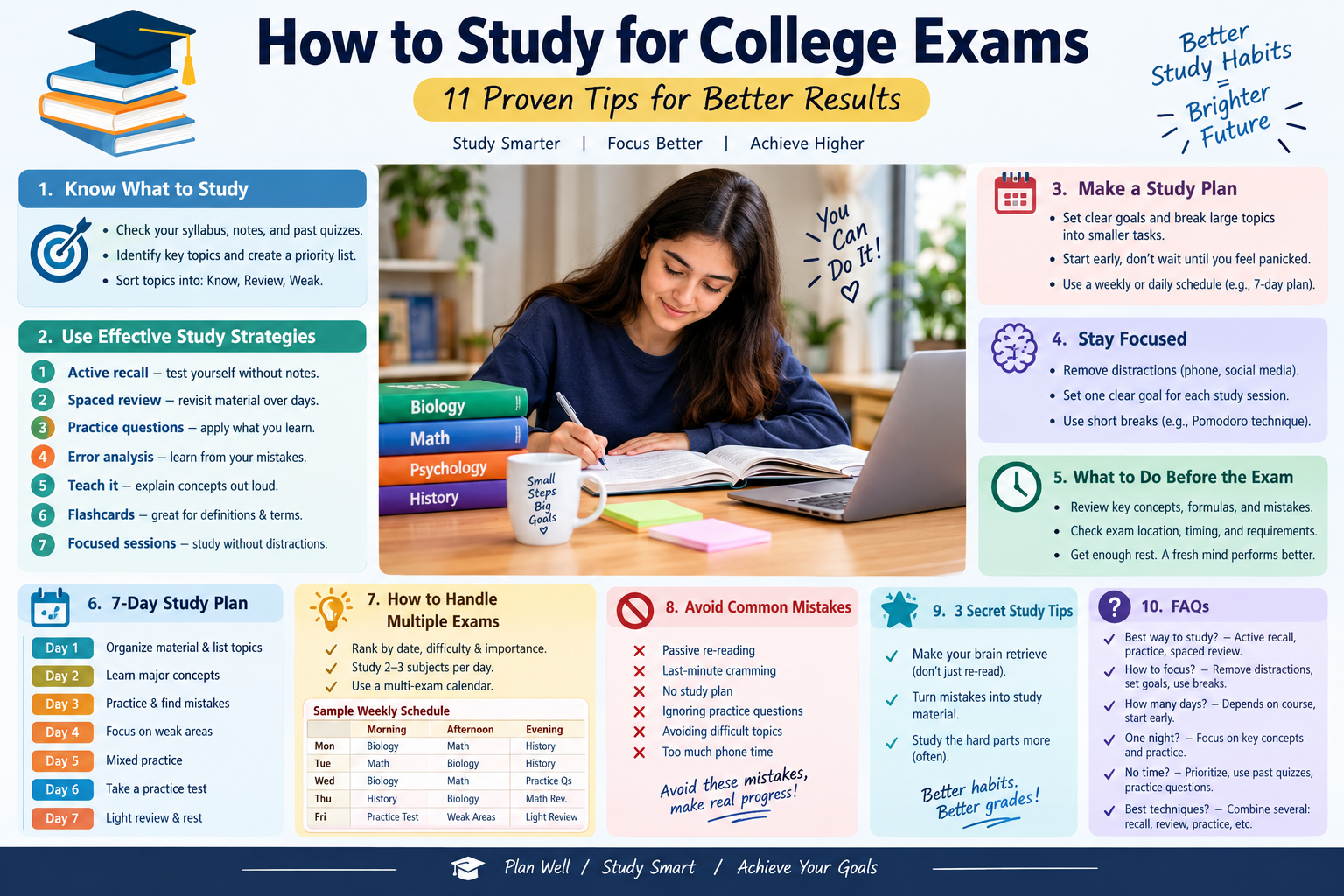
In this guide, you will learn 11 practical strategies for remembering what you study, including active recall, spaced repetition, flashcards, teaching, note-taking, focus techniques, sleep, and exam preparation. These methods can also help you remember difficult subjects and retain information for longer. The related techniques and search topics in this guide are based on the supplied content brief.
1. Understand What You Are Studying
One of the easiest ways to forget information is to memorize words without understanding their meaning.
Before trying to remember a definition, formula, process, or concept, ask yourself what it actually means.
Learn the Main Idea First

Start with the big picture.
For example, if you are studying photosynthesis, first understand that plants use light energy to help convert water and carbon dioxide into glucose and oxygen.
Once you understand the main idea, individual details become easier to organize.
Turn Difficult Ideas Into Simple Language
After reading a section, close the book and explain it using your own words.
If you cannot explain it simply, you may need to study the concept again.
This technique is particularly useful when learning difficult subjects because it exposes gaps in your understanding before they become problems on an exam.
Ask “Why?” and “How?”
Instead of only asking what something is, ask:
- Why does it happen?
- How does it work?
- What causes it?
- What happens next?
- How is it different from another concept?
These questions turn passive reading into active learning.
2. Use Active Recall
Active recall is one of the most useful techniques for learning and remembering information.
Instead of repeatedly looking at your notes, you try to retrieve information from memory.
How Active Recall Works
Read a small section of material. Then close your book or notes.
Ask yourself:
“What did I just learn?”
Write down everything you can remember.
After that, check your notes and identify what you missed.
This process makes your brain practice retrieving information instead of simply recognizing it on a page.
Use Questions Instead of Repeated Reading
Turn your notes into questions.
For example:
Question: What are the three branches of the U.S. government?
Answer: Legislative, executive, and judicial.
Now cover the answer and try to recall it.
This simple change can make your study sessions more active and useful.
3. Practice Spaced Repetition
If you study something once and never review it, forgetting is normal.
Spaced repetition solves this problem by spreading reviews over time instead of putting all your effort into one long session.
A Simple Spaced Repetition Schedule

You can try a schedule such as:
| Review | Suggested Time |
|---|---|
| First review | Same day |
| Second review | 1–2 days later |
| Third review | About 1 week later |
| Fourth review | 2–3 weeks later |
| Final review | Before the exam |
You do not have to follow these exact intervals. The important idea is to return to the information multiple times.
Combine Spaced Repetition With Active Recall
Do not simply reread the same notes during every review.
Test yourself.
If you can retrieve the information without looking, move on. If you struggle, review the weak area and test yourself again later.
This approach can help you remember what you study for a much longer period.
4. Break Large Topics Into Smaller Parts
A large chapter can feel overwhelming when you try to memorize everything at once.
Instead, divide it into manageable sections.
Use the Chunking Method
Suppose you have a 40-page chapter.
Rather than studying all 40 pages in one sitting, divide it into four sections:
- Pages 1–10
- Pages 11–20
- Pages 21–30
- Pages 31–40
Finish one section, test yourself, and then continue.
Build Connections Between Chunks
After studying several sections, explain how they connect.
For example:
Concept A causes Concept B, which leads to Concept C.
This creates a mental structure rather than a collection of unrelated facts.
5. Create Better Study Notes
Good notes should make reviewing easier, not simply reproduce your textbook.
Write Short Explanations

Instead of copying entire paragraphs, write the main idea in your own words.
For example:
“Photosynthesis = plants use light energy to make glucose.”
A short explanation is often easier to review than a full textbook paragraph.
Use Headings and Examples
Organize notes with clear headings, definitions, examples, formulas, and important relationships.
You can also use diagrams when a process is easier to understand visually.
Summarize From Memory

After completing a topic, close your notes and write a short summary.
Then compare your summary with the original material.
This gives you another opportunity to retrieve information and discover what you still need to learn.
6. Use Flashcards and Self-Testing
Flashcards can be useful when you use them for retrieval rather than simply reading them.
Make One Clear Question Per Card
Avoid putting an entire chapter on one flashcard.
Instead:
Front: What is the definition of opportunity cost?
Back: The value of the next-best alternative given up when making a choice.
Keep each card focused on one idea.
Separate Strong and Weak Cards
Create two groups:
Strong: Information you can recall easily.
Weak: Information you repeatedly forget.
Spend more time reviewing weak cards.
This prevents you from wasting your entire study session on information you already know.
7. Explain What You Learn
Teaching is another practical way to discover whether you actually understand a topic.
You do not need a classroom or another person.
Use the Teach-Back Method
Study a concept and then pretend you are teaching it to a beginner.
Explain:
- What it means
- Why it matters
- How it works
- An example
- Common mistakes
If you get stuck, return to the material and identify the missing piece.
Make Difficult Ideas Simple
Imagine that you are explaining the topic to a younger student.
Avoid complicated words unless they are necessary.
When you can explain a difficult concept clearly and accurately, you have probably developed a much stronger understanding of it.
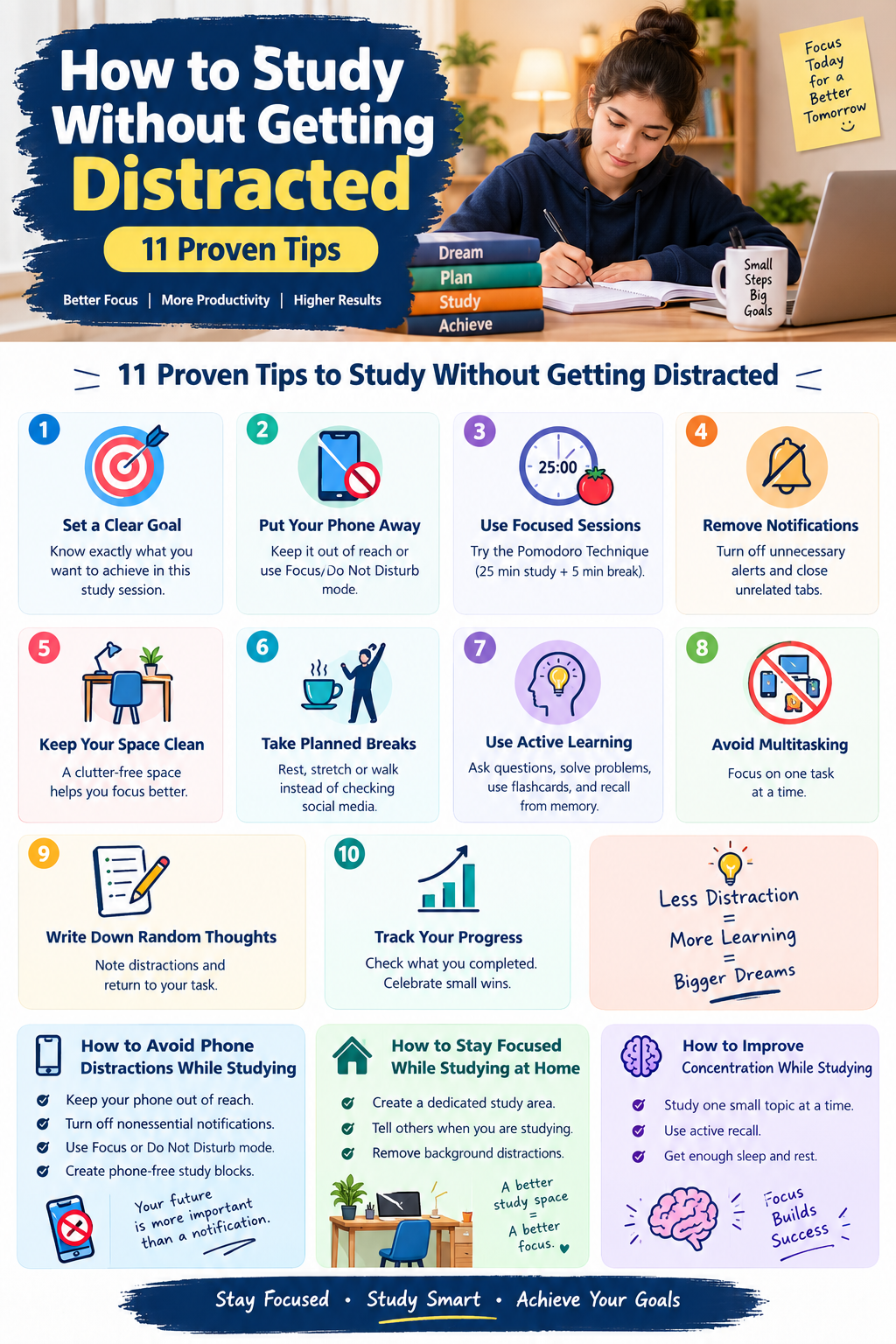
8. Improve Your Focus While Studying
Even the best memory techniques become less effective when your attention keeps moving from your textbook to your phone.
If you are wondering how you can focus 100% on studying, start by reducing distractions instead of expecting yourself to have unlimited concentration.
Remove Your Biggest Distractions
Before starting:
- Put your phone away.
- Close unnecessary browser tabs.
- Turn off nonessential notifications.
- Keep only the materials you need nearby.
- Choose a quiet study location.
The goal is to make focused studying easier.
Try Focused Study Sessions
Start with a manageable session such as 25 to 30 minutes.
Study only one task during that period.
Then take a short break before beginning another session.
As your concentration improves, you can gradually increase the length of your focused sessions.
9. Connect New Information to What You Know
Your brain has an easier time working with new information when you connect it to something familiar.
Use Examples From Everyday Life
If you are learning economics, connect concepts to shopping, prices, saving money, or household decisions.
If you are learning biology, connect processes to familiar examples from the human body or environment.
Examples give abstract information meaning.
Compare Similar Concepts

Create simple comparisons.
For example:
| Concept | Main Idea | Example |
|---|---|---|
| Recall | Retrieve information from memory | Answering a question without notes |
| Recognition | Identify familiar information | Choosing the correct answer |
| Understanding | Explain meaning | Describing a concept in your own words |
Comparisons can make differences easier to remember.
10. Sleep and Take Effective Study Breaks
Studying longer is not always better.
Your brain needs time away from intense learning, and sleep is an important part of maintaining normal learning and memory processes.
Avoid Making All-Nighters Your Normal Strategy
Staying awake all night may give you more hours with your books, but it can leave you tired and less able to concentrate.
Whenever possible, plan your study schedule so that you are not depending on last-minute overnight studying.
Take Short Breaks
After a focused study period, step away from your desk.
Walk around, stretch, drink water, or simply rest your eyes.
A short break can help you return to your work with renewed attention.
11. Use a Simple Review System for Exams
Exam preparation becomes easier when you avoid leaving everything until the last night.
Start With a Topic List
Write down all the subjects or chapters you need to know.
Mark each one:
Green: I know it well.
Yellow: I understand some of it.
Red: I struggle with it.
Start with the red topics while you still have enough time to improve.
Test Yourself Before the Exam
Do not judge your preparation by how familiar your notes look.
Instead, put the notes away and answer questions from memory.
This is especially important when learning how to remember what you study for exams.
If you cannot retrieve an answer, you have identified something that needs more work.
What Is the 7-3-2-1 Memory Technique?
The 7-3-2-1 method is sometimes presented online as a structured review schedule. However, the supplied material identifies it as a search topic but does not provide a verified definition or evidence for one specific standardized version.
Rather than relying on a particular number sequence, use a review schedule that repeatedly brings information back into your study routine. Active recall and spaced reviews can be applied regardless of the exact schedule you choose.
Best Study Methods at a Glance
| Method | Best For | How to Use It |
|---|---|---|
| Active recall | Remembering facts | Test yourself without notes |
| Spaced repetition | Long-term memory | Review information over increasing intervals |
| Flashcards | Definitions and vocabulary | Question on one side, answer on the other |
| Teaching | Understanding concepts | Explain the topic in simple language |
| Chunking | Large topics | Divide information into smaller sections |
| Mind maps | Connections | Link related ideas visually |
| Practice questions | Exams | Answer questions without looking at notes |
| Focused sessions | Concentration | Study one task without distractions |
How to Memorize 10x Faster?
There is no reliable shortcut that makes everyone memorize information exactly 10 times faster.
A better approach is to improve the quality of each study session.
Use this simple sequence:
Understand → Recall → Check → Repeat → Review later
For example, study a concept for 15 minutes, close your notes, recall the key points, check what you missed, and then review the concept again after a suitable interval.
This is usually more useful than reading the same page repeatedly.
How to Remember What You Study in Only 15 Minutes
A short session can still be productive if you use it correctly.
Try this 15-minute routine:
Minutes 1–5: Read and understand one small concept.
Minutes 6–9: Close your notes and recall the main points.
Minutes 10–12: Write down what you forgot.
Minutes 13–15: Check your notes and correct your mistakes.
The goal is not to memorize an entire chapter in 15 minutes. The goal is to make every minute active and focused.
How to Remember What You Study the Night Before a Test
If your exam is tomorrow, focus on high-value material instead of attempting to relearn everything.
Start with major concepts, important definitions, formulas, practice questions, and areas where you regularly make mistakes.
Use active recall rather than repeatedly reading your textbook.
Most importantly, avoid turning last-minute studying into a routine. Earlier preparation gives you more opportunities to review information over time.
Frequently Asked Questions
How do I improve my memory for studying?
Improve your study memory by using active recall, spaced repetition, self-testing, focused sessions, and meaningful connections. Instead of reading the same material repeatedly, close your notes and try to retrieve the information. Then check your answer and review weak areas later.
How can I focus 100% on studying?
Remove distractions before you begin. Put your phone away, close unnecessary tabs, choose one specific task, and study for a focused period. Short sessions can be useful when your concentration is low. Gradually increase the session length as you become more comfortable focusing.
How can I remember what I read?
After reading a section, close the book and explain the main idea from memory. Write down the key points without looking at the text. Then reopen the material and compare your answer. This turns reading into an active learning process.
How do I remember what I study for exams?
Start by identifying the topics you need to learn. Study difficult areas first, use active recall, practice questions, and review important material several times before the exam. Avoid relying entirely on one long study session the night before.
How can I memorize difficult subjects?
First understand the basic concepts. Then break the subject into smaller sections, connect new information to things you already know, explain concepts in simple language, and test yourself regularly. Difficult subjects often become easier when you strengthen weak foundational knowledge.
Is active recall better than rereading?
Active recall serves a different purpose from rereading because it requires you to retrieve information without looking at the answer. Rereading can help you become familiar with material, but testing yourself reveals whether you can actually produce the information from memory.
Can sleep help me remember what I study?
Yes. Sleep is an important part of healthy learning and memory. A study plan that regularly sacrifices sleep for additional late-night studying may also make it harder to maintain attention the next day. Aim for a consistent routine that includes both study time and adequate rest.
How long should I study before taking a break?
There is no single ideal study duration for everyone. You can begin with focused sessions of around 25 to 30 minutes and take a short break. If you can maintain strong concentration for longer periods, you can gradually extend your sessions.
Conclusion
Learning how to remember what you study is less about studying for endless hours and more about using effective methods.
Start with understanding the material. Then use active recall to retrieve it, spaced repetition to review it, and self-testing to find your weak areas. Break difficult subjects into smaller pieces, create useful notes, explain concepts in your own words, and remove distractions during focused sessions.
Do not wait until the night before an exam to discover what you have forgotten. A simple review routine can help you identify weak topics early and give you time to improve them.
The most practical formula is simple:
Understand → Recall → Practice → Review → Repeat
Use this process consistently, and your study sessions can become more focused, organized, and useful penstripe