






Taking notes sounds simple, but many students struggle to create notes that are actually useful later. You may write several pages during a lecture or while reading a textbook, yet still find yourself confused when it is time to study.
The problem is usually not the amount of writing. It is the way information is selected, organized, and reviewed.
Learning how to take better notes can make studying more efficient. Good notes help you identify important ideas, connect related concepts, and quickly review information before a test. They can also help you stay focused instead of passively reading or listening.
In this guide, you will learn 11 practical note-taking strategies, including how to choose a note-taking method, organize information, take notes faster, review them effectively, and turn your notes into useful study materials.
Why Better Notes Matter
Good notes are more than a record of what a teacher says or what a textbook contains. They are a study tool that helps you process information.
When you take useful notes, you are forced to decide what matters most. This can make you pay closer attention and notice relationships between different ideas.
Better notes can also save time later. Instead of going through an entire chapter again, you can review a clear summary of the main concepts.
Better Notes Improve Understanding
Writing important ideas in your own words can help you process them more deeply. Instead of copying a definition, try explaining it in a way that makes sense to you.
For example, rather than copying a long scientific definition, write a short explanation and add an example underneath it.
Good Notes Make Reviewing Easier
Well-organized notes allow you to find important information quickly. Clear headings, short sections, and consistent formatting make review sessions less stressful.
Note-Taking Can Improve Focus
Taking notes gives your brain an active task during a lecture or reading session. Instead of simply hearing or seeing information, you are deciding what deserves attention.
How to Take Better Notes: 11 Proven Tips

1. Understand Before You Write
One of the biggest mistakes students make is trying to write down everything.
Instead, listen or read for meaning first. Ask yourself what the main idea is and which details actually support it.
Focus on the Main Idea
Before writing a point, ask:
- What is the main concept?
- Why is it important?
- Is this detail likely to help me understand the topic later?
If a teacher explains a concept for several minutes, you may only need two or three useful sentences in your notes.
Avoid Writing Every Word
Your notes should not look like a transcript.
Write keywords, short explanations, examples, formulas, dates, and important relationships. This leaves more mental space for understanding the lesson.
2. Choose the Right Note-Taking Method
Different situations require different approaches. There is no single method that works perfectly for everyone.
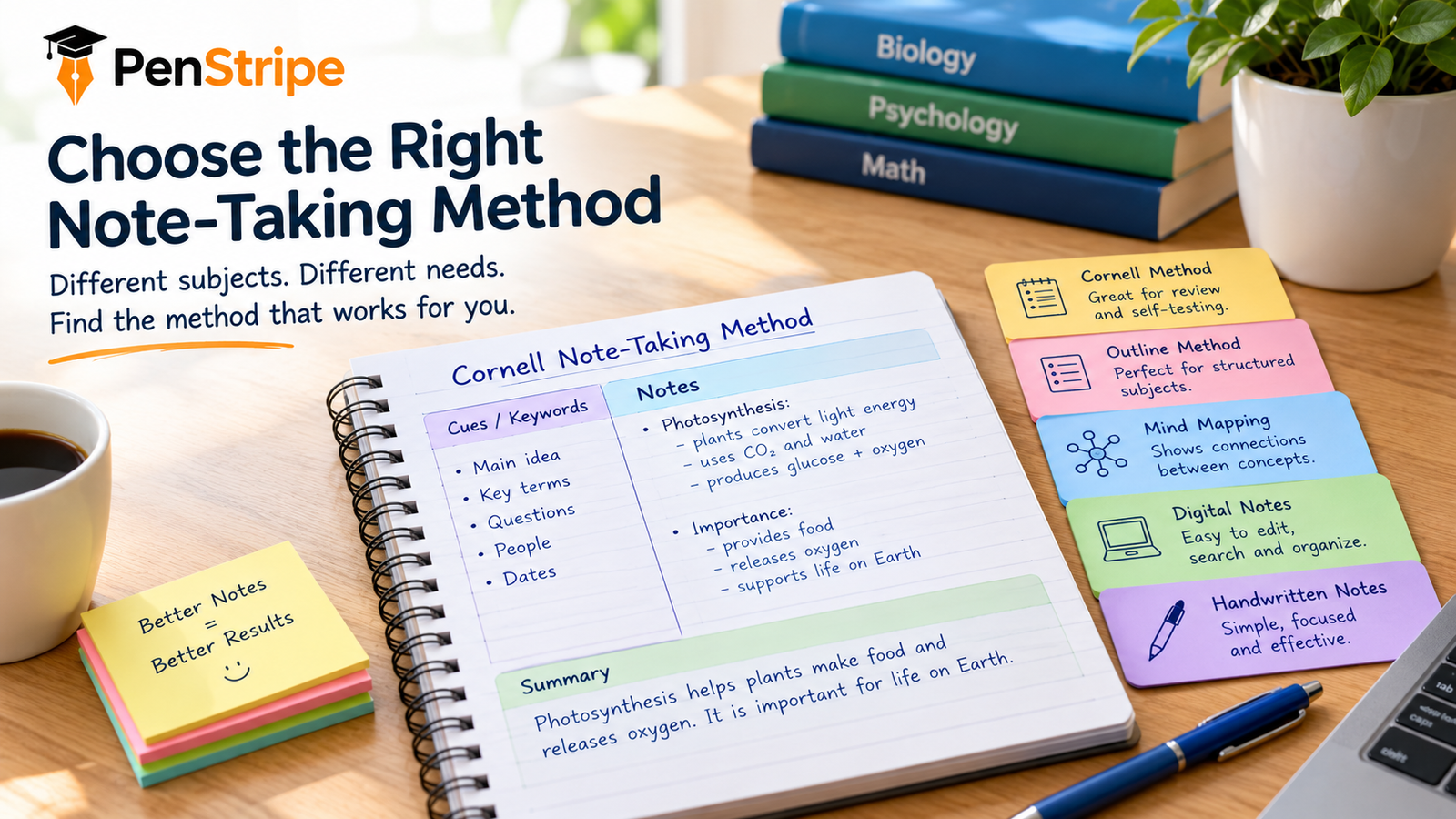
Three popular options are the Cornell method, outline method, and mind mapping.
Cornell Note-Taking Method
The Cornell method divides a page into sections for notes, questions or keywords, and a summary.
It works particularly well when you want to review your notes later because the question section can become a quick self-test.
Outline Method
The outline method organizes information using headings and subpoints.
For example:
Main Topic
- Key idea
- Supporting detail
- Example
This method works well for subjects with clear categories and relationships.
Mind Mapping Method
Mind maps arrange ideas around a central topic. Related concepts branch outward from the main idea.
This can be useful when studying topics that involve many connections.
Note-Taking Method Comparison
| Method | Best For | Main Advantage | Possible Limitation |
| Cornell | Lectures and exam review | Easy to review | Requires page setup |
| Outline | Structured subjects | Very organized | Less useful for visual relationships |
| Mind Map | Connected concepts | Shows relationships | Can become messy |
| Digital Notes | Large amounts of information | Easy to edit and search | Can create distractions |
| Handwritten Notes | Active learning | Simple and focused | Harder to search |
3. Focus on Key Ideas
Effective notes capture the information that helps you understand the subject.
Listen for phrases such as “the main reason,” “the important difference,” “for example,” or “remember this.” These often signal information worth recording.
Identify Main Points
Use headings for major ideas and short phrases underneath them.
For example:
Photosynthesis
- Plants convert light energy
- Uses carbon dioxide and water
- Produces glucose and oxygen
This is easier to study than a large paragraph.
Add Useful Examples
Examples can make abstract concepts easier to remember.
If a teacher explains a mathematical rule, include one simple example showing how the rule works.
4. Use Short Words, Symbols, and Abbreviations
You do not need to write complete sentences in every note.
Use simple abbreviations that you can understand later.
For example:
- because → bc
- important → imp.
- example → ex.
- increase → ↑
- decrease → ↓
- leads to → →
The goal is speed without making your notes difficult to understand.
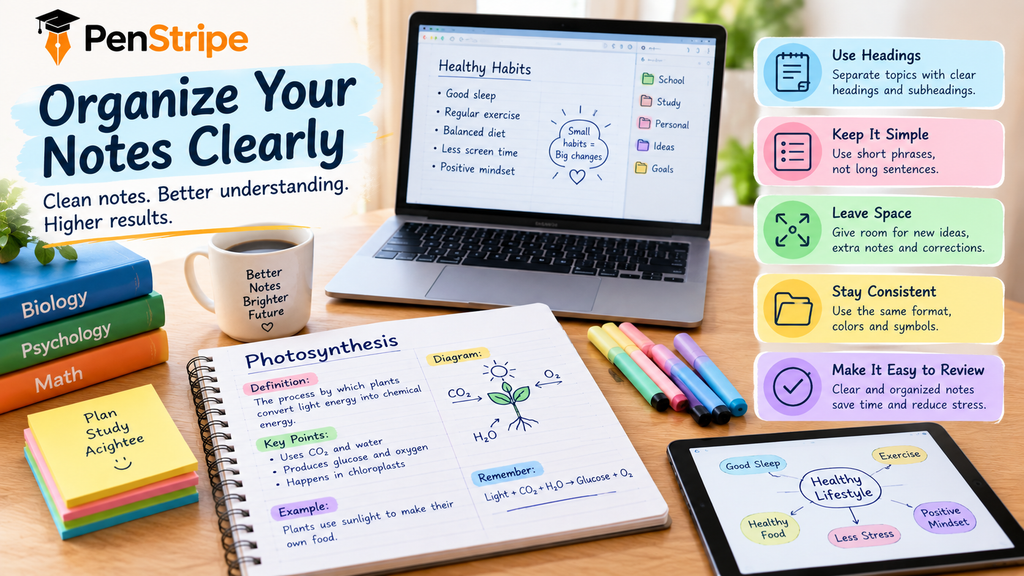
5. Organize Your Notes Clearly
Good organization makes a major difference when you return to your notes days or weeks later.
Use Headings and Subheadings
Separate major topics with clear headings. Keep related information together.
You can use a consistent structure:
Main Topic
Definition
Key points
Example
Questions
Leave Some Empty Space
Do not fill every part of the page.
Leaving space allows you to add new information, corrections, questions, or examples during review.
6. Decide Between Handwritten and Digital Notes
Both handwritten and digital notes can work well. The better option depends on the situation and your personal study habits.
Handwritten Notes
Writing by hand can be useful when you want to slow down and process information. It also makes it easy to draw diagrams, arrows, and quick sketches.
Digital Notes
Digital tools are useful when you need searchable, editable, and well-organized notes.
They can be especially convenient for large courses where you have many documents and topics.
The important thing is not the device. The important thing is whether your method helps you understand and review the material.
7. Highlight Only Important Information
Highlighting can make review easier, but highlighting almost everything defeats the purpose.
Try to highlight only definitions, important terms, formulas, dates, and central ideas.
Use Colors With a Purpose
If you use multiple colors, give each one a consistent meaning.
For example:
- One color for definitions
- One for examples
- One for important facts
You do not need five or six colors for every page.
8. Review Your Notes Soon After Studying
Writing notes is only the first step. Reviewing them helps turn information into something you can use.
Try to look over your notes soon after the class or study session.
Review Within 24 Hours
A quick review can help you identify unclear information while the lesson is still fresh.
Fix incomplete sentences, add missing examples, and mark topics that need more study.
Turn Notes Into Questions
Instead of only rereading your notes, cover the answers and ask yourself questions.
For example:
Note: The water cycle includes evaporation, condensation, and precipitation.
Question: What are the three main stages mentioned in the water cycle?
This turns passive review into active recall.
9. Add Your Own Questions and Explanations
Your notes should reflect your understanding, not just someone else’s words.
Write Questions
Whenever you see something confusing, write a question beside it.
For example:
“Why does this happen?”
“What is the difference between these two concepts?”
“What example can explain this?”
These questions can guide your next study session.
Explain Difficult Ideas Simply
After writing a difficult concept, explain it as if you were teaching it to a younger student.
If you cannot explain it simply, you may need to review the topic again.
10. Connect New Information to What You Already Know
Learning becomes easier when new information has a connection to something familiar.
Link Related Concepts
Use arrows or short notes to show relationships between ideas.
For example:
Cause → Effect
or
Concept A → leads to → Concept B
This makes your notes more meaningful than a list of disconnected facts.
Use Real-Life Examples
Whenever possible, connect academic concepts to everyday situations.
A real-world example can give an abstract idea a context that is easier to remember.
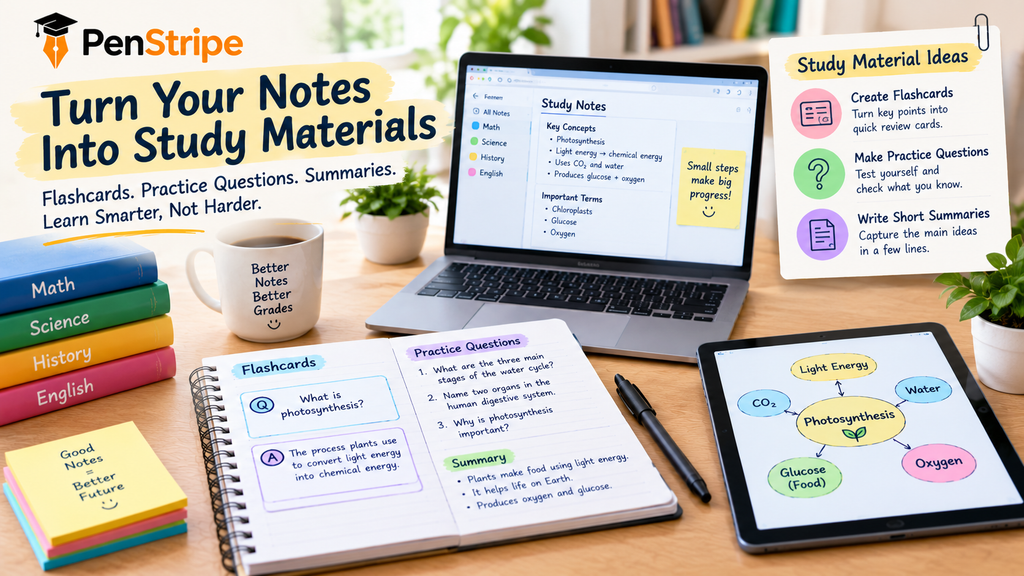
11. Turn Notes Into Study Materials
Your notes become more valuable when you use them to create other study resources.
Create Flashcards
Turn important terms and definitions into question-and-answer cards.
Front: What is photosynthesis?
Back: The process plants use to convert light energy into chemical energy.
Make Practice Questions
Create questions from your notes and answer them without looking at the page.
This helps reveal what you actually remember.
Create Short Summaries
After finishing a topic, write a three-to-five sentence summary.
If you can summarize a large section accurately in a few sentences, you probably understand its central ideas.
Common Note-Taking Mistakes to Avoid
Even well-intentioned students can develop habits that make notes less useful.
Copying Everything
Trying to record every word makes it harder to listen, think, and identify important ideas.
Making Notes Too Complicated
Beautiful notes are not necessarily effective notes. Spending more time decorating a page than understanding the subject is usually not helpful.
Never Reviewing Notes
Notes that are never reviewed quickly lose their value. Schedule short review sessions instead of waiting until the night before an exam.
Keeping Everything Disorganized
Mixing subjects, dates, and topics makes revision unnecessarily difficult.
Use folders, notebooks, labels, or digital categories to keep information organized.
How to Take Better Notes in Class
Before class, check the topic and prepare your notebook or digital document.
During class, focus on the teacher’s main explanations, examples, definitions, and important connections.
Do not panic if you miss a sentence. Leave a small space and continue listening. You can fill the gap later.
After class, spend a few minutes reviewing what you wrote. Add missing information while the discussion is still fresh.
How to Take Notes From a Textbook

Taking notes from a textbook requires a slightly different approach because you can control the reading speed.
Preview the Chapter
Look at the title, headings, diagrams, and summary before reading deeply.
This gives you an idea of what information to expect.
Focus on Important Information
Do not copy entire paragraphs. Look for definitions, major arguments, processes, examples, formulas, and important conclusions.
Summarize Each Section
After reading a section, stop and explain its main point in your own words.
This simple step can make textbook notes much more useful for later revision.
How to Take Notes Faster
Speed comes from selecting information, not simply writing faster.
Use abbreviations, symbols, short phrases, and headings. Prepare your page before a lecture begins so you do not waste time formatting while the teacher is speaking.
Most importantly, do not try to capture everything. Good notes are selective.
FAQs
How do I get better at taking notes?
You get better by practicing active note-taking. Focus on main ideas instead of copying everything, use a consistent structure, and review your notes after each study session. Over time, you will become faster at identifying which information deserves to be written down.
What are the 7 rules of note-taking?
Seven useful rules are to listen actively, identify key ideas, use your own words, keep notes organized, use simple abbreviations, leave space for additions, and review your notes regularly. These principles help make notes easier to understand and more useful for studying.
How can I focus 100% on studying?
You cannot always maintain perfect concentration, but you can reduce distractions. Put your phone away, choose a specific study goal, work in short focused sessions, keep only necessary materials nearby, and take planned breaks. Active tasks such as writing questions can also keep your attention engaged.
What do ADHD notes look like?
There is no single appearance for notes used by people with ADHD. Some people may prefer short sections, visual cues, colors, diagrams, checklists, or digital tools. The most useful format is the one that makes information easier for the individual to follow, review, and remember.
Is it better to write notes by hand or type them?
Both methods can be effective. Handwritten notes can encourage you to summarize information, while digital notes are easier to edit, search, and organize. Choose the method that helps you stay focused and understand the material rather than choosing a method simply because it looks better.
How can I take notes faster from a textbook?
Preview the chapter first, identify the main headings, and read for key ideas rather than copying complete paragraphs. Write short summaries, keywords, definitions, and examples. After each section, pause and explain the main idea in your own words.
Should I highlight everything in my notes?
No. Highlighting works best when it draws attention to the most important information. If nearly every sentence is highlighted, nothing stands out. Use highlighting selectively for definitions, key concepts, formulas, dates, and information you need to remember.
How often should I review my notes?
Review your notes soon after creating them and then revisit difficult topics regularly. Short, repeated review sessions are generally more useful than trying to relearn everything immediately before an exam.
Conclusion
Learning how to take better notes is not about writing more. It is about identifying important information, understanding it, organizing it clearly, and reviewing it effectively.
Start with one simple improvement. During your next class or study session, avoid copying every sentence. Instead, focus on the main ideas, use short explanations, organize your notes with clear headings, and add questions that you can answer later.
Once you have created useful notes, turn them into flashcards, practice questions, or short summaries. This gives your notes a purpose beyond simply recording information.
The best note-taking system is the one you can use consistently. Choose a method that fits your subject and learning style, practice it regularly, and improve it as you discover what helps you learn best penstripe