





Studying for several hours does not always mean you are learning effectively. You can spend an entire evening reading textbooks and still struggle to remember the information the next day. The difference often comes down to how you study, not simply how long you study.
If you want to learn how to study effectively, focus on active learning, clear goals, focused sessions, regular review, and a study environment that helps you concentrate. Techniques such as active recall, spaced repetition, practice questions, and explaining concepts in your own words can make study sessions more productive.
This guide explains 11 practical strategies you can use for school, college, exams, or independent learning. You will also learn how to stay focused, study difficult subjects, create a realistic routine, and avoid common mistakes that waste study time.
What Does It Mean to Study Effectively?

Studying effectively means using methods that help you understand, remember, and apply information rather than simply spending more time with your books.
A productive study session usually has a clear goal. Instead of saying, “I will study biology,” you might decide, “I will learn the three stages of cellular respiration and answer 10 practice questions.”
This small change makes your session more focused and measurable.
Studying Hard vs. Studying Effectively
Studying hard usually means putting in a lot of time and effort. Studying effectively means making that time count.
For example, a student may read the same chapter three times and feel familiar with the material. Another student may read it once, close the book, explain the main ideas from memory, and complete practice questions.
The second approach creates more opportunities to retrieve and use the information.
| Studying Hard | Studying Effectively |
| Focuses mainly on hours | Focuses on learning outcomes |
| Often relies on rereading | Uses active recall |
| May involve multitasking | Uses focused sessions |
| Reviews everything equally | Prioritizes important and difficult topics |
| Often relies on last-minute revision | Uses regular review |
| Measures time spent | Measures progress and understanding |
The goal is not to study as little as possible. The goal is to use your available time intelligently.
Why Effective Study Methods Matter
Good study methods can help you identify what you understand and what you still need to learn.
They also make it easier to prepare for exams because you are regularly testing your knowledge instead of discovering gaps at the last minute.
A useful study system combines learning new information, practicing it, retrieving it from memory, and reviewing it over time.
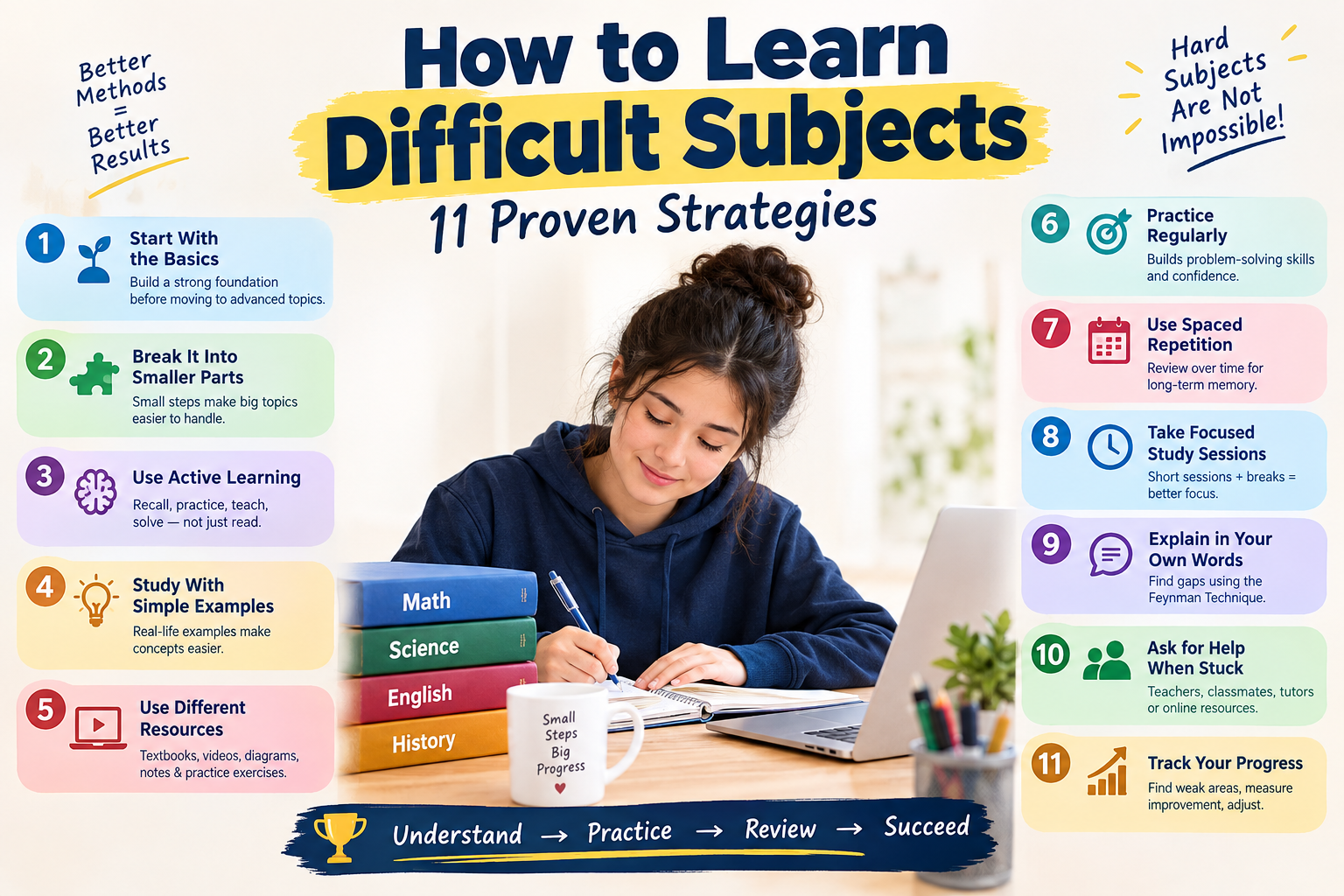
How to Study Effectively: 11 Proven Strategies
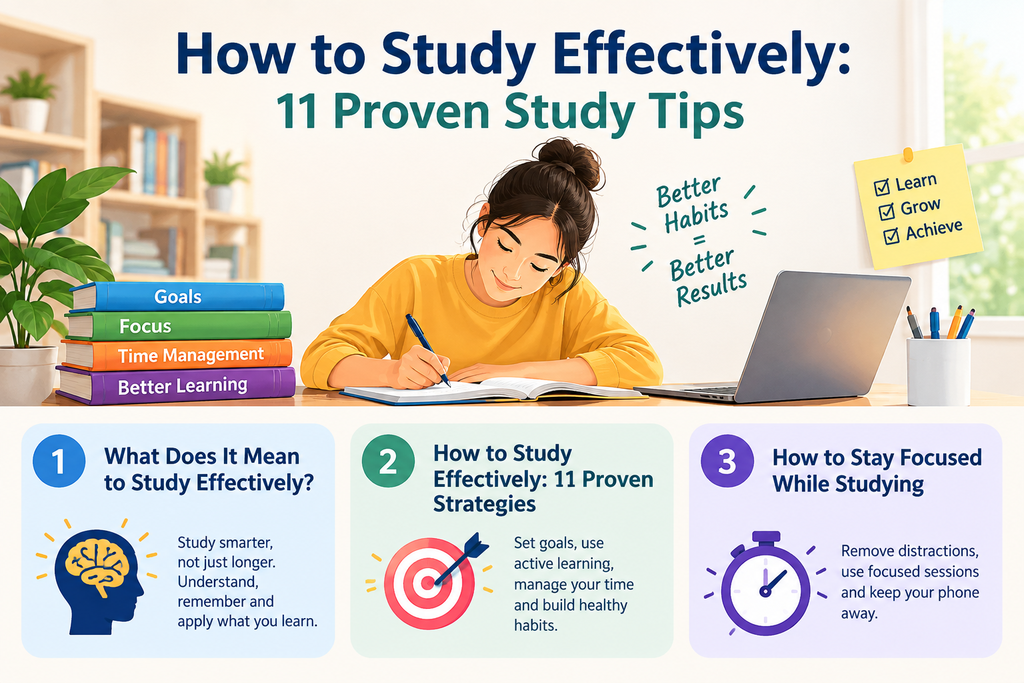
1. Set Clear Study Goals
Start every study session with a specific objective.
A vague goal such as “study chemistry” is difficult to measure. A better goal would be “understand chemical bonding and complete 15 practice questions.”
Clear goals give your brain a defined target and make it easier to recognize when a session is complete.
Try setting three types of goals:
- What topic will you learn?
- What task will you complete?
- How will you check your understanding?
For example, you could spend 30 minutes learning a topic, 15 minutes answering questions, and 10 minutes reviewing mistakes.
2. Create a Realistic Study Schedule
A study schedule helps you decide when and what you will study before distractions appear.
Do not fill every available hour with schoolwork. A schedule that is too demanding can become difficult to maintain.
Instead, divide your workload into manageable sessions.
For example:
Monday: Mathematics and Biology
Tuesday: English and Chemistry
Wednesday: Mathematics and History
Thursday: Biology and English
Friday: Chemistry and review
Weekend: Practice tests and difficult topics
Leave some flexibility for unexpected assignments or activities.
Consistency is more useful than creating a perfect schedule that you abandon after a few days.
3. Choose a Distraction-Free Study Environment
Your surroundings can influence how easily you maintain attention.
Choose a place with enough light, comfortable seating, and the materials you need. Keep unnecessary tabs, games, social media, and notifications away from your workspace.
If your phone repeatedly interrupts you, place it outside your immediate reach or use a focus mode.
A good rule is simple: prepare everything you need before starting so you do not have to keep leaving your study area.
4. Use Active Recall
Active recall is one of the most useful ways to test whether you actually remember something.
Instead of repeatedly looking at your notes, close them and try to retrieve the information yourself.
For example, after reading about photosynthesis, close the textbook and answer:
What is photosynthesis?
Where does it occur?
What are its main inputs?
What does it produce?
If you cannot answer a question, return to the material, review it, and test yourself again.
The important part is attempting to retrieve the information rather than simply recognizing it on the page.
5. Practice Spaced Repetition
Spaced repetition means reviewing information at increasing intervals instead of trying to memorize everything in one session.
For example, you might review a new topic:
- Later the same day
- The next day
- Several days later
- The following week
- Again before an exam
The exact schedule can vary depending on the difficulty of the material.
This approach is especially useful for vocabulary, formulas, definitions, dates, scientific concepts, and other information that needs repeated retrieval.
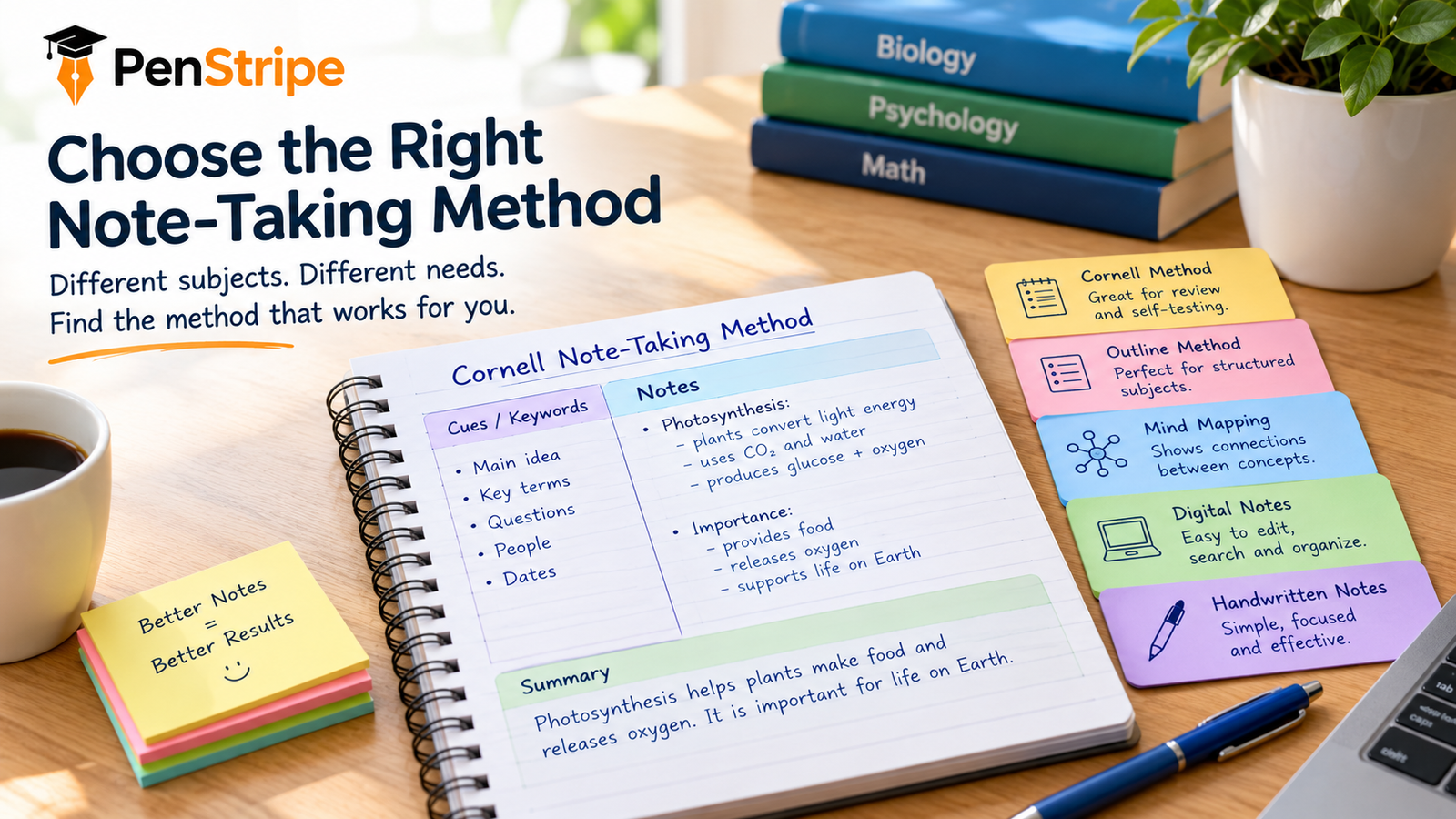
6. Take Effective Study Notes
Good notes should help you understand and review information quickly.
Avoid copying every sentence from a textbook or lecture. Instead, identify the main idea and record important supporting details.
You can use:
- Short explanations
- Examples
- Key terms
- Questions
- Diagrams
- Formulas
- Connections between concepts
After finishing a section, look away from your notes and summarize what you learned.
If you cannot explain the main idea without looking, that topic may need another review.
7. Break Difficult Topics Into Smaller Parts
Large subjects can feel overwhelming because they contain many connected ideas.
Instead of trying to learn an entire chapter at once, divide it into smaller sections.
For example, if you are learning algebra, you might separate the topic into:
- Basic equations
- Variables
- Linear equations
- Graphs
- Word problems
- Practice exercises
Master one part before moving to the next.
This approach makes difficult subjects feel more manageable and gives you clear progress markers.
8. Use Practice Tests and Questions
Practice questions turn studying into an active process.
After learning a topic, answer questions without immediately checking the solution. Then review your mistakes and identify why you made them.
Do not only count correct answers. Study your incorrect answers carefully.
Ask yourself:
What did I misunderstand?
Did I forget a fact?
Did I use the wrong formula?
Did I misunderstand the question?
Did I make a calculation error?
This process can reveal weaknesses that ordinary reading may hide.
9. Take Short, Strategic Breaks
Long study sessions without breaks can become less productive as concentration declines.
Short breaks give you an opportunity to step away, move around, drink water, or rest your eyes.
You can experiment with different study intervals. For example, study for 30 to 50 minutes, then take a short break.
The best duration depends on the student, subject, and task.
A break should actually be a break. Scrolling through social media for 20 minutes can make it harder to return to focused work.
10. Explain What You Learn in Your Own Words
One powerful way to check understanding is to explain a concept as if you were teaching someone else.
Choose a topic and explain it without reading your notes.
If your explanation is clear and simple, you probably understand the basic concept. If you become stuck or rely heavily on textbook language, identify the part you do not fully understand.
You can use this method with a friend, study partner, or even an imaginary student.
The key is to explain the idea rather than simply repeat a definition.
11. Review and Improve Your Study Routine
Your study routine should change when you discover what works and what does not.
At the end of the week, ask yourself:
Which subjects improved?
Which topics are still difficult?
Which study methods helped?
Where did I waste time?
What should I change next week?
This turns studying into a process of continuous improvement.
If flashcards work well for vocabulary but practice problems work better for mathematics, use each method where it makes sense.
How Long Should You Study Each Day?
There is no single number of study hours that works for every student.
The appropriate amount depends on your academic level, workload, goals, upcoming exams, difficulty of your subjects, and personal schedule.
Instead of asking only, “How many hours should I study?” ask, “What do I need to accomplish today?”
For example, a two-hour focused session with active recall and practice questions may be more productive than four hours of distracted reading.
Factors That Affect Study Time
Consider:
- Your current workload
- The difficulty of the subject
- Upcoming deadlines
- Your existing knowledge
- Your concentration level
- The amount of practice required
- Your sleep and daily responsibilities
A student preparing for a major exam may temporarily need more study time than a student reviewing ordinary coursework.
How to Avoid Studying for Too Many Hours
More hours are not automatically better.
If you notice that you are reading the same paragraph repeatedly, making careless mistakes, or struggling to remember basic information, pause and reset.
Use focused sessions instead of forcing yourself to continue indefinitely.
Protecting sleep is also important. Cutting sleep repeatedly to gain extra study hours can make learning and concentration more difficult the next day.
How to Stay Focused While Studying

Knowing how to study effectively is only useful if you can actually concentrate on the task.
Focus is easier when you reduce distractions before starting.
Remove Common Distractions
Put unnecessary devices and notifications away.
Before starting, decide what you will work on and prepare the required books, notes, calculator, water, and other materials.
This reduces the number of reasons to leave your study session.
Use Short Focused Study Sessions
If concentrating for a long period feels difficult, start with a shorter session.
For example:
10 minutes: review your goal
30 minutes: focused study
5 minutes: short break
30 minutes: practice
10 minutes: recall and review
You can gradually increase the length of your focused sessions as your concentration improves.
Keep Your Phone Away
A phone can interrupt studying even when you are not actively using it.
Turn off unnecessary notifications and keep the device away from your immediate workspace when possible.
If you need your phone for educational resources, use only the required app or website and disable unrelated notifications.
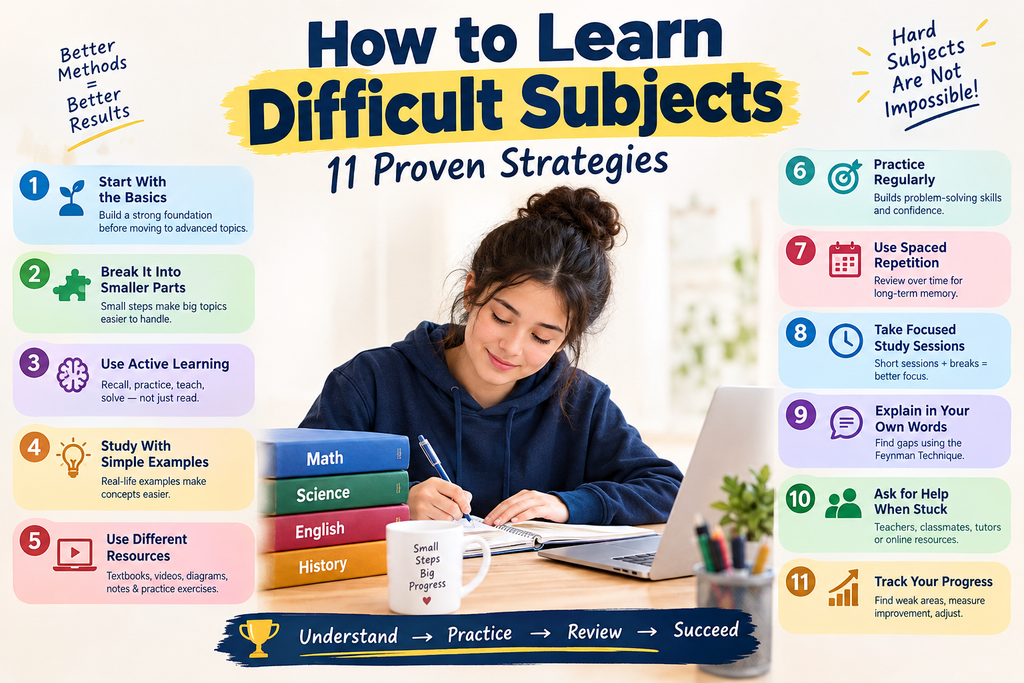
How to Study Difficult Subjects
Difficult subjects usually become easier when you identify exactly where the problem begins.
Strengthen Your Basic Concepts
Advanced topics often depend on earlier knowledge.
If a student struggles with a complicated mathematics problem, for example, the issue may actually be a weakness in fractions, equations, or basic algebra.
Go back to the earliest concept you do not understand and rebuild from there.
Break Complex Topics Into Smaller Steps
Do not try to understand an entire complicated process simultaneously.
Separate it into stages and learn how each stage connects to the next.
Use diagrams, examples, practice problems, and simple explanations when necessary.
Once the individual pieces make sense, combine them into the larger concept.
Ask Questions When You Get Stuck
Getting stuck does not mean you should immediately abandon a topic.
Write down the exact point that confuses you.
Instead of saying, “I don’t understand physics,” ask a specific question such as, “Why does this force change the object’s acceleration?”
Specific questions are easier to research, discuss with a teacher, or solve with a study partner.
Common Study Mistakes to Avoid
Even motivated students can waste study time through ineffective habits.
Passive Reading
Reading notes repeatedly can create a feeling of familiarity without proving that you can recall the information.
Add active recall, questions, summaries, or practice exercises to your reading.
Last-Minute Cramming
Cramming can feel productive because you are studying intensely for a short period.
However, depending entirely on last-minute study makes it harder to distribute review across multiple days.
Start earlier whenever possible and use repeated review.
Multitasking While Studying
Switching between studying, messaging, entertainment, and social media can interrupt your attention.
Give one important task your full attention before moving to another.
Skipping Revision
Learning something once is not the same as being able to remember it later.
Schedule regular review sessions and use retrieval practice to check what you still know.
How to Create an Effective Study Routine
An effective routine does not need to be complicated.
Start by identifying your priorities for the week.
Plan Your Weekly Study Goals
Write down the subjects and topics you need to complete.
Then divide large tasks into smaller sessions.
Instead of “finish biology,” write:
Read chapter section
Create five questions
Answer the questions
Review mistakes
Explain the topic from memory
This makes progress easier to measure.
Prioritize Difficult Subjects
Do not always spend your best concentration time on subjects you already find easy.
If mathematics requires more mental effort than another subject, consider studying it when your energy and attention are strongest.
You can use easier tasks later in the day when your concentration is lower.
Track Your Progress
At the end of each study session, record what you completed.
You might use a simple system:
Topic learned
Practice completed
Mistakes identified
Review needed
This creates a clear record of your progress and helps you decide what to study next.
What Is the 3-2-1 Rule for Study?
The 3-2-1 rule can refer to different study routines, so students should define the version they are using rather than assuming there is one universal method.
One practical version is to identify three key ideas, two important details or questions, and one main takeaway after studying a topic.
For example, after reading a history section, you could write three major events, two important causes, and one central lesson.
The value comes from summarizing and retrieving information rather than from the numbers themselves.
What Is the Best Method of Studying?
There is no single study method that is equally effective for every subject and student.
A strong general approach combines active recall, spaced review, practice questions, clear goals, and focused study sessions.
The best method also depends on what you are learning. Mathematics often requires solving problems, while vocabulary may benefit from repeated retrieval and spaced practice.
Choose methods based on the learning task rather than using one technique for everything.
How Can I Focus 100% on Studying?
You cannot guarantee perfect concentration for every minute, but you can make focused studying easier.
Start with one specific task, remove unnecessary notifications, keep your phone away, prepare your materials, and use a defined study period.
If your attention drifts, notice it and return to the task without spending too much time criticizing yourself.
Regular practice can make focused study sessions easier to maintain.
How to Be a Top 1% Student?
There is no single habit that guarantees a student will become a top-performing student.
Strong academic performance generally involves consistent study habits, understanding rather than memorization alone, regular practice, effective time management, asking questions, and reviewing mistakes.
Instead of focusing only on a ranking, concentrate on measurable behaviors such as completing assignments on time, improving weak topics, practicing regularly, and preparing before exams.
How to Study Effectively for Exams
Start exam preparation early enough to divide the material into manageable sections.
First identify what you need to know. Then study the material, retrieve it from memory, complete practice questions, and review mistakes.
As the exam approaches, spend more time testing yourself instead of simply rereading notes.
For example, create a mock test under realistic conditions and complete it without checking your notes.
How to Study Effectively at Home
Create a consistent study location and keep the space organized.
Tell people around you when you need uninterrupted time if possible. Keep entertainment devices away and prepare your study materials before starting.
A simple routine can help:
Choose a topic
Set a specific goal
Study actively
Take a short break
Test your memory
Record what needs review
The goal is to make your home environment support concentration rather than compete with it.
FAQs About Studying Effectively
What is the most effective way to study?
Active learning is a strong general approach because it requires you to retrieve, explain, and apply information instead of only reading it. Combine active recall with spaced review and practice questions. The exact technique should depend on the subject and learning goal.
How many hours should I study a day?
There is no universal number of hours that works for every student. Your ideal study time depends on your workload, academic goals, subject difficulty, and schedule. Focus on completing meaningful learning tasks rather than simply accumulating hours.
How can I remember what I study?
Use active recall and spaced repetition. After learning a topic, close your notes and explain what you remember. Then review the material again later. Practice questions and teaching the concept in your own words can also reveal gaps in your memory.
How can I study without getting distracted?
Start by removing predictable distractions. Silence unnecessary notifications, keep your phone away, choose a clean workspace, and set one specific goal for the session. Short focused sessions can also make it easier to maintain attention.
Is it better to study in the morning or at night?
The best time depends on your individual schedule, energy, and responsibilities. Choose a period when you can consistently concentrate. If a difficult subject requires strong attention, consider studying it during the part of the day when you feel most alert.
How can I study difficult subjects?
Begin by identifying the specific concept you do not understand. Review the prerequisite knowledge, divide the topic into smaller parts, work through examples, and practice questions. If you remain stuck, ask a teacher, tutor, or study partner a specific question.
Can I learn effectively by reading notes repeatedly?
Reading notes can help with initial exposure, but rereading alone does not test whether you can retrieve the information later. Add active recall, practice questions, summaries, or explanations to make your study sessions more active.
How can I study effectively in a short time?
Prioritize the most important topics, remove distractions, and use active methods. Instead of trying to reread everything, identify the material that requires attention, test yourself, practice key questions, and review your mistakes.
Conclusion
Learning how to study effectively is less about spending endless hours at a desk and more about using your time with purpose.
Start with clear goals, create a realistic schedule, remove distractions, and use active learning techniques such as recall, spaced review, practice questions, and self-explanation. Break difficult subjects into smaller parts and regularly review the areas where you make mistakes.
You do not need a complicated system. Choose a few strategies that fit your subjects and use them consistently.
For your next study session, set one clear goal, study without distractions, test yourself before looking at your notes, and write down what you need to review. Small improvements repeated consistently can make your study routine more productive over time penstripe