






Studying for several hours does not automatically mean you are learning more. You can spend an entire evening reading the same chapter, highlighting every sentence, and still struggle to remember the material the next day. The better approach is to focus on how you study rather than simply how long you study.
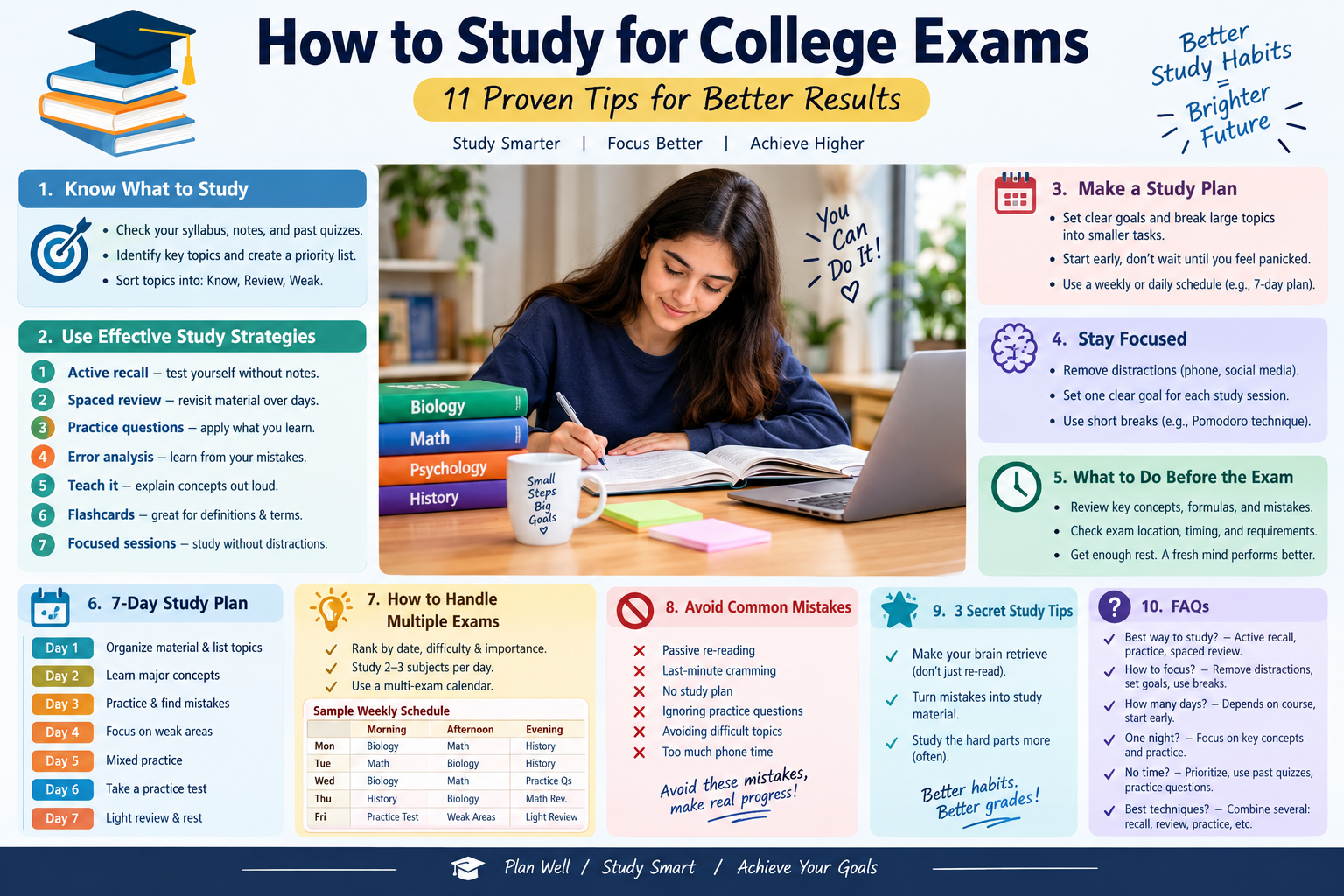
Learning how to study smarter not harder means using effective techniques that help you understand, remember, and apply information with less wasted effort. Active recall, spaced repetition, practice testing, focused study sessions, better note-taking, and a distraction-free environment can make your study time more productive.
This does not mean you should avoid hard work. Instead, it means putting your effort into activities that actually support learning. A focused 60-minute session can be more useful than several hours of distracted studying.
In this guide, you will learn 11 practical strategies for studying more efficiently, improving memory, staying focused, managing your time, and building better study habits.
What Does How to Study Smarter Not Harder?
Studying smarter means choosing learning methods that make your study time more effective. Instead of repeatedly reading information, you actively work with it by recalling ideas, answering questions, solving problems, explaining concepts, and reviewing material over time.
The goal is not to find a shortcut that eliminates effort. Learning still requires concentration and practice. The difference is that smart studying reduces wasted effort.
Studying More Hours vs. Learning More Effectively
Imagine two students preparing for the same exam.
Student A studies for five hours while checking a phone, rereading notes, and taking frequent unplanned breaks.
Student B studies for two focused hours. They review difficult concepts, test themselves, solve practice questions, and review mistakes.
More study time does not automatically mean better learning. What happens during that time matters.
| Harder Study Approach | Smarter Study Approach |
|---|---|
| Rereading chapters repeatedly | Active recall |
| Studying everything at once | Breaking topics into sections |
| Long unfocused sessions | Focused study blocks |
| Memorizing without understanding | Connecting ideas |
| Reviewing only before exams | Spaced review |
| Ignoring mistakes | Analyzing mistakes |
| Studying with constant distractions | Creating a focused environment |
Why Study Quality Matters More Than Study Time
Your brain needs opportunities to retrieve and use information. Simply looking at a page can create a feeling of familiarity without proving that you can recall the information independently.
Before adding another hour to your schedule, ask yourself:
Am I learning more, or am I simply spending more time studying?
That question can help you identify inefficient habits and replace them with better strategies.
Use Active Recall to Learn Faster

Active recall is one of the most useful ways to make studying more mentally engaging. Instead of looking at your notes while learning, you close the book and try to remember the information yourself.
Test Yourself Instead of Rereading
After studying a topic, put your notes away and answer questions from memory.
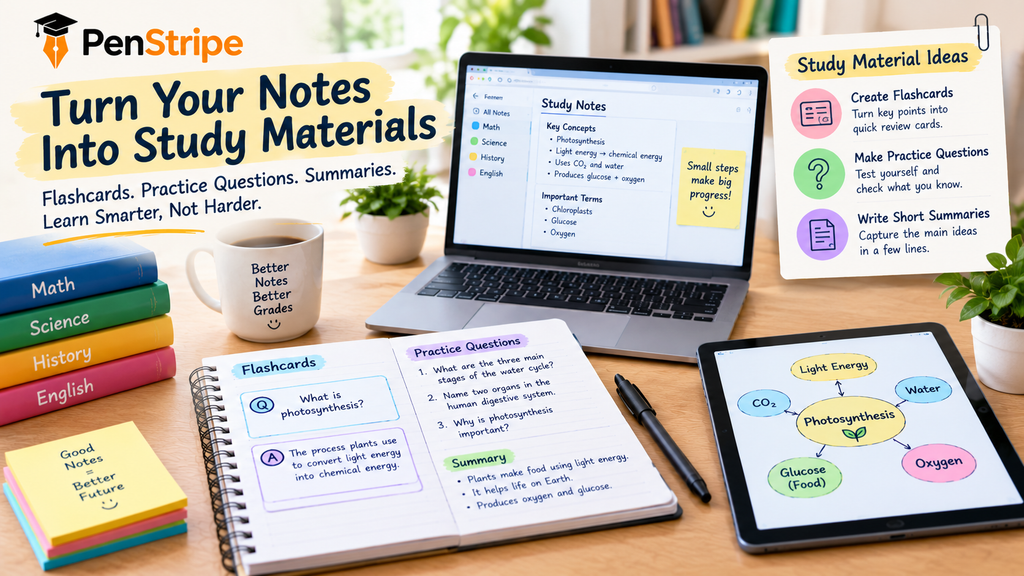
For example, after reading about photosynthesis, ask yourself:
- What is photosynthesis?
- Where does it occur?
- What materials does a plant need?
- What products are created?
- Why is photosynthesis important?
If you cannot answer a question, return to your notes, review the missing information, and test yourself again.
This turns studying into a process of retrieval rather than passive reading.
Create Questions From Your Study Material
Turn headings, definitions, formulas, and major concepts into questions.
For example:
Note: The heart has four chambers.
Question: How many chambers does the human heart have, and what are they?
This approach gives you a ready-made practice system. You can use flashcards, a notebook, or a digital study tool.
Use Spaced Repetition to Improve Memory
Spaced repetition means reviewing information at intervals instead of trying to learn everything during one long session.
Review Information at the Right Time
Instead of studying a topic once and forgetting about it until exam week, return to it several times.
A simple pattern could look like this:
Day 1: Learn the topic
Day 2: Quick review
Day 4: Test yourself
Day 7: Review difficult areas
Day 14: Test yourself again
The exact schedule can vary. The important idea is to spread review across time.
Build a Simple Spaced Repetition Schedule
You do not need a complicated system.
Create three categories:
Need to Learn: Material you do not understand yet.
Needs Review: Material you understand but cannot recall consistently.
Know Well: Material you can recall and explain without help.
Spend most of your time on the first two categories. This prevents you from wasting valuable study time repeatedly reviewing information you already know.
Study With Practice Testing
Practice testing is especially useful when preparing for exams because it requires you to produce an answer instead of simply recognizing information.
Use Practice Questions Regularly
Do not wait until the night before an exam to solve practice questions.
After finishing a topic, answer several questions without looking at the solution. For subjects such as mathematics, science, accounting, or statistics, solve problems yourself before checking the answer.
For reading-heavy subjects, create questions based on important concepts and answer them from memory.
Learn From Your Mistakes
A wrong answer can show you exactly where your understanding needs improvement.
When you make a mistake, do not simply look at the correct answer and move on. Ask:
- What did I misunderstand?
- Where did my reasoning go wrong?
- What information did I forget?
- How can I avoid making the same mistake?
Keep a small mistake log for difficult subjects. Reviewing this list before an exam can make your preparation more targeted.
Break Large Topics Into Smaller Parts
Large chapters can feel overwhelming because they contain too much information at once. Breaking them into smaller sections makes the learning process easier to manage.
Divide Difficult Subjects Into Manageable Sections
Suppose you need to study a 50-page biology chapter.
Instead of writing “Study biology” on your schedule, divide the chapter into specific tasks:
- Cell structure
- Cell membrane
- Cellular transport
- Cell division
- Practice questions
- Review
Now you have several clear targets instead of one huge task.
Focus on One Learning Goal at a Time
Each study session should have a specific objective.
For example:
Weak goal: Study chemistry.
Better goal: Understand three types of chemical bonds and solve five practice questions.
A clear goal tells your brain what to focus on and gives you a way to measure progress.
Use the Pomodoro Technique
The Pomodoro Technique is a simple time-management method that divides work into focused periods followed by short breaks.
Create Focused Study Sessions
A traditional Pomodoro session often uses 25 minutes of focused work followed by a short break. However, students can adjust the length based on their needs.
For example:
45 minutes: Focused study
10 minutes: Break
45 minutes: Focused study
10 minutes: Break
During the focused period, work on one task. Avoid switching between your textbook, social media, messages, and unrelated websites.
Take Breaks Without Losing Momentum
A break should help you recover rather than completely distract you.
Stand up, stretch, drink water, walk around, or rest your eyes. If scrolling through social media makes it difficult to return to studying, choose a different type of break.
The purpose of a break is to return to the next session with attention available again.
Remove Distractions Before Studying
One of the simplest ways to study smarter is to make distraction harder.
Control Phone and Social Media Distractions
If your phone constantly interrupts you, place it away from your desk or use a focus mode.
You can also:
- Turn off unnecessary notifications.
- Keep social media closed during study sessions.
- Use website blockers when needed.
- Put your phone on silent.
- Check messages during planned breaks.
If you are wondering, “How can I focus 100% on studying?” start by removing the distractions that repeatedly compete for your attention.
You do not need perfect concentration every minute. The goal is to create conditions that make focused work easier.
Create a Better Study Environment
Your study environment should make the desired behavior simple.
Keep the materials you need nearby. Clear unnecessary items from your desk. Use comfortable lighting and choose a location where interruptions are limited.
At home, tell family members when you need a quiet study period if possible.
Take Better Notes
Good notes should help you understand and remember information. They do not need to contain every sentence from a lecture or textbook.
Use Short and Organized Notes
Focus on:
- Key ideas
- Definitions
- Important examples
- Formulas
- Relationships between concepts
- Questions you still need to answer
Use headings and short explanations so you can review the material quickly later.
Combine Notes With Active Recall
Do not treat note-taking as the final step.
After writing your notes, close them and explain the main ideas from memory. Then compare your explanation with the original notes.
You can also turn your notes into questions.
For example:
Note: The mitochondria are involved in producing usable energy for cells.
Recall question: What is the role of mitochondria?
This transforms ordinary notes into a study tool.
Focus on Understanding Instead of Memorizing
Memorization has a place in education, but understanding makes information easier to use and remember.
Connect New Ideas With What You Already Know
When learning something new, ask:
What does this remind me of?
How does this idea connect to something I already understand?
For example, when learning a new mathematical formula, understand what each part represents rather than memorizing the symbols without context.
Connections give information meaning.
Explain Difficult Concepts in Simple Words
Try explaining a difficult topic as if you were teaching it to a younger student.
If you cannot explain the concept clearly, you may need to review it again.
This method can reveal gaps that are easy to miss while reading.
For difficult subjects, use this simple process:
Learn → Close the material → Explain → Find gaps → Review → Explain again
Create a Smart Study Schedule
A study schedule should organize your priorities rather than fill every available hour.
Prioritize Important Subjects
Start by identifying:
- Subjects you find difficult.
- Topics that appear frequently on assessments.
- Assignments with approaching deadlines.
- Material you have not reviewed recently.
Give challenging subjects regular attention instead of leaving them until the last minute.
Match Difficult Tasks With Your Best Focus Time
Not everyone has the same energy pattern.
Some students concentrate better in the morning. Others prefer afternoon or evening sessions.
Notice when your attention is strongest and use that period for demanding work.
Save easier activities, such as organizing notes or reviewing flashcards, for times when your energy is lower.
Take Care of Your Brain and Body
Effective studying is difficult when you consistently ignore sleep, movement, food, and recovery.
Get Enough Sleep
Sleep is an important part of learning and memory. Staying awake all night to study may give you more hours with your textbook, but it can leave you tired when you need to recall and apply what you learned.
Instead of making all-night studying your normal strategy, build review into your schedule earlier.
Use Exercise, Food, and Breaks to Support Learning
Regular movement and balanced meals can support your overall energy and well-being.
You can keep your study routine simple:
Study → Break → Move → Return → Review
Drink water, eat regular meals, and avoid turning every study session into an endurance test.
11 Smart Study Tips You Can Start Today
If you want to study smarter not harder, start with a small number of changes instead of completely rebuilding your routine.
- Use active recall instead of only rereading.
- Review material over time instead of cramming.
- Practice with questions before exams.
- Break large topics into smaller tasks.
- Use focused study sessions with planned breaks.
- Remove phone distractions before starting.
- Take concise notes that highlight important ideas.
- Explain difficult concepts in your own words.
- Create specific study goals for every session.
- Review your mistakes instead of ignoring them.
- Protect your sleep and recovery so you can study with better attention.
You do not need to use all 11 strategies immediately. Choose two or three that address your biggest study problems and build from there.
Common Study Mistakes to Avoid

Studying Without a Plan
Opening a textbook and deciding what to do as you go can waste time.
Before starting, choose a specific topic and define what you want to accomplish.
Rereading Everything Repeatedly
Rereading can feel productive because the information looks familiar. However, familiarity is not the same as being able to recall information independently.
Add questions, practice problems, and recall activities to your routine.
Studying for Long Hours Without Breaks
Long sessions can become less productive when attention drops.
Instead of measuring success only by hours studied, measure what you accomplished. Completing three meaningful learning goals is more useful than sitting at a desk for six unfocused hours.
FAQs About Studying Smarter
How can I study smarter not harder?
Study smarter by using active recall, spaced repetition, practice testing, focused sessions, and clear study goals. Instead of repeatedly reading the same material, test yourself and identify what you do not know. Break large topics into smaller tasks and review them over time.
How many hours should I study each day?
There is no single number of hours that works for every student. Your required study time depends on your courses, workload, goals, and current understanding. Focus on productive sessions rather than chasing a specific number of hours. Regular focused study is usually easier to maintain than constant long sessions.
What is the most effective study method?
No single study method works equally well for every situation. Active recall, spaced review, and practice testing are useful approaches because they require you to retrieve and use information. Combining these methods with focused study sessions can create a more effective learning routine.
How can I remember what I study?
Use active recall and spaced repetition. After learning a topic, close your notes and try to explain the main ideas from memory. Review the information again later rather than waiting until the exam. Practice questions can also reveal which information you still need to learn.
How can I study faster and retain more?
Start by removing unnecessary distractions and focusing on one learning goal at a time. Use active recall instead of relying only on rereading, and review important information over multiple sessions. Studying faster should mean reducing wasted effort, not rushing through material without understanding it.
How can I focus 100% on studying?
You cannot always guarantee perfect concentration, but you can make focus easier. Put your phone away, remove unnecessary browser tabs, choose one task, and use a timed study session. When your mind wanders, return to the specific task instead of switching to another activity.
How can I become a top 1% student?
Strong academic performance usually requires more than simply studying longer. Build consistent study habits, understand your subjects deeply, practice retrieving information, manage deadlines, learn from mistakes, and protect your sleep and well-being. Focus on improving your learning process rather than comparing yourself constantly with other students.
What is the 7-8-9 rule for studying?
The phrase “7-8-9 rule” does not have one universally accepted definition as a standard study method. If you encounter this term online, check how the particular source defines it before applying it. For reliable studying, focus on established principles such as retrieval practice, spaced review, practice testing, focused sessions, and adequate rest.
Conclusion
Learning how to study smarter not harder is about making your effort more productive. You do not need to spend every waking hour with a textbook to become a better student.
Start by replacing passive habits with active ones. Test yourself instead of only rereading. Review important information over time. Break difficult subjects into smaller goals, remove distractions, and use focused study sessions.
Your routine does not have to change overnight. Choose two strategies from this guide and use them consistently for the next week. Then evaluate what helped you learn more effectively penstripe
The goal is simple: less wasted effort, better focus, stronger understanding, and more effective learning.