






Getting better grades is not simply about studying for more hours. Many students spend long evenings reading notes but struggle to remember what they studied, stay focused, or perform well on exams. The better approach is to improve the way you learn.
If you want to know how to improve academic performance, start by focusing on a few high-impact behaviors: active learning, spaced review, effective time management, good sleep, distraction control, and regular feedback. These habits help turn studying from a stressful activity into a repeatable system.
Academic performance can also improve when students identify the real reason they are struggling. A weak grade might come from poor study methods, gaps in foundational knowledge, procrastination, unclear goals, test anxiety, or simply an overloaded schedule. The solution depends on the problem.
This guide explains practical strategies students can use in high school, college, or university. You will learn how to study more effectively, improve concentration, build motivation, recover from poor grades, and create a realistic academic improvement plan.
What Does Academic Performance Really Mean?

Academic performance is more than grades
Academic performance refers to how well a student achieves learning goals. Grades are one measure, but they are not the complete picture.
Understanding concepts, completing assignments, participating in class, retaining information, solving problems, preparing for assessments, and developing independent learning skills are also important.
A student who receives an A by memorizing information for one night may not have stronger learning skills than a student who earns a B while developing deep understanding.
The goal should therefore be sustainable academic growth rather than chasing individual grades.
Why do students struggle academically?
Poor academic results can have several causes. Common problems include:
- Passive reading instead of active practice
- Inconsistent study schedules
- Procrastination
- Phone and social media distractions
- Weak foundational knowledge
- Poor time management
- Lack of sleep
- Trying to multitask while studying
- Not asking for help early enough
- Studying only immediately before an exam
The important point is that poor performance does not automatically mean a student lacks ability.
For example, a student struggling with algebra may have difficulty because earlier mathematical concepts were never fully understood. Reviewing advanced formulas repeatedly will not solve the underlying problem. Rebuilding the missing foundation may produce much better results.
Measure the problem before fixing it
Before changing your entire routine, identify where your marks are being lost.
Review your recent tests, assignments, and quizzes. Ask:
- Which subjects are weakest?
- Which types of questions cause the most mistakes?
- Do I understand the material but make careless errors?
- Do I run out of time during tests?
- Do I forget information after studying?
- Do I procrastinate until deadlines?
- Am I attending classes and taking useful notes?
This creates a personal academic diagnosis instead of relying on generic study advice.
How to Improve Academic Performance With Better Study Habits
What are 5 habits for good studying?
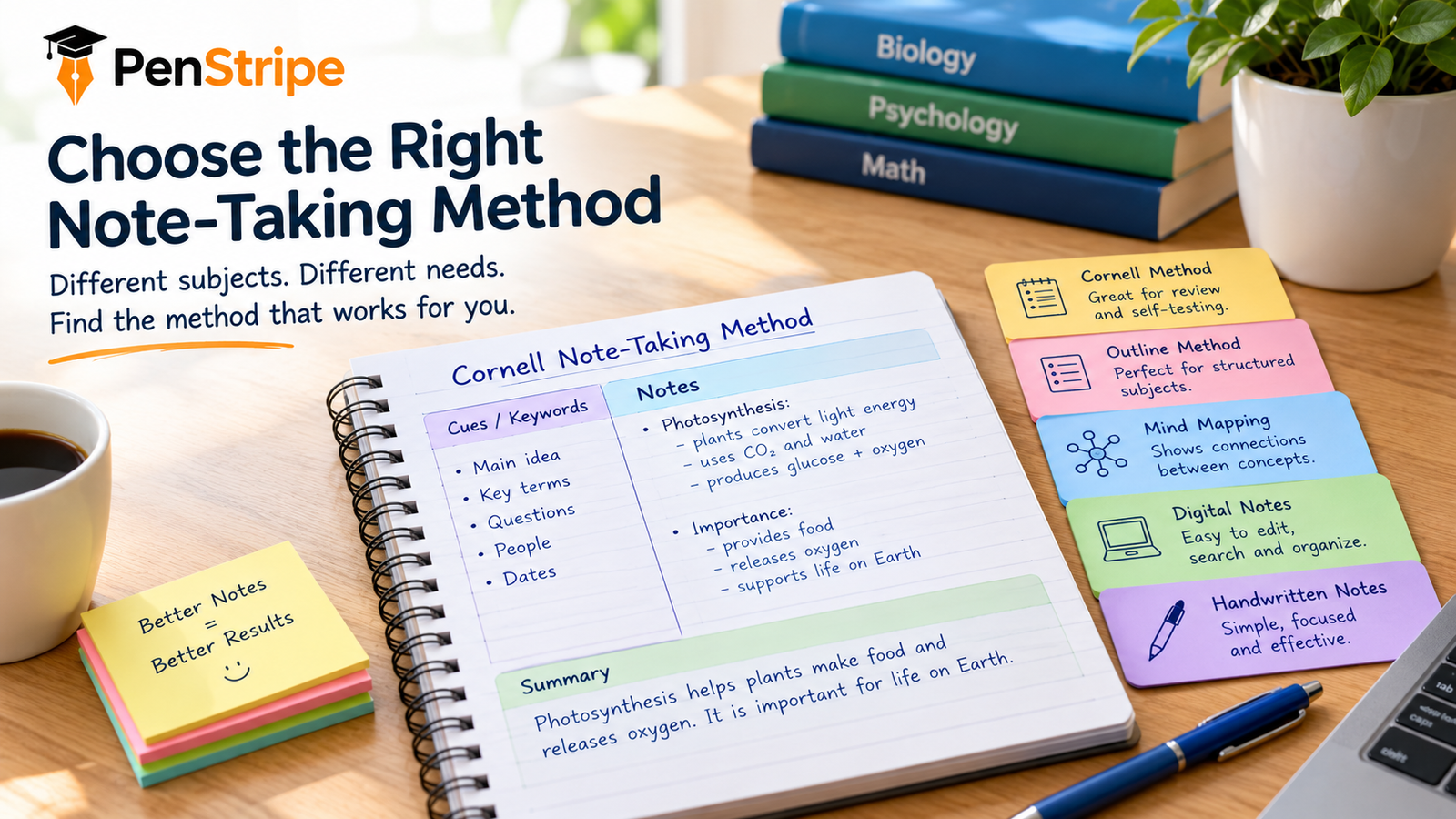
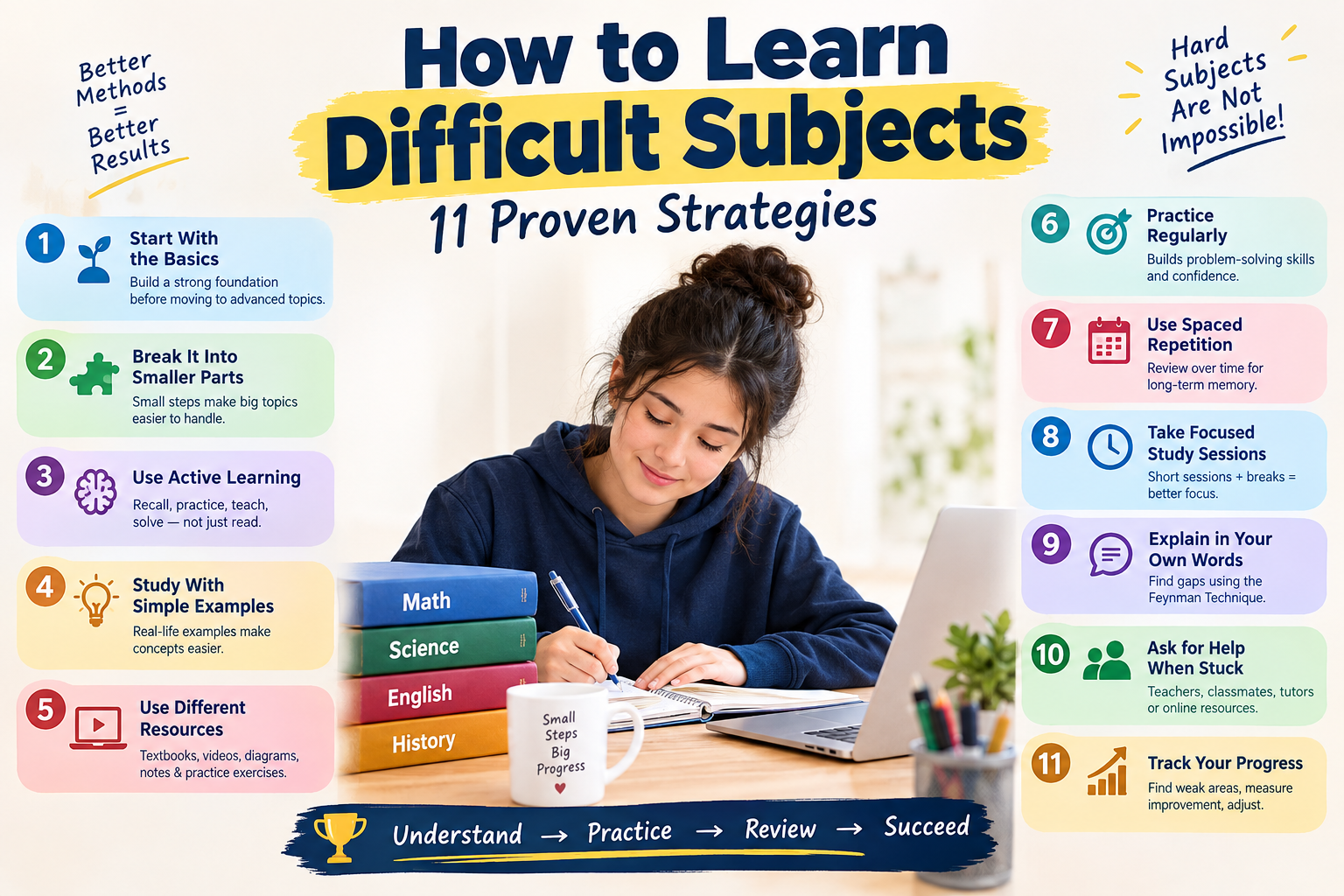
Five particularly useful study habits are active recall, spaced practice, focused study sessions, regular review, and self-testing.
Active recall means attempting to retrieve information from memory instead of simply rereading it. Close your textbook and explain the concept in your own words.
Spaced practice means reviewing information across multiple sessions rather than completing all studying in one sitting.
Focused study requires working on one meaningful task without constantly switching between apps, messages, and unrelated activities.
Regular review prevents previously learned material from disappearing from memory.
Self-testing shows what you actually know. Practice questions, flashcards, quizzes, and explaining a topic without notes can all reveal knowledge gaps.
These methods are generally more useful than repeatedly highlighting the same paragraph.
Use the 50/10 study cycle
A simple approach is to study for 50 minutes and take a 10-minute break.
During the 50-minute session:
- Choose one specific task.
- Put your phone away.
- Keep only necessary materials open.
- Work actively rather than passively reading.
- Record questions you cannot answer.
During the 10-minute break, stand up, drink water, walk briefly, or rest your eyes.
The exact timing does not need to be 50/10. Some students work better with 25/5 or 45/10. The important principle is to create a clear boundary between focused work and recovery.
Replace rereading with active learning
Rereading can create the feeling that material is familiar without proving that you can recall or apply it.
Instead, after studying a topic, close your notes and answer:
- What are the three most important ideas?
- Why does this concept work?
- Can I explain it without looking?
- What example demonstrates it?
- What question could my teacher ask about it?
For subjects such as biology, history, psychology, and science, try explaining the topic as if you were teaching a younger student.
For mathematics and physics, solve problems without immediately checking the solution.
For writing-heavy subjects, practice creating outlines and answering questions under realistic conditions.
How to Improve Academic Performance

A strong schedule does not need to fill every hour.
Start by identifying fixed commitments such as classes, work, meals, exercise, family responsibilities, and sleep. Then place focused study blocks around them.
A useful weekly structure might look like this:
| Activity | Suggested approach |
|---|---|
| Class preparation | 15–30 minutes before difficult classes |
| Same-day review | 20–30 minutes |
| Difficult subject | 45–60 minute focused blocks |
| Practice questions | 30–60 minutes |
| Weekly review | 1–2 hours |
| Exam preparation | Begin days or weeks ahead |
| Planning | 10–15 minutes each evening |
The schedule should be realistic. A plan that requires six perfect hours of studying every day may fail within a week.
How Can I Focus 100% on Studying?
Remove distractions before you begin
If you repeatedly check your phone while studying, relying on willpower alone is inefficient.
Make distraction harder.
Put your phone in another room, use website blockers when necessary, close unnecessary browser tabs, and turn off nonessential notifications.
Your study environment should make the desired behavior easy.
A useful rule is:
Prepare the environment first, then begin the task.
Instead of telling yourself, “I will study chemistry for three hours,” choose a concrete target:
“During the next 45 minutes, I will complete 15 chemistry practice questions and review every mistake.”
Specific goals are easier to start and easier to measure.
Use single-tasking instead of multitasking
Studying while watching videos, checking messages, and switching between assignments creates unnecessary mental interruptions.
Try one-task studying.
For example:
Bad target: Study biology.
Better target: Review cellular respiration and answer 15 practice questions.
The second target tells your brain exactly what success looks like.
Use the five-minute starting rule
When motivation is low, promise yourself that you only need to study for five minutes.
Open the book.
Write the first question.
Solve the first problem.
Read the first section.
Once you begin, continuing is often easier than starting. Even when you stop after five minutes, you have reduced the psychological barrier to beginning future sessions.
Protect your sleep
Sleep should not be treated as time stolen from studying.
Students need sufficient sleep to support attention, learning, memory, and daily functioning. For teenagers, the American Academy of Sleep Medicine recommends 8–10 hours of sleep per 24 hours. For adults aged 18–60, the CDC recommends at least 7 hours.
A student who regularly sacrifices sleep to study may spend more time at the desk while becoming less effective at learning.
A better strategy is to plan study sessions earlier and protect a consistent sleep schedule.
How to Improve Academic Performance of Weak Students

Start with the biggest academic weakness
Students with low grades often make the mistake of trying to improve everything simultaneously.
Instead, identify the subject or skill producing the largest academic problem.
Suppose a student has these results:
| Subject | Current Grade | Priority |
|---|---|---|
| Mathematics | 58% | Very high |
| Biology | 72% | Medium |
| English | 84% | Low |
| History | 79% | Low |
The student should probably spend additional effort on mathematics rather than distributing study time equally across every subject.
Improvement becomes easier when effort follows need.
Rebuild missing foundations
If a student consistently struggles with advanced material, go backward.
Ask, “What do I need to understand before this topic makes sense?”
For example, difficulty with quadratic equations may involve weaknesses in factoring, basic algebra, or arithmetic.
Create a short foundation checklist and repair one gap at a time.
This approach is particularly important for students who believe they are “bad” at a subject. The problem may be a missing sequence of skills rather than a lack of intelligence.
Get feedback quickly
Do not wait until the end of the semester to discover that your study method is ineffective.
Ask teachers specific questions.
Instead of saying:
“I don’t understand math.”
Try:
“I understand how to factor simple equations, but I get confused when the quadratic has a coefficient before x². Can you show me where my method breaks down?”
Specific questions usually produce more useful feedback.
Students can also use tutoring, office hours, study groups, writing centers, academic support programs, and reliable educational resources.
Track mistakes instead of hiding them
Create a mistake log.
For every important error, write:
- The question
- Your answer
- The correct answer
- Why your answer was wrong
- What rule or concept you missed
- How you will avoid the mistake next time
This turns mistakes into study material.
Over time, patterns become visible. You may discover that your problem is not lack of knowledge but rushing, misreading questions, using the wrong formula, or failing to show intermediate steps.
How to Become a Top 1% Student
What separates high-performing students?
How to be a top 1% student? There is no single secret technique.
High-performing students often develop systems that make good academic behavior consistent.
They tend to:
- Start assignments before deadlines.
- Review difficult material regularly.
- Ask questions when confused.
- Track their performance.
- Practice instead of simply rereading.
- Protect sleep.
- Prepare for exams early.
- Learn from mistakes.
- Set specific goals.
- Avoid relying entirely on motivation.
The goal is not to study every waking hour. It is to make your study time more productive.
Set outcome goals and process goals
Outcome goals describe what you want:
“I want an A in biology.”
Process goals describe what you will do:
“I will complete three biology practice sessions each week and review every missed question.”
Process goals are more controllable.
A useful system combines both:
Outcome: Raise biology grade from B- to B+.
Process: Complete four focused study blocks each week.
Measurement: Score at least 80% on weekly practice quizzes.
Review: Identify weak areas every Sunday.
Learn how your assessments work
Study according to the skills your assessment requires.
If an exam requires problem solving, spend significant time solving problems.
If it requires essay writing, practice writing essays.
If it tests vocabulary and factual recall, use retrieval practice and spaced review.
This is called alignment between preparation and performance.
Simply spending more time with course material does not guarantee improvement if the practice does not resemble what you will be asked to do.
Build an environment that supports success
Your environment can influence your behavior.
Keep frequently used study materials organized. Choose a consistent study location. Prepare your desk before beginning. Keep distractions away.
You can also use social accountability.
Tell a classmate what you plan to complete and check in afterward. A study partner can be useful when both students actually work rather than turning the session into a social event.
A Simple Academic Performance Improvement Plan
Step 1: Audit your current performance
Spend 20–30 minutes reviewing your grades, assignments, attendance, tests, and study habits.
Identify your three biggest problems.
For example:
- I procrastinate on assignments.
- I forget material after reading it.
- I lose marks on careless mistakes.
Step 2: Choose three habits
Do not change everything at once.
For the example above:
- Study for 45 minutes immediately after school or class.
- Use active recall after every study session.
- Review mistakes after every test.
Step 3: Create a seven-day experiment
Test the system for one week.
Track:
| Metric | Goal |
|---|---|
| Focused study sessions | 5+ |
| Practice questions | 50+ |
| Phone-free sessions | 5+ |
| Weekly review | 1 |
| Sleep | Consistent schedule |
The purpose is not perfection. The purpose is discovering what works.
Step 4: Review and adjust
At the end of the week, ask:
- What improved?
- What did not work?
- Which subject still needs attention?
- What caused distractions?
- Did I underestimate the time needed?
- Which study method helped me remember information?
Then adjust the next week’s plan.
This creates a feedback loop instead of depending on motivation.
What are the 10 ways to motivate a student?
What are the 10 ways to motivate a student? Motivation strategies work best when they make progress visible and tasks manageable.
Ten practical approaches are:
- Set small, specific goals.
- Connect schoolwork to personal interests.
- Break large assignments into smaller tasks.
- Track progress visibly.
- Celebrate genuine improvement.
- Use short, focused study sessions.
- Provide meaningful feedback.
- Reduce unnecessary distractions.
- Give students some choice over how they study.
- Connect effort with measurable outcomes.
Avoid using fear or constant pressure as the primary motivation strategy. Sustainable academic motivation usually grows when students experience competence, progress, and a clear reason for learning.
Comparison Table: Effective vs. Ineffective Study Methods
| Ineffective approach | Better alternative | Why it helps |
|---|---|---|
| Rereading notes repeatedly | Active recall | Tests actual memory |
| Cramming the night before | Spaced practice | Distributes learning |
| Highlighting everything | Writing brief explanations | Forces processing |
| Studying with constant notifications | Phone-free sessions | Reduces interruptions |
| Only studying favorite subjects | Prioritizing weak areas | Targets improvement |
| Checking answers immediately | Attempting first | Strengthens retrieval |
| Studying for hours without breaks | Focused study blocks | Supports sustained attention |
| Ignoring mistakes | Maintaining a mistake log | Reveals patterns |
| Waiting for motivation | Following a schedule | Builds consistency |
| Sacrificing sleep | Protecting sleep | Supports learning and attention |
Frequently Asked Questions
How can I improve my academic performance quickly?
The fastest sustainable improvement usually comes from fixing the biggest weakness first. Identify where you are losing marks, switch from passive rereading to active practice, schedule focused study sessions, and review mistakes. Also protect sleep and ask teachers for targeted feedback. Small improvements repeated consistently are more reliable than last-minute cramming.
How to be a top 1% student?
How to be a top 1% student? Focus on consistency rather than trying to study all day. Use active recall, spaced practice, realistic planning, frequent self-testing, and mistake analysis. Start assignments early, ask questions quickly, protect sleep, and track your results. High academic performance usually comes from a strong system repeated over time.
What are 5 habits for good studying?
Five useful habits are active recall, spaced practice, focused single-tasking, regular review, and self-testing. Together, these habits help students retrieve information, identify knowledge gaps, and avoid depending entirely on last-minute studying. A consistent routine is usually more valuable than occasional marathon sessions.
How can I focus 100% on studying?
You cannot guarantee perfect focus, but you can make concentration easier. Remove your phone, turn off unnecessary notifications, choose one specific task, work in a timed block, and take planned breaks. Instead of setting a vague goal such as “study chemistry,” choose a measurable target such as completing 15 practice questions.
How can I improve academic performance of weak students?
Begin by identifying the specific reason for low performance. Check for foundational knowledge gaps, ineffective study methods, missed assignments, concentration problems, or test-taking issues. Then choose one or two high-impact interventions, provide frequent feedback, and monitor progress. Students should be supported rather than labeled according to their current grades.
What are the 10 ways to motivate a student?
Ten useful approaches include setting clear goals, breaking tasks into smaller steps, connecting learning with interests, tracking progress, providing useful feedback, celebrating improvement, reducing distractions, offering reasonable choice, creating accountability, and showing how learning connects to future goals. Motivation is stronger when students can see progress and understand why the work matters.
How many hours should a student study each day?
There is no universal number that guarantees better grades. Study requirements vary by age, course difficulty, workload, and individual needs. Instead of focusing only on hours, measure productive output. A focused 60-minute session with practice and retrieval can be more useful than several hours of distracted rereading.
Does sleep affect academic performance?
Yes. Sleep supports attention, learning, memory, and daytime functioning. Regularly sacrificing sleep for studying can undermine the effectiveness of your study time. Teenagers generally need 8–10 hours of sleep per 24 hours, while most adults need at least 7 hours. A consistent sleep routine should be part of an academic improvement strategy.
Conclusion
Learning how to improve academic performance is less about finding a secret trick and more about building an effective system. Start by identifying your weakest areas, then use active recall, spaced practice, focused study sessions, mistake analysis, and regular feedback to improve them.
If your grades are currently low, do not assume you lack ability. Find the specific barrier, repair missing foundations, and measure progress over time. If you already perform well, refine your system rather than simply adding more study hours.
Start today with three actions: choose one weak subject, complete one distraction-free study session, and review your mistakes before tomorrow. Repeat those actions consistently, adjust your strategy based on results, and give your academic skills time to develop.
Better academic performance is rarely created by one extraordinary study session. It is built through ordinary, effective habits repeated consistently penstripe