





Learning a new language can feel overwhelming at first. You have unfamiliar words to remember, grammar rules to understand, sounds to pronounce, and conversations to follow. The good news is that you do not need to spend years studying before you can start communicating. With the right approach, consistent practice, and realistic goals, you can make noticeable progress much faster.
If you are wondering how to learn a new language fast, the most important step is to stop treating language learning as simple memorization. A language is a practical skill. You need to hear it, understand it, speak it, read it, and use it repeatedly in meaningful situations.
This guide explains 11 proven strategies that can make your learning routine more efficient. You will discover the best way to learn a language, how to memorize vocabulary, how to practice speaking, how to learn by yourself at home, and how to build a realistic 30-day routine. You will also learn whether it is possible to learn a language in seven days and what A1, A2, B1, B2, C1, and C2 actually mean.
How to Learn a New Language Fast

The fastest approach is not about studying for an extreme number of hours. It is about spending your available time on activities that produce useful learning.
1. Choose One Clear Language Goal
Start by deciding why you want to learn the language.
Your goal could be:
- Hold basic conversations
- Travel comfortably
- Communicate with family
- Study abroad
- Improve career opportunities
- Understand movies and music
- Become conversational
- Eventually reach fluency
Your goal determines what you should learn first.
For example, someone preparing for a vacation does not need the same vocabulary as someone planning to work professionally in another country. A traveler may prioritize greetings, directions, transportation, restaurants, numbers, and emergency phrases.
A clear goal prevents you from wasting time learning information you are unlikely to use.
2. Learn High-Frequency Words and Phrases
One of the smartest ways to learn a language faster is to prioritize commonly used vocabulary.
Instead of trying to memorize thousands of random words, start with words related to your everyday life.
Focus on categories such as:
- Greetings
- Family
- Food
- Numbers
- Time
- Transportation
- Work
- School
- Shopping
- Common verbs
- Question words
- Everyday expressions
Also learn complete phrases.
Knowing a useful phrase can be more valuable than knowing individual words without understanding how they work together.
For example, instead of memorizing only “want,” learn a practical sentence pattern such as “I want to…” and then substitute different words.
3. Practice Every Day
Consistency matters more than occasional marathon sessions.
A learner who practices for 30 minutes every day can build a stronger routine than someone who studies for four hours once a week and then stops.
A simple daily routine could look like this:
| Activity | Time |
|---|---|
| Vocabulary review | 10 minutes |
| Listening | 10 minutes |
| Speaking | 10 minutes |
| Reading | 10 minutes |
| Writing | 5–10 minutes |
You do not have to follow these exact times. The important principle is regular exposure.
4. Use the Language From Day One
Do not wait until you know perfect grammar before using the language.
Start with simple sentences.
Talk about:
- Your name
- Where you live
- Your family
- Your hobbies
- Your daily routine
- What you like
- What you want
- What you did today
Making mistakes is normal. In fact, mistakes show you where your knowledge needs improvement.
The goal at the beginning is communication, not perfection.
5. Combine Listening, Speaking, Reading, and Writing
A language has several interconnected skills. If you only study vocabulary lists, you may recognize words but struggle to understand a real conversation.
Try to practice all four major skills:
Listening: Understand what people say.
Speaking: Produce words and sentences.
Reading: Recognize written language.
Writing: Build sentences accurately.
A balanced routine helps prevent one skill from developing much faster than the others.
What Is the Best Way to Learn a Language?

There is no single method that works perfectly for everyone. However, combining active practice, repeated exposure, meaningful context, and real communication creates a strong learning system.
Use Active Recall
Active recall means attempting to remember information before looking at the answer.
Instead of repeatedly reading a vocabulary list, cover the translation and try to produce the word yourself.
For example:
English: “window”
Your task: Say the word in the language you are learning.
If you cannot remember it, check the answer and try again later.
This approach makes vocabulary practice more active.
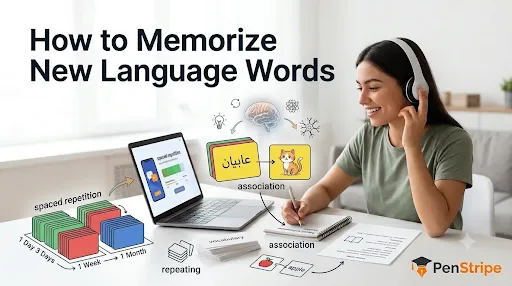
Practice Spaced Repetition
Spaced repetition means reviewing information over increasing periods rather than repeating everything in one session.
You might review a new word:
- Later the same day
- The next day
- A few days later
- The following week
- Again after additional time
The purpose is to revisit information before it completely disappears from memory.
This is especially useful for vocabulary, irregular verbs, definitions, and phrases.
Learn Through Context
Words are easier to understand when you see how they are used.
Instead of memorizing:
“appointment = ___”
learn the word inside a meaningful sentence.
For example:
“I have a doctor’s appointment tomorrow.”
Context helps you understand not only what a word means but also how it behaves in a real sentence.
Try Immersion Learning
Immersion does not necessarily mean moving to another country.
You can create a small language-learning environment around yourself.
Try:
- Watching videos in the target language
- Listening to podcasts
- Reading simple articles
- Following native speakers online
- Listening to songs
- Changing selected device settings
- Speaking with language partners
The more meaningful exposure you receive, the more familiar the language becomes.
How to Memorize New Language Words
Vocabulary is one of the biggest challenges for beginners. The solution is not simply memorizing more words. You need a system that makes those words easier to retrieve and use.
Use Flashcards Strategically
Flashcards are useful when each card focuses on a manageable piece of information.
Instead of putting an entire paragraph on one card, keep it simple.
Front: What does this phrase mean?
Back: Translation + a short example.
For better results, try producing the answer before revealing it.
Digital flashcards can make it easier to review vocabulary regularly, while physical cards can work well for learners who prefer writing by hand.
Group Vocabulary by Topic
Organizing vocabulary into meaningful categories can make learning more practical.
For example:
Travel
- Airport
- Ticket
- Hotel
- Passport
- Train
- Station
Food
- Breakfast
- Dinner
- Water
- Restaurant
- Menu
- Order
Daily Life
- Wake up
- Work
- Study
- Sleep
- Cook
- Walk
Topic-based vocabulary is easier to apply because you can practice related words together.
Create Personal Connections
Connect unfamiliar words with images, situations, people, or experiences.
If you learn a word for “rain,” imagine yourself standing outside in heavy rain while saying the word.
Personal associations can make vocabulary more memorable.
Use New Words in Sentences
Do not stop after learning a translation.
Use the word.
Write a sentence. Say a sentence. Ask a question using the word.
If you learn the word “coffee,” you might create several sentences:
“I drink coffee.”
“I like coffee.”
“Where can I buy coffee?”
“I would like a coffee.”
This turns passive vocabulary into usable language.
How to Speak a New Language Fluently
Fluency develops through repeated communication, not just studying grammar rules.
Start Speaking Before You Feel Ready
Many learners wait until they believe their vocabulary and grammar are good enough.
That can delay progress.
Start with short sentences and gradually increase complexity.
You can practice by describing what you see around you:
“This is my desk.”
“The book is on the table.”
“I am studying now.”
Simple sentences create a foundation for longer conversations.
Find Conversation Practice
Real interaction gives you something textbooks cannot completely reproduce.
You can practice with:
- A language exchange partner
- A tutor
- A friend
- A conversation group
- Online speaking communities
- Language-learning services
During conversation practice, ask the other person to correct important mistakes rather than interrupting every sentence.
Too many corrections can make beginners afraid to speak.
Improve Your Pronunciation
Good pronunciation starts with listening.
Choose a short sentence from a native speaker and listen carefully. Then repeat it while trying to copy the rhythm, sounds, and intonation.
Recording yourself can also help.
Compare your pronunciation with the original and identify one or two sounds to improve rather than attempting to fix everything at once.
Think in the Target Language
As your vocabulary grows, practice thinking using simple words from your new language.
When you see a door, mentally name it.
When you drink water, describe the action.
When you walk outside, describe what you see.
This reduces your dependence on translating every sentence from your first language.
How to Learn a Language at Home
You can make substantial progress without attending a traditional classroom. Learning independently simply requires structure.
Create a Language Learning Space
Choose one place where you regularly practice.
Keep useful materials nearby:
- Notebook
- Flashcards
- Headphones
- Dictionary
- Reading material
- Study planner
A consistent environment can make it easier to maintain your routine.
Use Online Resources
Online resources can provide access to lessons, pronunciation examples, vocabulary practice, videos, reading materials, and conversations.
However, avoid downloading dozens of apps and using none consistently.
Choose a small number of useful resources and learn how to use them well.
Watch Content for Learners
If you are a beginner, native-level movies without support may feel overwhelming.
Start with content you can mostly understand.
Use subtitles when helpful. As your listening ability improves, gradually reduce your dependence on them.
A useful progression is:
Native-language subtitles → target-language subtitles → no subtitles
The exact progression depends on your ability/penstrip
Read Simple Mater
Start with content that is slightly challenging but still understandable.
You could use:
- Graded stories
- Beginner dialogues
- Children’s books
- Simple news
- Short articles
- Language-learning texts
Do not stop for every unfamiliar word. Try to understand the overall meaning first, then investigate important vocabulary.
How to Learn a Language Quickly in 30 Days
Thirty days is enough to create momentum, build useful vocabulary, and establish basic communication habits. It is not a realistic guarantee of complete fluency for every learner.
Days 1–7: Build the Foundation
Focus on:
- Greetings
- Numbers
- Essential verbs
- Basic questions
- Pronunciation
- Common phrases
- Everyday vocabulary
Spend some time listening and speaking every day.
Days 8–14: Build Simple Sentences
Start combining vocabulary into sentences.
Practice:
- Present-tense sentences
- Questions
- Negatives
- Basic descriptions
- Daily routines
- Personal information
Your goal is to move beyond isolated words.
Days 15–21: Increase Speaking and Listening
Spend more time using the language.
Try:
- Short conversations
- Beginner podcasts
- Simple videos
- Voice recordings
- Reading aloud
- Question-and-answer practice
Focus on understanding and communicating rather than achieving perfect grammar.
Days 22–30: Review and Communicate
Use everything you have learned.
Try having a basic conversation about yourself, your family, your work, your interests, food, travel, or daily activities.
At the end of the month, test yourself.
Ask:
- How many words can I recall?
- Can I introduce myself?
- Can I understand simple speech?
- Can I ask basic questions?
- Can I write a short paragraph?
- Which areas still cause problems?
This gives you a clear starting point for the next month.
How to Learn a New Language by Yourself for Free
You do not need an expensive course to begin.
A free self-study system can include:
- Free beginner lessons
- Free videos
- Public library resources
- Free reading material
- Language exchange opportunities
- Free flashcard tools
- Podcasts for learners
- Your own notebook and study plan
The biggest challenge with free resources is organization. Choose a simple routine instead of jumping between dozens of unrelated lessons.
How to Learn a New Language Fast for Beginners
Beginners should avoid trying to master advanced grammar immediately.
Start with practical communication.
Learn how to:
- Introduce yourself
- Ask simple questions
- Give basic answers
- Describe your routine
- Talk about family
- Order food
- Ask for directions
- Talk about likes and dislikes
Once you can communicate basic ideas, gradually expand your grammar and vocabulary.
How to Learn a New Language as an Adult
Adults can successfully learn another language, although they may have different challenges from children.
Adults often have limited time because of work, family, and other responsibilities.
The solution is to make language learning fit your existing routine.
For example:
Morning: Review five vocabulary items.
Lunch: Listen to a short lesson.
Evening: Practice speaking for 15 minutes.
Before bed: Review difficult words.
Small sessions can add up when you maintain them consistently.
Language Learning Levels Explained: A1 to C2

The A1, A2, B1, B2, C1, and C2 labels are commonly used in the Common European Framework of Reference for Languages (CEFR).
| Level | General Meaning |
|---|---|
| A1 | Beginner |
| A2 | Elementary |
| B1 | Intermediate |
| B2 | Upper-intermediate |
| C1 | Advanced |
| C2 | Highly proficient |
These levels describe increasing ability across areas such as understanding, speaking, reading, and writing.
A learner does not necessarily progress at exactly the same speed in every skill. Someone might understand conversations fairly well while still struggling to speak spontaneously.
What Are the 7 Stages of Language Learning?
There is no single universally accepted system of exactly seven stages for every language learner. However, learning can be viewed as a practical progression:
- Exposure — becoming familiar with sounds and words.
- Recognition — understanding common words and phrases.
- Basic production — creating simple sentences.
- Conversation — participating in basic interactions.
- Expansion — developing vocabulary and grammar.
- Fluency development — communicating with greater ease.
- Advanced proficiency — handling complex communication more naturally.
The speed of progression depends on the language, learner, practice time, previous experience, and learning environment.
What Are the 3 Hardest Languages?
There is no universal ranking of the three hardest languages because difficulty depends heavily on your first language.
For an English speaker, languages that differ substantially from English in writing systems, grammar, sounds, or sentence structure may require more learning time.
Frequently cited examples include:
- Mandarin Chinese
- Arabic
- Japanese
That does not mean these languages are inherently “hard.” A learner’s linguistic background makes a major difference. Someone who already speaks a related language may find a particular language much easier than an English-only speaker.
Can I Learn a Language in 7 Days?
You can make meaningful progress in seven days, but becoming fluent in a completely new language in one week is generally unrealistic.
In seven days, a focused beginner could work toward:
- Basic greetings
- Essential phrases
- Numbers
- Simple questions
- Basic introductions
- Useful travel expressions
- A small core vocabulary
Think of seven days as a launch period, not a complete language-learning journey.
The better question is not “Can I become fluent in seven days?” but “What useful communication skills can I build in seven days?”
Best Language Learning Methods Compared
| Method | Best For | Main Strength | Challenge |
|---|---|---|---|
| Active Recall | Vocabulary | Improves retrieval | Requires effort |
| Spaced Repetition | Long-term memory | Regular review | Needs consistency |
| Conversation | Speaking | Real communication | Can feel difficult initially |
| Immersion | Overall skills | Lots of exposure | Can overwhelm beginners |
| Flashcards | Vocabulary | Convenient review | Can become passive |
| Reading | Vocabulary | Builds comprehension | Advanced text may be difficult |
| Listening | Understanding | Improves comprehension | Native speech can be fast |
| Writing | Grammar | Reveals mistakes | Requires correction |
The most effective routine usually combines several methods instead of relying on one technique.
Common Language Learning Mistakes
Trying to Learn Too Much at Once
A huge vocabulary list can quickly become overwhelming.
Prioritize useful words and gradually expand your vocabulary.
Focusing Only on Grammar
Grammar matters, but knowing grammar rules does not automatically mean you can communicate.
Balance grammar study with listening and speaking.
Memorizing Without Context
A translation alone may not tell you how a word is actually used.
Learn words inside phrases and sentences whenever possible.
Avoiding Conversation
You will not become comfortable speaking if you never practice speaking.
Start with simple conversations and increase difficulty gradually.
Changing Resources Constantly
Using a new app every few days can create the feeling of progress without consistent learning.
Choose a manageable system and stick with it long enough to evaluate whether it works.
Frequently Asked Questions
What is the fastest way to learn a new language?
The fastest practical approach combines frequent exposure, high-frequency vocabulary, active recall, listening, speaking, reading, and regular review. Instead of studying everything, prioritize the language you actually need and use it every day.
How long does it take to learn a new language?
There is no universal timeline. The difficulty of the language, your first language, learning goals, previous experience, practice frequency, and amount of exposure all affect progress. Basic communication can develop much earlier than advanced proficiency.
Can I learn a language by myself?
Yes. You can learn a language independently using structured lessons, books, videos, flashcards, reading material, listening practice, and speaking opportunities. Self-study works best when you follow a consistent routine and regularly test whether you can actually use what you have learned.
Can I learn a language in 7 days?
You can learn useful words, phrases, pronunciation basics, and simple communication patterns in seven days, but complete fluency is not a realistic expectation for most beginners. Use the first week to establish a foundation and continue building from there.
How can I memorize new language words quickly?
Use active recall, spaced repetition, flashcards, personal associations, and example sentences. Instead of repeatedly reading a word, try to retrieve it from memory and then use it in a meaningful sentence.
How can I speak a new language fluently?
Speak regularly, listen to native or proficient speakers, learn useful phrases, practice pronunciation, and have real conversations. Fluency develops through repeated use, so do not wait until your grammar is perfect before speaking.
What is A1, A2, B1, B2, C1, C2 in language?
These are CEFR proficiency levels. A1 and A2 represent beginner and elementary ability, B1 and B2 represent intermediate levels, while C1 and C2 represent advanced and highly proficient ability. The levels describe increasing language competence across different skills.
What are the 3 hardest languages to learn?
Difficulty depends on your native language and previous language experience. For many English speakers, Mandarin Chinese, Arabic, and Japanese are often considered challenging because of differences in writing, sounds, grammar, and vocabulary. However, the difficulty varies from learner to learner.
Conclusion
Learning a language quickly is less about finding a magical shortcut and more about building an efficient system. If you want to know how to learn a new language fast, start with useful vocabulary, practice every day, use active recall, review with spaced repetition, and spend plenty of time listening and speaking.
You do not need to master everything at once. Set a clear goal, learn the language you actually need, and gradually increase the difficulty of your practice. If you are learning by yourself, create a simple routine that fits your schedule and use a combination of free or paid resources rather than constantly switching between them.
Start with your first 10 useful words today, create a few simple sentences, and speak them aloud. Small, consistent actions can turn a completely unfamiliar language into something you can understand and use penstripe