




Knowing you need to study and actually feeling ready to study are two very different things. You may have an important exam coming up, a long list of assignments, or a personal academic goal, yet still find yourself scrolling on your phone, watching videos, or putting your books away after a few minutes.
Learning how to stay motivated to study is not about forcing yourself to feel excited every day. Motivation naturally changes. Some days you will feel focused and productive, while other days even opening a textbook can feel difficult. The key is to create a study system that works even when motivation is low.
Simple changes can make a big difference. Setting smaller goals, creating a realistic routine, removing distractions, using active study methods, and tracking progress can make studying feel less overwhelming.
This guide explains practical ways to build study motivation, overcome procrastination, stay focused at home, prepare for exams, and develop habits that make consistent studying easier.
Why Do You Lose Motivation to Study?
Before trying to increase motivation, it helps to understand why studying feels difficult in the first place. Lack of motivation does not always mean that you are lazy. Sometimes the real problem is an unclear goal, an unrealistic workload, tiredness, distractions, or fear of failure.
Common reasons students struggle with studying include:
- The subject feels difficult or boring.
- The workload seems too large.
- There is no clear study plan.
- Social media and phones create constant distractions.
- Previous poor results reduce confidence.
- The student expects perfection.
- Studying is associated with stress rather than progress.
- The student has not developed a consistent routine.
When a task feels enormous, your brain may naturally look for something easier and more immediately rewarding. Instead of thinking, “I have to finish this entire chapter,” focus on one small action, such as reading two pages or answering five questions.
The goal is not to create perfect motivation. The goal is to make starting easier.
How to Stay Motivated to Study Every Day
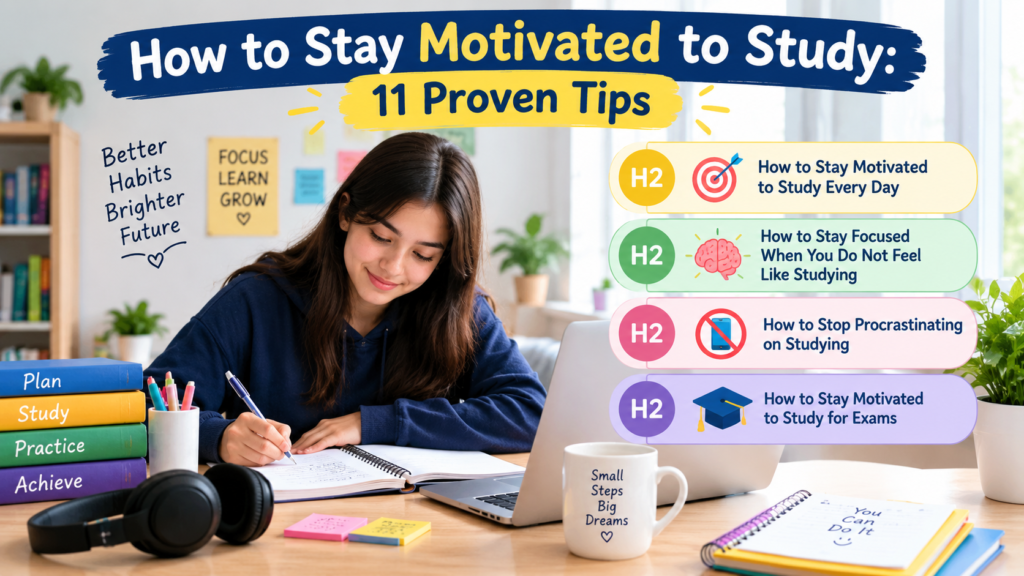
Daily motivation becomes easier when you stop depending entirely on feelings. A good routine gives you a clear starting point and reduces the number of decisions you have to make.
1. Set Small and Specific Study Goals
One of the easiest ways to lose motivation is to create a vague goal such as “study biology all day.” You may sit at your desk without knowing exactly what to do.
Instead, create a specific target.
For example:
- Read pages 20–30.
- Learn 15 vocabulary words.
- Complete 10 practice questions.
- Review yesterday’s notes for 20 minutes.
- Write a one-page summary.
Small goals provide a visible finish line. Once you complete one task, you can decide what comes next.
A useful approach is to divide a large academic goal into smaller daily actions. This makes progress easier to see and can reduce the feeling of being overwhelmed.
2. Create a Realistic Study Schedule
A study schedule should help you, not punish you. If you create a schedule that requires six or eight hours of intense studying every day, you may abandon it after a few days.
Start with study periods that realistically fit your school, work, sleep, and personal responsibilities.
For example:
Morning:
- 30 minutes of review
Afternoon:
- 45 minutes of difficult coursework
Evening:
- 30 minutes of practice questions
Leave room for breaks. A sustainable schedule is usually more useful than an ambitious schedule that you cannot maintain.
3. Start With Five Minutes
When you do not feel motivated, tell yourself that you only need to study for five minutes.
Open the book. Put your phone away. Read the first page. Write one answer. Begin.
The hardest part is often starting. Once you begin, continuing may feel easier because the task is no longer just an idea in your head.
This strategy is especially useful when you are thinking, “I will study later.” Replace “later” with one tiny action you can take immediately.
4. Make Your Study Environment Better
Your environment can either support concentration or constantly compete for your attention.
Before studying, prepare your workspace:
- Keep only necessary materials on the desk.
- Put your phone away or silence notifications.
- Keep water nearby.
- Use adequate lighting.
- Close unrelated browser tabs.
- Keep distracting items out of reach.
If you normally study in a noisy or distracting location, experiment with a quieter environment such as a library, dedicated study area, or calm room at home.
How to Stay Focused When You Do Not Feel Like Studying
Motivation and concentration are connected, but they are not the same thing. You can be motivated to achieve a goal and still struggle to focus.
The solution is to make focused studying easier.
Use Short Study Sessions
Long study sessions can become mentally exhausting, especially when the material is difficult. One practical approach is to divide your work into focused sessions followed by short breaks.
For example:
- 25 minutes: Study
- 5 minutes: Break
- 25 minutes: Study
- 5 minutes: Break
- 25 minutes: Study
- Longer break
This resembles the Pomodoro technique and can help create clear periods for focused work.
The exact timing does not have to be 25 minutes. Some students may prefer 30, 40, or 50-minute sessions. Choose a duration that allows you to concentrate without feeling overwhelmed.
Make Studying More Interesting
If studying feels repetitive, change the way you interact with the material.
Instead of only rereading a textbook, try:
- Flashcards
- Practice questions
- Mind maps
- Self-quizzing
- Teaching the topic aloud
- Short summaries
- Diagrams
- Practice tests
Active learning can make study sessions more engaging because you are doing something with the information instead of simply looking at it.
Put Your Phone Away
A phone can turn a short study break into an hour of scrolling.
If you repeatedly check notifications while studying, create physical distance between yourself and the device. Put it in another room, inside a bag, or somewhere that requires effort to reach.
You can also turn off nonessential notifications during your study session.
The goal is not to eliminate technology. It is to control when technology gets your attention.
How to Stop Procrastinating on Studying
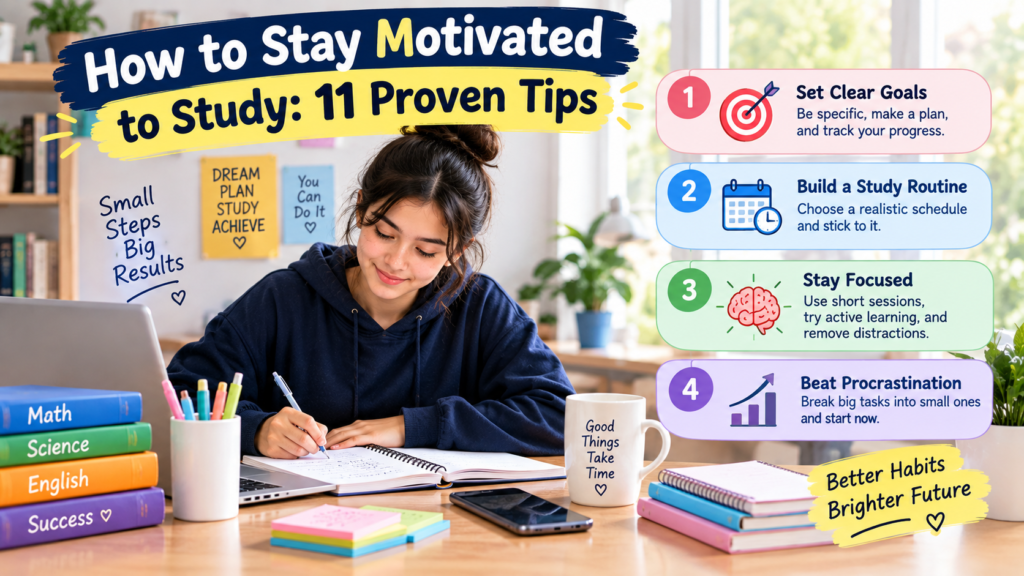
Procrastination often becomes a cycle:
You avoid studying → the workload grows → you feel stressed → studying feels even harder → you avoid it again.
Breaking that cycle requires reducing the size of the first step.
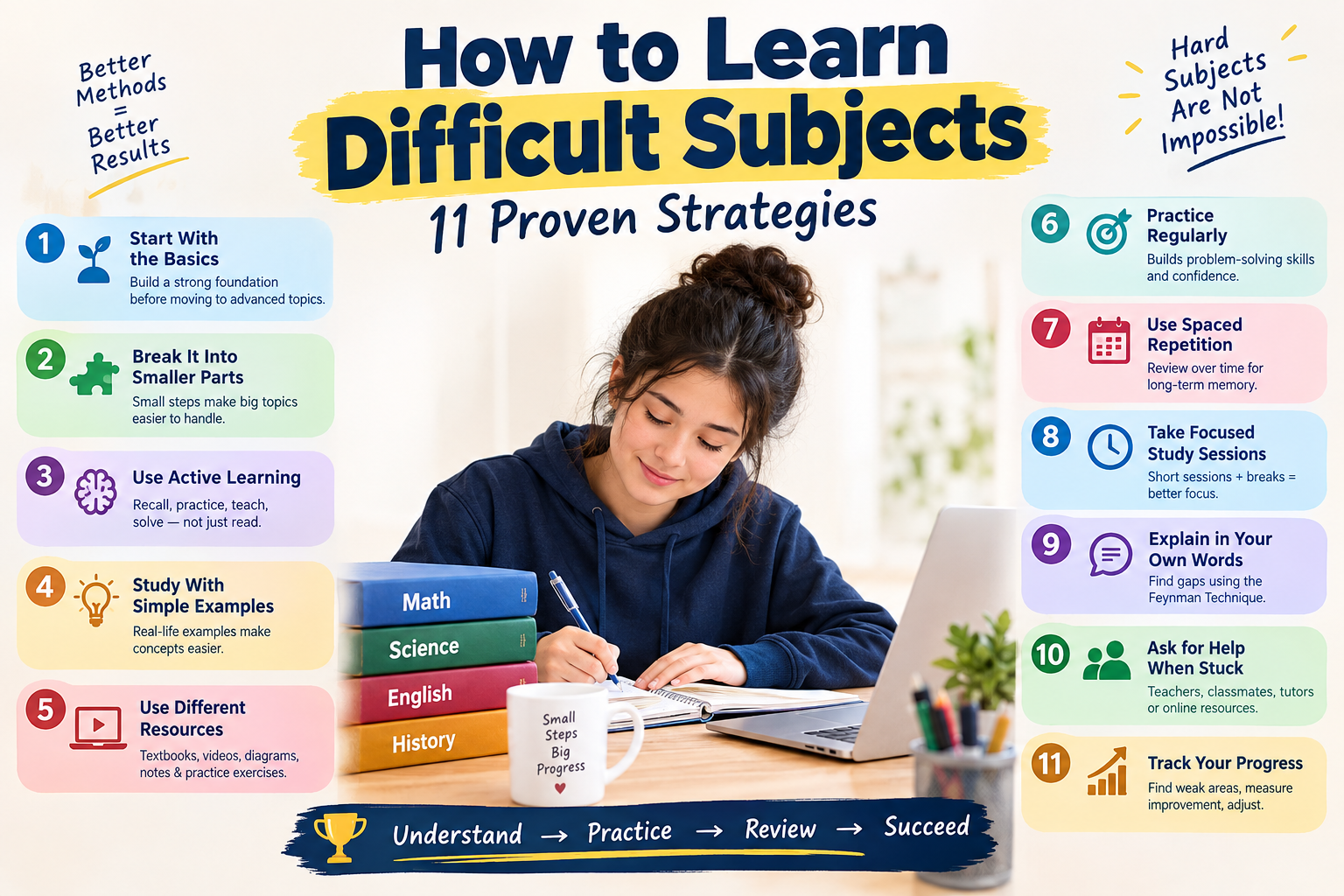
Break Large Tasks Into Smaller Tasks
Imagine that you have to prepare an entire chapter for an exam. “Study the chapter” sounds like one huge task.
Break it into smaller actions:
- Read the headings.
- Study the first section.
- Write five key points.
- Answer practice questions.
- Review mistakes.
- Move to the next section.
Now you have several achievable tasks instead of one overwhelming task.
Use a “Start Now” Rule
Do not wait for the perfect mood to appear.
If you know you need to study, take one action immediately. Open your notes. Write the heading. Solve one question. Read one paragraph.
Motivation often follows action rather than appearing before it.
Once you begin making progress, the task may feel less difficult than it did when you were only thinking about it.
How to Stay Motivated to Study for Exams
Exam preparation creates a special challenge because the deadline can create both motivation and anxiety.
The best approach is to replace last-minute pressure with smaller milestones.
Create an Exam Countdown Plan
Start by identifying:
- Exam date
- Subjects
- Topics
- Difficult areas
- Practice requirements
- Review days
Then distribute the workload across the available days.
For example, if you have four weeks before an exam, you might use the first weeks for learning and practice, followed by dedicated review and practice-test sessions.
Do not leave every difficult topic for the final few days.
Track Your Progress
A simple checklist can make your progress visible.
For example:
☐ Chapter 1
☐ Chapter 2
☐ Chapter 3
☐ Practice Test 1
☐ Review mistakes
☐ Chapter 4
Checking completed tasks gives you a clear picture of what you have already accomplished.
Focus on Progress, Not Perfection
A common mistake is believing that every study session must be highly productive.
Real study sessions vary. Some days you may understand a topic quickly. Other days you may need to review the same concept several times.
Instead of asking, “Did I study perfectly today?” ask:
“What did I understand today that I did not understand before?”
That question keeps your attention on progress.
How to Build Long-Term Study Habits
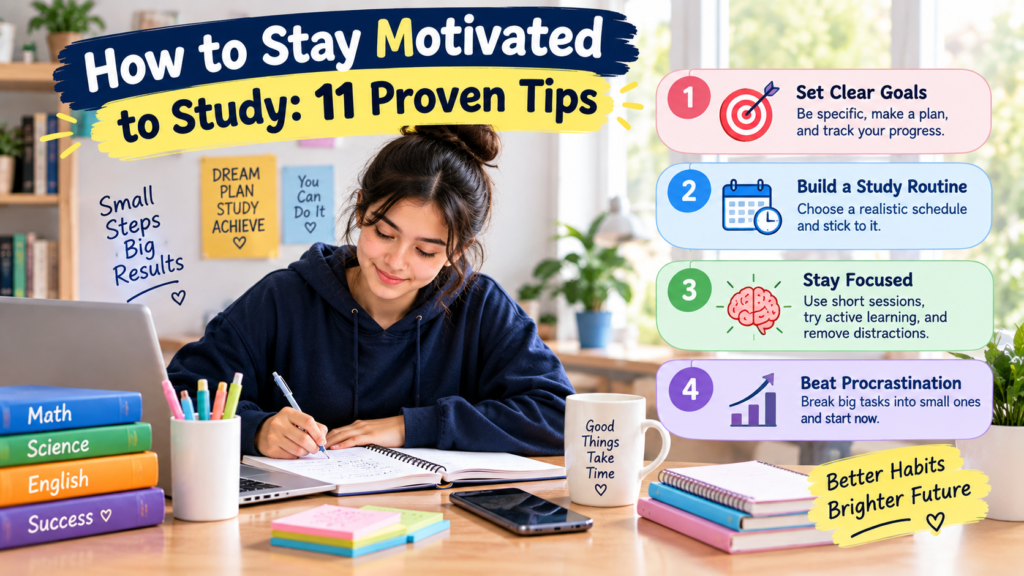
If you want to stay motivated for months, motivation alone is not enough. You need habits that make studying a normal part of your routine.
Study at a Consistent Time
Try studying at roughly the same time each day. A consistent routine can make it easier to transition into study mode.
For example, you might study after breakfast, after school, or after dinner depending on your schedule.
Consistency matters more than choosing a supposedly “perfect” study time.
Create a Daily Study Routine
A simple routine could look like this:
- Prepare your workspace.
- Decide your first task.
- Put away distractions.
- Start a focused study session.
- Take a short break.
- Continue with the next task.
- Record what you completed.
Repeating the same process can make studying feel more automatic.
Avoid Study Burnout
Studying harder is not always the answer. If you constantly sacrifice sleep, meals, exercise, relaxation, and social time, your routine may become difficult to sustain.
Include recovery in your plan.
Get adequate sleep, take reasonable breaks, move your body, eat regular meals, and give yourself time away from academic work.
A sustainable routine should support your education without taking over your entire life.
What Are the 3-2-1 Method and 1-3-5-7 Rule?
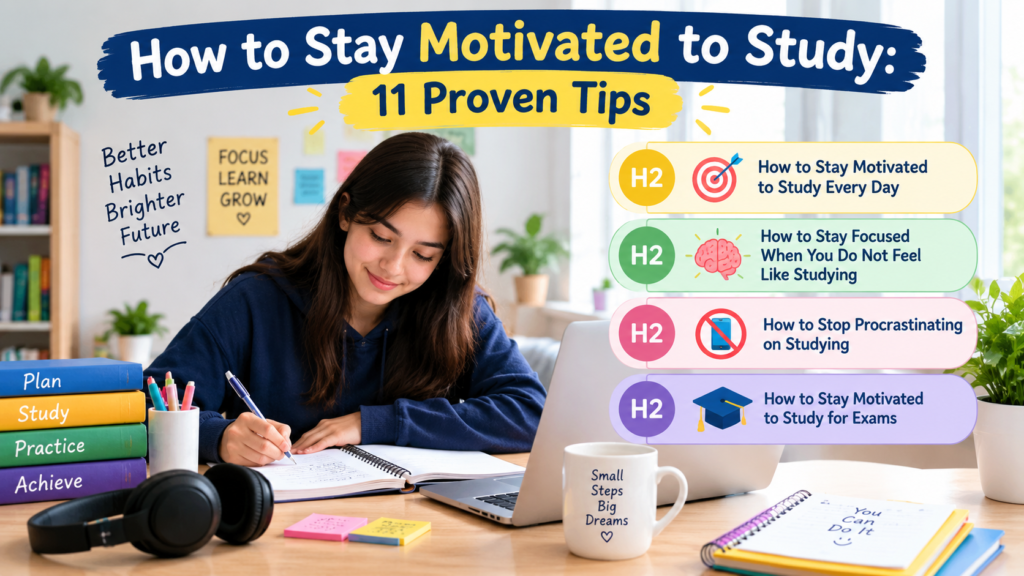
Students often search for specific study systems such as the 3-2-1 method and the 1-3-5-7 rule. These terms can refer to different frameworks depending on who is teaching them, so there is no single universally accepted definition.
The useful principle behind numbered study methods is structure. A simple framework can help you turn a vague intention into a specific plan.
For example, instead of saying “I need to study today,” decide exactly what you will accomplish, when you will do it, and how you will measure completion.
The same principle applies to the idea of “7 secret methods for studying effectively.” There is no secret technique that guarantees excellent results. Effective studying generally depends on active practice, review, focused sessions, realistic planning, and consistency.
A Simple Motivation Comparison
| Approach | Main Benefit | Possible Problem |
|---|---|---|
| Waiting for motivation | Feels comfortable | You may never start |
| Small goals | Makes tasks manageable | Requires planning |
| Long study sessions | Covers more material at once | Can cause fatigue |
| Short focused sessions | Easier to start | Requires consistency |
| Phone nearby | Convenient | Creates distractions |
| Phone away | Improves study environment | Less convenient |
| Last-minute studying | Creates urgency | Can increase stress |
| Regular review | Builds steady progress | Requires routine |
What to Do When You Completely Lose Motivation
Sometimes the problem is bigger than simple procrastination. If you have been struggling for several days, stop and identify what is actually getting in the way.
Ask yourself:
- Am I tired?
- Is the workload unrealistic?
- Do I understand the material?
- Am I afraid of failing?
- Is my phone distracting me?
- Do I need help with this subject?
- Am I trying to do too much at once?
Then choose the smallest useful action.
If the material is confusing, ask a teacher, tutor, classmate, or another trusted person for help. If you are feeling persistently overwhelmed, hopeless, or unable to function, consider talking with a qualified mental-health professional or another trusted adult.
You do not have to solve every problem by simply “trying harder.”
Frequently Asked Questions
How can I motivate myself to study?
Start with a small, specific task rather than waiting to feel motivated. Study for five minutes, complete one question, or read one section. Once you begin, continue if you feel able. A consistent routine, clear goals, fewer distractions, and visible progress can make studying easier to maintain.
Why am I so unmotivated to study?
Lack of motivation can have many causes, including difficult material, unclear goals, procrastination, distractions, stress, tiredness, or an unrealistic workload. Identify the main barrier instead of assuming you are lazy. Once you know the problem, you can choose a more useful solution.
How can I stay motivated to study every day?
Create a realistic daily routine and set small study goals. Studying at a consistent time can make the behavior easier to repeat. Track completed tasks and avoid setting an unrealistic workload. The goal is consistent progress, not forcing yourself to perform at your maximum level every day.
How do I study when I do not feel like studying?
Make the first step extremely small. Put your phone away, open your notes, and study for five minutes. Choose one easy task to build momentum. You can then continue with a longer session if you feel ready. Starting is often easier when the task does not feel overwhelming.
How can I stop procrastinating on studying?
Break large assignments into small actions and decide exactly what you will do first. Remove distractions before beginning and use a short timer to create a clear starting point. Instead of planning to finish everything at once, focus on completing the next manageable task.
What is the best way to stay motivated during exams?
Create a study plan based on the exam date, divide topics into manageable sections, and include regular practice and review. Track your progress instead of focusing only on the final grade. Protect sleep and breaks as well, because an exhausted study routine is difficult to maintain.
What are effective methods for studying?
Effective methods can include active recall, practice questions, spaced review, teaching concepts aloud, flashcards, and summarizing information in your own words. The best method depends on the subject and learner. Combining active practice with a consistent study schedule is generally more useful than simply rereading material repeatedly.
How can I stay motivated to study at home?
Create a dedicated study area, keep your phone away, decide your task before starting, and use focused study sessions with planned breaks. If your home environment is consistently distracting, consider another suitable location such as a library or quiet study space.
Conclusion
Learning how to stay motivated to study is less about finding endless inspiration and more about building a system you can repeat. Motivation will naturally rise and fall, but small goals, realistic schedules, focused sessions, fewer distractions, and consistent habits can help you keep moving forward.
When studying feels difficult, do not look at the entire workload at once. Choose one task. Start with five minutes. Complete one question, one page, or one section. Then build from there.
Your goal is not to become perfectly motivated every day. Your goal is to become consistent enough that progress continues even on ordinary days.
Start with one small study task today, track your progress, and let the habit grow. That is one of the most practical ways to stay motivated to study over the long term penstripe