


Picking a curriculum for home education is usually the first decision that makes homeschooling feel real and also the one that stalls parents the longest. There’s no single required program, no government office handing you a syllabus, and dozens of philosophies claiming to be the “right” one, whether you’re a first-time homeschooling parent in the US or a family in Lahore weighing the Cambridge system against a self-built plan.
This guide walks through what a home education curriculum actually is, the major types you can choose from, how to match one to your child instead of the other way around, and how to build your own if nothing off-the-shelf fits. You’ll also get a grade-by-grade breakdown, a free-versus-paid comparison, a sample daily schedule, and answers to the questions parents ask most including how homeschooling actually works in Pakistan, where there’s no mandated curriculum at all. By the end, you’ll have a clear framework for choosing, not just a longer list of options
What Is a Curriculum for Home Education?
A curriculum for home education is simply the structured plan of what a child will learn, in what order, and how that learning gets delivered whether that’s a boxed program with daily lesson plans, an online platform, or a loose framework you build yourself around your child’s interests.
How Home Education Curriculum Works
At its core, any curriculum answers three questions: what subjects get covered, what resources or materials teach them, and how progress gets measured. Some curricula answer all three for you (open the book, follow the lesson, take the quiz). Others leave the “how” almost entirely up to the parent, offering just a scope-and-sequence outline of what to cover by age or grade.
Traditional vs. Customized Curriculum
A traditional, pre-built curriculum whether it’s a boxed set, an all-in-one online program, or an accredited distance-learning school gives structure and reduces planning time, which matters a lot for parents juggling homeschooling with work or other children. A customized curriculum, built subject by subject from different sources, takes more upfront effort but lets you match pacing, teaching style, and content to exactly what your child needs. Most experienced homeschooling families end up somewhere in between: a core spine curriculum for math and language arts, supplemented with independently chosen resources for science, history, or electives.
Why Choosing the Right Home Education Curriculum Matters
The curriculum you choose shapes your daily routine far more than most new homeschooling parents expect, which is why it’s worth slowing down on this decision rather than grabbing the first popular option you find online.
Child’s learning style: a curriculum built around worksheets and independent reading will frustrate a hands-on learner just as much as an unstructured, discovery-based program will frustrate a child who thrives on clear daily checklists.
Academic goals: a family aiming for a specific university pathway, a national exam system, or a religious education track needs a curriculum aligned to that endpoint not just anything that covers “the basics.”
Flexible learning schedule: part of the appeal of homeschooling is pacing that fits your family’s life. A rigid, day-by-day curriculum can undercut that flexibility if your family actually needs a looser structure.
Parent involvement: some curricula expect a parent to actively teach every lesson; others are designed for the child to work largely independently, with the parent checking in and grading. Being honest about how much daily instruction time you can realistically give changes which curricula will actually work.
Long-term education planning: switching curricula every few months creates gaps, especially in sequential subjects like math. Choosing with an eye toward at least a full school year ideally longer saves a lot of later frustration.
Types of Curriculum for Home Education
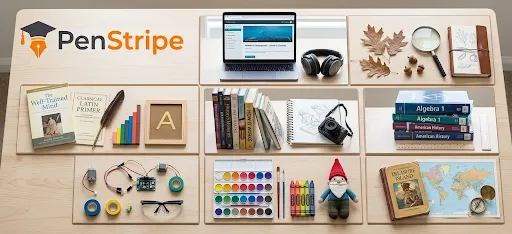
There’s no single “correct” home education curriculum different philosophies suit different families, and many homeschoolers blend more than one.
Traditional Homeschool Curriculum
Textbook-based and closely mirrors a conventional school structure, with sequential lessons, workbooks, tests, and clear grade-level benchmarks. This tends to suit families who want an experience close to what they remember from school themselves, and it transfers easily if a child later moves into a traditional classroom.
Online Homeschool Curriculum
Delivered through a website or learning platform, often with video lessons, auto-graded quizzes, and built-in progress tracking. This works well for families who want structure without having to personally teach every subject, and it’s increasingly common for older students preparing for standardized exams.
Unit Study Curriculum
Instead of separating subjects, unit studies build lessons around a single theme studying ancient Egypt might combine history, geography, art, and even math and writing assignments all tied to that one topic. This suits families with multiple children of different ages learning together, since the theme stays the same even if the assignment difficulty is adjusted per child.
Montessori-Inspired Learning
Built around child-led exploration, hands-on materials, and mixed-age learning environments. It works best for younger children and families comfortable with less rigid daily structure, though pure Montessori materials can be a significant upfront cost.
Charlotte Mason Method
Emphasizes “living books” (rich, narrative-driven texts) over dry textbooks, nature study, and short, focused lessons rather than long blocks of instruction. Families drawn to a gentler, literature-rich approach often gravitate here Easy Peasy All-in-One Homeschool, one of the most searched free curricula, actually blends Charlotte Mason and traditional approaches.
Interest-Led Learning
Sometimes called unschooling in its purest form, this approach lets the child’s curiosity drive what gets studied, with the parent facilitating rather than directing. It demands the most trust and the least predictable structure, and it suits self-motivated learners far better than children who need external accountability.
How to Choose the Best Curriculum for Your Child
This is the question most parents are actually asking when they search for “the best curriculum for homeschooling” and the honest answer is that best is relative to your specific child and household, not a universal ranking.
Consider Your Child’s Age and Grade Level
Younger children generally need shorter, more hands-on lessons; older students can handle longer independent blocks and more self-directed research. A curriculum that doesn’t scale appropriately by age will either bore or overwhelm.
Understand Their Learning Style
Watch how your child naturally engages with information do they retain more from reading, from listening, from building something physical, or from discussing ideas out loud? Curricula heavy in one of these modes will suit some children and frustrate others.
Set Your Education Goals
Decide upfront whether you’re aiming for a specific exam system (like SAT/ACT prep in the US, or O-Levels and A-Levels internationally), general life-skills education, or something else entirely. This single decision narrows the field faster than almost anything.
Consider Your Budget
Costs range from completely free (like Easy Peasy) to several thousand dollars a year for accredited online schools. Neither end guarantees better outcomes the fit matters more than the price tag.
Decide How Much Parent Involvement You Want
Be realistic about your available time. A curriculum requiring hours of daily parent-led instruction won’t survive contact with a full-time work schedule, no matter how good it looks on paper.
Real-world scenario: a working parent with a highly independent 10-year-old might thrive with an online, self-paced curriculum with weekly check-ins, while a stay-at-home parent with a hands-on 6-year-old might get far more value from a Montessori or unit-study approach with daily involvement.
How to Create Your Own Home Education Curriculum
Plenty of parents ask whether they even need a pre-built curriculum at all and the answer is no, you can absolutely build your own, though it takes more planning discipline.
Step 1: Define Learning Goals
Write down what you want your child to know and be able to do by the end of the year, broken down by subject. This becomes your scope-and-sequence and keeps you from drifting off track.
Step 2: Choose Core Subjects
Settle on the non-negotiables typically language arts and math before filling in secondary subjects like science, social studies, or electives.
Step 3: Select Learning Resources
For each subject, choose the specific books, websites, workbooks, or programs you’ll use. Mixing free online resources with a few paid materials for core subjects is a common, budget-friendly approach.
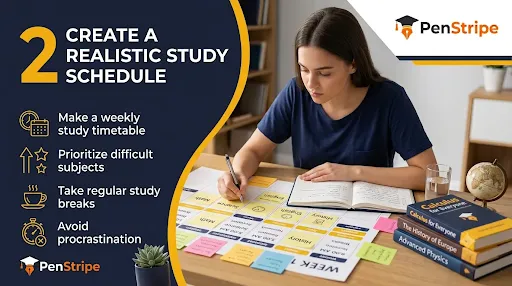
Step 4: Create a Weekly Schedule
Map subjects onto days and rough time blocks. This doesn’t need to be rigid to the minute, but a loose weekly rhythm prevents subjects from quietly getting skipped.
Step 5: Track Progress
Keep a simple log even a shared spreadsheet of what’s been covered and how your child is doing with it. This matters for adjusting pace mid-year and, in regions with exam-based pathways, for preparing records that support later enrollment or exam registration.
Checklist for building your own curriculum:
- Learning goals written down per subject
- Core subjects and resources chosen for each
- A weekly (not just daily) schedule mapped out
- A simple progress-tracking method in place
- A built-in review point every 8–10 weeks to adjust what isn’t working
Essential Subjects to Include in a Home Education Curriculum
Regardless of which curriculum philosophy you choose, most well-rounded home education programs cover the same core ground:
- English and language arts reading, writing, grammar, and vocabulary
- Mathematics sequential and cumulative, so consistency matters more here than in almost any other subject
- Science ideally with some hands-on or experimental component, not just reading
- Social studies covering civics, geography, and cultural knowledge
- History world and/or national history depending on family goals
- Arts music, drawing, or other creative expression
- Physical education structured or informal, but genuinely planned rather than assumed
- Life skills practical knowledge like budgeting, cooking, or basic home management, often the most overlooked subject in a formal curriculum
Home Education Curriculum by Grade Level

Preschool and Kindergarten
Focus stays light and play-based: early letter and number recognition, fine motor skill development, and short attention-span activities. Formal “curriculum” at this stage is often closer to structured play than academic instruction.
Elementary School
This is where a consistent core curriculum in reading and math becomes important, since these years build the foundational skills everything else depends on. Science and social studies can stay flexible and exploratory.
Middle School
Subjects typically become more distinct and structured, with an increased expectation of independent work and the introduction of pre-algebra or algebra, depending on pacing. This is also a natural point to start layering in study skills that will matter for high school.
High School
Curriculum choices start carrying real weight here transcripts, credit hours, and exam pathways (SAT/ACT in the US, or O-Levels/A-Levels internationally) come into play. Many families shift toward online or accredited programs at this stage specifically to produce records that colleges and universities recognize.
Free vs. Paid Home Education Curriculum
| Factor | Free Curriculum | Paid Curriculum |
| Cost | $0 (occasionally optional printed materials) | Ranges from modest workbook costs to several thousand dollars a year |
| Structure | Varies widely; some (like Easy Peasy) are fully planned, others require assembly | Usually fully structured with lesson plans included |
| Support | Community forums and Facebook groups, no formal support line | Often includes customer support, sometimes teacher access |
| Accreditation | Rarely accredited | Some paid programs offer accredited transcripts |
| Best for | Budget-conscious families comfortable with self-direction | Families wanting turnkey structure or a path to an accredited transcript |
Benefits of Free Curriculum
Free options remove the financial barrier to homeschooling entirely and often turn out to be just as academically solid as paid alternatives Easy Peasy All-in-One Homeschool, for instance, is a completely free, all-in-one program covering preschool through 12th grade, created by a homeschooling mother of six, and it’s frequently cited as one of the most complete free options available.
Advantages of Paid Curriculum
Paid programs typically offer more polish, dedicated customer support, and in some cases accredited records that matter for college admissions. For families who want to spend less time researching and assembling materials themselves, that convenience can be worth the cost.
Which Option to Choose
Start by being honest about your budget and your tolerance for assembling your own materials. Many families successfully run a hybrid model: a free core curriculum for most subjects, with one paid, higher-stakes resource often math where consistency and quality control matter most.
How to Create a Daily Homeschool Schedule
A daily schedule doesn’t need to mirror a traditional school day hour for hour one of homeschooling’s biggest advantages is compressing focused academic time into far fewer hours than a conventional classroom requires.
Sample Morning Routine
Start with the subject requiring the most focus usually math or writing while attention is freshest, followed by a short break before moving to reading or language arts.
Core Learning Time
Most homeschooling families find that two to four hours of focused academic time covers a full day’s core subjects for a single student, especially without the transition time and group-pacing delays built into a traditional classroom.
Breaks and Activities
Build in movement breaks between subjects rather than one long block at the end of the day shorter, more frequent breaks generally sustain attention better than a single extended one.
Independent Learning
Reserve afternoon time for independent reading, projects, or interest-led exploration. This is also a natural slot for subjects like art, life skills, or physical education that don’t require constant parent supervision.
Homeschooling in Pakistan: Legal Status and Getting Started
Homeschooling occupies a different legal space in Pakistan than in many other countries, which directly affects how families there approach curriculum choice.
Is Homeschooling Legal in Pakistan?
Yes. Pakistan has no law that prohibits or regulates home education, and the Ministry of Federal Education and Professional Training does not mandate registration, reporting, or a specific curriculum for homeschooling families. In practice, this means Pakistani parents have full freedom to choose their curriculum but also full responsibility for making sure it actually prepares their child for whatever comes next.
Common Curriculum Choices for Homeschooling Syllabus in Pakistan
Many Pakistani homeschooling families choose an international British (Cambridge) curriculum leading to O-Levels and A-Levels, since this pathway is already well recognized by Pakistani universities and has an extensive network of exam centers across the country. Others build toward matriculation (Class 10) or intermediate (Class 12) by registering as a private candidate through their local education board, such as BISE Lahore or BISE Karachi, and studying to the board’s official syllabus.
Steps Involved in Homeschooling in Pakistan
- Decide on your child’s exam pathway international (O/A-Levels) or national board (matric/FSc) since this determines the syllabus you’ll follow
- Choose or assemble a curriculum aligned to that pathway
- If pursuing board exams, contact your local BISE office in advance to understand private-candidate registration requirements
- Join local or online Pakistani homeschooling communities for shared resources and support, since formal infrastructure is limited
- Track progress consistently, since there’s no external inspection to catch gaps for you
Practical tip: because there’s no mandated curriculum for home education in Pakistan, the biggest risk isn’t doing something illegal it’s drifting without a clear exam or qualification target in mind until it’s too late to correct course before an important exam cycle.
Common Mistakes to Avoid When Planning a Home Education Curriculum
Choosing too many subjects at once. A packed schedule of eight or nine subjects often collapses within a few weeks. Prioritize core subjects and add electives gradually.
Building a rigid schedule. Overly strict, minute-by-minute planning tends to fall apart the first time a child has an off day and homeschooling families have more off days to plan around than a traditional classroom, not fewer.
Ignoring your child’s learning style. Sticking with a curriculum that clearly isn’t working, out of a sense of obligation to finish it, wastes time that a switch could have saved months earlier.
Not tracking progress. Without some form of ongoing record, it’s easy to discover gaps especially in math only once they’ve compounded into a real problem.
Ignoring breaks and practical learning. A curriculum that’s 100% academic, with no life-skills or unstructured time built in, tends to produce burnout faster than one that leaves room to breathe.
Frequently Asked Questions
What is the best curriculum for homeschooling? There’s no single best curriculum it depends on your child’s learning style, your academic goals, and how much daily involvement you can offer. Traditional, online, unit-study, Montessori, Charlotte Mason, and interest-led approaches all work well for different families.
How do I create a curriculum for homeschooling? Define clear learning goals per subject, choose core subjects first (usually math and language arts), select specific resources for each, build a loose weekly schedule, and track progress consistently so you can adjust course as needed.
Can I use a free homeschool curriculum? Yes. Free options like Easy Peasy All-in-One Homeschool cover preschool through 12th grade at no cost and are considered academically solid by many homeschooling families. Free doesn’t mean lower quality it usually means less built-in structure and support.
How many hours a day should home education take? Most families find two to four hours of focused academic time covers a full day’s core subjects for one student, since homeschooling avoids the transition time and group pacing that stretch out a traditional school day.
Do homeschool students follow the same curriculum as schools? Not necessarily. Some families follow an accredited program closely mirroring school content, while others build a custom curriculum. In places like Pakistan, there’s no mandated curriculum at all, so families choose freely based on their goals.
What are the 8 types of curriculum in education? Educational theory generally categorizes curriculum into types including the recommended, written, taught, supported, tested, learned, hidden, and excluded curriculum. For homeschooling purposes, most parents only need to actively plan the written and taught curriculum the rest describes broader educational theory more relevant to formal school systems.
What are the steps involved in homeschooling in Pakistan? Decide on an exam pathway (international O/A-Levels or national board exams), choose a curriculum aligned to that pathway, register as a private candidate with your local board if pursuing matric or intermediate, and join homeschooling communities for support, since there’s no formal registration process required by law.
Do I need a curriculum to homeschool, or can I make my own? You don’t need a pre-built curriculum you can absolutely create your own by defining goals, choosing resources subject by subject, and tracking progress. It requires more planning time upfront but allows complete customization to your child’s needs.
Conclusion
Choosing a curriculum for home education isn’t about finding the one program everyone agrees is best it’s about matching structure, subjects, and pace to the child actually sitting at your kitchen table. Whether that means a free, all-in-one program like Easy Peasy, a Cambridge pathway toward O-Levels and A-Levels in Pakistan, or a fully custom plan built subject by subject, the right choice is the one your family can actually sustain for a full school year.
Start with your child’s learning style and your realistic time availability, pick one core approach, and give it a real trial period before switching. Revisit the plan every few months, adjust what isn’t working, and remember that a home education curriculum is meant to serve your child not the other way around.
Stay in touch with Penstripe