


Most struggling readers aren’t struggling to read the words they’re struggling to hold onto what those words mean. That gap between decoding and understanding is exactly what reading comprehension strategies are built to close, and it’s why teachers, parents, and even standardized test-prep coaches keep coming back to the same handful of techniques.
This guide breaks down the seven research-backed reading comprehension strategies that show up again and again in classroom studies, explains how to teach or practice each one, and gives you real examples you can use immediately whether you’re working with a 3rd grader who freezes up on word problems in a story, a middle schooler skimming instead of reading, or an adult prepping for the LSAT or GRE. You’ll also get printable-style activity ideas, a comparison of which strategy fits which kind of reader, and straight answers to the questions people search most, including what the “big 7” actually are and how they differ from the “big 5.”
What Are Reading Comprehension Strategies?
Reading comprehension strategies are deliberate, teachable techniques readers use to understand, remember, and think critically about a text as opposed to comprehension skills, which develop more gradually through practice and exposure. The distinction matters: a strategy is something you can explicitly model and coach (“ask yourself a question before you turn the page”), while a skill, like fluency, builds up over months of consistent reading.
Why These Strategies Work
According to research reviewed by the UK’s Education Endowment Foundation, one of the most cited sources on literacy interventions, reading comprehension strategies produce an average of six to seven additional months of academic progress over the course of a year when taught well. That’s a meaningful jump for a set of techniques that cost very little to implement mainly teacher time and training rather than expensive materials.
Strategies vs. Skills vs. Background Knowledge
Comprehension doesn’t rest on strategies alone. Researchers increasingly describe good reading as resting on three connected pillars: background knowledge (what you already know about the topic), reading skills (decoding and fluency), and strategies (the deliberate techniques covered in this guide). Miss any one of the three and comprehension suffers which is why a strategy like “make a prediction” works far better on a topic the reader already has some context for than one that’s completely unfamiliar.
Who Actually Benefits
Every age group benefits from explicit strategy instruction, but the payoff is largest for readers who can decode text reasonably well but still struggle to explain what they just read a common profile among students labeled “reluctant readers” or those who technically pass fluency checks but score low on comprehension tests.
The 7 Reading Comprehension Strategies, Explained
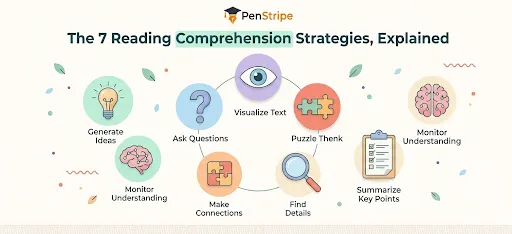
This is the answer to one of the most common searches on this topic: what are the 7 reading comprehension strategies? While different sources group them slightly differently, the strategies below consistently show up across decades of literacy research, from the National Reading Panel’s findings to classroom-tested frameworks used in U.S. schools today.
1. Activating Background Knowledge
Before reading, connect the topic to something the reader already knows. A student about to read a story set in a desert benefits from a two-minute conversation about what deserts are like heat, sand, scarce water before ever opening the book.
2. Predicting
Readers use titles, headings, images, and early details to guess what’s coming next, then check those predictions as they read. This keeps attention active instead of passive, and it’s one of the easiest strategies to model out loud: “Based on this title, what do you think this chapter is going to be about?”
3. Questioning
Strong readers ask questions constantly before, during, and after reading. This includes literal questions (“Who is the main character?”) and deeper ones (“Why did the character make that choice?”). Teaching students to generate their own questions, not just answer the teacher’s, is one of the more powerful versions of this strategy.
4. Visualizing
Turning words into mental images helps readers hold onto details, especially in narrative or descriptive text. A reader picturing the setting of a scene is more likely to remember plot details tied to that setting later.
5. Inferring
This is reading between the lines drawing conclusions the text implies but doesn’t state outright. If a character “slammed the door and didn’t say a word,” a reader has to infer anger or frustration, since the text never uses those exact words.
6. Summarizing and Synthesizing
Summarizing means restating the main points in fewer words. Synthesizing goes a step further, combining information across a whole text (or multiple texts) into a new understanding. Both are essential for longer, nonfiction, or multi-source reading.
7. Monitoring Comprehension (and Fixing It)
Also called “fix-up strategies,” this is the skill of noticing when understanding breaks down and knowing what to do about it. That might mean rereading a confusing paragraph, looking up an unfamiliar word, or slowing down. Readers who lack this strategy often keep reading past the point where they’ve stopped understanding, without realizing it.
Expert insight: if you’re only going to teach one strategy first, teach monitoring comprehension. Without it, students don’t even know they’ve lost the thread, which makes every other strategy harder to apply consistently.
Reading Comprehension Strategies for Different Age Groups
The core seven strategies apply across ages, but how you teach them changes significantly depending on the reader’s stage of development.
Reading Comprehension Strategies for 3rd Grade
Third grade is a pivotal year it’s often described as the shift from “learning to read” to “reading to learn.” At this stage, strategies work best when they’re short, concrete, and modeled out loud repeatedly before students try them independently. Picture walks (previewing illustrations before reading), simple prediction charts, and “stop and think” pauses every page or two tend to work better than long independent strategy checklists.
Reading Comprehension Strategies for Elementary and Middle School Students
By upper elementary and middle school, students can start holding a graphic organizer in their head rather than needing one on paper for every reading session. This is also the age where explicit question-generation (teaching students to write their own quiz questions about a passage) starts paying off, since it forces active engagement instead of passive skimming.
Reading Comprehension Strategies for High School and College Students
High schoolers and college students benefit most from synthesis-heavy strategies comparing multiple sources, annotating for argument structure rather than just plot, and practicing summarizing dense nonfiction in their own words. This is also where strategies start overlapping with study skills more broadly, since much of the reading load shifts to textbooks and academic articles.
Real-world scenario: a 10th grader assigned a dense history chapter will get more out of annotating margins with short questions and one-line summaries per section than from rereading the whole chapter a second time rereading without a strategy attached tends to just repeat the same confusion, not resolve it.
Active Reading Strategies: Notes, Highlighting, and Questioning

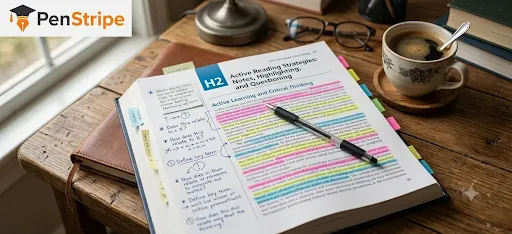
Active reading strategies are the physical, on-the-page habits that support the seven core comprehension strategies above. They matter because comprehension strategies are mental processesactive reading techniques are how you make those processes visible and trackable.
Annotating and Note-Taking
Writing brief notes in the margic a question mark next to a confusing sentence, a star next to an important point keeps the reader’s thinking visible and searchable later. For digital reading, sticky notes or a simple two-column notes page (quote on one side, reaction on the other) does the same job.
Highlighting (and Its Limits)
Highlighting is popular but often overused. Research on study techniques consistently finds that highlighting alone, without an accompanying note explaining why something was highlighted, does little to improve retention. The fix is simple: never highlight without also writing a word or two next to it explaining why it mattered.
Self-Questioning While Reading
This ties directly back to the “questioning” strategy above, but as an active reading habit, it means physically pausing at natural breaks end of a paragraph, end of a page to ask “What did I just read?” out loud or on paper.
Checklist for active reading:
- Preview the text (title, headings, images) before reading
- Make one prediction before starting
- Pause at natural breaks to summarize in one sentence
- Mark (don’t just highlight) anything confusing with a note
- Ask at least one question you’d want answered by the end
Reading Comprehension Activities and Practice Exercises
Strategies need practice to stick, and the right activity depends on which strategy you’re targeting.
Graphic Organizers
Story maps, Venn diagrams for comparing characters or texts, and cause-and-effect charts all give students a physical structure for organizing what they’ve read particularly useful for visual learners and for anyone practicing summarizing or synthesizing.
Think-Alouds
A teacher or parent reads a passage aloud and verbalizes their own thinking process in real time: “Hmm, I wonder why she said that let me reread that line.” This models invisible mental strategies in a way silent reading never can, and it’s one of the most effective ways to teach inferring and questioning specifically.
Reciprocal Teaching
Students take turns leading a small-group discussion using four roles: predicting, questioning, clarifying, and summarizing. This structure directly maps onto four of the seven core strategies and works particularly well for upper elementary through high school.
Worksheets and Printable Practice
For independent or homework practice, short passages paired with structured response questions one prediction question, one inference question, one summary prompt reinforce the strategies without requiring a full classroom setup. These work well as a supplement to instruction, though they shouldn’t replace the modeling and think-aloud work that builds the strategies in the first place.
Strategies for Struggling Readers

Struggling readers often aren’t lacking intelligence or effort they’re usually missing one specific link in the comprehension chain, and generic “read more” advice rarely fixes it.
Diagnose Before You Prescribe
The EEF’s research on this topic is direct on one point: comprehension approaches need to be tailored to a reader’s current capabilities rather than applied as a one-size-fits-all program. A student who decodes fluently but can’t summarize needs different support than one who’s still sounding out words and has little mental energy left over for meaning-making.
Scaffolding That Actually Helps
For readers who struggle to generate their own questions or predictions, sentence starters (“I predict that… because…”) lower the barrier to entry without doing the thinking for them. Gradually removing that scaffolding as confidence builds is the key step people often skip.
Matching Text Difficulty to the Reader
Texts that are too hard overwhelm working memory before any strategy can help; texts that are too easy don’t give strategies anything meaningful to do. Effective practice happens in that middle zone challenging but not overwhelming sometimes called the instructional reading level.
Pros and cons of common struggling-reader interventions:
Small-group or one-on-one instruction: highly effective because it allows real-time diagnosis and adjustment, but resource-intensive and harder to scale in a full classroom.
Peer-assisted strategies (like reciprocal teaching): cost-effective and builds independence, but requires students to already have a baseline ability to follow structured roles, which not every struggling reader has yet.
Digital comprehension tools: can provide useful prompts and immediate feedback, and some evidence suggests technology-assisted practice helps but it works best as a supplement to teacher-led instruction, not a replacement for it.
Reading Comprehension Strategies for Standardized Tests
Test-based reading comprehension on the SAT, GRE, or LSAT, for example rewards a slightly different application of the same core strategies, mainly because of time pressure and unfamiliar, dense passage types.
LSAT and GRE Reading Comprehension
These tests favor active annotation over passive rereading, since time constraints punish anyone who has to reread a whole passage to find one detail. Strong test-takers tend to summarize each paragraph in a few words in the margin as they go a compressed version of the summarizing strategy so they can locate information quickly when a question references it.
Common Test-Taking Mistakes
The biggest mistake isn’t a lack of vocabulary it’s reading passively, letting the eyes move across the page without actively predicting, questioning, or summarizing along the way. A close second is skipping the “monitoring comprehension” strategy entirely under time pressure, plowing ahead even after losing the thread of a dense paragraph.
A Simple Test-Day Framework
- Skim the first and last sentence of each paragraph before reading closely
- Note the main idea of each paragraph in three to five words
- Predict the author’s overall argument before reaching the final paragraph
- Answer main-idea questions first, using your paragraph notes; save detail-lookup questions for after
Choosing the Right Strategy: A Comparison
Not every strategy fits every reading situation. This table maps the seven core strategies to where they tend to add the most value.
| Strategy | Best For | Weakest Fit |
| Activating background knowledge | Unfamiliar topics, nonfiction | Highly familiar or simple topics |
| Predicting | Narrative text, building engagement | Reference material or manuals |
| Questioning | Critical reading, test prep | Very short, simple texts |
| Visualizing | Narrative and descriptive text | Abstract or highly technical text |
| Inferring | Literature, character analysis | Literal instructions or data tables |
| Summarizing/synthesizing | Nonfiction, research, multi-source reading | Poetry or highly figurative text |
| Monitoring comprehension | Dense or difficult text of any kind | Rarely a weak fit nearly universal |
How to read this table: most strong readers don’t pick just one strategy they shift between two or three depending on what the text demands. A history textbook chapter might call for background knowledge activation plus summarizing, while a short story leans more on predicting, visualizing, and inferring.
Frequently Asked Questions
What are the 7 reading comprehension strategies? Activating background knowledge, predicting, questioning, visualizing, inferring, summarizing/synthesizing, and monitoring comprehension. These seven show up consistently across major literacy research and classroom frameworks used in U.S. schools.
What are the strategies for improving reading comprehension? Beyond the core seven, active reading habits help significantly: annotating instead of just highlighting, pausing to summarize at natural breaks, matching text difficulty to the reader’s level, and practicing with structured activities like graphic organizers or reciprocal teaching.
What are the 10 reading strategies? Some frameworks expand the core seven into ten by separately listing related sub-skills, such as skimming, scanning, and rereading, alongside the seven comprehension strategies. There’s no single universally agreed “10,” so treat any list beyond the core seven as an extension, not a replacement.
What are the five reading comprehension strategies? Some shortened frameworks combine visualizing into inferring and merge predicting with questioning, leaving five: activating background knowledge, questioning/predicting, inferring/visualizing, summarizing, and monitoring comprehension. The underlying skills are the same as the “big 7,” just grouped differently.
How do I teach reading comprehension strategies to struggling readers? Start by diagnosing exactly where the breakdown happens decoding, vocabulary, or strategy use rather than assuming more general reading practice will fix it. Use sentence starters to scaffold predictions and questions, match texts to an appropriately challenging level, and prioritize monitoring comprehension first.
Are there free reading comprehension strategies PDFs or worksheets available? Yes. Many reputable education sites, including Reading Rockets and various state education department resources, offer free downloadable guides and worksheets covering these strategies. Look for ones tied to research-based frameworks rather than generic printable packs with no instructional backing.
Do reading comprehension strategies work for adults preparing for tests like the LSAT or GRE? Yes, though the application shifts toward speed and annotation under time pressure. The same core strategies especially summarizing each paragraph and monitoring comprehension translate directly into faster, more accurate performance on dense standardized test passages.
What’s the difference between a reading comprehension strategy and a reading skill? A strategy is a deliberate, teachable technique, like pausing to predict what happens next. A skill, like fluency or vocabulary, builds gradually through repeated exposure and practice rather than being consciously applied in the moment.
Conclusion
Reading comprehension strategies work because they turn an invisible mental process into something a reader can actually practice and improve whether that’s a 3rd grader learning to predict what happens next, a struggling reader finally getting the scaffolding they need, or an adult sharpening their pace for the LSAT. The core seven background knowledge, predicting, questioning, visualizing, inferring, summarizing, and monitoring comprehension cover nearly every reading situation you’ll run into, and they’re backed by real classroom research showing measurable gains.
Start small: pick one strategy, like monitoring comprehension or questioning, and practice it deliberately for a week before adding another. Reading comprehension strategies aren’t meant to be memorized all at once they’re meant to become second nature, one habit at a time.
Stay in touch with Penstripe