





If you’ve ever reread the same paragraph five times and still couldn’t remember it an hour later, you’re not alone and you’re not doing anything wrong. You just haven’t been using the right study techniques for exams. Most students were never actually taught how to study; they were just told to “study harder,” which usually means more hours, not better results.
The truth is, scoring higher on exams has less to do with how long you sit at your desk and more to do with which methods you use while you’re there. Cognitive scientists have spent decades researching how memory actually works, and the findings are surprisingly different from what most students practice highlighting, rereading, and cramming the night before.
In this guide, you’ll learn the scientifically proven study methods top-performing students and psychology researchers actually recommend, including active recall, spaced repetition, the Feynman Technique, and the Leitner system. You’ll also get a realistic study schedule, memory tricks that speed up recall, and focus strategies to help you concentrate for longer stretches. By the end, you’ll have a complete, practical system for walking into your next exam prepared and confident.
Why Most Study Methods Fail
The Problem With Rereading and Highlighting
Rereading notes and highlighting textbooks feel productive because the material starts to look familiar. But familiarity isn’t the same as recall. Research published in Psychological Science in the Public Interest reviewed ten common study techniques and found that rereading and highlighting produced some of the weakest learning outcomes, while techniques like practice testing and distributed practice produced the strongest results.
What Are the 4 Types of Study Methods?
Most study approaches fall into four broad categories:
- Passive review rereading, highlighting, and copying notes (low effectiveness)
- Active recall testing yourself on material without looking at it (high effectiveness)
- Spaced practice reviewing material across multiple sessions over time (high effectiveness)
- Elaborative learning connecting new information to what you already know, such as through teaching or analogy (high effectiveness)
The best study techniques for exams almost always combine categories two, three, and four. Passive review has a place, mainly for first exposure to new material, but it should never be your main strategy.
Effective Study Techniques Backed by Science

This section covers the core, scientifically proven study methods worth building your entire exam prep around.
Active Recall: The Single Most Effective
Active recall means closing your notes and forcing your brain to retrieve information from memory, rather than simply looking at it again. This could mean answering practice questions, writing down everything you remember about a topic, or using flashcards.
Example: Instead of rereading a chapter on the French Revolution, close the book and write down every cause, event, and outcome you can remember. Then check your notes for what you missed.
Active recall works because the act of retrieving information strengthens the neural pathways associated with it a concept psychologists call the “testing effect.” Multiple studies have shown that students who use practice testing outperform students who simply reread material, even when both groups spend the same amount of time studying.
Spaced Repetition for Exams
Spaced repetition means reviewing material at increasing intervals over time instead of cramming it all at once. Instead of studying a topic once and moving on, you revisit it after one day, then three days, then a week, then two weeks.
This technique directly counters the “forgetting curve,” a concept first documented by psychologist Hermann Ebbinghaus, which shows that we lose most new information within 24 hours unless we review it. Apps like Anki and Quizlet automate spaced repetition using algorithms, but you can do it manually with a simple calendar or planner.
The Feynman Technique for Studying
Named after physicist Richard Feynman, this method asks you to explain a concept in plain, simple language, as if teaching it to a 10-year-old. If you struggle to explain a topic simply, that’s a sign you don’t fully understand it yet.
Step-by-step:
- Choose a concept or topic
- Write or say an explanation as if teaching someone with no background knowledge
- Identify the gaps where your explanation gets vague or complicated
- Go back to your source material and clarify those specific gaps
The Leitner System
The Leitner system is a flashcard-based method that combines active recall with spaced repetition. Cards you answer correctly move to a review box you revisit less often; cards you get wrong move back to a box you review daily. Over time, this focuses your study time on the material you actually struggle with, instead of wasting time reviewing things you already know.
How to Prepare for Exams: A Step-by-Step Plan
Two to Three Weeks Before the Exam
This is the ideal window to begin serious exam preparation. Start by reviewing the full syllabus or course outline and identifying which topics are weighted most heavily. Break the material into manageable chunks and begin spaced repetition early, rather than waiting until the final week.
One Week Before the Exam
Shift your focus toward active recall and practice testing. Take full-length practice exams under timed conditions if they’re available. This is also the point to identify your weakest areas and dedicate extra review sessions specifically to them.
Last Minute Exam Preparation
If you’re reading this the night before an exam, don’t panic but also don’t try to learn everything from scratch. Focus on:
- Reviewing summary notes or flashcards for high-yield topics only
- Practicing a few recall questions instead of rereading full chapters
- Getting at least 6–7 hours of sleep, since sleep plays a critical role in memory consolidation
- Eating a normal meal and avoiding excessive caffeine, which can increase anxiety
How to Revise for Exams the Right Way
Effective revision isn’t about rewriting your notes word for word. It’s about testing yourself repeatedly, identifying gaps, and closing them. A simple, repeatable revision cycle looks like this: review → self-test → identify weak points → target those weak points → retest.
Study Planning and Time Management

How to Make a Study Schedule That Actually Works
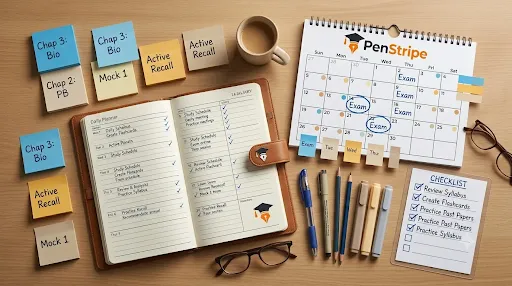
A good study timetable for exams isn’t just a list of subjects it’s a realistic plan built around your energy levels and other commitments. Start by working backward from your exam date, then block out specific study sessions for specific topics rather than vague blocks labeled “study.”
Example weekly structure:
| Day | Focus | Method |
| Monday | New material (Topic A) | First read-through + notes |
| Tuesday | Active recall (Topic A) | Self-testing / flashcards |
| Wednesday | New material (Topic B) | First read-through + notes |
| Thursday | Spaced review (Topic A + B) | Practice questions |
| Friday | Active recall (Topic B) | Flashcards / Leitner system |
| Saturday | Full review + practice test | Timed mock exam |
| Sunday | Rest or light review | Light flashcard review only |
How Many Hours Should You Study for Exams?
There’s no universal number, but research on effective learning suggests quality matters more than quantity. Two focused, distraction-free hours using active recall typically outperform five unfocused hours of passive rereading. Most experts recommend 25–50 minute focused study blocks with short breaks, rather than marathon sessions.
Time Management for Students With Busy Schedules
If you’re balancing school, work, or other responsibilities, prioritize your highest-value study activities first: active recall and practice testing. Passive activities like organizing notes can be squeezed into smaller pockets of time, such as a 10-minute break between classes.
Memory Techniques to Remember What You Study
Mnemonic Techniques for Studying
Mnemonics help encode information in a way that’s easier for your brain to store and retrieve. Common types include:
- Acronyms such as “PEMDAS” for order of operations in math
- Chunking breaking long information (like a 10-digit number) into smaller groups
- Method of loci mentally placing information at specific points along a familiar route, such as your walk from your bedroom to the kitchen
- Rhymes and songs useful for memorizing sequences, dates, or lists
How to Memorize Faster for Exams
Memorization speeds up significantly when you combine two or more techniques. For example, pairing active recall with a mnemonic device tends to produce faster, more durable memory than either technique alone. Testing yourself immediately after first learning something, even if you get it wrong, also strengthens memory more than passive review does.
Best Revision Techniques for Retention
For long-term retention, alternate between different subjects or topics during a single study session rather than focusing on just one for hours (a strategy known as “interleaving”). Studies on interleaved practice show it improves the brain’s ability to distinguish between similar concepts, which is especially useful for subjects like math, chemistry, and language learning.
Focus and Productivity: How to Study Without Getting Distracted
How Can I Focus 100% on Study?
No one focuses with 100% consistency, and aiming for that can actually increase stress and reduce performance. A more realistic goal is minimizing avoidable distractions and working in focused sprints.
Practical checklist:
- Put your phone in another room or use an app blocker
- Study in a consistent, dedicated location your brain associates with focus
- Use noise-canceling headphones or background white noise if needed
- Keep a notepad nearby to jot down intrusive thoughts instead of chasing them
- Set a specific, small goal for each study session (e.g., “finish 20 practice questions,” not “study biology”)
The Pomodoro Technique for Studying
The Pomodoro Technique breaks study time into 25-minute focused intervals followed by a 5-minute break. After four intervals, take a longer 15–30 minute break. This structure works well because it makes large tasks feel manageable and gives your brain regular recovery periods, which helps sustain concentration over several hours.
How to Avoid Distractions While Studying
Digital distractions are the biggest culprit for most students today. Turning off notifications, using website blockers during study sessions, and physically separating yourself from your phone are more effective than simply “trying to have willpower,” since willpower is a limited resource that depletes throughout the day.
How to Stay Motivated to Study
Motivation often follows action rather than preceding it meaning you’re more likely to feel motivated after starting a task than before. Lowering the barrier to starting (such as committing to just 10 minutes) is often more effective than waiting to “feel ready.”
Study Techniques Comparison Table
| Technique | Best For | Effort Level | Scientific Support |
| Active Recall | All subjects, especially fact-based content | Medium | Very strong |
| Spaced Repetition | Long-term retention, cumulative exams | Low–Medium | Very strong |
| Feynman Technique | Complex concepts, understanding gaps | Medium–High | Strong |
| Leitner System | Vocabulary, formulas, definitions | Medium | Strong |
| Interleaving | Math, science, similar concepts | Medium | Strong |
| Mnemonics | Lists, sequences, dates | Low | Moderate |
| Rereading/Highlighting | Initial exposure only | Low | Weak |
| Pomodoro Technique | Focus and time management | Low | Moderate |
Frequently Asked Questions
What are the 5 best study techniques for an exam?
The five most effective, research-backed study techniques are active recall, spaced repetition, the Feynman Technique, interleaved practice, and practice testing under timed conditions. Combining these consistently over several weeks produces significantly better exam results than passive review methods like rereading or highlighting.
How can I focus 100% on study?
You can’t realistically focus 100% of the time, but you can minimize distractions by removing your phone, studying in a consistent location, and using structured sessions like the Pomodoro Technique. Setting small, specific goals for each session also makes it easier to stay engaged.
How can I study easier?
Studying feels easier when you use active recall and spaced repetition instead of passive rereading, because these methods make progress visible and reduce the feeling of “starting from scratch” each time. Breaking material into small chunks also makes studying feel far less overwhelming.
Which technique is the best for studying?
Active recall is widely considered the single most effective study technique because it directly strengthens memory retrieval, which is exactly what you need to do during an exam. However, pairing it with spaced repetition produces even stronger long-term results.
What are the 4 types of study methods?
The four main types are passive review (rereading, highlighting), active recall (self-testing, flashcards), spaced practice (reviewing material over time), and elaborative learning (teaching concepts, making connections). The most effective study techniques for exams combine the last three.
How many hours should I study for exams?
There’s no fixed number, but 2–4 hours of focused, active studying using techniques like recall and spaced repetition typically outperforms 6+ hours of passive rereading. Quality and consistency matter far more than total hours logged.
What is the Leitner system and how does it help with exams?
The Leitner system is a flashcard method that sorts cards into review boxes based on how well you know them. Cards you get wrong are reviewed more frequently, while cards you know well are reviewed less often, which makes your study time more efficient.
Are there secret study tips that actually make a difference?
There’s no real “secret” the techniques with the strongest scientific support are simply underused. Active recall, spaced repetition, and interleaved practice consistently outperform common habits like rereading and cramming, yet most students were never taught to use them.
Conclusion
Scoring higher on exams isn’t about studying for more hours it’s about studying in a way that actually matches how memory works. Active recall, spaced repetition, the Feynman Technique, and the Leitner system are consistently backed by cognitive science, while common habits like rereading and last-minute cramming tend to produce weak, short-lived results.
Start small: pick one or two techniques from this guide, such as active recall and a basic study schedule, and apply them to your very next study session. As these habits become routine, layer in spaced repetition and interleaved practice for even stronger retention. The best study techniques for exams aren’t complicated they just require replacing passive habits with active ones, starting today.