






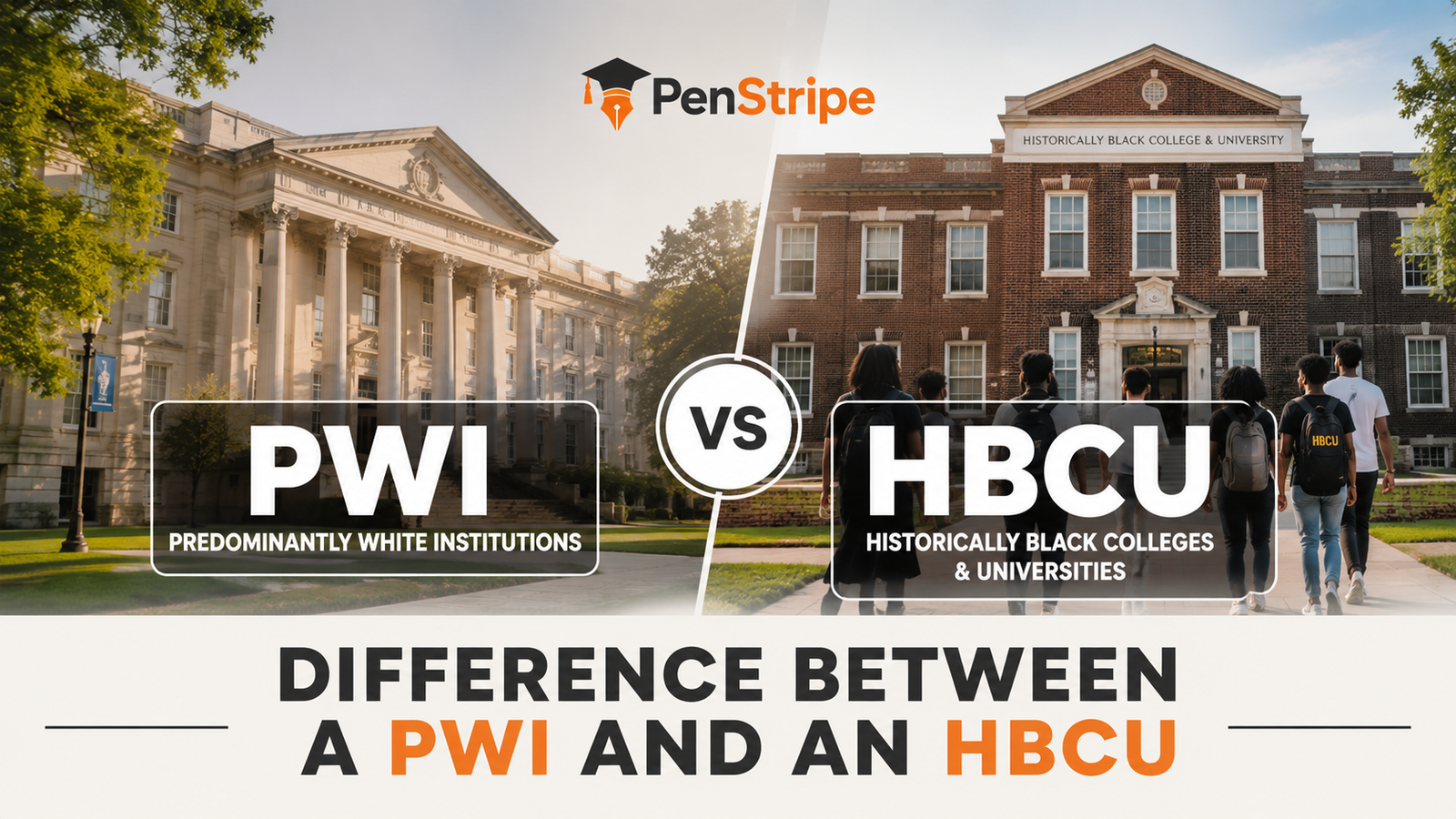
PWI vs. HBCU is one of the biggest questions Black students face when picking a college, and it is not just about test scores or campus size. It is about where you will feel safe, supported, and ready to grow for the next four years. The PWI meaning is simple: a Predominantly White Institution is any college where white students make up more than half the student body. An HBCU, on the other hand, is a Historically Black College or University built specifically to educate Black students at a time when most schools would not.
This guide goes beyond dictionary definitions. You will learn how cost actually compares, what students really say about belonging and mental health at each type of school, how faculty support differs, and how to decide between an HBCU or PWI based on your own goals, not someone else’s opinion. Whether you are a first generation student, thinking about transferring, or just trying to figure out where you will feel most like yourself, this article covers it all.
What Does PWI Mean and What Does HBCU Mean
PWI College Meaning in Plain English
The PWI college meaning refers to enrollment numbers, not mission or policy. Any school where white students are the clear majority gets called a PWI, whether it is a small private college or a massive state university. About 95 percent of colleges in the United States fall into this category simply because of population patterns, not because of any special design.
What Makes a School an HBCU
HBCUs were founded before 1964, back when Black students were legally shut out of most other colleges. Today there are just over 100 HBCUs still operating, and they graduate close to 20 percent of all Black bachelor’s degree holders even though they enroll only about 10 percent of Black college students nationwide. That gap alone tells you how much these schools punch above their weight.
Top PWI Colleges and PWI College Lists
When people search for a PWI colleges list, they usually mean large public flagships and well known private universities where Black enrollment sits well under 20 percent. Rather than naming a fixed list, the smarter move is checking each school’s own enrollment report, since these numbers shift every year.
PWI vs. HBCU Cost: Which One Actually Costs More
Sticker Price vs. Real Price
On paper, HBCUs often list lower tuition than large PWIs. But the sticker price is not the full story. PWIs, especially well funded flagship schools, frequently offer bigger financial aid packages and larger merit scholarships, which can bring the real cost down close to or below what an HBCU charges.
PWI vs HBCU Cost 2022 and Beyond
Data from recent years shows the gap has been shrinking. Many HBCUs have expanded need-based aid programs, while some PWIs have cut merit scholarships for out-of-state students. The honest answer to PWI vs. HBCU cost is to request the actual financial aid letter from each school before assuming either one is cheaper.
A Practical Cost Checklist
- Compare net price calculators, not just published tuition
- Factor in housing and meal plan costs, which vary a lot by region
- Ask about retention-based scholarships that renew each year
- Check if the school offers HBCU-specific corporate scholarships
Black Student Experience at PWI vs. HBCU
What to Expect at a PWI as a Black Student
Many Black students describe PWIs as academically strong but socially heavier lifting. Personal essays and interviews commonly describe feeling like the only Black student in a lecture hall. having to explain their identity to classmates, and searching for community through cultural organizations rather than finding it automatically.
What to Expect at an HBCU as a Black Student
At an HBCU, students often describe the opposite feeling almost immediately. Being surrounded by professors, mentors, and classmates who share your background tends to remove a layer of pressure that many Black students carry at PWIs without even realizing it.
Do Black Students Feel Isolated at PWIs?
Research comparing racial stress between the two settings found that Black students at PWIs reported meaningfully higher levels of race-related stress than Black students at HBCUs, based on a well-known racial stress index used in campus climate research. Isolation is not universal, but it is common enough to plan for.
Faculty Support and Academic Environment
HBCU vs PWI Faculty Support for Black Students
HBCUs tend to have more Black faculty per student, which many students say makes office hours, mentorship, and letters of recommendation feel more personal. PWIs, especially research-heavy ones, often offer bigger labs and more funding, but students sometimes have to search harder to find a mentor who understands their specific experience.
Class Sizes and Attention
HBCUs commonly run smaller student-to-faculty ratios, often close to 13 to 1, compared to much larger lecture-style classes at big PWIs. Smaller ratios usually mean professors know your name, not just your student ID number.
Sense of Belonging and Mental Health
HBCU vs PWI Sense of Belonging
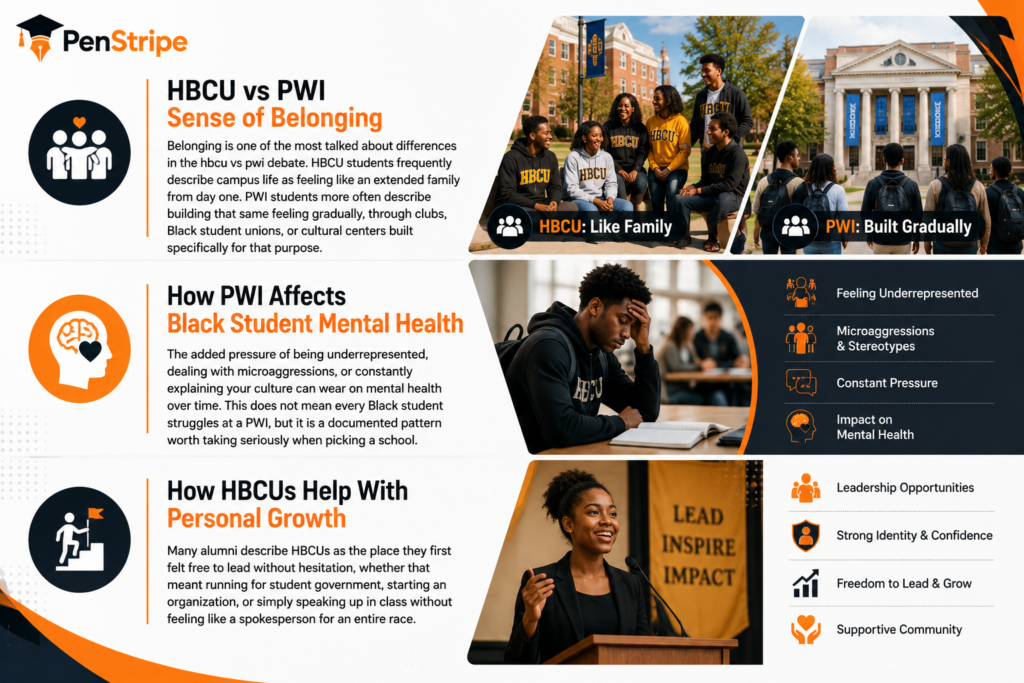
Belonging is one of the most talked about differences in the hbcu vs pwi debate. HBCU students frequently describe campus life as feeling like an extended family from day one. PWI students more often describe building that same feeling gradually, through clubs, Black student unions, or cultural centers built specifically for that purpose.
How PWI Affects Black Student Mental Health
The added pressure of being underrepresented, dealing with microaggressions, or constantly explaining your culture can wear on mental health over time. This does not mean every Black student struggles at a PWI, but it is a documented pattern worth taking seriously when picking a school.
How HBCUs Help With Personal Growth
Many alumni describe HBCUs as the place they first felt free to lead without hesitation, whether that meant running for student government, starting an organization, or simply speaking up in class without feeling like a spokesperson for an entire race.
Learn about history of pwi
How to Decide Between HBCU and PWI
Should I Go to HBCU or PWI as a Black Student
Start by asking yourself three honest questions: What kind of environment helps me focus? Do I want a bigger alumni and resource network or a tighter-knit community? And how much does cultural comfort matter to my daily happiness in college.
HBCU vs PWI for First-Generation Black Students
First-generation students often benefit from the built-in mentorship culture at HBCUs, where navigating financial aid, registration, and career planning tends to feel less intimidating. That said, some PWIs have strong first-generation support offices too, so it is worth checking before ruling one out.
Transferring From PWI to HBCU
It is common, and it is not a failure. Many students start at a PWI, realize the fit is not right, and transfer to an HBCU later, often describing it as the moment college finally clicked for them.
PWI vs. HBCU Comparison Table
| Factor | PWI | HBCU |
| Definition | 50%+ white enrollment | Founded before 1964 to educate Black Americans |
| Number in U.S. | About 95% of all colleges | Just over 100 schools |
| Class sizes | Often larger lecture style | Commonly smaller, around 13:1 |
| Cost | Higher sticker price, often larger aid packages | Lower sticker price, growing need based aid |
| Faculty support | Varies by school and department | Often deeply personal mentorship |
| Sense of belonging | Built gradually through clubs and orgs | Often present from day one |
| Racial stress | Reported higher on average | Reported lower on average |
| Program range | Typically broader and more specialized | Strong in core programs, growing overall |
Frequently Asked Questions
Is an HBCU better than a PWI for Black students?
Neither is universally better. HBCUs often offer stronger cultural belonging and lower reported racial stress, while PWIs may offer larger program variety and research funding. The right choice depends on your personal priorities, not a ranking.
What is the difference between HBCU and a PWI for Black students?
An HBCU is founded specifically to educate Black students and typically offers a deep cultural community. A PWI is any school where white students are the majority, offering broader resources but sometimes less built-in racial community.
Is the PWI vs. HBCU cost really that different?
Not always. HBCUs often list lower tuition, but PWIs frequently offset their higher price with bigger financial aid packages. Compare actual net price calculators from each school rather than assuming one is automatically cheaper.
Do Black students feel isolated at a PWI?
Some do, and studies on racial stress support this pattern, though it is not universal. Isolation often depends on the specific school’s diversity programs, cultural organizations, and how proactive the student is about finding community.
How do I decide between HBCU and PWI?
Consider your academic goals, budget, and how much cultural comfort matters to your daily well-being. Visiting both types of campuses and talking to current students usually gives clearer answers than any ranking list ever could.
Can white students attend an HBCU?
Yes. HBCUs are open to students of every race, though the culture and mission remain rooted in Black history and community, which many non-Black students say they value experiencing firsthand.
What are the top PWI colleges?
There is no single official list, since PWI is a demographic description rather than a formal category. Most large public flagship universities and many private universities across the U.S. fall under this term based on current enrollment data.
Conclusion
The PWI vs. HBCU decision is not about which school is objectively better. It is about which environment helps you learn, grow, and feel like yourself. HBCUs tend to offer tighter community, lower reported racial stress, and personal faculty mentorship. PWIs often bring bigger resources, wider program choices, and larger financial aid packages once you look past the sticker price.
Before you decide, request real financial aid numbers from each school, talk to current students honestly about their day-to-day experience, and, if possible, visit both types of campuses. Whether you choose an HBCU or a PWI, the goal is the same: a school where you can do your best work and become who you are meant to be.