




Improving academic performance is not simply about studying for longer hours. Many students spend a lot of time with their books but still struggle to remember information, complete assignments, or perform well on tests. The real difference often comes from how you study, manage your time, handle distractions, and respond to difficult subjects.
If you want to know how to improve academic performance, start by building a few consistent habits instead of trying to change everything at once. A realistic schedule, active learning, better concentration, regular practice, and enough sleep can make studying more productive.
This guide explains 11 practical strategies that students can use to become more organized, focused, and confident. Whether you are in high school, college, or another learning environment, these methods can help you turn your study time into more effective learning.
What Is Academic Performance?
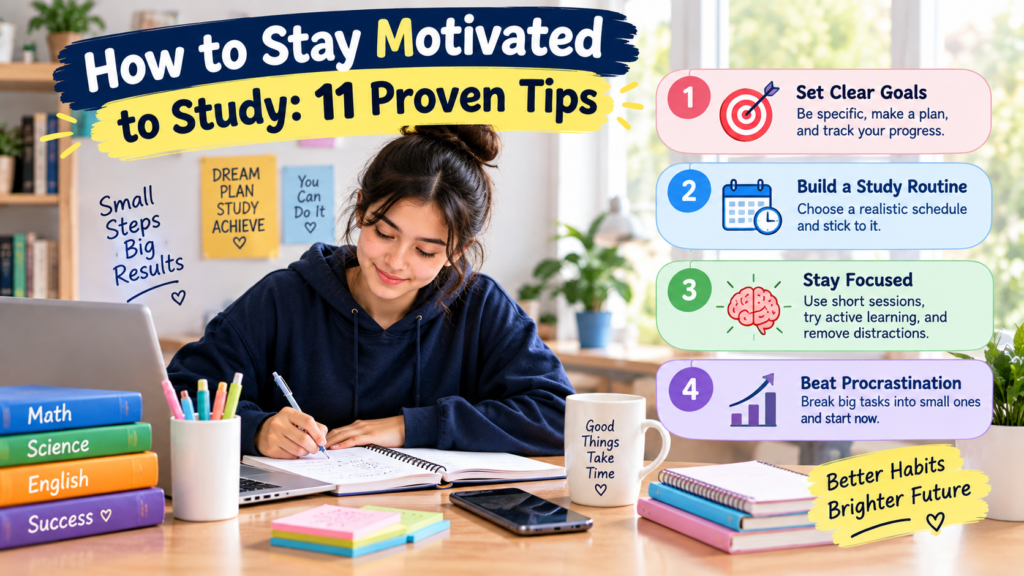
Academic performance refers to how well a student achieves learning goals in school, college, or another educational setting. It can be reflected through grades, test results, assignments, projects, classroom participation, and overall progress.
Good academic performance does not mean getting perfect grades in every subject. A student can improve by understanding difficult concepts, completing work on time, developing stronger study skills, and making steady progress.
The goal should be meaningful improvement rather than perfection.
How to Improve Academic Performance
The most effective approach is to combine several habits instead of depending on one study trick. Here are 11 practical strategies that can help.
1. Set Clear Academic Goals
Start with specific goals. Instead of saying, “I want better grades,” choose a measurable target.
For example, you might decide to improve your mathematics grade, complete assignments at least one day early, or study for 45 minutes each evening.
Break larger goals into smaller weekly targets. Small achievements make progress easier to see and can keep you motivated.
2. Create a Realistic Study Schedule
A study schedule gives your schoolwork a specific place in your day.
Write down your classes, assignments, tests, activities, and available study periods. Then assign realistic blocks of time to different subjects.
Avoid creating a schedule that leaves no time for rest. A plan that is too demanding can quickly become difficult to maintain.
A simple schedule might include:
- 30 minutes for reviewing class notes
- 45 minutes for homework
- 30 minutes for difficult subjects
- A short break between study sessions
- Time for sleep and personal activities
Consistency matters more than creating the perfect timetable.
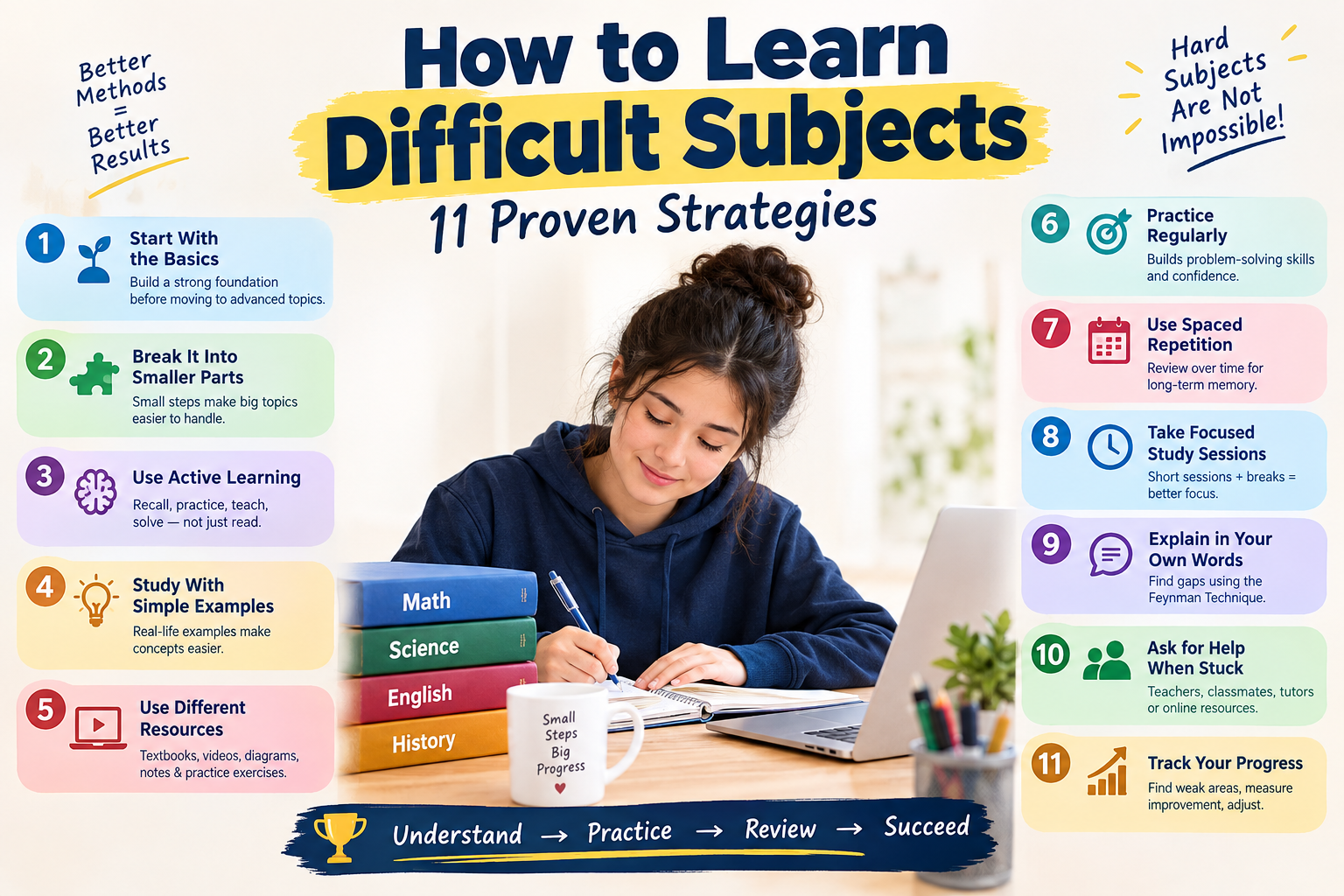
3. Use Active Learning Techniques
Reading the same page several times may feel productive, but passive reading does not always lead to strong understanding.
Active learning requires you to interact with the information.
After studying a topic, close your book and explain the main idea from memory. Ask yourself questions, solve practice problems, create examples, or teach the concept to someone else.
Useful techniques include active recall, practice testing, self-explanation, and spaced repetition.
The basic idea is simple: do something with the information instead of only looking at it.
4. Improve Your Time Management
Poor time management can cause unnecessary academic stress. Students may delay assignments until deadlines are close, leaving little time for careful work.
Start by identifying your most important tasks.
If you have a major project due next week, do not wait until the night before. Divide it into smaller steps such as research, planning, writing, editing, and final review.
You can also use a calendar, planner, or digital task list to keep track of deadlines.
Good time management allows you to study consistently instead of relying on last-minute cramming.
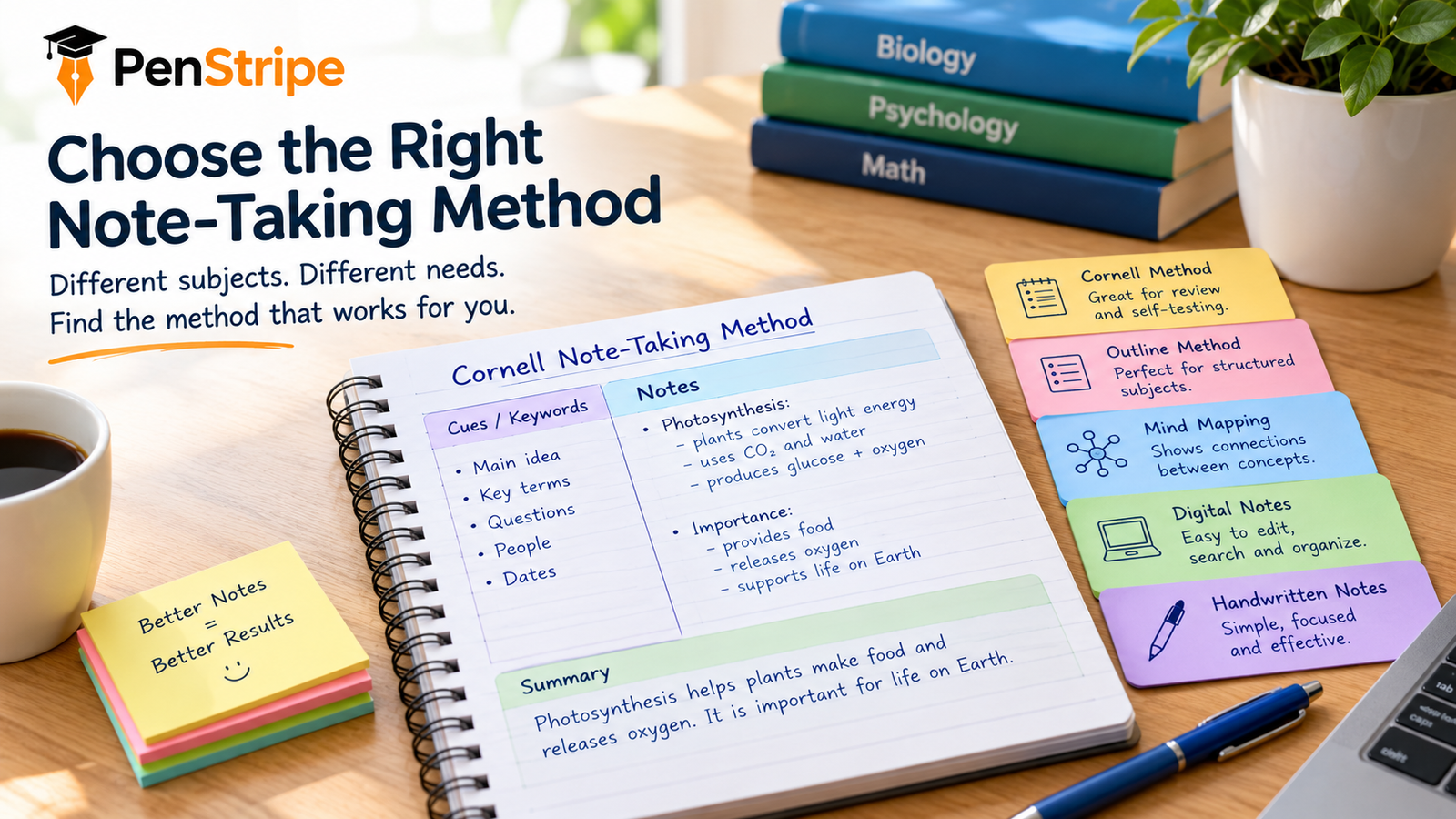
5. Take Better Notes
Effective notes should help you understand and remember the lesson later.
Do not try to write down every word your teacher says. Focus on key concepts, definitions, examples, formulas, explanations, and questions you do not understand.
After class, spend a few minutes reviewing your notes. Fill in missing information while the lesson is still fresh.
You can organize notes using headings, short explanations, diagrams, questions, or summaries.
The best note-taking system is one that helps you review information quickly and understand it clearly.
6. Improve Concentration While Studying
Concentration can be difficult when your phone, social media, games, notifications, or other distractions are nearby.
Create a study environment that makes focusing easier.
Put your phone away or turn off unnecessary notifications. Keep only the materials you need on your desk. Choose a quiet location when possible.
Try studying for a focused period followed by a short break. For example, you might work for 25 to 50 minutes and then take a short break.
If your attention starts to decline, avoid immediately switching to entertainment. Take a brief break and return to the task.
7. Stay Motivated to Study
Motivation naturally changes from day to day. You do not need to feel highly motivated before every study session.
Instead, create routines that make starting easier.
Begin with a small task. Tell yourself that you will study one topic, complete five practice questions, or review your notes for 10 minutes.
Once you start, continuing often becomes easier.
It can also help to connect academic goals with something meaningful. A strong academic record may support future education, career opportunities, personal goals, or greater confidence in your abilities.
8. Ask for Help When You Need It
Struggling with a subject does not mean you are incapable of learning it.
If you do not understand a concept, ask your teacher, instructor, tutor, classmate, or another reliable learning resource for help.
Do not wait until several weeks of confusion have accumulated.
Write down specific questions before asking for assistance. Instead of saying, “I don’t understand math,” identify the exact problem or concept causing difficulty.
Getting help early can prevent small learning gaps from becoming larger ones.
9. Practice With Questions and Tests
Practice questions can reveal what you actually know.
After studying a chapter, test yourself without looking at your notes. Try to answer questions, solve problems, define important terms, or explain the subject in your own words.
Practice tests can also make you more comfortable with the format and pressure of real exams.
When you make a mistake, do not simply look at the correct answer and move on. Find out why your answer was wrong.
Your mistakes can show you exactly where additional study is needed.
10. Get Enough Sleep
Sleep is an important part of effective learning. Staying awake late every night to study can leave you tired and less focused the next day.
Instead of sacrificing sleep regularly, plan your study sessions earlier when possible.
A consistent sleep routine can make it easier to concentrate during classes and study sessions.
Students should treat sleep as part of their academic routine rather than seeing it as time taken away from studying.
11. Track Your Academic Progress
You cannot improve what you never evaluate.
Keep track of grades, assignment completion, test results, and areas that need attention.
At the end of each week, ask yourself:
- What did I improve?
- Which subject needs more attention?
- Which study method worked best?
- What distracted me?
- What should I change next week?
This short review can help you identify patterns and make better decisions.
Build Better Study Habits

Good study habits develop through repetition. You do not need to completely change your routine overnight.
What Are Good Study Habits?
Strong study habits include studying consistently, reviewing material regularly, completing assignments on time, organizing notes, practicing difficult topics, and reducing distractions.
A student who studies for a reasonable amount of time every day may achieve better results than someone who studies for many hours only before an exam.
How to Build Better Study Habits
Choose one habit to improve first.
For example, start by reviewing class notes for 20 minutes each evening. Once this becomes routine, add another habit such as practice testing or weekly planning.
Make the habit easy to start. Keep your books ready, choose a regular study location, and decide what you will study before sitting down.
Common Study Habits to Avoid

Some habits can make studying less effective.
These include constantly checking your phone, multitasking, skipping difficult topics, studying only before tests, copying notes without understanding them, and staying awake extremely late to finish work.
Replacing these habits gradually can improve both productivity and confidence.
Improve Time Management for Students
Time management is not about filling every minute with schoolwork. It is about using available time wisely.
Prioritize Important Tasks
Start with assignments and activities that have the closest deadlines or the greatest importance.
A simple priority system can help:
| Priority | Type of Task | Example |
| High | Urgent and important | Tomorrow’s exam |
| Medium | Important but not urgent | Next week’s project |
| Low | Less urgent | Organizing old notes |
Review your priorities each day because deadlines can change.
Break Large Assignments Into Smaller Tasks
A large assignment can feel overwhelming when viewed as one task.
Instead, divide it into manageable steps. Research today, create an outline tomorrow, write the first section afterward, and reserve time for editing.
This approach reduces procrastination and gives you visible progress.
Avoid Procrastination
Procrastination often begins when a task feels boring, difficult, or overwhelming.
Use the five-minute rule: commit to working on the task for just five minutes.
Once you begin, you may find it easier to continue. The important part is removing the barrier to getting started.
Use Active Learning Techniques

Active learning can make study sessions more meaningful because it requires you to retrieve and apply information.
Active Recall
Read a section, close your materials, and try to remember the main points.
For example, after studying a biology topic, explain the process without looking at your notes.
Spaced Repetition
Instead of studying everything in one long session, review important information at different times.
You might review new material today, again in a few days, and again the following week.
This creates repeated opportunities to retrieve information.
Practice Testing
Use questions to test yourself before an exam.
Practice testing can identify weak areas while there is still time to improve them.
Improve Concentration While Studying
Concentration improves when your environment and routine support focused work.
Create a Distraction-Free Study Space
Keep your study area simple. Remove unnecessary devices, close unrelated browser tabs, and keep your materials organized.
If you need your phone for studying, silence notifications and use only the required apps.
Use Focused Study Sessions
Choose one task for each session.
For example, instead of saying, “I will study science,” choose a specific goal such as, “I will review the causes of this historical event and answer 10 practice questions.”
Specific tasks are easier to start and measure.
Take Useful Breaks
Short breaks can help you maintain attention during longer study periods.
Stand up, stretch, drink water, or walk briefly. Try not to turn a five-minute break into an hour of social media.
Stay Motivated to Study
Motivation becomes easier to maintain when your goals are clear and your progress is visible.
Set Small Goals
Large academic goals can feel distant. Divide them into smaller achievements.
Instead of focusing only on getting an A, focus on completing today’s assignment, reviewing one chapter, or improving your next test score.
Track Your Progress
Use a simple checklist or study log.
Seeing completed tasks can provide a sense of progress and show whether your routine is working.
Build Consistency
You will not have the same level of motivation every day.
A consistent routine helps you continue even when motivation is low. The goal is not to study perfectly. The goal is to keep moving forward.
Prepare More Effectively for Exams
Exam preparation should begin before the final days.
Create an Exam Study Plan
List the subjects and topics covered on the exam. Give additional time to areas you find difficult.
Start with the material you understand least rather than repeatedly reviewing what you already know.
Combine Different Study Methods
Use reading, active recall, practice questions, summaries, and explanations.
Different methods can reveal different weaknesses.
Practice Under Test Conditions
Occasionally complete practice questions without notes and within a set time.
This helps you discover whether you can retrieve information without assistance.
Habits That Can Hurt Academic Performance
Improving academic performance also means identifying behaviors that hold you back.
Cramming
Cramming may help you remember information temporarily, but it can create stress and leave little time for understanding.
Regular review is generally a better approach.
Multitasking
Switching between studying, messages, videos, and social media can interrupt concentration.
Focus on one meaningful task at a time.
Ignoring Difficult Subjects
Avoiding a difficult subject does not make the problem disappear.
Give challenging topics smaller, regular study sessions and ask for help when necessary.
Sacrificing Sleep
Studying late occasionally may be unavoidable, but regularly sacrificing sleep can make it harder to focus and learn effectively.
A Simple Academic Improvement Plan
If you want to start improving immediately, use this seven-day plan.
| Day | Action |
| Day 1 | Identify your weakest academic areas |
| Day 2 | Create a realistic weekly schedule |
| Day 3 | Remove major study distractions |
| Day 4 | Try active recall and practice questions |
| Day 5 | Review and organize your notes |
| Day 6 | Complete a self-test |
| Day 7 | Review your progress and adjust your plan |
After the first week, continue the habits that produced the best results.
The objective is not to create a perfect routine. It is to create a routine you can maintain.
Frequently Asked Questions
How can I improve my academic performance quickly?
Start by identifying the biggest problem affecting your results. It could be poor time management, weak study habits, distractions, incomplete assignments, or difficulty understanding a subject. Address one major issue first, create a consistent study routine, and track your progress each week.
What are five habits for good studying?
Five useful study habits are studying consistently, using active recall, practicing with questions, managing your time, and reviewing material regularly. These habits make study sessions more focused and help you identify areas that need additional attention.
How can I focus 100% on studying?
Create a distraction-free environment, silence notifications, choose one specific task, and use focused study periods followed by short breaks. Avoid switching between multiple activities. Complete your most important work when your concentration is strongest.
How can weak students improve academic performance?
Students who are struggling can begin by identifying specific learning gaps rather than labeling themselves as weak. Breaking difficult subjects into smaller topics, practicing regularly, asking teachers for help, and tracking progress can make improvement more manageable.
How can I become a top student?
Focus on consistent habits rather than trying to study all day. Set clear goals, attend classes, review material regularly, practice actively, manage deadlines, ask questions, and protect your sleep. Strong students usually build systems that make productive behavior consistent.
How can I motivate a student to study?
Help the student create small, realistic goals rather than relying only on pressure. Connect learning with meaningful goals, reduce distractions, recognize progress, and create a predictable study routine. Encouragement and practical support can make starting difficult tasks easier.
How long does it take to improve academic performance?
There is no fixed timeline because improvement depends on the student’s starting point, subjects, habits, and consistency. Some changes may appear quickly, while meaningful academic improvement can take several weeks or longer. Tracking progress helps determine whether your strategy is working.
Does studying more hours improve academic performance?
Not necessarily. More study time does not automatically mean better learning. Focused study using active recall, practice questions, regular review, and effective time management can be more useful than spending long hours studying without a clear strategy.
Conclusion
Learning how to improve academic performance is mainly about making better decisions consistently. You do not need to study every waking hour or completely change your life overnight.
Start with a realistic schedule, clear goals, active learning, better concentration, regular practice, and healthy routines. Pay attention to your mistakes and adjust your approach when something is not working.
Most importantly, focus on progress rather than perfection. A few effective habits repeated consistently can make your study time more productive and help you become a more confident learner.
Choose one strategy from this guide today, put it into practice, and build from there penstripe