





Some subjects seem difficult because they contain complex ideas, unfamiliar terms, formulas, or too much information at once. You may read the same page several times and still feel like nothing is making sense. That experience can be frustrating, but it does not mean you are unable to learn the subject.
The real challenge is often the learning method, not your ability.
When you understand how to learn difficult subjects, you can break complicated material into smaller pieces, connect new information to what you already know, practice actively, and review it at the right time. These strategies can work for subjects such as mathematics, science, history, languages, economics, and other challenging courses.
In this guide, you will learn 11 practical strategies for understanding difficult topics, remembering important concepts, staying focused, and preparing for exams. You will also learn what to do when you feel completely stuck.
Why Do Some Subjects Feel Difficult?
Before changing your study method, it helps to understand why a subject feels hard.
Difficulty can come from several sources. A topic may depend on knowledge you have not fully learned yet. You may also be trying to memorize information without understanding how different ideas connect.
Complex Concepts and Too Much Information
Some subjects introduce many new ideas in a short period. For example, a biology chapter may contain unfamiliar terms, processes, diagrams, and scientific relationships.
Trying to learn everything at once can overload your working memory.
A better approach is to divide the material into smaller sections. Learn one concept, make sure you understand it, and then connect it to the next concept.
Weak Foundation in Basic Topics
Advanced topics often depend on earlier knowledge.
For example, a student who struggles with algebra may have difficulty with more advanced mathematics because basic operations, equations, or formulas are not fully understood.
If an advanced lesson feels impossible, go back and identify the earlier concept you are missing. Strengthening that foundation can make the current lesson much easier.
Lack of Practice and Confidence
Understanding something once does not mean you can use it independently.
A student might understand a teacher’s explanation but become confused when facing a new problem alone. Regular practice helps turn knowledge into a usable skill.
Confidence also develops through successful practice. Instead of expecting to master an entire subject immediately, focus on making progress one small skill at a time.
How to Learn Difficult Subjects Step by Step

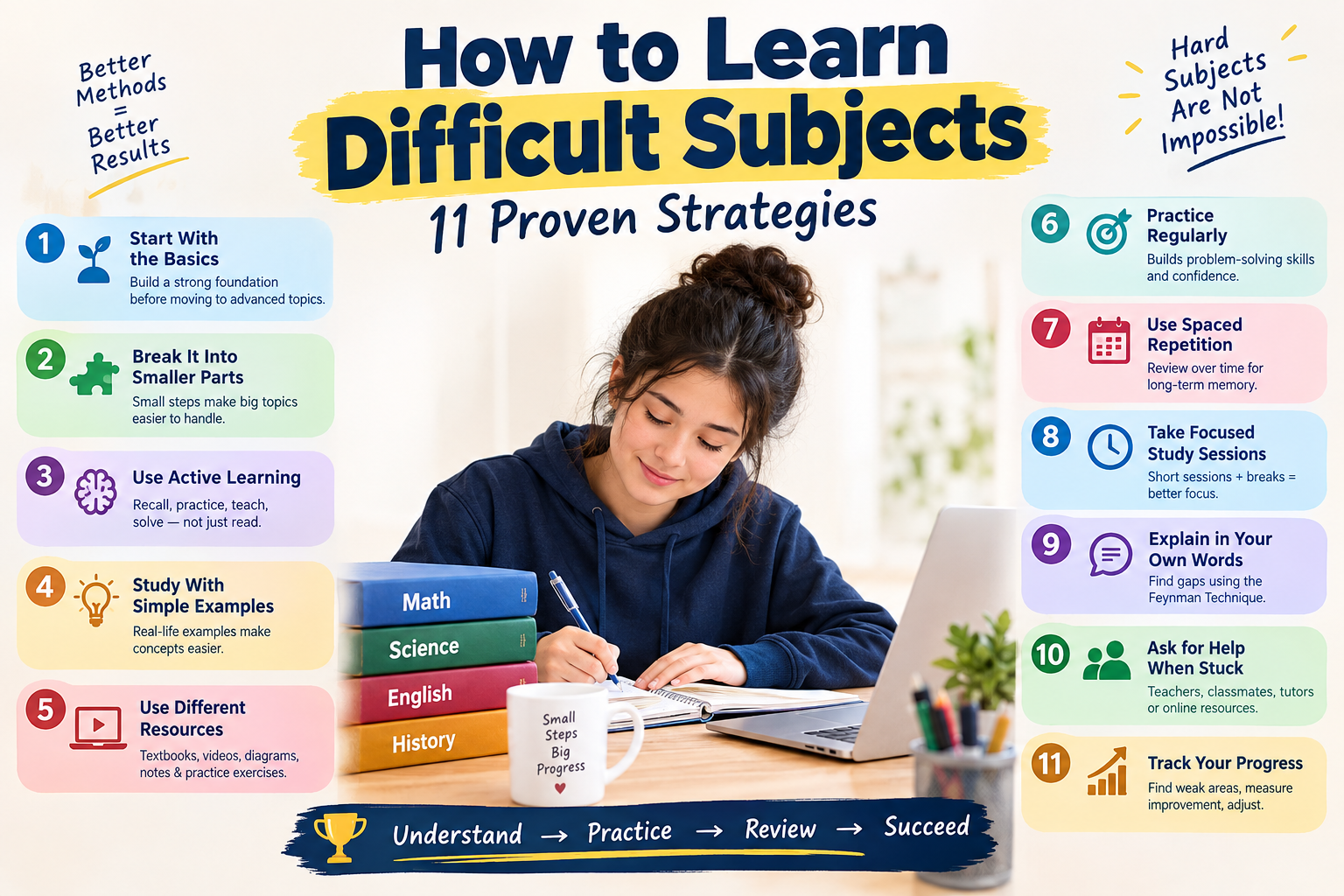
The following 11 strategies can help you approach difficult material more effectively.
1. Start With the Basics
Do not begin with the hardest chapter if you are missing important background knowledge.
First, identify the basic ideas required to understand the topic. For example, before studying advanced chemistry, make sure you understand basic chemical terms, equations, and atomic structure.
Create a simple foundation checklist:
- What do I already understand?
- What terms are unfamiliar?
- Which basic skills do I need?
- What should I learn before this topic?
Once the foundation is stronger, advanced material usually becomes less confusing.
2. Break Large Topics Into Smaller Parts
One of the simplest ways to make a difficult subject easier is to reduce the size of the learning task.
Instead of saying, “I need to learn this entire chapter,” divide it into smaller goals.
For example:
Today:
- Learn five important terms.
- Understand one main concept.
- Solve five practice questions.
Tomorrow:
- Review the first concept.
- Learn the next concept.
- Complete another set of questions.
Small goals make progress easier to see and reduce the feeling of being overwhelmed.
3. Use Active Learning
Reading a textbook repeatedly can create the feeling that you understand something when you actually only recognize the information.
Active learning requires you to do something with the material.
After reading a section, close the book and try to explain the main idea from memory. Answer practice questions without looking at the solution. Draw a diagram or teach the concept to someone else.
A useful cycle is:
Learn → Close the book → Recall → Practice → Check → Correct
This approach turns studying from passive reading into active problem-solving.
4. Study With Simple Examples
A difficult concept becomes easier when you can connect it to something familiar.
Suppose you are learning percentages. Instead of thinking only about formulas, connect the concept to discounts, grades, shopping prices, or sports statistics.
For theoretical subjects, create your own examples.
Ask yourself:
“What would this concept look like in real life?”
“Can I explain it using a simple example?”
“If I had to teach this to a younger student, what example would I use?”
Creating examples forces you to understand the idea rather than simply repeat its definition.
5. Use Different Learning Resources
One explanation does not always work for every student.
If your textbook explanation is confusing, try another reliable resource. You might use a classroom lecture, educational video, diagram, practice worksheet, or another textbook.
However, avoid jumping between too many resources without practicing. More information does not automatically mean better learning.
Use additional resources to clarify a specific problem, then return to practice.
6. Practice Difficult Problems Regularly
If a subject requires problem-solving, practice is essential.
Do not spend your entire study session watching explanations. After learning a method, solve problems without assistance.
When you make a mistake, do not simply look at the correct answer and move on. Find the exact step where your reasoning went wrong.
Keep a mistake log with three columns:
| Problem | My Mistake | Correct Approach |
| Algebra equation | Incorrect sign | Check each operation. |
| Science question | Misread the concept | Review the definition. |
| History question | Forgot the connection | Create a timeline. |
Reviewing mistakes can reveal patterns in your learning.
7. Use Spaced Repetition
Trying to learn everything in one long session is usually less useful than reviewing information across several sessions.
Spaced repetition means reviewing material at increasing intervals.
For example:
Day 1: Learn the concept
Day 2: Review it.
Day 4: Test yourself. Day 7: Review again
Day 14: Test yourself again.
The exact schedule can vary. The important idea is to return to information after some time instead of studying it only once.
This is especially useful for vocabulary, definitions, formulas, dates, and other information that needs to stay in long-term memory.
8. Take Short, Focused Study Sessions
Studying for several hours does not guarantee effective learning.
If your attention is constantly moving to your phone, messages, social media, or unrelated thoughts, much of that time may not be productive.
Instead, use focused study periods.
For example, you might study for 30 to 45 minutes, take a short break, and then begin another focused session.
During the study period:
- Put your phone away.
- Keep only necessary materials nearby.
- Choose one clear task.
- Avoid switching between subjects unnecessarily.
- Take a short break when your attention drops.
The goal is not simply to spend more time studying. It is to make your study time more useful.
9. Explain the Topic in Your Own Words
One powerful way to identify gaps in your understanding is to explain a concept without using the textbook’s wording.
This is closely related to the Feynman Technique.
Choose a concept and explain it as if you were teaching someone who knows nothing about it. Use simple language.
If you cannot explain one part clearly, return to that section and study it again.
For example, instead of memorizing a complicated definition, ask:
“What does this actually mean?”
“Why does it happen?”
“What is an example?”
“How is it connected to the previous concept?”
If you can answer these questions clearly, your understanding is becoming stronger.
10. Ask for Help When You Get Stuck
There is no need to struggle with the same problem for hours.
If you have tried to understand a concept and still cannot solve it, ask for help. A teacher, tutor, classmate, study group, or reliable educational resource may explain the same idea differently.
When asking for help, avoid saying only, “I don’t understand this.”
Instead, identify the exact problem.
For example:
“I understand the first two steps, but I don’t understand why this formula is used in the third step.”
That gives the person helping you a specific starting point.
11. Track Your Progress
Difficult subjects become easier to manage when you can see what you have learned.
At the end of each study session, write down:
- What did I learn?
- What can I explain without help?
- What do I still find confusing?
- Which questions did I get wrong?
- What should I study next?
You can also rate your understanding of each topic from “needs review” to “can explain independently.”
This creates a simple learning map and prevents you from repeatedly studying material you already understand.
How to Study a Subject You Are Bad At
Being weak in a subject does not mean you cannot improve. Start by identifying exactly where the difficulty begins.
Identify What You Do Not Understand
Do not label an entire subject as “too hard.”
Find the specific problem.
Maybe you understand the first part of a chapter but struggle with one formula. Maybe you know the vocabulary but cannot apply it. Maybe you understand the theory but struggle with exam questions.
The more specific the problem, the easier it becomes to solve.
Rebuild Your Foundation
If you discover a gap in your basic knowledge, temporarily step backward.
Review the earlier material and practice it until you can use it comfortably.
For example, if a student struggles with quadratic equations because basic algebra is weak, reviewing foundational algebra may be more useful than repeatedly reading the quadratic equation chapter.
Practice One Skill at a Time
Avoid trying to improve everything simultaneously.
Choose one weak area and work on it until your performance improves. Then move to the next.
This creates measurable progress and makes a difficult subject feel more manageable.
How to Remember Difficult Concepts
Understanding and remembering are connected, but they are not exactly the same.
Use Active Recall
After studying, put your notes away and ask yourself questions.
For example:
“What are the three main ideas?”
“How does this process work?”
“What is the formula?”
“Why does this happen?”
If you cannot answer, review the material and try again.
Create Simple Notes
Good notes should help you understand the material later, not reproduce every sentence from the textbook.
Use short explanations, key terms, examples, diagrams, and relationships between ideas.
Instead of copying:
“The process occurs as a result of…”
Write:
“Process → caused by → result”
The goal is to make the information easier for your future self to understand.
Connect New Ideas With What You Already Know
New information becomes easier to remember when it has a connection to existing knowledge.
Ask:
“What does this remind me of?”
“How is this similar to something I already know?”
“How is it different?”
Connections create a stronger mental structure than isolated facts.
Review Information at Spaced Intervals
Do not wait until the night before an exam to review everything.
Use short review sessions throughout the week. Combine spaced repetition with active recall by testing yourself instead of simply rereading your notes.
How to Learn Difficult Subjects for Exams

Exam preparation requires more than reading the textbook.
Create an Exam Study Plan
Start by listing the topics you need to learn.
Then divide them across the available days.
Give more time to topics you do not understand and less time to material you already know well.
A simple plan might look like this:
| Study Day | Main Focus | Practice |
| Monday | Topic 1 | 10 questions |
| Tuesday | Topic 2 | 10 questions |
| Wednesday | Topic 1 review | Practice test |
| Thursday | Topic 3 | 10 questions |
| Friday | Weak areas | Mixed questions |
Prioritize Weak Topics
Do not spend most of your study time reviewing topics you already know because they feel comfortable.
Identify your weakest areas and give them focused attention.
You can still review strong topics, but your biggest improvement often comes from fixing knowledge gaps.
Practice Past Questions
Practice questions show whether you can actually apply what you learned.
When possible, use questions that match the style and difficulty of your course or exam.
After completing them, analyze your mistakes rather than focusing only on your score.
Review Mistakes Before the Exam
Your mistakes are useful study material.
Create a final review list containing formulas, concepts, question types, or misunderstandings that previously caused problems.
Review this list before the exam instead of trying to reread every page.
Common Mistakes When Studying Difficult Subjects

Even a good study plan can fail if your approach creates unnecessary problems.
Memorizing Without Understanding
Memorization can help with facts, but it is not enough when you need to apply a concept.
Understand what information means before trying to memorize it.
Studying Everything at Once
Trying to learn an entire subject in one sitting can create penstripe overload.
Break your workload into smaller sessions and focus on one clear goal at a time.
Avoiding Difficult Topics
Students often spend more time on topics they enjoy because they feel productive.
Do not permanently avoid difficult material. Identify the specific barrier and work through it gradually.
Relying Only on Reading
Reading is useful for introduction and review, but difficult subjects usually require active practice.
Use a combination of reading, recall, explanation, questions, examples, and problem-solving.
Frequently Asked Questions
What is the best way to learn a difficult subject?
The best approach is to build a strong foundation, break the subject into smaller topics, practice actively, review information over time, and identify mistakes. Instead of repeatedly reading difficult material, test yourself and explain concepts in your own words. This helps reveal what you actually understand and what still needs work.
How can I understand a subject I am bad at?
Start by finding the exact topic or skill causing difficulty. Then review the basic knowledge needed for that topic and practice one skill at a time. Avoid treating the entire subject as impossible. Specific problems can usually be addressed more effectively than a general feeling that a subject is too hard.
How can I learn difficult subjects faster?
Focus on effective learning rather than simply increasing study hours. Break topics into smaller sections, remove distractions, use active recall, practice questions, and review material using spaced repetition. Avoid spending most of your time rereading notes because recognition is not the same as being able to recall and apply information.
How can I remember difficult concepts?
Use active recall, spaced repetition, simple notes, examples, and connections to information you already understand. After learning a concept, close your notes and explain it from memory. If you cannot explain it clearly, review that part and test yourself again later.
What should I do if I cannot understand a subject?
Identify the exact point where your understanding stops. Check whether you are missing a basic concept, then find another explanation or ask a teacher, tutor, or classmate for help. Work through smaller examples before attempting more difficult problems. Avoid repeatedly reading the same confusing explanation without changing your approach.
What are the top 5 hardest subjects?
There is no universal list of the five hardest subjects because difficulty depends on the student, course level, background knowledge, and type of assessment. Mathematics, physics, chemistry, advanced languages, and some areas of computer science are often considered challenging, but individual experiences can differ substantially.
What is the 9 8 7 rule for studying?
The phrase “9 8 7 rule” is not a single universally established study method. Different online sources may use similar numbers for different study routines. Before following a specific version, check what the source means by the rule and whether it fits your study schedule and learning goals.
How can I focus 100% on studying?
Instead of trying to maintain perfect concentration, create conditions that reduce distractions. Choose one task, put your phone away, prepare your materials before starting, and use a defined study period followed by a short break. If your attention drops, reset your focus and continue rather than assuming the entire study session is wasted.
Conclusion
Learning a difficult subject is not about being naturally gifted or studying for endless hours. A better approach is to make the learning process more structured.
Start with the basics, break complex topics into smaller pieces, use active learning, practise difficult problems, and review information over time. When you make mistakes, use them to identify gaps rather than treating them as failure.
If you want to learn difficult subjects more effectively, begin with one topic today. Identify what you do not understand, learn the missing foundation, practise it, and test yourself without looking at your notes.
Small improvements repeated consistently can turn a subject that once seemed impossible into something you can understand and use confidently penstripe