






The history of predominantly white institutions in the United States did not happen by accident. It was built, brick by brick, through laws, exclusion, and policy decisions that shaped who could sit in a college classroom for more than a century. Understanding this history matters because it explains why most American colleges look the way they do today, and why researchers now describe them using a much more direct term than “predominantly white.”
This guide walks through how predominantly white institutions formed, how they changed after desegregation, and what current academic research says about the racial structure still built into many campuses today. You will also learn about the concept of historically white colleges and universities, a framework introduced by sociologists Eduardo Bonilla-Silva and Crystal Peoples, and how it helps explain patterns that go far beyond simple enrollment numbers.
What Is a Predominantly White Institution and Where Did the Term Come From
The Basic Definition
A predominantly white institution, or PWI, is any college where white students make up the clear majority of enrollment. It is a demographic description rather than a formal legal category, which is part of why the term can feel vague compared to something like an HBCU classification.
Why Researchers Started Using a Stronger Term
In 2022, sociologists Eduardo Bonilla-Silva and Crystal Peoples published research arguing that calling most American colleges “predominantly white” understates what is actually happening. Their study introduced the term historically white colleges and universities, or HWCUs, to describe how whiteness is embedded not just in who enrolls, but in a school’s history, demographics, curriculum, campus climate, and traditions all at once.
Why This Distinction Matters
This reframing pushed the conversation beyond simple percentages. Instead of asking only how many white students attend a school, researchers began asking how deeply whiteness is built into the institution’s identity, symbols, and everyday culture, even at schools that have become more diverse over time.
The Early History of Predominantly White Institutions
Higher Education Before the Civil War
Long before the term PWI existed, American colleges were built almost exclusively for white students, and in most states, Black Americans were legally barred from higher education entirely, especially during slavery.
The Founding of Alternative Institutions
Because Black students were shut out of nearly every existing college, separate institutions were created specifically to serve them, which eventually became the Historically Black Colleges and Universities we know today. These schools were not a footnote to PWI history. They were a direct response to it.
Segregation-Era Policy and Practice
Even after slavery ended, formal segregation laws kept most colleges racially exclusive well into the 20th century. Many flagship state universities did not admit their first Black students until decades after founding, often only after lawsuits or federal intervention forced the issue.
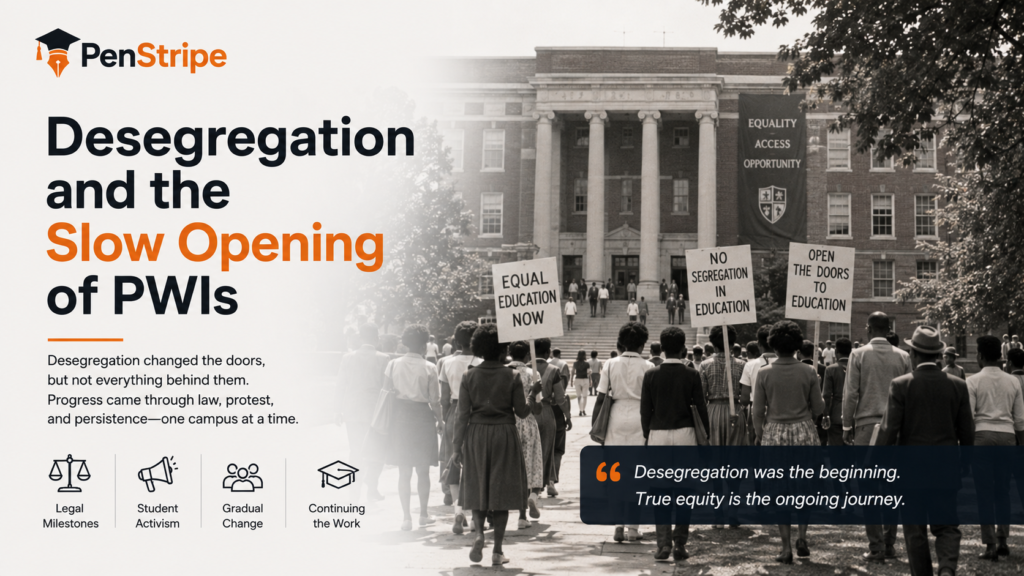
Desegregation and the Slow Opening of PWIs
Landmark Legal Changes
Civil rights era court decisions and legislation gradually forced colleges to open their doors, though change came unevenly and often only after direct legal pressure on individual schools.
Enrollment Growth After the 1960s
Black student enrollment at PWIs increased steadily after desegregation, though access remained uneven based on geography, family income, and how welcoming individual campuses actually were once students arrived.
The Gap Between Legal Access and Real Inclusion
Opening the doors legally did not automatically create a welcoming campus climate. Research consistently shows that formal desegregation and genuine cultural inclusion moved at very different speeds, a gap that current HWCU research argues still shapes campus life today.
How Historically White Colleges and Universities Research Reframes the Conversation
Whiteness Built Into Institutional Structure
Bonilla-Silva and Peoples argue that whiteness in higher education shows up in five connected areas: a school’s founding history, its current demographic makeup, its curriculum choices, its overall campus climate, and its symbols and traditions. Their framework treats these as one interconnected system rather than five separate issues.
Curriculum and Campus Symbols
Their research points to how course content, campus statues, building names, and long-standing traditions often reflect a single cultural default, shaping whose history and achievements get centered in everyday campus life.
Campus Climate as a Measurable Factor
Rather than treating campus climate as just a feeling, their research treats it as something structural, connected directly to demographic composition, curriculum choices, and institutional history, not something that changes just because enrollment numbers shift slightly.
PWIs vs. HBCUs vs. HWCUs: How the Terms Compare
| Term | What It Describes | Key Focus |
| PWI | Any college with a white student majority | Enrollment demographics only |
| HBCU | College founded before 1964 to educate Black students | Historical mission and legal classification |
| HWCU | Framework describing how whiteness shapes a school’s full identity | History, demographics, curriculum, climate, and symbols together |
Learn more about PWI vs HBCU
Why the HWCU Framework Adds Value
The HWCU concept helps explain why some colleges with growing diversity numbers still get described by students as feeling unwelcoming. Enrollment alone does not capture curriculum, symbols, or institutional culture, which is exactly the gap this research was designed to address.
Practical Takeaway for Students and Researchers
If you are researching or writing about this topic, do not rely on enrollment percentages alone. Look at a school’s history, its curriculum requirements, its named buildings and traditions, and its published campus climate surveys for a fuller picture.
Frequently Asked Questions
What is the history of predominantly white institutions? Predominantly white institutions trace back to a time when most American colleges legally excluded Black students entirely. After desegregation, enrollment slowly opened, but full cultural inclusion took much longer, a gap researchers continue to study today.
What does HWCU stand for? HWCU stands for historically white college or university, a term introduced by sociologists Eduardo Bonilla-Silva and Crystal Peoples in 2022. It describes how whiteness shapes a school’s history, demographics, curriculum, climate, and traditions together, not just enrollment numbers.
Is PWI the same as HWCU? Not exactly. PWI describes current enrollment demographics, while HWCU is a broader research framework covering history, curriculum, climate, and symbols. HWCU was introduced specifically to capture patterns that enrollment percentages alone cannot explain.
When did PWIs start admitting Black students? Most PWIs began admitting Black students in meaningful numbers only after civil rights era legal pressure during the 1960s, and many flagship universities did not admit their first Black students until decades after they were founded.
Why were HBCUs created if PWIs exist? HBCUs were created because Black students were legally excluded from nearly every existing college before the mid-1900s. Rather than waiting for PWIs to open, communities built dedicated institutions to guarantee access to higher education.
Do PWIs still have racial climate issues today? Research suggests many do, even at schools with growing diversity numbers. Campus climate is shaped by curriculum, symbols, and institutional history, not just current enrollment, which is a central argument in recent HWCU research.
Conclusion
The history of predominantly white institutions is really the history of who was allowed into American higher education, and when. From legal exclusion to slow desegregation to today’s more nuanced HWCU research, this story shows that enrollment numbers alone never tell the full picture. If you are researching this topic for a paper, an essay, or your own college decision, look beyond demographics and dig into a school’s actual history, curriculum, and climate data before drawing conclusions.