






If you have been searching to understand what is predominantly white institution is, you are not alone. This term shows up a lot when students are choosing colleges, writing essays, or trying to understand campus life in the United States. It sounds like a fancy phrase, but the idea behind it is actually simple once it is explained the right way.
In this guide, we will break down everything in plain, easy words. We will cover the real meaning, how it started, and what daily life looks like for students who go to these schools. We will also compare PWIs vs HBCUs, talk about the Black student experience at PWIs, and help you figure out how to choose the right college for yourself.
This article is written so that even a school student can understand it. No hard words. No confusing terms. Just clear facts, explained step by step, so you leave this page fully confident about what a PWI really means, why the term matters, and how to use this information when picking your own school.
What Is a Predominantly White Institution?
Simple Definition of a PWI
A predominantly white institution, often shortened to PWI, is simply a college or university where more than half of the students are white. That is the whole idea. It is not a rule made by the government. It is just a way people describe a school based on who goes there.
There is no single official percentage that every person agrees on. Most people use the term when a school’s white student population is clearly the majority, usually well above 50 percent. But the exact number can change depending on who is talking about it or which report you are reading. Some researchers use 50 percent as the starting point, while others only use the term when the number is closer to 70 or 80 percent white enrollment.
This is why the term can feel a little confusing at first. It is not a strict math formula. It is more like a general way to describe the racial makeup of a school so people can talk about campus life, student support, and college choices more easily.
How the Term Is Commonly Used in Higher Education
Teachers, researchers, and college guidance counselors use the word “PWI” mostly to help explain campus culture. If a report says a school is a PWI, it usually means the writer wants readers to understand that white students are the majority group on that campus, which can shape things like clubs, events, and the overall feel of the school.
The term is also used a lot in college essays, especially when students are asked to write about diversity, personal identity, or their own college experience. Many students search things like “what is predominantly white institution essay” because their teacher asked them to reflect on this topic for a class assignment or college application.
What Makes a College or University a PWI?
A few things usually decide whether a school gets called a PWI:
- Student demographics: how many students of each race attend the school
- Historical background: some schools were built during times when only white students were allowed in
- Institutional culture: the traditions, events, and daily campus vibe
- Geographic and regional factors: schools in certain states or towns naturally have different populations
None of these factors alone decide it. It is really the mix of who is enrolled that matters most. A school in a rural area with a smaller minority population nearby may naturally have fewer minority students, even if the school itself works hard on diversity efforts. On the other hand, a large city school might have a much more mixed student body simply because of where it is located.
Is PWI an official classification?
No, it is not an official government label like some other college categories. The U.S. Department of Education has formal categories for things like Historically Black Colleges and Universities (HBCUs) or Hispanic-Serving Institutions (HSIs). These are legal classifications with specific rules attached to them, and schools often qualify for extra funding once they meet those rules.
PWI is different. It is more of a common term people use in conversations, research papers, and college guides. It describes a pattern, not a legal status. This is an important difference to understand, especially if you are writing a school paper, because mixing up “official classification” with “common term” is one of the most frequent mistakes students make.
History of Predominantly White Institutions in the United States

Higher Education Before Desegregation
A long time ago, many colleges in America did not allow Black students to attend at all. This was not just an accident of history. It was often the law. Many states had rules that kept Black students out of most colleges completely, no matter how smart or qualified they were.
This is part of why historically Black colleges and universities were created in the first place. Since Black students were kept out of most white schools, separate schools were built so they could still get an education, earn degrees, and build careers. These schools became centers of learning, leadership, and community pride for generations of Black families.
Desegregation and Increased Access
Big changes came during the civil rights movement. Laws changed, doors opened, and students of every background slowly gained the right to attend any college they wanted. This did not happen overnight, and it did not happen easily. Many students had to fight, protest, and push through unfair treatment just to sit in a classroom.
Over time, colleges that were once only for white students began to open up to everyone. Court decisions and new laws made it illegal for schools to turn students away because of their race. This was one of the biggest turning points in the history of American education.
How PWIs Have Changed Over Time
Today, many PWIs have far more diversity than they did decades ago. Enrollment numbers have shifted, more scholarships exist for minority students, and campus diversity programs have grown in almost every part of the country. Colleges now often have entire offices dedicated to helping minority students feel supported and included.
Still, some challenges around fair representation continue, which we will talk about later in this guide. Change has happened, but it has not erased every gap. Many schools are still working on things like hiring more diverse faculty, offering better mental health support for minority students, and making sure every student feels like they belong on campus.
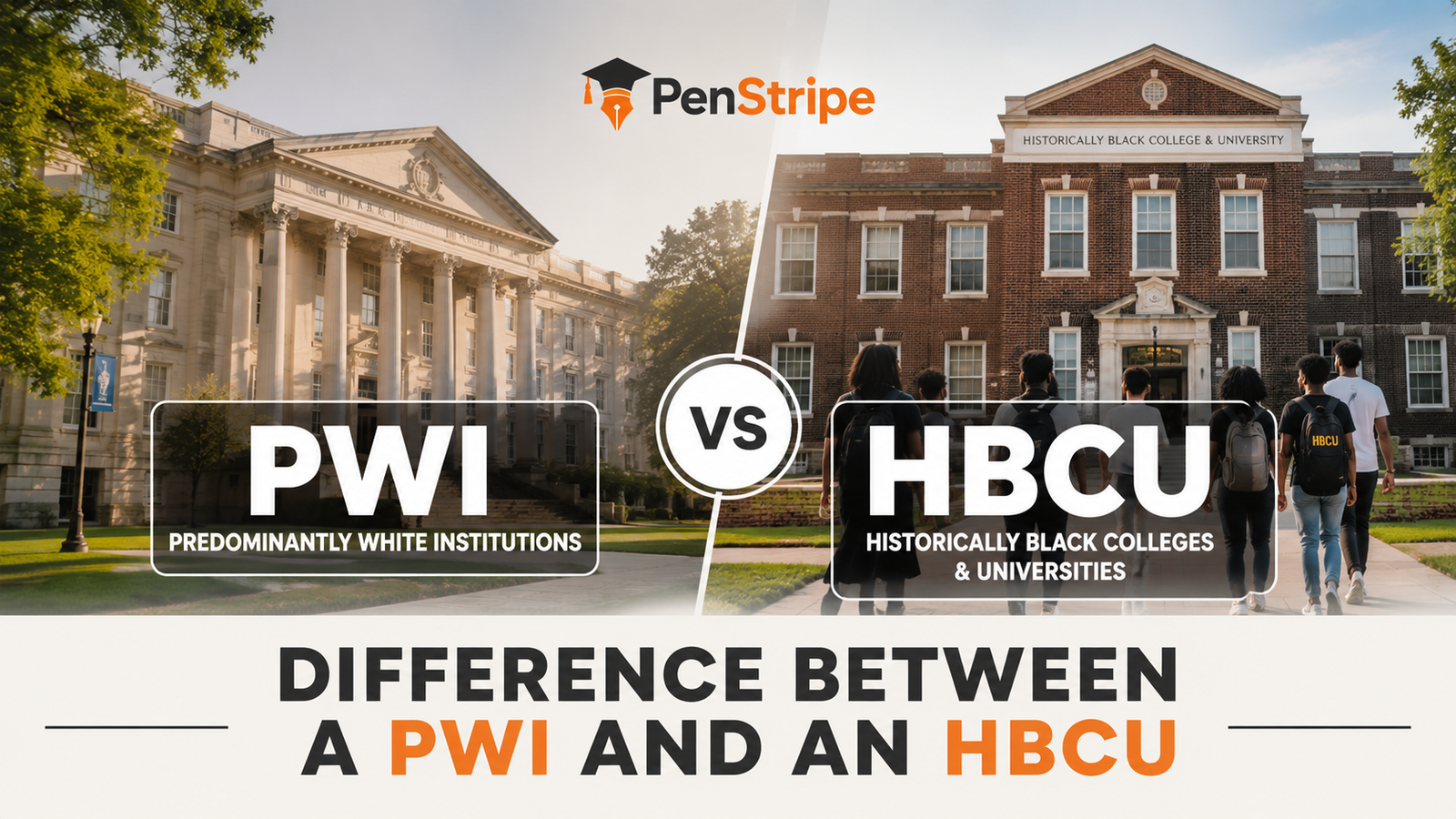
What Is the Difference Between a PWI and an HBCU?
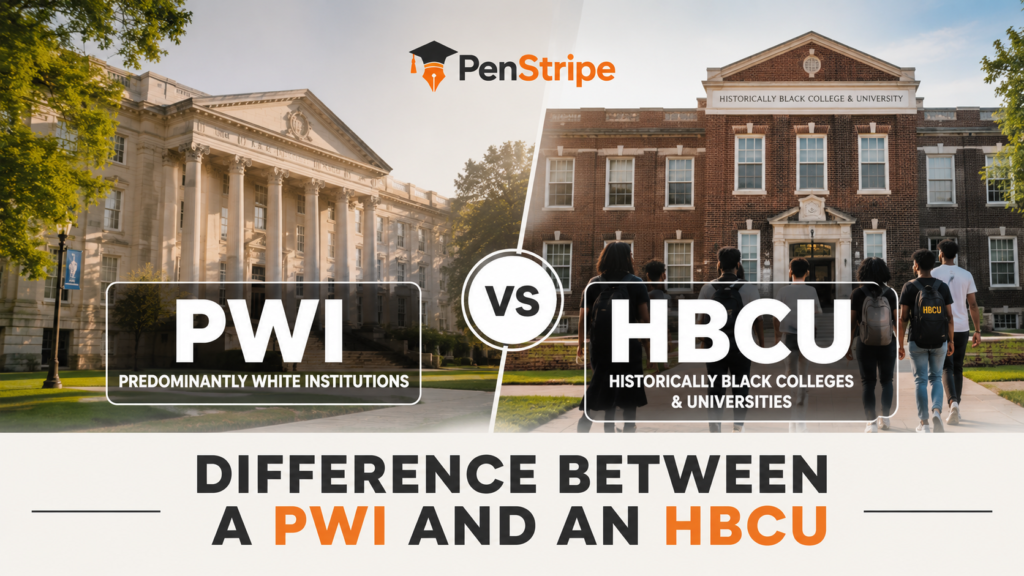
This is one of the most searched comparisons, so let’s make it super clear.
| PWI | HBCU |
| Predominantly white student population | Historically established to educate Black students |
| Can still have diverse enrollment | Strong historical connection to Black higher education |
| Not created for one specific race | Has a specific historical and legal context |
| Term used to describe demographics | Official federal classification |
| Culture shaped by many different groups | Culture deeply rooted in Black history and tradition |
Can Black Students Attend a PWI?
Yes, of course. Black students, along with students of every race, can attend any PWI they qualify for. There is no rule stopping anyone from applying or enrolling. Many PWIs today have active support systems just for Black and minority students, including cultural centers, mentoring programs, and student-run organizations built specifically to help students feel less alone on a large campus.
Learn more about black students at PWI
Can White Students Attend an HBCU?
Yes. HBCUs are open to students of all races, even though they were originally created for Black students. Many HBCUs today have students from many different backgrounds, including white, Hispanic, Asian, and international students, all learning together.
Are PWIs Better Than HBCUs?
Neither one is “better.” It depends on what a student is looking for, like campus culture, community, programs, and personal comfort. Some students grow the most in a large, diverse PWI with huge resources and research programs. Other students grow the most in a tight-knit HBCU community with strong cultural roots and support. Both paths can lead to great careers and happy college memories.
PWI vs. HBCU: Which Is Right for You?
This depends on your goals. Some students prefer the strong sense of community at an HBCU. Others prefer the size, programs, or location of a PWI. There is no wrong choice, only the right one for you. Before deciding, it can help to visit both types of schools, talk to current students, and think honestly about what kind of environment helps you feel comfortable, motivated, and ready to learn. Learn more about PWI vs HBCU.
PWI vs. Other Types of Colleges
PWI vs. HBCU
Covered above, mainly a difference in history and student population.
PWI vs. Minority-Serving Institution (MSI)
An MSI is a school where minority students make up a large share of enrollment, often with special federal funding to support them. This is an official classification, unlike PWI, which is more of a descriptive term.
PWI vs. Hispanic-Serving Institution (HSI)
An HSI has at least 25 percent Hispanic student enrollment, which is an official federal classification, unlike PWI. HSIs often receive federal grants aimed at improving resources for Hispanic students.
PWI vs. Tribal Colleges and Universities (TCUs)
TCUs are built specifically to serve Native American communities and preserve their culture, language, and traditions through education.
PWI vs. Predominantly Black Institution (PBI)
A PBI has a majority Black student population but was not founded specifically as an HBCU. This is another important difference students often mix up.
What Is It Like to Attend a PWI?
Campus Culture
Campus culture at a PWI can vary a lot. Some schools have big diversity programs and clubs, while others feel more traditional. The overall vibe often depends on the size of the school, its location, and how much effort the administration puts into inclusion.
Diversity and Representation
Even though white students are the majority, many PWIs still have active multicultural communities and international students. Some large PWIs actually have thousands of minority students, even if the overall percentage is still lower than the white student population.
Social Life and Student Organizations
Most PWIs offer cultural clubs, fraternities, sororities, and student unions built around different backgrounds and interests. These groups often become a home base for students who want to connect with others who share similar experiences.
Academic Environment
Academics at PWIs usually follow standard American college structures, with a wide mix of majors and research options. Many PWIs are also large research universities, which means students often get access to big labs, funding, and academic opportunities that smaller schools cannot offer.
Sense of Belonging
This is different for every student. Some minority students feel very supported, while others may feel like they stand out more. A student’s major, dorm life, friend group, and personal personality can all affect how connected they feel to campus life.
Experiences Can Differ From One PWI to Another
It is important to remember that not every PWI feels the same. Location, size, leadership, and campus programs all shape the experience differently. A small private PWI in a rural town will feel very different from a huge public PWI in a major city, even though both are technically “predominantly white.”
Challenges Black and Minority Students May Experience at PWIs
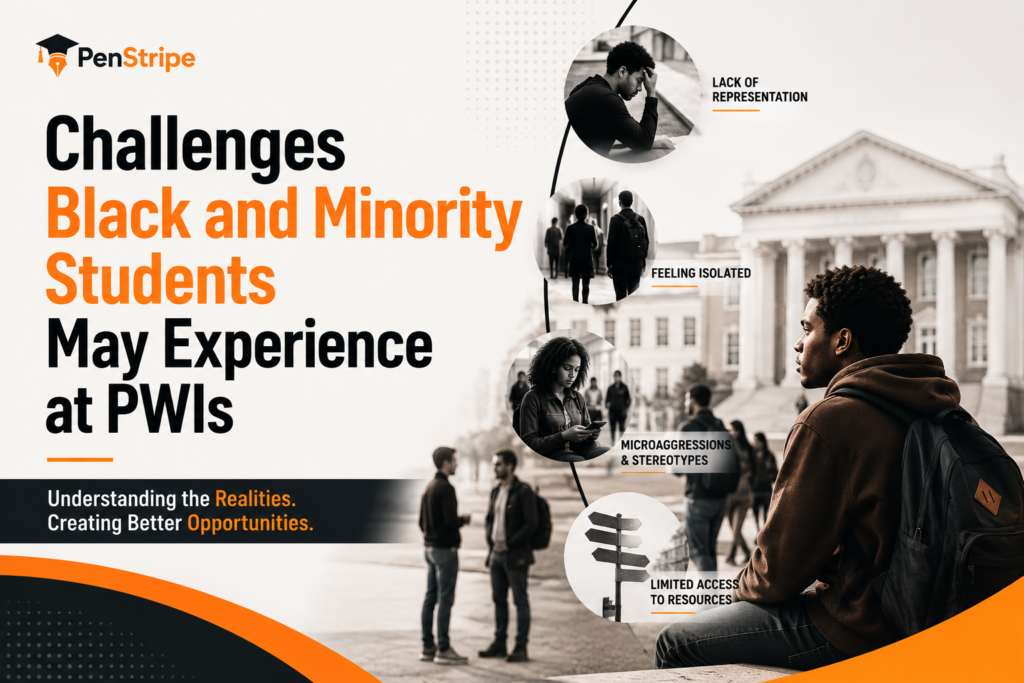
Some common challenges include:
- Lack of racial representation in classrooms or clubs
- Feeling isolated or like the only person from their background
- Microaggressions and stereotypes, even if unintentional
- Finding a strong community that understands their experience
- Fewer faculty and staff who share their background
- Limited access to culturally relevant resources
These challenges are real, and many students and researchers have written about them for years. Feeling like “the only one” in a classroom can be tiring, and small comments or assumptions from classmates, even if not meant to hurt, can add up over time.
Support Systems That Can Make a Difference
Many PWIs are working to close these gaps through:
- Multicultural centers
- Student organizations
- Mentoring programs
- Counseling and wellness resources
- Diversity and inclusion offices
- Cultural clubs and events
These support systems can make a huge difference in how connected and confident a student feels. Schools that invest heavily in these programs often see better retention rates among minority students, meaning more students stay enrolled and graduate successfully.
Benefits of Attending a PWI
It is not all challenges. There are real benefits too.
- Academic and research opportunities with bigger funding and resources
- Wide range of programs and majors to choose from
- Large alumni networks that help with jobs later
- Extracurricular opportunities like sports, arts, and clubs
- Diverse student organizations, even within a majority white school
- Career and internship opportunities through strong school partnerships
- Exposure to different backgrounds and perspectives, which can build valuable life skills
Many students who attend PWIs say the experience helped them learn how to work with people from many different backgrounds, which is a valuable skill in almost every career field today.
How to Find a PWI That Is a Good Fit
Before choosing, check these things:
- Research the student demographics
- Look at faculty diversity
- Explore campus organizations
- Research diversity and inclusion resources
- Talk to current students
- Visit the campus if possible
- Check graduation and retention data
- Consider location and cost
Taking the time to research these details before applying can save a lot of stress later. It also helps you walk onto campus already knowing what kind of support systems are available to you.
Examples of Predominantly White Institutions
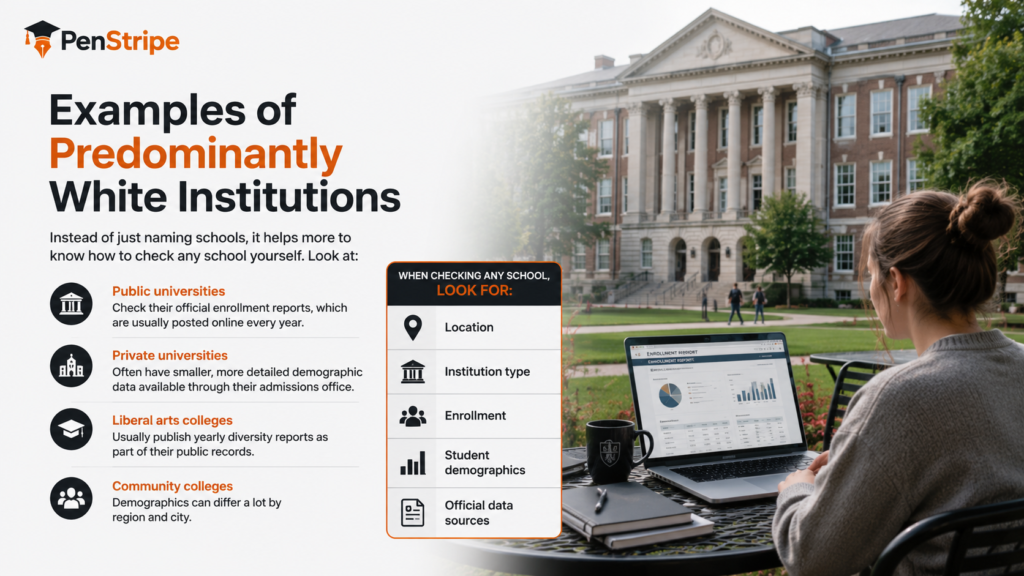
Instead of just naming schools, it helps more to know how to check any school yourself. Look at:
- Public universities – check their official enrollment reports, which are usually posted online every year
- Private universities – often have smaller, more detailed demographic data available through their admissions office
- Liberal arts colleges – usually publish yearly diversity reports as part of their public records
- Community colleges – demographics can differ a lot by region and city
When checking any school, look for location, institution type, enrollment demographics, diversity resources, and the date of the data, since numbers change every year. A school’s demographics from ten years ago may look very different from today, so always check the most recent report available.
How Do You Know If a College Is a PWI?
Use this simple checklist:
- Check enrollment demographics on the school’s website
- Review official institutional data reports
- Look at the percentage of white students
- Examine racial and ethnic representation overall
- Read the school’s official diversity reports
- Compare past and current numbers to see the trend
Most colleges publish this information on their official website, usually under sections labeled “About,” “Diversity,” or “Institutional Research.”
Common Misconceptions About PWIs
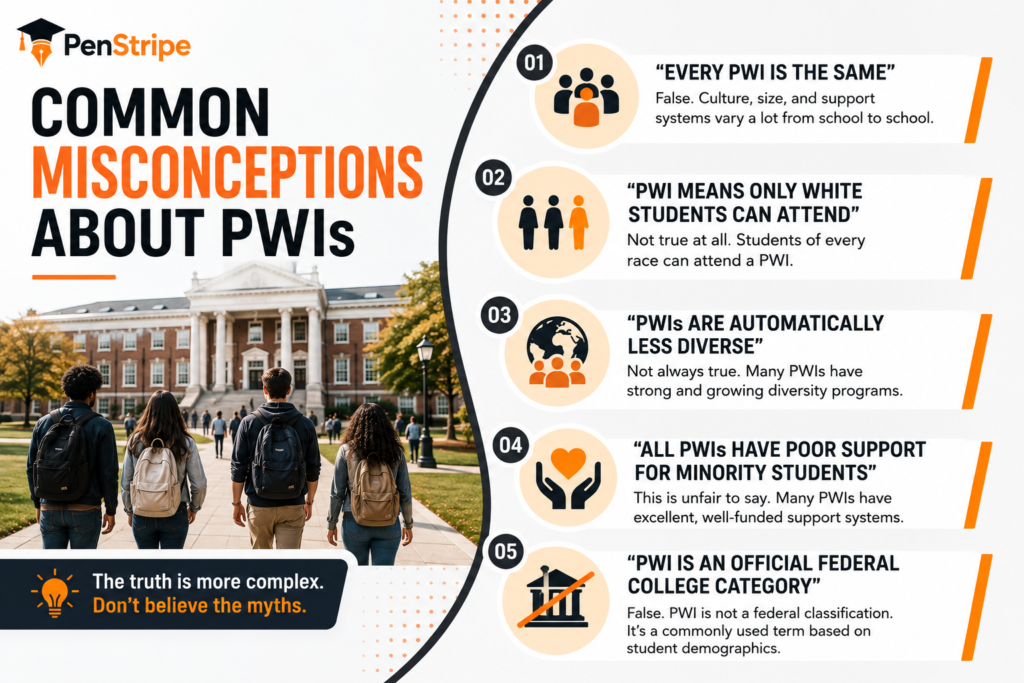
“Every PWI Is the Same”
False. Culture, size, and support systems vary a lot from school to school.
“PWI Means Only White Students Can Attend”
Not true at all. Students of every race can attend a PWI.
“PWIs Are Automatically Less Diverse”
Not always true. Many PWIs have strong and growing diversity programs.
“All PWIs Have Poor Support for Minority Students”
This is unfair to say. Many PWIs have excellent, well-funded support systems.
“PWI Is an Official Federal College Category”
It is not. It is a commonly used term, not a legal classification.
Frequently Asked Questions About PWIs
What does PWI stand for?
“PWI” stands for “predominantly white institution,” a college where most students are white.
What percentage of students makes a college a PWI?
There is no fixed number, but usually it means white students are clearly the majority.
Is a PWI the same as a white college?
No. A PWI simply has more white students, but students of all races can attend.
What is the difference between a PWI and an HBCU?
A PWI has mostly white students, while an HBCU was built specifically to educate Black students.
What are some examples of PWIs?
Many large public and private universities across the U.S. fall under this term, depending on their current enrollment data.
Final Takeaway
So, what is predominantly white institution really about? It simply means a college where white students make up most of the population. It is not an official label, not a rulebook, and definitely not something that decides how welcoming a school is.
Every PWI feels different depending on its location, leadership, programs, and student community. Instead of judging a school only by the PWI label, it is smarter to research its diversity programs, talk to real students, and visit if you can. Whether you choose a PWI or an HBCU, the right school is the one where you feel supported, challenged, and ready to grow into who you want to become.