



Knowing how to study for a test effectively is not about spending every free hour with a textbook. The quality of your study sessions matters more than simply counting the hours.
Many students reread the same chapter several times, highlight almost every sentence, or wait until the night before an exam to begin. These habits can feel productive, but they do not always help you remember information when you need it most.
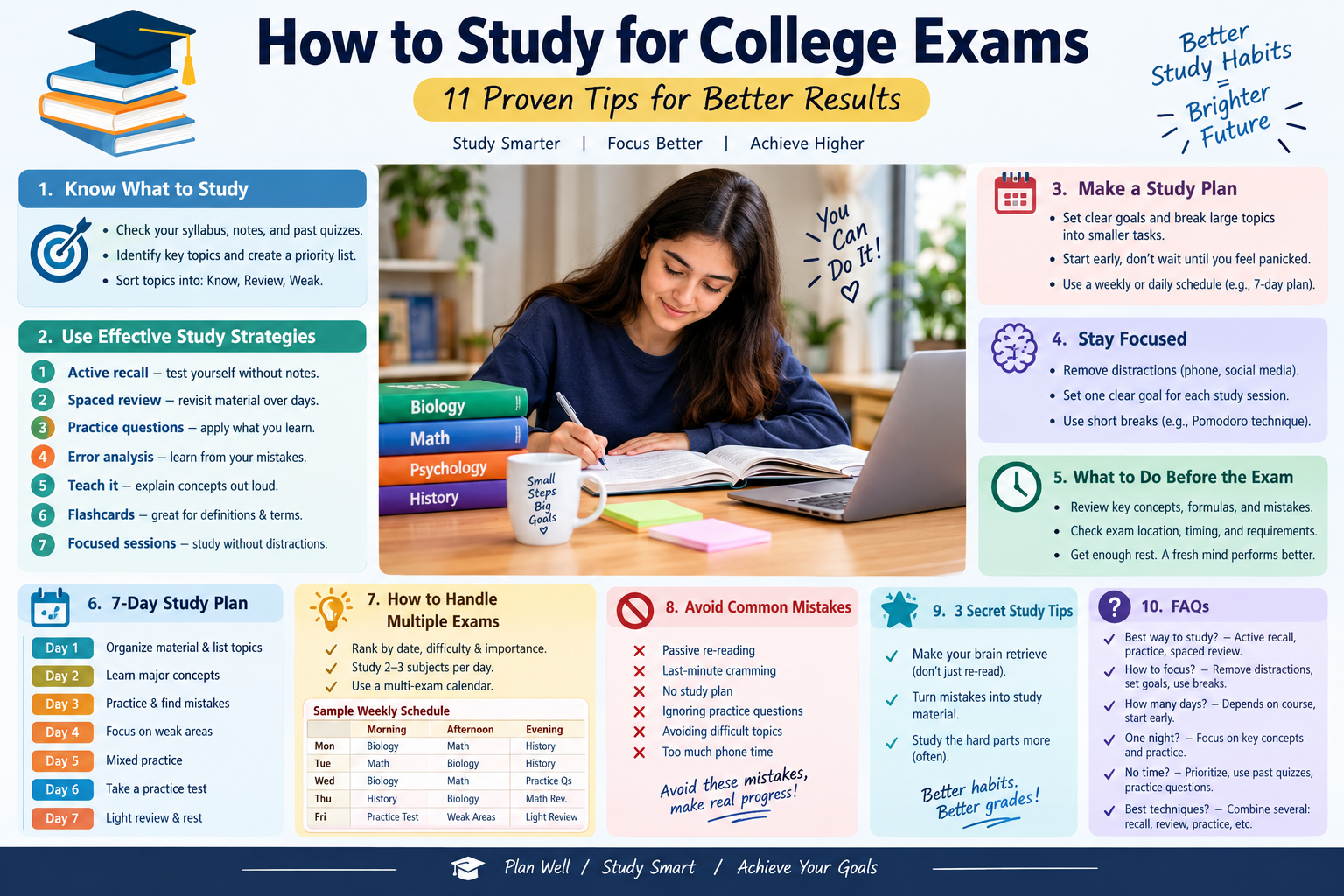
Effective test preparation combines active recall, practice questions, spaced review, focused study sessions, and enough rest. It also requires a realistic plan that matches the amount of material you need to learn.
Whether you are preparing for a school exam, college test, math assessment, history test, or another important evaluation, the right strategy can make studying more organized and less stressful.
This guide explains how to prepare, what study techniques to use, how to remember information, how to manage your time, and what to do on test day.
What Is the Most Effective Way to Study for a Test?

The most effective way to study for a test is to actively retrieve information instead of only rereading it. Practice questions, flashcards, explaining concepts from memory, and taking practice tests can help you identify what you actually know.
A strong study session usually follows this pattern:
Learn → Recall → Practice → Check → Review
For example, instead of reading a biology chapter three times, read a section once, close the book, and explain the main idea without looking. Then answer practice questions and review the mistakes.
This approach makes your study time more purposeful.
Start With the Test Material
Before studying, find out exactly what the test covers.
Check your class notes, textbook chapters, teacher study guide, previous quizzes, homework assignments, practice tests, and important terms.
Do not spend most of your time studying material that is unlikely to appear on the test.
Identify Your Weak Areas
Make three simple categories:
| Category | Meaning | Action |
|---|---|---|
| Strong | You can answer confidently | Quick review |
| Okay | You understand but make mistakes | More practice |
| Weak | You struggle without help | Highest priority |
This prevents you from spending an hour reviewing something you already understand while ignoring a difficult topic.
How to Prepare Before You Start Studying
Good preparation can make the actual study session much easier.
Set a Specific Goal
Avoid goals such as “study science.”
Instead, create a measurable target:
“Review cell division and answer 20 practice questions.”
A specific goal tells your brain exactly what needs to be completed.
Create a Realistic Study Schedule
Break large amounts of material into smaller sessions.
For example:
Monday: Chapter 1
Tuesday: Chapter 2
Wednesday: Chapter 3
Thursday: Practice questions
Friday: Review weak areas
Saturday: Full practice test
If your test is tomorrow, prioritize the most important and weakest topics rather than trying to relearn an entire course overnight.
Remove Distractions
Before beginning, put your phone away or activate Do Not Disturb. Keep only the materials needed for the current task on your desk.
A distraction-free environment makes it easier to maintain attention during focused sessions.
11 Effective Ways to Study for a Test
1. Use Active Recall
Active recall means trying to retrieve information from memory instead of simply looking at it.
After reading a topic, close your book and ask yourself:
- What are the main ideas?
- Can I explain this without looking?
- What terms do I remember?
- What example can I give?
If you cannot explain something without checking your notes, that topic needs more practice.
2. Practice With Questions
Practice questions are one of the most useful ways to prepare for an exam.
They show you whether you can actually apply what you learned.
After answering each question, check your work carefully. Do not just look at the correct answer. Find out why your answer was wrong.
Create a small mistake list and review it later.
3. Use Spaced Review
Instead of studying everything in one long session, review information over multiple days.
For example:
Day 1: Learn the topic
Day 2: Quick recall
Day 4: Practice questions
Day 7: Review mistakes
Spacing your study sessions gives you repeated opportunities to retrieve information.
4. Explain the Topic in Simple Words
Try teaching the concept to an imaginary student.
If you can explain a difficult idea using simple language, you probably understand it.
For example, rather than memorizing a complicated definition, explain what it means, why it matters, and give an example.
If you get stuck, return to your notes and identify the missing piece.
5. Make Flashcards for Important Information
Flashcards can work well for vocabulary, definitions, formulas, dates, foreign-language words, scientific terms, and key concepts.
Keep each card focused on one idea.
Instead of writing a paragraph on the answer side, use a short explanation. The goal is to make yourself retrieve the answer.
6. Use Practice Tests
A practice test can show you what studying alone cannot.
Try to simulate real test conditions. Set a timer, put away your notes, and answer the questions without assistance.
Afterward, review every mistake.
Pay special attention to questions you guessed correctly because a lucky answer does not necessarily mean you understand the concept.
7. Break Difficult Topics Into Smaller Parts
A difficult subject can feel overwhelming when you look at it as one large problem.
Divide it into smaller questions.
For example:
Instead of:
“Learn the entire chemistry chapter.”
Use:
- What is an atom?
- What are the main particles?
- How do chemical bonds work?
- What is a chemical reaction?
- How do I balance an equation?
Small targets make difficult subjects easier to approach.
8. Use the Pomodoro Technique Carefully
One popular approach is to study for a focused period and then take a short break.
A simple version is:
25 minutes studying → 5 minutes break
After several rounds, take a longer break.
You do not have to follow exactly 25 minutes. Some students prefer 40–50 minute sessions with longer breaks.
The important point is to protect focused study time and avoid turning breaks into long social-media sessions.
9. Study the Hardest Topics When You Are Most Focused
Not every student has the same productive hours.
If you concentrate best in the morning, use that time for difficult subjects.
If you focus better in the afternoon or evening, schedule challenging material then.
Use easier review tasks during periods when your energy is lower.
10. Mix Different Study Activities
Do not spend your entire study session doing only one activity.
A productive two-hour session might look like this:
30 minutes: Review concepts
30 minutes: Active recall
30 minutes: Practice questions
20 minutes: Review mistakes
10 minutes: Quick summary
This gives you several ways to interact with the material.
11. Sleep Before the Test
Studying until extremely late can leave you tired on test day.
A better approach is to finish the most important preparation before bedtime and allow yourself enough time to rest.
Your goal is not simply to know information. You also need enough energy and concentration to use that information during the test.
How to Improve Memory and Recall
Memorizing information becomes easier when you interact with it instead of repeatedly reading it.
Connect New Information to Something You Know
Try to create connections between new concepts and familiar ideas.
For example, when learning a new scientific process, connect each step to a simple real-world example.
Meaningful connections can make information easier to retrieve later.
Use Retrieval Instead of Recognition
Seeing an answer and thinking “I know that” is different from producing the answer yourself.
Test yourself before checking your notes.
That small change can reveal knowledge gaps that passive reading hides.
Review Your Mistakes
Your mistakes are useful study material.
If you repeatedly miss a question, ask:
- Did I misunderstand the concept?
- Did I forget a fact?
- Did I misread the question?
- Did I make a calculation error?
- Did I run out of time?
Understanding the reason for the mistake is more useful than simply memorizing the correct answer.
How to Manage Your Study Time

Good time management prevents last-minute panic.
Estimate the Work
Write down every major topic that needs review.
Then estimate how much time each one requires.
| Topic | Difficulty | Estimated Time |
|---|---|---|
| Chapter 1 | Easy | 30 min |
| Chapter 2 | Medium | 45 min |
| Chapter 3 | Difficult | 60 min |
| Practice test | Medium | 60 min |
| Mistake review | Difficult | 30 min |
Add some extra time for unexpected problems.
Prioritize Weak Areas
Do not divide your time equally if your understanding is not equal.
If you already know one chapter well but struggle with another, the difficult chapter deserves more attention.
This is one of the simplest ways to make limited study time more effective.
Use a Daily Checklist
Keep your checklist short and specific.
For example:
- Review 20 vocabulary terms
- Complete 15 math questions
- Explain Chapter 3 from memory
- Review yesterday’s mistakes
- Complete one practice section
Checking off clear tasks gives you a better sense of progress than simply writing “study for three hours.”
How to Study for a Test Effectively the Night Before
If your test is tomorrow, do not try to learn an entire semester in one night.
Focus on high-value activities.
Review Key Concepts
Look over your study guide, important notes, formulas, vocabulary, and concepts that your teacher emphasized.
Complete Targeted Practice
Answer a manageable number of practice questions.
Focus particularly on areas where you have already made mistakes.
Prepare Your Materials
Before going to sleep, prepare:
- Pens and pencils
- Calculator if required
- Student ID if needed
- Water
- Appropriate clothing
- Any permitted test materials
This reduces unnecessary stress in the morning.
Avoid an All-Nighter
Staying awake all night may give you more study hours, but exhaustion can make concentration and recall harder.
A shorter, focused review followed by adequate sleep is often a more practical approach.
How to Study for Different Types of Tests
Different subjects may require different preparation strategies.
How to Study for a Math Test Effectively
Math usually requires more than reading notes.
Start by reviewing the rules and formulas, then solve problems without looking at worked examples.
When you make a mistake, identify exactly where your solution went wrong.
For example:
Concept problem: You used the wrong formula.
Process problem: You knew the formula but applied it incorrectly.
Calculation problem: Your method was correct but your arithmetic was wrong.
This distinction helps you target the real problem.
How to Study for a History Test Effectively
History often involves dates, people, events, causes, and consequences.
Instead of memorizing isolated facts, create connections.
Ask:
- What happened?
- Why did it happen?
- Who was involved?
- What changed afterward?
- How did one event lead to another?
A timeline can help organize events, while active recall can help you remember names and important details.
What Is the 1/3,5/7 Rule in Study?
The “1/3, 5/7 rule” is not a universally standardized study method with one official definition. Different study resources may use similar numbers to describe different review schedules or study habits.
For that reason, focus less on memorizing the name of a rule and more on using a consistent review system.
A practical approach is:
Learn → Review → Test yourself → Review mistakes → Test again
The exact schedule can be adjusted according to the difficulty of the material and the date of the exam.
What Are 7 Secret Methods for Studying Effectively?
There are no truly “secret” study methods that guarantee a particular test score.
However, seven practical methods students can use are:
- Active recall
- Spaced review
- Practice testing
- Teaching the material
- Reviewing mistakes
- Breaking difficult topics into smaller parts
- Studying with clear goals
The important factor is not whether a technique sounds secret. It is whether you use it consistently and actively.
Which Are the 3 Toughest Exams in the World?
There is no single official global ranking of the “three toughest exams.” Difficulty depends on factors such as subject matter, competition, eligibility requirements, exam length, scoring system, and preparation required.
Different sources may identify different exams based on different criteria.
Instead of focusing on a universal ranking, students preparing for a difficult examination should examine the actual syllabus, exam format, previous questions, time limits, and required level of preparation.
What to Do on Test Day
Your preparation does not end when you close your books.
Read Questions Carefully
Do not rush through the instructions.
Look for words such as:
- Explain
- Compare
- Calculate
- Identify
- Describe
- Choose the best answer
Understanding exactly what a question asks can prevent avoidable mistakes.
Manage Your Time
If the test has many questions, avoid spending too long on one difficult problem.
A useful strategy is:
Answer easy questions → mark difficult ones → return later
This allows you to collect points from questions you can answer confidently.
Check Your Answers
If time remains, review your answers.
Look especially for:
- Calculation mistakes
- Unanswered questions
- Misread instructions
- Spelling errors where relevant
- Incorrect units
- Answers that do not match the question
Study Methods Comparison
| Study Method | Best For | Main Benefit | Common Problem |
|---|---|---|---|
| Active Recall | Concepts and facts | Tests real memory | Requires effort |
| Flashcards | Vocabulary and definitions | Fast review | Can become passive |
| Practice Tests | Exam preparation | Builds test familiarity | Takes preparation |
| Spaced Review | Long-term retention | Repeated retrieval | Requires planning |
| Rereading | Initial review | Familiarizes you with material | Can create false confidence |
| Group Study | Discussion and explanation | Different perspectives | Can become distracting |
| Pomodoro | Focused sessions | Creates study structure | Breaks need discipline |
No single technique is perfect for every subject. The strongest approach is usually a combination of methods that matches the material and the type of test.
Frequently Asked Questions
How Many Hours Should You Study for a Test?
There is no universal number of hours that works for every student or exam. The required time depends on the amount and difficulty of the material, your current knowledge, and the test date. Focus on completing specific learning goals rather than studying for a fixed number of hours.
How Can I Study for a Test Quickly?
Start with the topics most likely to matter and the areas you understand least. Use active recall, practice questions, and focused study sessions instead of spending most of your time rereading. If the test is very soon, prioritize essential concepts and common question types.
How Can I Study for a Test Without Forgetting Everything?
Use repeated retrieval over time. Review information, close your notes, recall what you learned, and then check your answers. Returning to difficult material on multiple days can be more useful than trying to memorize everything in one long session.
Is It Better to Study Alone or With a Group?
Both can work. Studying alone can make it easier to control distractions and follow your own schedule. Group study can be useful when students explain concepts to one another or solve difficult problems together. Choose the method that helps you stay focused and actively engage with the material.
How Do I Study for a Test by Myself?
Create a study schedule, gather your test materials, divide the syllabus into manageable sections, and use active recall and practice questions. Explain difficult concepts aloud and keep a list of mistakes. This gives you a structured way to measure your progress without relying on another person.
What Are Three Secret Study Tips?
Three useful strategies are active recall, spaced review, and practice testing. Active recall makes you retrieve information, spaced review gives you repeated opportunities to remember it, and practice tests show whether you can apply your knowledge under test-like conditions.
Should I Study the Night Before a Test?
Yes, but keep the session focused. Review key concepts, important formulas, vocabulary, and previous mistakes rather than trying to learn everything from scratch. Prepare your materials and allow enough time for sleep so you can concentrate during the test.
What Is the Fastest Way to Study for a Test?
The fastest useful approach is to identify your weakest high-priority topics and practice retrieving them. Combine short focused sessions with practice questions and immediate mistake review. Avoid spending most of your limited time passively rereading information you already know.
Conclusion
Learning how to study for a test effectively is mainly about using your time intelligently. Instead of relying on long hours of passive reading, focus on active recall, practice questions, spaced review, mistake analysis, and clear study goals.
Start by identifying what the test covers and which topics need the most attention. Then create a realistic schedule and divide difficult material into smaller tasks.
As the test approaches, use practice questions to check your understanding and review the mistakes that continue to appear.
You do not need a complicated system. Choose a few effective techniques, use them consistently, and adjust your approach when something is not working.
The next time you prepare for an exam, start with one simple step: write down what you need to learn, identify your weakest area, and test yourself on it today penstripe