







Forgetting what you studied can be frustrating. You may read the same chapter several times, highlight important sentences, and spend hours reviewing notes, yet struggle to remember the information during a test. The problem is often not a lack of intelligence. It may be the way you are studying.
Learning how to improve memory for studying starts with understanding how to make information easier to recall. Instead of relying only on rereading, students can use active recall, spaced repetition, meaningful connections, practice questions, and focused study sessions.
Your daily habits also matter. Sleep, physical activity, nutrition, stress management, and regular breaks can affect how well you concentrate and learn.
In this guide, you will learn 11 practical ways to strengthen your study memory. You will also discover how to remember information for exams, how to study without forgetting, and which memorization techniques are worth adding to your routine.
1. Understand How Study Memory Works
Before changing your study routine, it helps to understand why information is forgotten.
Memory is not simply a storage box where everything you read stays permanently. Your brain needs repeated opportunities to process, connect, and retrieve information.
Why Do Students Forget What They Study?
One common reason is passive studying.
When you reread a page, the information may look familiar. However, familiarity does not always mean you can recall it without seeing the page.
For example, you may recognize a definition while looking at your textbook but forget it when the teacher asks you to explain it.
That is why effective studying should include activities that require you to retrieve information from memory.
Understanding Beats Simple Memorization
Memorizing isolated facts can be useful for some subjects, but understanding usually makes information easier to remember.
Instead of asking only, “What is this?”
Also ask:
- Why does it happen?
- How does it work?
- What is an example?
- How is it connected to something I already know?
- Could I explain it without looking at my notes?
These questions turn studying into a deeper learning process.
2. How to Improve Memory for Studying

Active recall is one of the most useful techniques for learning information. It involves trying to retrieve information from memory instead of repeatedly looking at it.
Test Yourself Without Looking
After studying a section, close your book and write down the main points you remember.
You can also turn headings into questions.
For example:
Heading: Photosynthesis
Question: What is photosynthesis, and why is it important?
Try answering before checking your notes.
If your answer is incomplete, review the missing information and test yourself again.
Use Flashcards Correctly
Flashcards can be useful when they require you to remember an answer before revealing it.
A weak flashcard might contain an entire paragraph.
A stronger card asks one focused question:
“What are the three main stages of cellular respiration?”
Answer the question from memory, then check your response.
This makes flashcards a form of active practice rather than simple reading.
Use Practice Questions
Practice questions are especially helpful before exams.
After completing a chapter, answer questions without looking at the textbook. Mark the questions you missed and review those topics.
Your mistakes show you where more learning is needed.
3. Practice Spaced Repetition
If you want to improve memory for studying, avoid trying to learn everything in one sitting.
Spaced repetition involves reviewing information over multiple sessions separated by time.
Spread Your Reviews

Instead of reviewing a topic five times in one evening, distribute your reviews.
A simple schedule might look like this:
| Review | Suggested Timing |
|---|---|
| First review | Same day |
| Second review | 1–2 days later |
| Third review | About a week later |
| Fourth review | Before the exam |
The exact schedule can vary. The important idea is to return to information multiple times.
Combine Spacing With Active Recall
Spaced repetition becomes more useful when each review requires retrieval.
Do not simply read your notes again.
Ask yourself questions, use flashcards, solve problems, or explain the concept without looking at the answer.
This combination gives your memory repeated practice.
Avoid Last-Minute Cramming
Cramming can make you feel productive because you are exposed to a large amount of information in a short time.
However, it leaves little room for repeated retrieval and correction.
If you know an exam is approaching, begin reviewing earlier and divide the material across several sessions.
4. Create Stronger Memory Connections
Information becomes easier to remember when it has meaning and connections.
Connect New Information to Existing Knowledge
When learning something new, ask yourself what it reminds you of.
For example, if you are learning a new scientific process, connect it to a real-world example. If you are studying history, create connections between events, people, dates, and causes.
The more meaningful connections you create, the easier it may be to retrieve the information later.
Use Examples and Stories
Abstract information can be difficult to remember.
Turn it into an example.
Suppose you are learning about supply and demand. Instead of memorizing a definition alone, imagine a popular product becoming difficult to find. Think about what could happen to its price when demand remains high but supply decreases.
Examples give your brain a context for the concept.
Teach the Topic to Someone Else
Try explaining the material as if you were teaching a younger student.
Use simple language.
If you become stuck while explaining a concept, that may reveal a gap in your understanding. Return to that part, learn it again, and explain it once more.
5. Improve Focus and Concentration
Memory begins with attention. If you are distracted while learning something, there is less useful information for your brain to process.
Remove Major Distractions
Before starting a study session:
- Put your phone away.
- Turn off unnecessary notifications.
- Close unrelated browser tabs.
- Keep only essential materials nearby.
- Choose a quiet study location.
You do not need a perfect environment. You need an environment that makes focused work easier.
Study One Topic at a Time
Constantly switching between subjects, messages, videos, and social media can break your concentration.
Choose one clear task.
For example:
“Complete 10 algebra problems.”
This is more useful than a vague goal such as:
“Study math.”
Use Focused Study Sessions
You can experiment with the Pomodoro technique or another timed study method.
For example, work for 25–50 minutes, take a short break, and then return to your work.
The best session length depends on your concentration and the difficulty of the task.
6. Use Better Memorization Techniques
Different subjects require different approaches. You do not need to use every memory technique for every topic.
Use Mnemonics
Mnemonics help you associate information with an easier phrase, pattern, or image.
For example, students sometimes create memorable phrases to remember lists or sequences.
The best mnemonic is one that makes sense to you and is easy to recall.
Group Information Into Chunks
Chunking means organizing smaller pieces of information into meaningful groups.
For example, instead of trying to remember ten unrelated items individually, group them into categories.
This can make complex information easier to organize.
Visualize Difficult Concepts
Mental images can help when studying information that is difficult to describe with words alone.
Create a simple mental picture, diagram, timeline, or flowchart.
For example, when studying a biological process, draw the stages in order rather than reading the description repeatedly.
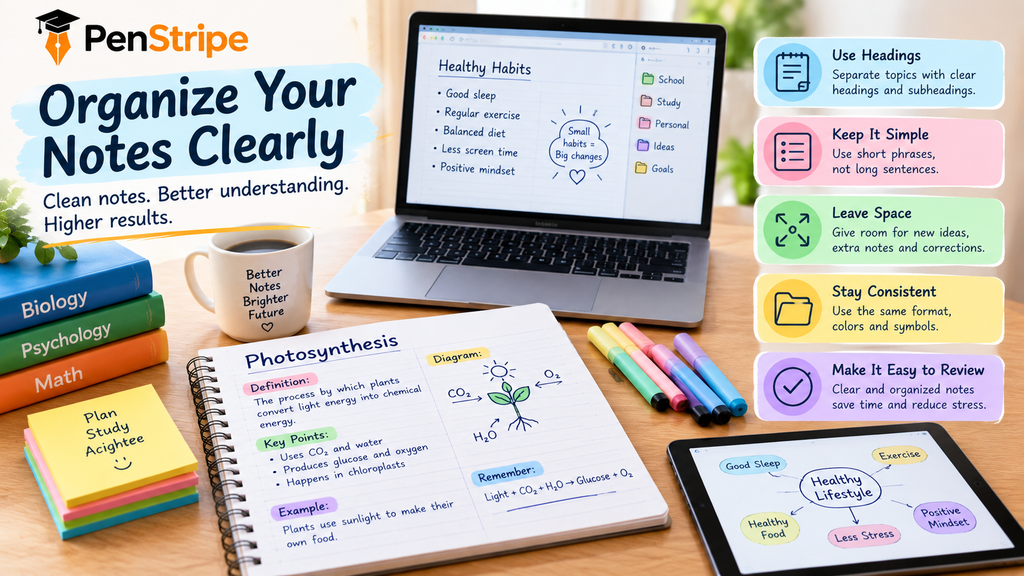
7. Take Better Notes
Good notes should make future review easier.
Write Key Ideas, Not Every Word
Trying to record everything can make note-taking exhausting.
Focus on:
- Main concepts
- Definitions
- Important examples
- Formulas
- Processes
- Questions you do not understand
Use your own words whenever possible.
Review Notes Soon After Learning
A short review after class can help you identify gaps while the information is still fresh.
Add missing explanations and turn important points into questions.
For example:
“Why does this process happen?”
“What are the three steps?”
“What example demonstrates this concept?”
These questions can later become your revision material.
Combine Notes With Retrieval
Do not let your notebook become something you only read.
Cover parts of your notes and try to recall them. Then check your answer.
This turns your notes into an active study tool.
8. Support Memory With Healthy Habits
Study techniques are important, but your daily routine also matters.
Get Enough Sleep
Sleep plays an important role in learning and memory. Staying up extremely late to study can leave you tired when you need to concentrate and recall information.
A consistent sleep schedule is generally more useful than repeatedly sacrificing sleep for extra study hours.
Stay Physically Active
Regular physical activity supports overall health and can be part of a balanced student routine.
You do not need an intense workout every time. Walking, stretching, sports, or other enjoyable movement can help you take meaningful breaks from sitting.
Eat and Hydrate Regularly
Your body and brain need adequate nutrition and hydration.
Instead of relying heavily on energy drinks or sugary snacks during long study sessions, build a balanced routine that includes regular meals and water.
If you have a medical condition or specific dietary concern, follow advice from an appropriate healthcare professional.
9. Prepare Your Memory for Exams
Exam preparation should test what you can actually retrieve, not just what looks familiar in your notes.
Create a Memory-Based Revision Plan
Start by listing the subjects and topics you need to cover.
Mark each topic as:
- Strong
- Needs review
- Difficult
Spend more time on topics that remain difficult.
This prevents you from repeatedly reviewing information you already know.
Use Practice Exams
Practice exams are valuable because they combine memory, understanding, and application.
Complete questions without your notes. Then check your answers carefully.
For every mistake, identify the cause.
Did you forget the information?
Did you misunderstand the concept?
Did you make a calculation error?
Did you misread the question?
Knowing the reason helps you choose the right correction.
Review Mistakes Before the Exam
Create a short mistake list.
Before the exam, review these errors rather than rereading every page from the beginning.
This makes your final revision more targeted.
10. Avoid Common Memory Mistakes
Some study habits feel productive but may not give you enough retrieval practice.
Do Not Depend Only on Highlighting
Highlighting can help identify important information, but highlighting alone does not test whether you can remember it.
After highlighting a section, close the book and explain the key ideas from memory.
Do Not Reread the Same Chapter Endlessly
If you can recognize the material but cannot answer questions without looking, switch to active recall.
Ask questions and practice retrieving the information.
Do Not Study Everything at Once
Trying to memorize an entire syllabus in one sitting creates unnecessary pressure.
Break the material into smaller sections and review them over time.
Do Not Ignore Your Weak Areas
Students sometimes spend too much time studying topics they already understand because those topics feel comfortable.
Instead, identify your weak areas and give them additional practice.
Study Methods Compared
| Method | Best Use | How It Helps |
|---|---|---|
| Active Recall | Facts and concepts | Tests retrieval |
| Spaced Repetition | Long-term learning | Revisits information over time |
| Practice Tests | Exam preparation | Identifies knowledge gaps |
| Mnemonics | Lists and sequences | Creates memorable associations |
| Chunking | Large amounts of information | Organizes material |
| Feynman Technique | Difficult concepts | Checks understanding |
| Mind Maps | Connected ideas | Shows relationships |
| Flashcards | Definitions and facts | Enables quick retrieval practice |
The strongest routine usually combines several methods. For example, learn a concept, explain it in your own words, create questions, review them later, and finish with practice problems.
Frequently Asked Questions
How can I sharpen my memory for studying?
Use active recall, spaced repetition, practice questions, and meaningful connections. Do not rely only on rereading. After learning a topic, close your notes and explain what you remember. Review the same information again after increasing periods of time.
How can I memorize 10x faster?
There is no reliable technique that guarantees you will memorize information 10 times faster. A better goal is to study efficiently. Use active recall, remove distractions, break information into smaller parts, and review it over multiple sessions rather than cramming everything at once.
What is the 7-3-2-1 memory technique?
The 7-3-2-1 memory technique is not a universally standardized learning method. Different sources may use the name for different review schedules. Before using a popular technique, focus on the underlying principles: active retrieval, repeated review, and increasing the time between study sessions.
How do I improve my brain memory for studying?
Start with effective learning methods and healthy daily habits. Practice active recall, use spaced repetition, sleep consistently, stay physically active, manage distractions, and give yourself enough time to review. If you have persistent or concerning memory problems outside normal studying, consider speaking with a healthcare professional.
How can I improve memory and concentration?
Improve both by creating focused study sessions, reducing digital distractions, sleeping consistently, taking regular breaks, and using active learning. Concentration helps you process information, while retrieval practice helps you strengthen your ability to recall it later.
What are the best memory techniques for students?
Active recall and spaced repetition are strong foundations. Students can also use mnemonics, chunking, visualization, practice tests, and teaching concepts aloud. The best combination depends on the subject. A useful approach is to test yourself first and then choose a technique that addresses the specific difficulty.
How can I remember what I study for exams?
Start reviewing before the last minute and divide the material into smaller topics. Use practice questions, flashcards, active recall, and spaced repetition. Keep track of mistakes and review weak areas repeatedly. Before the exam, simulate test conditions so you practice retrieving information under pressure.
Conclusion
Improving your study memory does not require a complicated system. The biggest change is to stop treating studying as simply reading information and start treating it as a process of retrieving, applying, and reviewing knowledge.
Active recall, spaced repetition, practice questions, meaningful connections, and focused study sessions can make your learning more effective. Good notes, sufficient sleep, physical activity, and regular breaks can support the process as well.
If you want to know how to improve memory for studying, start with two techniques today: active recall and spaced repetition. Use them consistently for one week, track what you remember, and then adjust your routine based on your results.
The goal is not to memorize everything instantly. It is to build a study system that helps important information stay with you when you need it most penstripe.