




Many students spend hours studying but still feel like they have not learned enough. The problem is often not the amount of time they study. It is how they use that time. If you want to know how to study in less time, the goal should be to make each study session more focused, active, and purposeful.
Studying faster does not mean rushing through textbooks or skipping important material. It means removing wasted time, choosing effective study techniques, and spending more time actively working with information.
This guide explains 11 practical strategies that can help you study more efficiently. You will learn how to plan your time, improve focus, use active recall, revise faster, and remember information for longer. These methods can also help when you need to prepare for an exam but have limited time.
1. Set a Clear Study Goal Before You Start

One of the easiest ways to waste study time is to begin without knowing what you want to accomplish.
Instead of saying, “I will study biology for two hours,” create a specific target. For example, you might decide to understand one chapter, answer 20 practice questions, or memorize a set of important terms.
Choose One Specific Target
A useful study goal should tell you exactly what needs to be completed.
For example:
“Read chemistry” is vague.
“Understand chemical bonding and answer 15 practice questions” is specific.
A clear goal gives your brain a defined task and makes it easier to recognize when the session is finished.
Use a Simple Study Checklist
Before each session, write down two or three tasks.
For example:
- Review yesterday’s notes
- Learn one new concept
- Complete 15 practice questions
Avoid creating a huge list. Too many tasks can make a study session feel overwhelming.
2. Use Short, Focused Study Sessions
Long study sessions are not always productive. After spending a long time on the same material, attention can decrease and information may become harder to process.
Short, focused sessions can make it easier to maintain concentration.
Try a Focused Study Cycle
You can experiment with a simple cycle:
Study for 25–40 minutes, take a short break, and then begin another focused session.
The exact length does not have to be the same for everyone. Some students work better with 25 minutes, while others prefer 40 or 50 minutes.
The important part is to make the study period distraction-free.
Make Breaks Actually Restful
A break should help you recover rather than consume more attention.
Stand up, stretch, drink water, or walk around for a few minutes. If checking social media regularly causes you to lose track of time, keep your phone away during breaks too.
3. Prioritize What Matters Most

If you have limited time, studying everything equally is rarely the best strategy.
Start by identifying the material that is most important for your goal.
Use a Priority System
Divide your topics into three groups:
| Priority | What to Study |
|---|---|
| High | Important or difficult topics |
| Medium | Topics you understand partially |
| Low | Material you already know well |
Spend most of your available study time on high-priority material.
This is especially useful when you need to know how to study in less time for exams. Instead of repeatedly reviewing information you already know, focus on areas where you are making mistakes.
Find Your Weak Areas
Take a short practice quiz before spending hours reviewing.
The questions you miss can show you where your study time will have the greatest benefit.
4. Use Active Recall
Active recall is one of the most useful study techniques because it requires you to retrieve information from memory instead of simply looking at it.
Turn Reading Into Questions
After reading a section, close the book and ask yourself questions.
For example:
“What are the three main causes?”
“How does this process work?”
“Why is this concept important?”
Then answer without looking at your notes.
This simple change can make studying more active.
Avoid Repeated Passive Reading
Reading the same page several times can feel productive because the material becomes familiar. However, familiarity is not the same as being able to recall the information independently.
A better approach is to read a small section, close the material, and explain what you remember.
5. Use Practice Testing
Practice testing is another powerful way to make study time more productive.
Instead of spending your entire session reviewing notes, test yourself regularly.
Answer Questions Without Looking
Use textbook questions, flashcards, old tests, or practice quizzes.
Try answering each question before checking the answer. When you make a mistake, study the explanation and attempt the question again later.
Keep an Error List
Create a small list of questions or concepts you repeatedly get wrong.
Your error list can become a personalized revision guide. Rather than reviewing everything again, you can concentrate on the areas that need the most attention.
6. Make Your Study Schedule Simple
A complicated schedule can take more time to maintain than it saves.
A useful schedule should show what you need to study and when you will do it.
Plan Around Your Priorities
For example:
| Time | Task |
|---|---|
| 4:00–4:35 | Difficult topic |
| 4:35–4:45 | Break |
| 4:45–5:20 | Practice questions |
| 5:20–5:30 | Break |
| 5:30–6:00 | Recall and revision |
The purpose is not to create a perfect timetable. It is to remove the question, “What should I study now?”
Leave Space for Review
Do not fill every available minute with new material.
Reserve some time for recall, practice questions, and revision. Learning becomes more useful when you return to information instead of studying it only once.
7. Remove Distractions Before Studying
If you frequently think, “I want to study but I can’t focus,” your environment may be part of the problem.
Distractions can break your attention and make a short task take much longer.
Control Your Phone
Put your phone on silent and keep it out of immediate reach when possible.
If you need your phone for a study app, disable unnecessary notifications and use only the tools required for the session.
Create a Study-Friendly Environment
Keep your desk simple.
Have the materials you need nearby, remove unnecessary tabs from your computer, and choose a place where interruptions are limited.
You do not need a perfect study room. You need an environment that makes focused work easier.
8. Use Spaced Repetition
Trying to learn everything in one sitting can create unnecessary pressure.
Spaced repetition means reviewing information at different points instead of repeating it continuously in one session.
Review Before You Forget
For example, after learning a concept today, review it again later rather than waiting until the night before the exam.
Your review sessions can become shorter as you become more confident with the material.
Combine Spacing With Active Recall
Do not simply reread the same notes during every review.
Ask yourself questions, use flashcards, solve problems, or explain the concept from memory.
This combination can make revision more efficient.
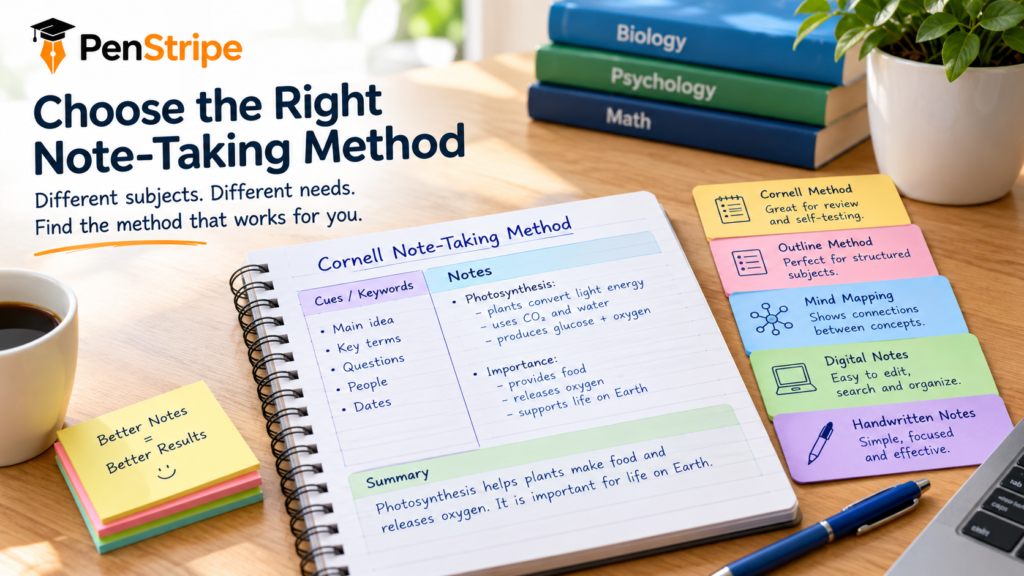
9. Improve Your Note-Taking
Good notes should help you understand and recall information. They should not become a transcript of everything your teacher or textbook says.
Write Key Ideas
Focus on:
- Main concepts
- Important definitions
- Formulas
- Examples
- Questions you still need to answer
Use your own words when possible.
Turn Notes Into Study Questions
Instead of leaving your notes as passive information, convert important points into questions.
For example:
“Photosynthesis converts light energy into chemical energy.”
Can become:
“What does photosynthesis convert light energy into?”
Now your notes can also function as a self-testing tool.
10. Teach What You Learn
Learning by teaching is a simple way to check whether you genuinely understand a topic.
You do not need another person. You can explain the concept aloud to yourself.
Explain It in Simple Language
Imagine you are explaining the topic to someone who has never studied it.
If you cannot explain a concept without repeatedly looking at your notes, you may have found a knowledge gap.
Go back to that specific section, learn it again, and then explain it in simpler words.
Use the Teach-Back Method
A useful sequence is:
- Learn the concept.
- Close your notes.
- Explain it aloud.
- Notice where you get stuck.
- Review only the weak part.
- Explain it again.
This can turn a long review session into a focused learning exercise.
11. Build a Fast Revision System
When exams approach, students often try to reread entire textbooks. This can consume a lot of time.
A better approach is to create a revision system while you study.
Keep a One-Page Summary
For each major topic, create a short summary containing the most important ideas, formulas, terms, or processes.
The summary should not contain every detail. Its purpose is to help you quickly identify what matters.
Use a Final Revision Checklist
Before an exam, check:
- Can I explain the main concepts?
- Can I answer practice questions without help?
- Can I remember important formulas or definitions?
- Have I reviewed my common mistakes?
- Can I explain difficult topics in simple words?
If the answer to one question is no, use your remaining time on that area.
Best Study Methods Compared
Different methods are useful for different situations.
| Study Method | Best For | Time Efficiency |
|---|---|---|
| Active recall | Remembering information | High |
| Practice testing | Exam preparation | High |
| Spaced repetition | Long-term memory | High |
| Note-taking | Organizing information | Medium |
| Passive rereading | Initial review | Low |
| Teaching | Understanding concepts | High |
| Focused study sessions | Concentration | High |
The most effective approach is usually not choosing one technique and using it for everything. Combine methods based on what you are trying to learn.
For example, learn a concept first, explain it, test yourself, and review it again later.
Frequently Asked Questions
What is the best way to study more in less time?
The best approach is to use focused study sessions, active recall, practice testing, and spaced repetition. Start with your most important or difficult topics and remove distractions. Instead of spending more hours rereading, spend more of your study time retrieving and applying what you learned.
What is the 1/3,5/7 study method?
The phrase “1/3,5/7 study method” can refer to different study or revision schedules, so it does not have one universally accepted definition. If you use this method, check the specific schedule recommended by your teacher, course, or study resource before relying on it.
How can I study in less time for exams?
Start by identifying the topics that matter most and the areas you find difficult. Use practice questions to find knowledge gaps, then focus your study sessions on those gaps. Active recall and practice testing can help you use limited preparation time more efficiently.
How can I study faster without forgetting information?
Do not simply increase your reading speed. Use active recall, practice questions, spaced repetition, and short focused sessions. These methods help you spend more time retrieving information instead of repeatedly reading material that already feels familiar.
How can I focus when I want to study but cannot concentrate?
Start with a small, specific task rather than trying to study an entire subject. Put your phone away, close unnecessary browser tabs, and work for a short focused period. Once you begin, continue for another session if your concentration remains strong.
How can I become a top 1% student?
There is no single study technique that guarantees a student will become a top 1% performer. Strong academic performance usually requires consistent study habits, effective learning methods, regular practice, good time management, and enough recovery. Focus on improving your process rather than chasing a ranking.
What are seven effective study methods?
Seven useful methods include active recall, practice testing, spaced repetition, focused study sessions, effective note-taking, teaching what you learn, and targeted revision. You do not need to use all seven during every session. Choose methods based on the subject and your current learning goal.
How can I remember what I study for longer?
Review information across multiple sessions rather than trying to memorize everything at once. Test yourself without looking at your notes, revisit difficult concepts, and use spaced repetition. Applying information through questions and examples can also strengthen your understanding.
Conclusion
Learning how to study in less time is not about rushing through your books or studying for fewer minutes without a plan. It is about making your available time more productive.
Start by setting a clear goal, prioritizing difficult material, and studying in focused sessions. Then use active recall, practice testing, spaced repetition, and teaching to make learning more active. Remove distractions and create a simple revision system so you do not have to relearn everything before an exam.
You do not need to change every habit overnight. Choose two or three strategies from this guide and use them consistently for the next week. Once they become natural, add another method. The goal is simple: spend less time studying passively and more time learning actively penstripe