


College studying is different from studying in high school. You may have fewer classes each day, but the reading, assignments, projects, and exams can require much more independent work. Nobody may remind you when to start preparing for a test or finish a chapter. You have to create a system that works for you.
Learning how to study in college is not about sitting at a desk for eight hours. Effective studying means using your time carefully, understanding what you learn, practicing active recall, managing distractions, and reviewing information before you forget it.
A good college study routine should also fit your real life. You may have a part-time job, family responsibilities, sports, social activities, or several demanding courses at once.
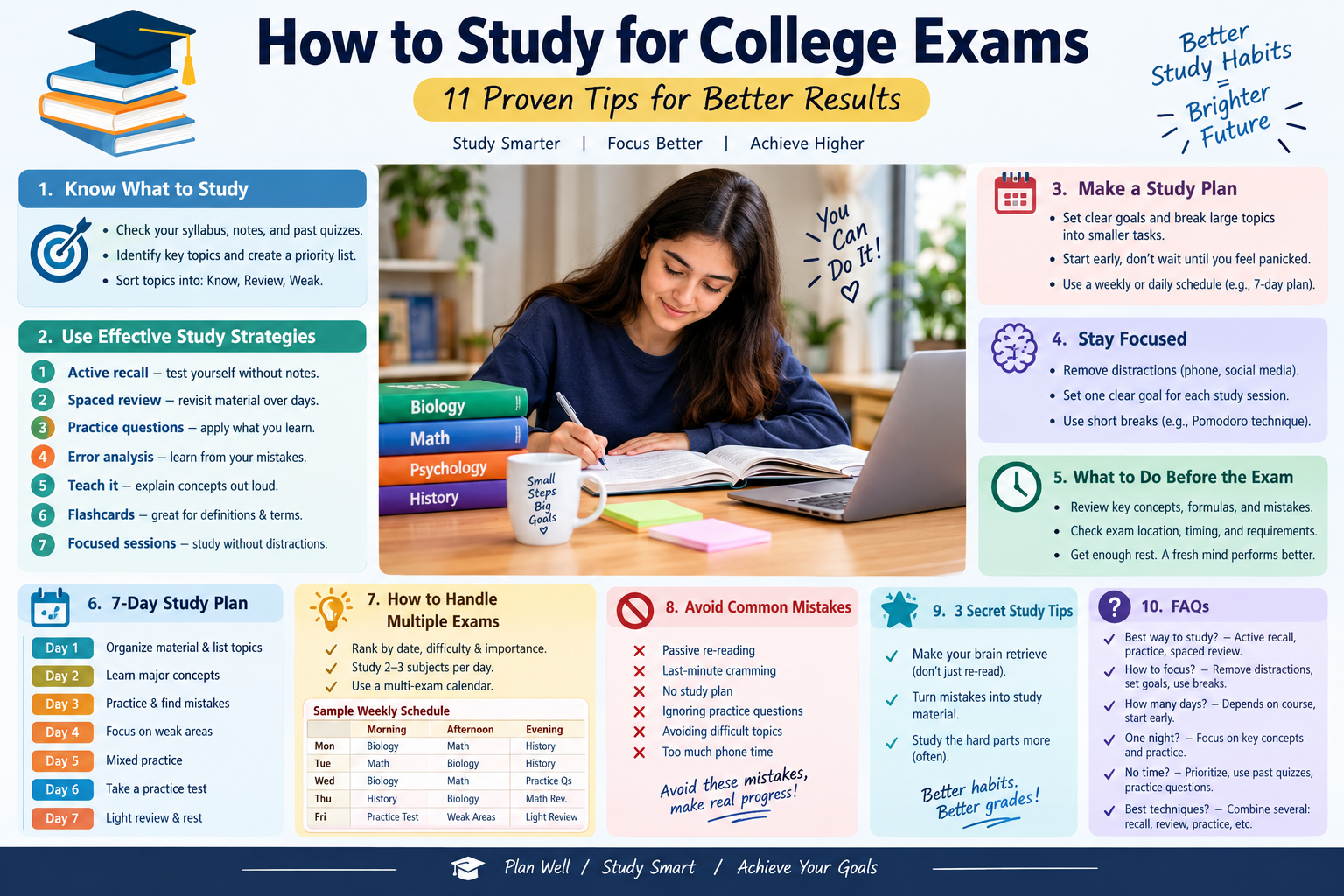
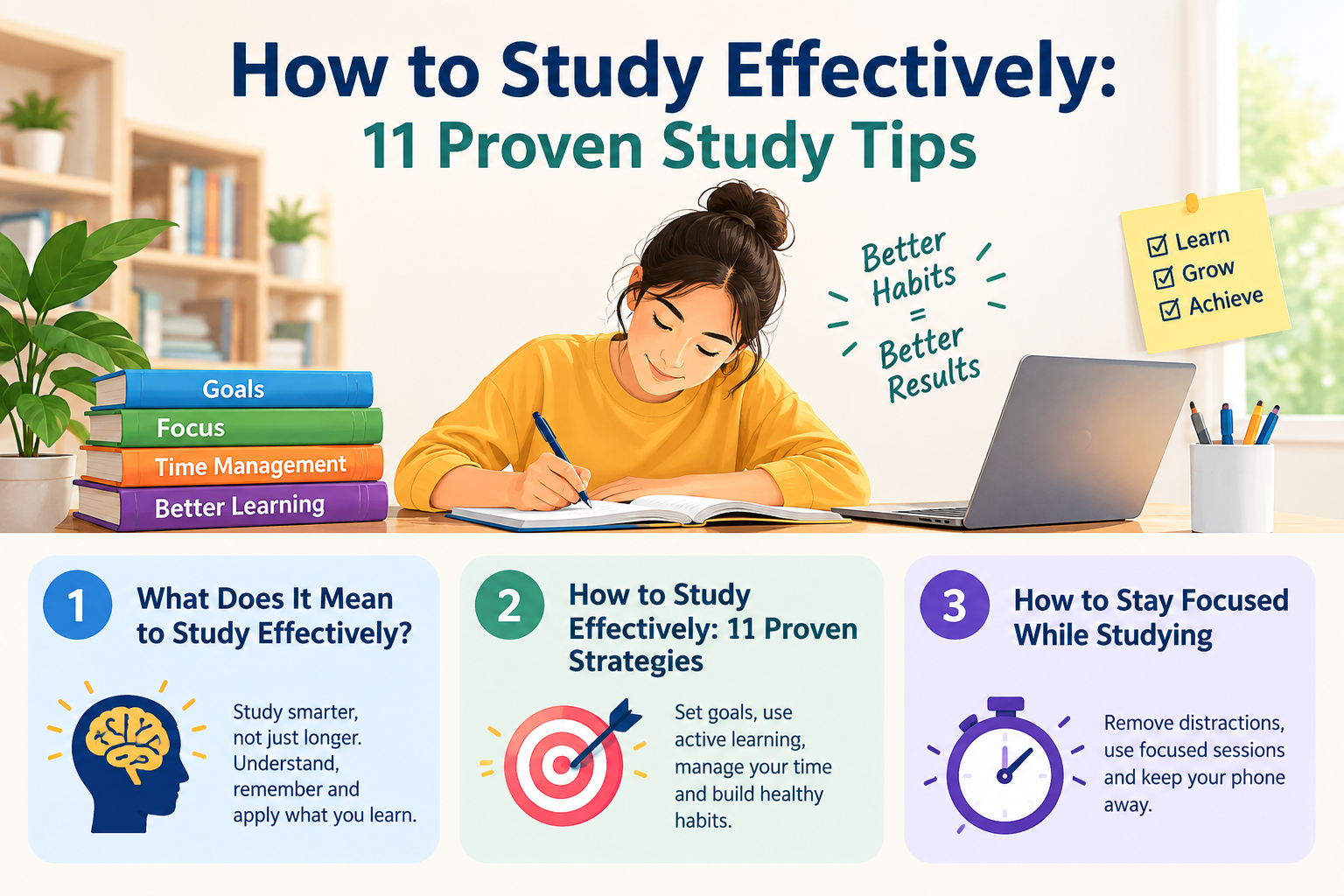
This guide explains 11 practical strategies that can make studying more organized and productive. You will learn how to plan your week, focus during study sessions, take better notes, prepare for exams, remember difficult material, and avoid common mistakes that waste time.
What Makes College Studying Different?

College Requires More Independent Learning
In college, instructors usually provide the material, deadlines, and direction, but much of the learning happens outside the classroom.
You may need to read textbook chapters, review lecture notes, solve practice problems, research topics, or prepare for exams without someone checking your progress every day.
That makes self-management one of the most important college study skills.
College Classes Can Have Different Workloads
Not every course requires the same type of preparation.
A mathematics course may require repeated problem-solving practice. A history course may require reading, recall, and connecting events. A science course may involve concepts, diagrams, laboratory work, and practice questions.
Because of these differences, using one study method for every subject is rarely efficient.
Studying Longer Does Not Always Mean Learning More
A three-hour distracted study session may produce less learning than a focused 60-minute session.
Effective studying depends on what you do during the time you have. Reading the same page repeatedly, checking your phone, or highlighting nearly every sentence can create the feeling of studying without producing strong learning.
The goal is not simply more hours. The goal is better learning during those hours.
How Can I Study Effectively for College?
Start With a Weekly Plan
Begin each week by looking at your syllabus, assignment deadlines, quizzes, exams, and other responsibilities.
Then divide large tasks into smaller study sessions.
For example, instead of writing “study biology” on your calendar, create specific tasks:
- Review cell structure
- Practice 20 questions
- Recall major definitions
- Review lecture notes
- Complete assigned reading
Specific tasks make it easier to know exactly what you should do when you sit down to study.
Use Active Recall
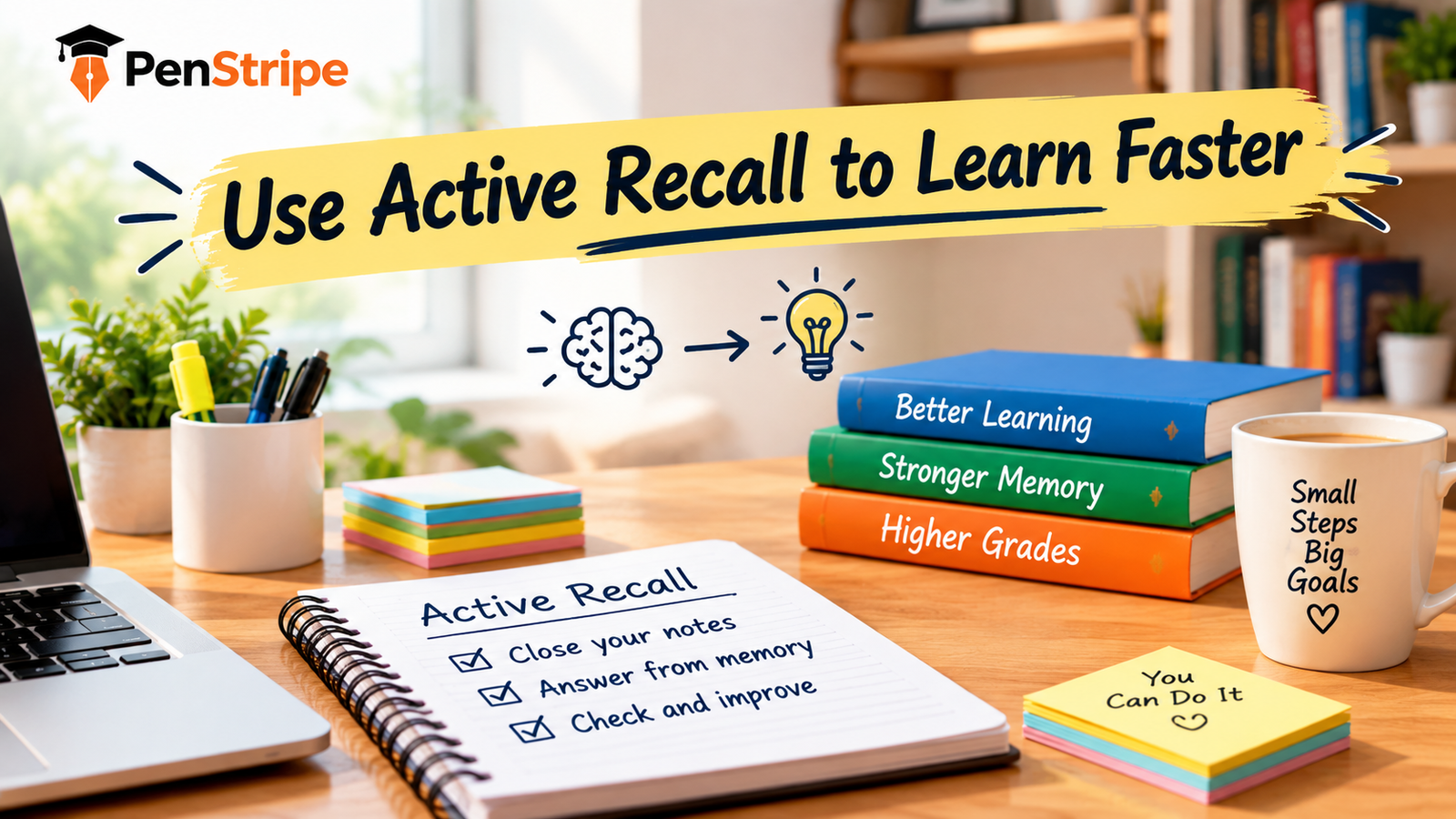
Active recall means trying to retrieve information from memory instead of simply reading it again.
After studying a topic, close your notes and ask yourself:
- What are the main ideas?
- Can I explain this without looking?
- What examples can I remember?
- What part is still unclear?
This turns studying into a learning activity rather than passive reading.
Review Material More Than Once
Spacing your study sessions over several days is usually more useful than trying to learn everything during one long session.
For example, if you have an exam on Friday, you might review the material briefly on Monday, Wednesday, and Thursday rather than waiting until Thursday night.
This approach gives you multiple opportunities to retrieve and strengthen what you have learned.
How to Build a College Study Schedule

Schedule Study Sessions Before You Need Them
A common mistake is waiting until you “feel like studying.”
College work becomes easier when study time is already on your calendar.
If you have class from 10:00 to 11:30 a.m., you might schedule a 45-minute review later that day. Reviewing material soon after class can help you identify confusing points while the lesson is still fresh.
Match the Study Method to the Subject
Use different methods depending on what you need to learn.
| Course Type | Useful Study Methods |
|---|---|
| Mathematics | Practice problems and error review |
| Biology | Active recall, diagrams, practice questions |
| History | Timelines, retrieval practice, concept connections |
| Psychology | Flashcards, explanations, practice questions |
| Literature | Reading notes, themes, quotations, discussion |
| Languages | Vocabulary practice, speaking, writing, listening |
| Computer Science | Coding practice and debugging |
The best method is usually the one that makes you actively work with the material.
Leave Time for Unexpected Work
Avoid filling every available hour with assignments.
College schedules change. An assignment may take longer than expected, a professor may add a reading, or you may need additional time to understand a difficult concept.
Leaving some open time makes your schedule more realistic.
How Can I Focus 100% on Study?
Remove the Biggest Distractions
You do not need perfect concentration to study effectively, but you should reduce unnecessary interruptions.
Put your phone away or enable a focus mode. Close unrelated browser tabs. Keep only the materials needed for the current task on your desk.
If social media is your biggest distraction, make it harder to access during study sessions.
Study in Focused Sessions
Try studying for a defined period instead of telling yourself to study “all afternoon.”
A simple approach is:
45 minutes of focused study + 10 minutes of rest
After several sessions, take a longer break.
You can also use the Pomodoro technique, commonly based on shorter work periods followed by brief breaks. The exact timing is less important than creating a clear boundary between focused work and rest.
Set One Goal Per Session
A study session should have a measurable purpose.
Instead of:
“Study chemistry.”
Try:
“Complete 15 practice questions and review every mistake.”
A specific goal makes it easier to start and easier to tell whether the session was successful.
11 Effective Study Strategies for College Students
1. Preview the Material Before Class
Spend a few minutes looking over the upcoming topic before class.
Read the headings, review key terms, or skim the assigned material.
You do not need to master the chapter beforehand. The purpose is to become familiar with the subject so the lecture has context.
2. Review Your Notes Soon After Class
Do not allow lecture notes to sit untouched for weeks.
A short review after class can help you identify missing information and confusing concepts.
Rewrite unclear points in your own words and mark questions that you need to ask your instructor or research later.
3. Use Active Recall Instead of Re-Reading
Re-reading feels easy because the information looks familiar.
Active recall is harder because you have to retrieve the answer yourself.
For example, rather than reading a definition five times, cover the definition and explain the concept from memory.
4. Practice With Questions
Practice questions are especially valuable when preparing for exams.
They force you to apply what you know and reveal areas where your understanding is weak.
When you make a mistake, do not simply check the correct answer. Identify why your answer was wrong.
5. Create a Mistake Log
Keep a simple record of repeated mistakes.
Your mistake log might include:
| Mistake | Why It Happened | Correct Approach |
|---|---|---|
| Forgot a definition | Did not review it | Add it to recall practice |
| Used wrong formula | Confused two formulas | Compare both |
| Misread question | Worked too quickly | Slow down and underline key information |
Review this list before an exam.
6. Explain Difficult Concepts in Simple Words
One useful test of understanding is whether you can explain a concept without copying the textbook.
Imagine you are explaining the topic to someone who has never studied it.
If you become stuck, that may indicate a gap in your understanding.
Go back to the material, clarify the difficult point, and try explaining it again.
7. Use Flashcards Carefully
Flashcards can be helpful for facts, vocabulary, formulas, definitions, and other information that benefits from repeated retrieval.
However, avoid putting entire textbook paragraphs on cards.
A better flashcard asks one clear question and requires one focused answer.
8. Study With Practice Tests
Practice tests help you become familiar with the process of retrieving information under pressure.
If your professor provides sample questions or previous exam formats, use them as study resources.
After completing a practice test, spend time reviewing your incorrect answers.
9. Study Difficult Subjects When Your Energy Is High
Not every hour of the day feels the same.
If you are more alert in the morning, use that time for challenging material. If you become more productive in the afternoon or evening, arrange your difficult work around your strongest period.
Save easier tasks for lower-energy periods.
10. Use Office Hours When You Are Stuck
Do not wait until the night before an exam to ask for help.
Office hours can help you clarify confusing concepts, understand assignments, and identify what you should practice.
When asking for help, bring a specific question. Instead of saying “I don’t understand anything,” explain exactly where your understanding stops.
11. Protect Sleep and Recovery Time
Studying while exhausted is not a sustainable strategy.
Sleep, meals, movement, and breaks are part of an effective academic routine. A schedule that leaves you constantly exhausted is difficult to maintain.
Your goal should be consistent learning, not maximum exhaustion.
Study Techniques: Which Method Should You Use?
Different study techniques work better for different learning tasks.
| Study Technique | Best For | Main Advantage | Limitation |
|---|---|---|---|
| Active recall | Facts and concepts | Strengthens retrieval | Requires effort |
| Spaced review | Long-term retention | Reduces cramming | Requires planning |
| Practice tests | Exam preparation | Shows knowledge gaps | Takes preparation |
| Flashcards | Definitions and vocabulary | Easy repetition | Can oversimplify concepts |
| Practice problems | Math and technical subjects | Builds application skills | Requires feedback |
| Teaching/explaining | Complex concepts | Reveals weak understanding | Takes time |
| Group study | Discussion and difficult topics | Multiple perspectives | Can become distracting |
The best approach is often a combination.
For example, a biology student might read a chapter, create a short concept map, use active recall, complete practice questions, and revisit weak areas several days later.
How to Study for College Exams
Start Exam Preparation Early
Avoid treating the night before an exam as your main study session.
Instead, divide the material across several days.
For a Friday exam, you might use this structure:
Monday: Review major topics
Tuesday: Practice difficult concepts
Wednesday: Complete practice questions
Thursday: Review weak areas
Friday: Short final review before the exam
Your exact schedule should depend on the amount and difficulty of the material.
Prioritize Weak Areas
Students sometimes spend too much time reviewing material they already know because it feels comfortable.
Instead, identify the topics you cannot explain or answer confidently.
Those areas deserve more attention.
Simulate the Exam
If possible, practice under conditions similar to the actual test.
Set a timer, put away your notes, and answer questions without checking the answers immediately.
This can show you whether you actually remember the material without assistance.
Common College Study Mistakes
Waiting Until the Last Minute
Cramming may help you remember some information temporarily, but it leaves little time to identify and correct misunderstandings.
Studying While Constantly Checking Your Phone
Frequent interruptions break concentration and make a study session feel longer than it actually is.
Highlighting Everything
Highlighting can help identify important information, but highlighting entire pages does not require much retrieval or problem-solving.
Use it as a supporting technique rather than your entire study strategy.
Studying Only What Feels Easy
Comfortable topics can create a false sense of preparation.
Spend more time on concepts you repeatedly miss or cannot explain.
Ignoring the Syllabus
Your syllabus often contains important information about readings, deadlines, grading, exams, and course expectations.
Use it as the starting point for your study plan.
A Simple Weekly College Study Plan
A practical schedule might look like this:
| Day | Main Study Focus |
|---|---|
| Monday | Review Monday classes and begin assignments |
| Tuesday | Review difficult concepts and complete practice |
| Wednesday | Review earlier material and work on projects |
| Thursday | Prepare for upcoming quizzes or exams |
| Friday | Finish assignments and review the week |
| Saturday | Longer study block for difficult courses |
| Sunday | Weekly review and plan the next week |
This is only a framework. Your schedule should change according to your classes, work, responsibilities, and energy levels.
The key is to study consistently rather than relying on last-minute sessions.
How to Choose What to Study in College
The phrase “what to study in college” can mean two different things.
You might be asking what subject to study as your major, or you might be asking what material to study for your current classes.
If you are choosing a major, consider several factors:
- Subjects you genuinely enjoy
- Your academic strengths
- Career options related to the field
- Required courses
- Internship opportunities
- Cost and program length
- Your preferred type of work
There is no single “best thing to study in college” for every student.
The right choice depends on your interests, goals, abilities, and circumstances.
If you mean deciding what to study for an exam, start with your syllabus, recent lectures, assigned readings, learning objectives, and practice questions.
How to Study in College With ADHD
Students with ADHD may find organization, task initiation, time management, and sustained attention challenging. Study strategies should be adapted to individual needs rather than assuming one method works for everyone.
Helpful approaches can include breaking assignments into very small tasks, using visible timers, reducing distractions, studying with an accountability partner, and creating a predictable routine.
For example, instead of writing “finish history paper,” create smaller steps:
- Choose the topic.
- Find three reliable sources.
- Create an outline.
- Write the introduction.
- Draft the first section.
- Edit the draft.
Students who need academic accommodations should also check the disability or accessibility services available at their college.
What About the How to Study in College Book?
Walter Pauk’s How to Study in College is a well-known study-skills book associated with college learning strategies, particularly note-taking and the Cornell Note-Taking System.
A book can provide useful guidance, but students do not need to follow one study system exactly.
Modern college learning also involves digital course platforms, online resources, recorded lectures, practice software, collaborative documents, and other tools.
Use established study principles while adapting them to your courses and learning environment.
If you are searching for a how to study in college PDF, make sure the copy is legally available. University libraries, bookstores, publishers, and legitimate digital services are safer sources than unauthorized copies.
Frequently Asked Questions
How can I study effectively for college?
Study effectively by planning specific tasks, using active recall, practicing with questions, reviewing material over several days, and focusing on weak areas. Avoid relying only on rereading or last-minute cramming. Your study method should also match the subject, because mathematics, languages, science, and essay-based courses require different types of practice.
How can I focus 100% on study?
You do not need perfect concentration to have a productive study session. Remove major distractions, put your phone away, choose one specific goal, and work for a defined period followed by a short break. If your attention keeps drifting, make the task smaller and easier to start.
What’s the best thing to study in college?
There is no single best subject for every college student. The right field depends on your interests, strengths, career goals, financial situation, and available programs. Before choosing a major, compare the curriculum, career paths, required skills, costs, and opportunities connected to the subjects you are considering.
What is the hardest year of college?
The hardest year varies by student and program. Some students find the first year challenging because they are adjusting to independent learning and college life. Others find later years harder because courses become more specialized and demanding. Workload, major requirements, personal responsibilities, and academic preparation can all affect the experience.
How many hours should a college student study?
There is no universal number that guarantees good results. Study time depends on the course load, difficulty, assignments, and your existing knowledge. A better approach is to plan regular focused sessions, monitor your performance, and increase study time when you are not mastering the required material.
Is studying with friends effective in college?
Group study can be effective when students have a clear goal and stay focused. It works particularly well for discussion, explaining concepts, solving problems, and reviewing practice questions. However, a group can become distracting. If the session turns into social time, individual study may be more productive.
How do I study in college when I do not know where to start?
Start with your syllabus and identify the nearest deadline or upcoming exam. Break the material into small tasks, such as reading one section, reviewing one lecture, or completing ten practice questions. After finishing the first task, use what you learned to decide what needs attention next.
Can I succeed in college if I do not have good study habits yet?
Yes. Study habits are skills that can be developed. Start with one or two changes instead of trying to completely redesign your routine overnight. For example, schedule one focused study session each day and use active recall instead of passive rereading. Once that routine becomes consistent, add another strategy.
Conclusion
Learning how to study in college is less about finding one perfect technique and more about building a reliable system.
Plan your week, divide large assignments into manageable tasks, use active recall, practice with questions, review material over time, and protect your concentration. Most importantly, adjust your approach when a method is not helping you learn.
Do not measure your progress only by the number of hours you spend studying. Measure it by what you can remember, explain, apply, and improve.
Start with one small change today. Choose one upcoming class, set a focused study session, remove distractions, and work on a specific learning goal. Over time, those small improvements can become study habits that make college more manageable and productive penstripe