



Studying can become frustrating when your attention keeps moving from your books to your phone, social media, notifications, conversations, or random thoughts. You may sit at your desk for two hours but remember very little because your attention was divided most of the time.
Learning how to study without getting distracted is not about forcing yourself to concentrate for several hours. It is about creating conditions that make focused studying easier. A clear goal, organized study space, controlled phone use, short focused sessions, and active learning can make a major difference.
If you often ask, “How can I focus 100% while studying?” the answer is not to eliminate every thought or distraction. Instead, reduce unnecessary interruptions and build a study routine that helps you return to the task quickly.
This guide explains 11 practical ways to stay focused, avoid common distractions, study effectively at home, and build better concentration habits.
Why Do Students Get Distracted While Studying?
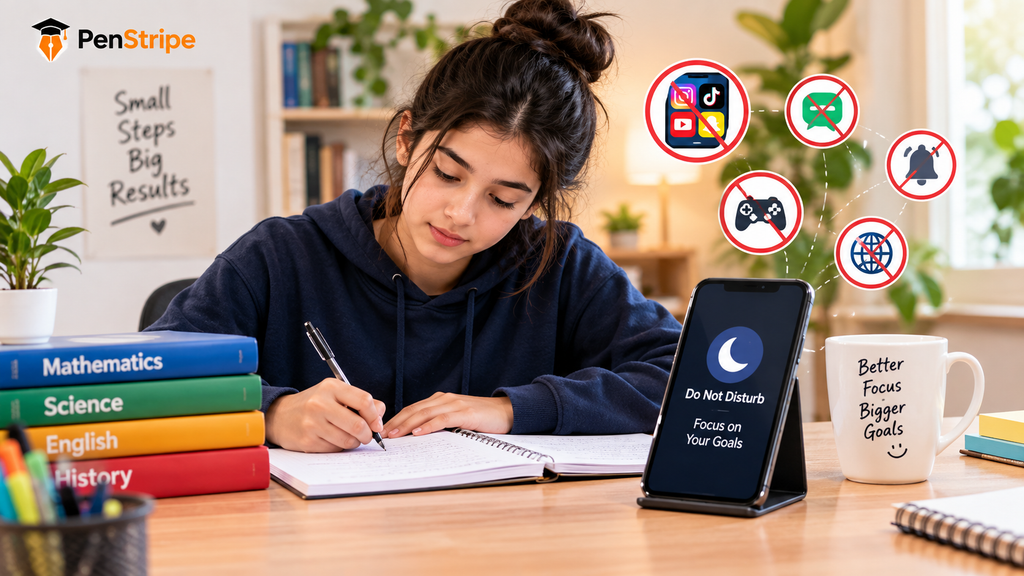
Distraction usually has more than one cause. Your phone may be the obvious problem, but boredom, unclear goals, difficult material, noise, tiredness, and poor study planning can also pull your attention away.
Phone and Social Media Distractions
Phones provide constant opportunities to switch tasks. A notification, message, short video, or social media update can interrupt a study session in seconds.
Even when you do not receive a notification, simply having your phone nearby can make checking it more tempting.
No Clear Study Goal
“Study biology” is a vague goal. Your brain has no specific finish line.
A better goal is “Review the five parts of the cell and answer 10 practice questions.” The second goal tells you exactly what needs to be completed.
Difficult or Boring Material
Students naturally look for something more interesting when a subject feels confusing or repetitive.
Instead of immediately leaving the task, break difficult material into smaller sections. Understanding one concept at a time makes the work feel more manageable.
A Poor Study Environment
Noise, television, conversations, an uncomfortable chair, clutter, and frequent interruptions can make concentration harder.
Your environment does not need to be perfect. It simply needs to remove as many unnecessary distractions as possible.
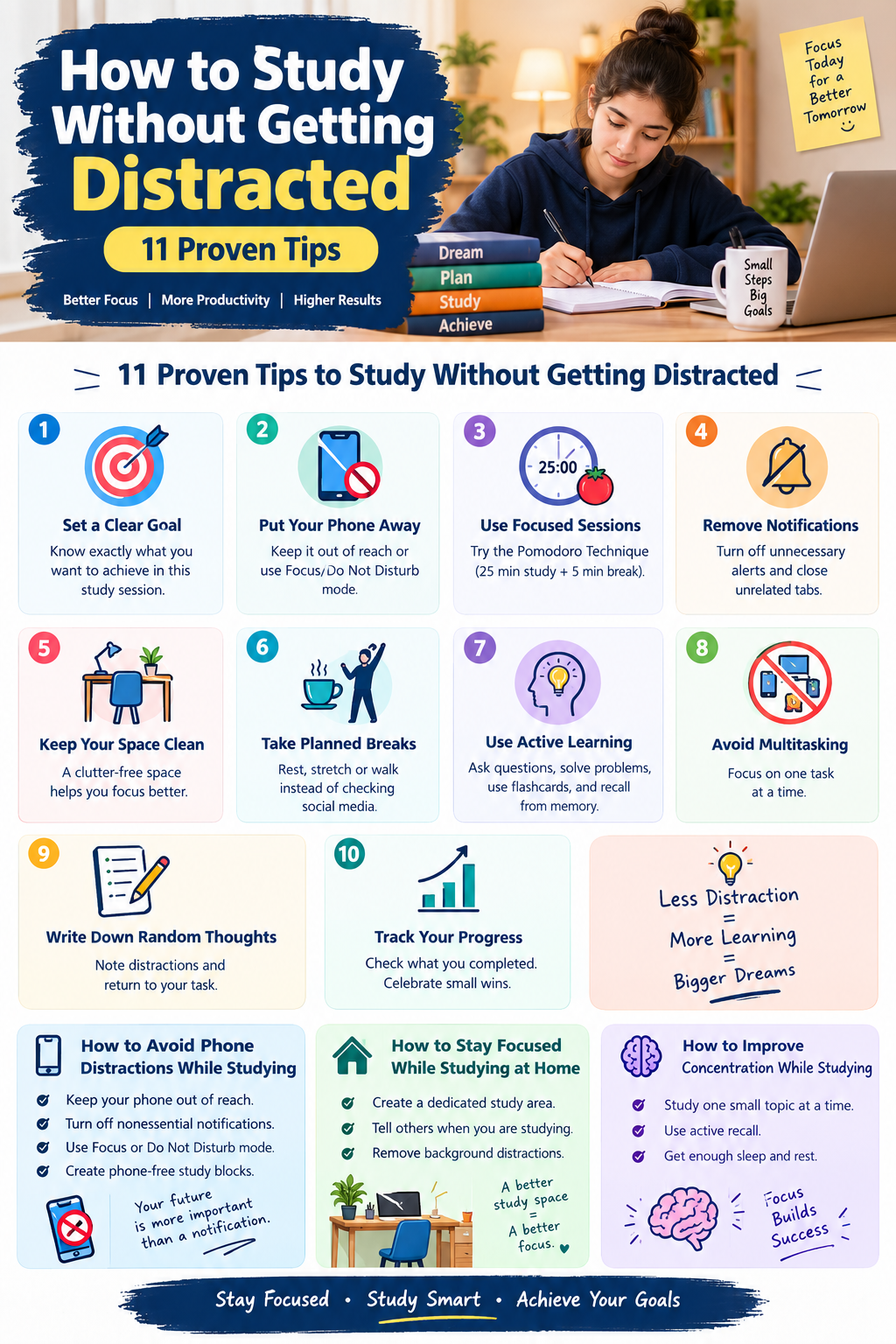
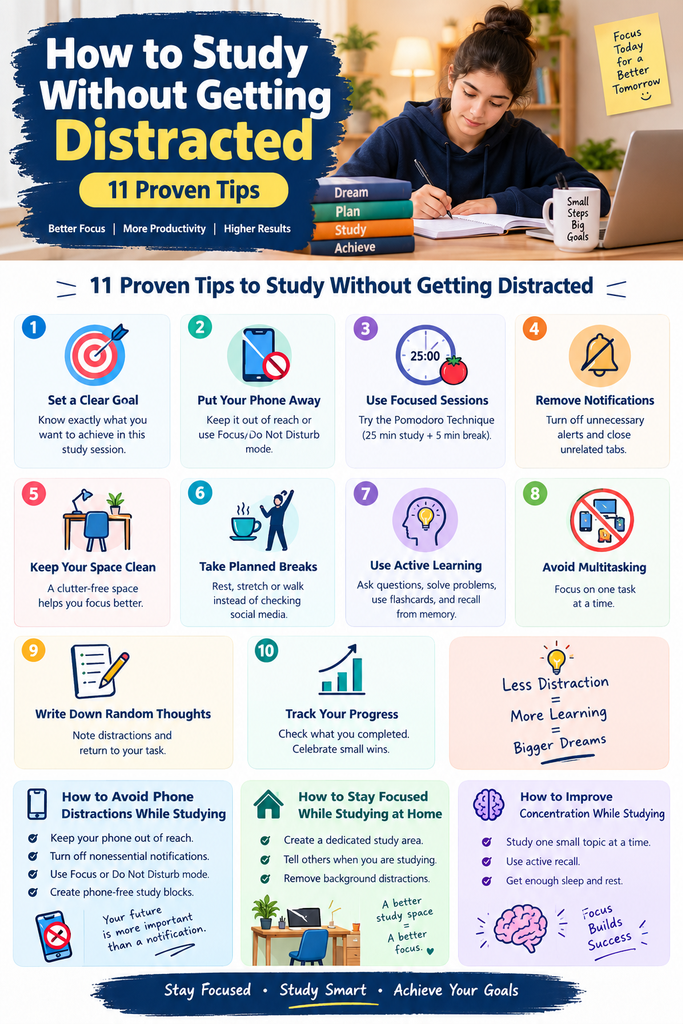
How to Study Without Getting Distracted
You do not need perfect concentration to study effectively. You need a system that protects your attention and makes it easy to continue when your mind wanders.
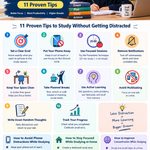
1. Set One Clear Study Goal
Before opening your book, decide exactly what you want to accomplish.
For example:
“Finish pages 40 to 50 and create five review questions.”
This is more useful than saying, “I will study chemistry.”
A specific goal gives your session direction and creates a clear stopping point.
2. Put Your Phone Away
One of the simplest ways to reduce distraction is to increase the distance between you and your phone.
Put it in another room, inside a drawer, or somewhere you cannot easily reach it. If you need it for studying, activate Do Not Disturb or Focus mode and disable unnecessary notifications.
Do not rely entirely on willpower. Changing your environment is often easier than repeatedly resisting temptation.
3. Use Short Focused Study Sessions
Long study sessions can become mentally exhausting. Instead, divide your work into focused blocks.
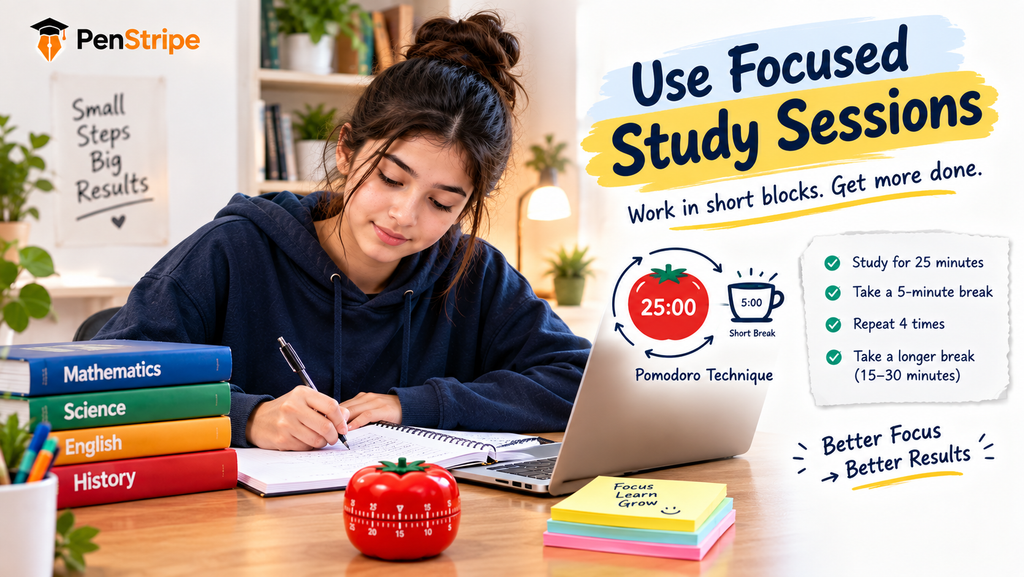
For example, you might study for 25 minutes, take a short break, and then begin another session. If 25 minutes feels too short, try 40 or 50 minutes.
The goal is not to follow one perfect number. The goal is to create a period in which studying is the only major task.
4. Use the Pomodoro Technique
The Pomodoro Technique is a time-management method that divides work into focused intervals followed by breaks.
A simple version looks like this:
Study for 25 minutes.
Take a 5-minute break.
Repeat the cycle.
After several cycles, take a longer break.
This approach can make a large assignment feel less overwhelming. It also gives you a planned time for rest instead of encouraging random phone checking during study sessions.
5. Remove Unnecessary Notifications
Notifications compete for attention even when they appear for only a few seconds.
Turn off unnecessary alerts from social media, shopping apps, games, and other services during your study period.
If you study on a computer, close unrelated browser tabs and applications. Keep only the tools required for your current task.
6. Keep Your Study Space Clean
A cluttered desk can create unnecessary visual distractions.
Before starting, remove items you do not need. Keep your textbook, notebook, pen, water, and other essential materials within reach.
You do not need an expensive study setup. A simple and organized workspace can be enough.
7. Take Planned Breaks
Breaks are useful when they are intentional.
Instead of saying, “I will take a quick break,” and opening social media for an unknown amount of time, decide what you will do and how long you will do it.
You could stand up, drink water, stretch, walk around, or simply rest your eyes.
A planned break helps you return to studying without turning five minutes into an hour.
8. Use Active Learning Techniques
Passive reading can become boring, especially when you are already struggling to concentrate.
Make studying more active by:
- Asking yourself questions
- Explaining concepts in your own words
- Creating practice questions
- Solving problems without looking at the answer
- Using flashcards
- Recalling information from memory
Active learning gives your brain something specific to do, which can make it easier to stay engaged.
9. Avoid Multitasking
Trying to study while watching videos, chatting with friends, checking social media, and listening to unrelated content divides your attention.
Choose one primary task.
If you need a computer for research, keep unrelated websites closed. If you are solving math problems, focus on the problems rather than switching between several activities.
One task at a time usually creates a cleaner study process.
10. Write Down Random Thoughts
Sometimes distractions come from your own thoughts.
You may suddenly remember an email you need to send, something you want to search for, or a task you need to complete.
Instead of acting on the thought immediately, write it down on a small piece of paper or in a notes app. Then return to your study task.
You are not ignoring the thought. You are simply postponing it until your planned break.
11. Track Your Progress
At the end of each study session, record what you completed.
For example:
“Completed two chapters.”
“Answered 20 practice questions.”
“Reviewed 30 flashcards.”
Progress tracking creates a sense of achievement and helps you see whether your study routine is actually working.
How to Avoid Phone Distractions While Studying
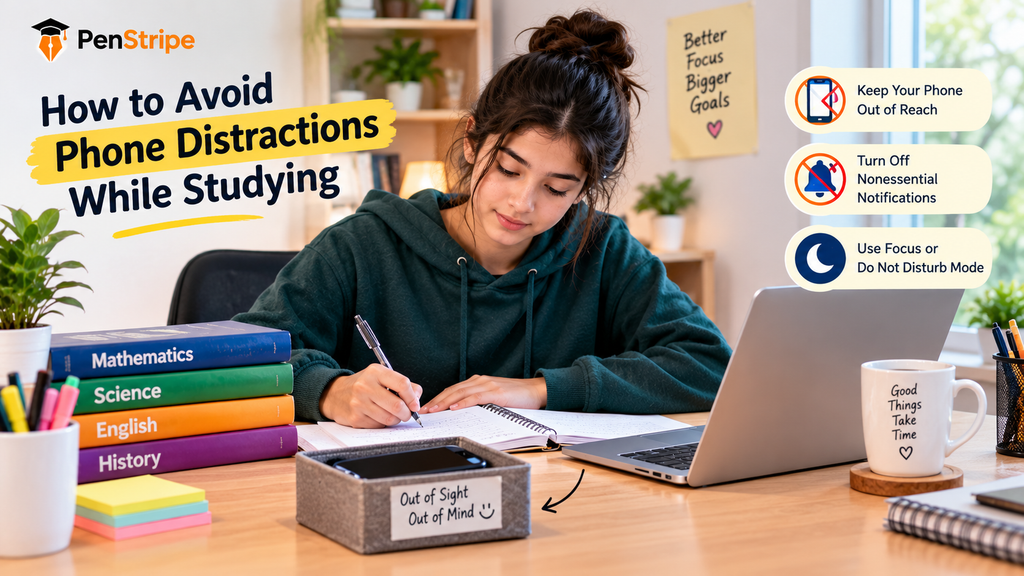
If your phone is your biggest distraction, start with environmental changes rather than depending on self-control.
Keep Your Phone Out of Reach
Place your phone somewhere that requires effort to access. Even a few extra steps can reduce impulsive checking.
If you need the phone for an educational app, use only the required application and enable Focus mode.
Remove Social Media Notifications
Notifications can repeatedly interrupt your attention. Disable nonessential notifications before beginning your study session.
You can check messages during a planned break rather than every few minutes.
Create Phone-Free Study Blocks
Choose specific periods during the day when your phone will not be used for entertainment.
For example, you might create two 45-minute phone-free study blocks in the evening.
Over time, your brain can become more comfortable with uninterrupted study periods.
How to Stay Focused While Studying at Home
Studying at home can be difficult because your usual relaxation activities are nearby.
Create a Dedicated Study Area
Use one location mainly for studying whenever possible.
It could be a desk, a section of a table, or another quiet area. Keep the space organized and remove entertainment devices that are not needed.
Tell Others You Are Studying
If family members or roommates frequently interrupt you, let them know when you will be studying.
A simple statement such as “I am studying for the next 45 minutes” can reduce unnecessary interruptions.
Control Background Noise
Some students work best in silence, while others prefer quiet background sounds.
Choose what helps you concentrate. Avoid entertainment that encourages you to pay attention to the audio instead of your studies.
How to Improve Concentration While Studying
Concentration becomes easier when your study method matches the task.
Study One Small Topic at a Time
Instead of trying to understand an entire chapter in one sitting, divide it into sections.
For example:
Read one concept.
Explain it in your own words.
Test yourself.
Move to the next concept.
This creates smaller targets and reduces the feeling of being overwhelmed.
Use Active Recall
After studying a topic, close your book and ask yourself what you remember.
Try to explain the concept without looking at your notes.
This turns studying into a mental activity rather than simply looking at information.
Give Yourself a Clear Finish Line
A study session should have an achievable endpoint.
Instead of saying, “I will study until I am tired,” choose a measurable target such as:
“Complete 15 practice problems.”
“Review two sections.”
“Learn 20 vocabulary words.”
A clear finish line makes it easier to maintain attention.
How to Stop Procrastinating While Studying
Procrastination often begins before the study session even starts.
Make the First Step Very Small
If an assignment feels overwhelming, do not focus on completing everything.
Start by opening the textbook and reading one page. Then solve one problem or write one paragraph.
Starting reduces the psychological barrier around the task.
Use the Five-Minute Start
Tell yourself that you only need to work for five minutes.
Once you begin, continuing often feels easier because the hardest part was starting.
The goal is not to trick yourself into studying forever. It is to remove the resistance associated with beginning.
Prepare Before Your Study Session
Gather your materials before the session begins.
Have your books, notebook, calculator, water, and other required items ready.
This prevents repeated trips away from your desk and reduces opportunities for distraction.
The Best Study Environment for Better Focus
A good study environment should support the task instead of competing with it.
Consider these factors:
| Study Factor | Distracting Setup | Focused Setup |
|---|---|---|
| Phone | Beside you with notifications | Away or on Focus mode |
| Desk | Cluttered | Organized |
| Browser | Many unrelated tabs | Only necessary tabs |
| Goal | “Study chemistry” | “Finish Chapter 3 questions” |
| Breaks | Random | Planned |
| Tasks | Multiple tasks at once | One main task |
| Environment | Frequent interruptions | Fewer interruptions |
The best environment is not necessarily the most expensive or attractive. It is the one that makes your intended behavior easier.
How to Become a More Focused Student
Being a strong student is not simply about studying for the longest number of hours.
A more useful approach is to build consistent habits.
Plan your work before starting. Study with a specific objective. Remove major distractions. Use active learning. Take intentional breaks. Review your progress.
If you want to be a top 1% student, focus on the quality and consistency of your learning rather than simply counting study hours. Strong academic performance can involve effective learning strategies, time management, practice, review, sleep, and regular effort.
What Is the 1/3,5/7 Rule in Studying?
The phrase “1/3,5/7 rule” does not refer to one universally established study method with a single standard definition.
Different students and online sources may use similar numbers to describe different study schedules or review patterns. Therefore, it is better to identify the exact method being referenced before treating the rule as a formal learning principle.
For practical studying, a clear schedule with focused sessions, active recall, spaced review, and planned breaks is more useful than following an unexplained numerical rule.
Distracted Studying vs Focused Studying
The difference between distracted and focused studying is often visible in the process, not simply the number of hours spent.
A student who studies for two hours while repeatedly checking social media may complete less useful work than a student who spends one focused hour completing a specific set of tasks.
The goal should therefore be meaningful learning rather than simply sitting at a desk for a long time.
FAQs
How can I study without getting distracted?
To study without getting distracted, choose one clear goal, put your phone away, remove unnecessary notifications, and work in focused sessions. Keep your study area organized and take planned breaks. If your mind wanders, write down the distracting thought and return to the task instead of acting on it immediately.
How do I focus 100% while studying?
You cannot always maintain perfect attention, but you can greatly reduce distractions. Start with one specific task, remove your phone, close unrelated tabs, and use a timed study session. When your attention wanders, notice it and return to the task without spending time judging yourself.
How do I stop getting distracted by my phone while studying?
Keep your phone out of reach and turn off nonessential notifications. If you need it for studying, use Focus or Do Not Disturb mode and open only the required application. Creating phone-free study blocks can also help you build a more consistent concentration habit.
How can I study without getting distracted at home?
Choose a dedicated study area, tell others when you need uninterrupted time, and remove entertainment devices from your workspace. Prepare all necessary materials before starting. Using short focused sessions with planned breaks can also make studying at home easier.
Why do I get distracted so easily while studying?
Distractions can come from phones, notifications, noise, boredom, unclear goals, difficult material, or mental fatigue. Sometimes the task itself feels overwhelming. Breaking the work into smaller goals and using active learning can make it easier to remain engaged.
How can I study for long hours without getting distracted?
Instead of trying to study continuously for several hours, divide your work into focused sessions with planned breaks. Set a specific target for each session, remove major distractions, and change tasks when appropriate. Longer study periods are easier to manage when they contain structured intervals.
What is the best study technique for concentration?
There is no single technique that works perfectly for every student. Focused study sessions, active recall, practice questions, and planned breaks are practical approaches. Experiment with session lengths and study methods to find a routine that allows you to remain engaged and remember the material.
How do I stop procrastinating while studying?
Make the first step extremely small. Open the required material, choose one task, and work on it for five minutes. Once you begin, continue with a clearly defined study block. Preparing your materials beforehand can also reduce the friction that causes you to delay starting.
Conclusion
Learning how to study without getting distracted starts with controlling your environment and making your study tasks clear.
Put your phone away, turn off unnecessary notifications, organize your workspace, and choose one specific goal before each session. Use focused study blocks, planned breaks, active recall, and progress tracking to make your learning more purposeful.
You do not need perfect concentration every minute. When your mind wanders, simply recognize the distraction and return to the task.
Start with one focused study session today. Remove one major distraction, choose one achievable goal, and give your full attention to that task. Consistent small improvements can gradually turn distracted study sessions into productive learning habits penstripe