



Studying for hours does not always lead to better results. You can spend an entire afternoon reading notes and still struggle to remember what you learned. The difference often comes down to how you study, not simply how long you study.
Learning how to study better means using methods that help your brain understand, remember, and apply information. Whether you are preparing for exams, studying at home, or trying to improve your grades, a few changes can make your study sessions much more productive.
The best approach combines active learning, focused study periods, good time management, regular review, and enough rest. You also need a realistic plan that fits your schedule instead of copying someone else’s routine.
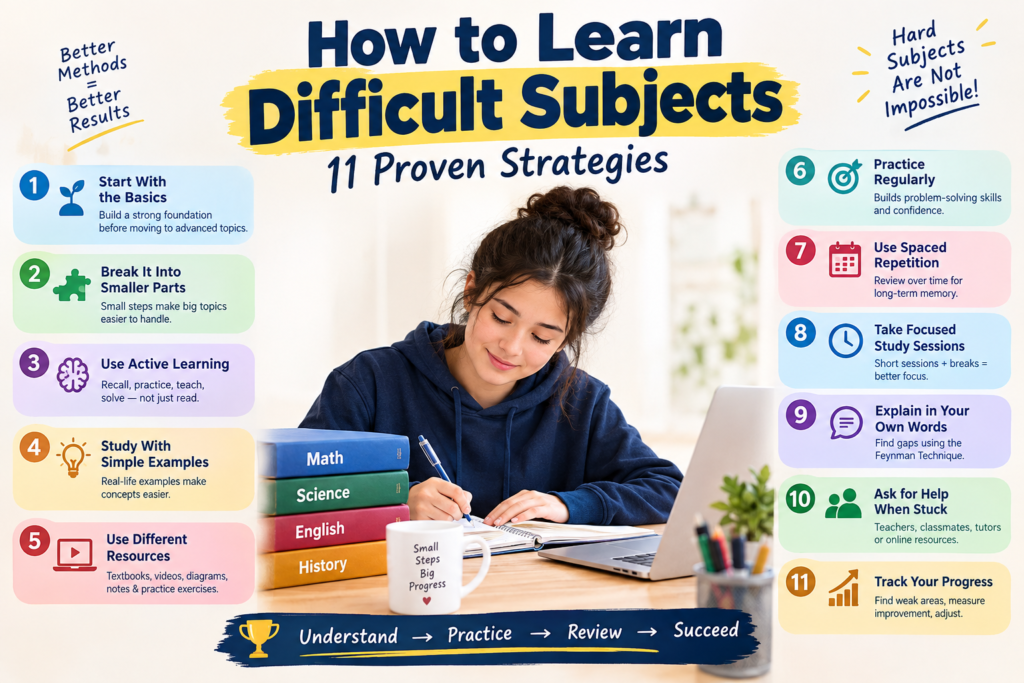
In this guide, you will learn 11 practical strategies for studying better. You will also discover how to improve focus, remember information longer, prepare for exams, and build study habits that actually last.
1. Understand What Effective Studying Means
Studying effectively is not about sitting with a textbook for the maximum number of hours. It is about spending your time on activities that produce real learning.
Focus on Learning, Not Just Reading
Reading the same page several times can feel productive, but recognition is not the same as recall.
After reading a topic, close your book and explain the main idea from memory. Ask yourself what you learned, why it matters, and how you would explain it to another student.
This simple change turns passive reading into active learning.
Set a Clear Goal
Before starting a study session, decide exactly what you want to accomplish.
Instead of saying, “I will study biology,” use a specific goal such as:
“By the end of this session, I will understand the three stages of cellular respiration and answer five practice questions.”
Clear goals make it easier to measure progress and prevent unfocused study.
Study in Smaller Sessions
Long study sessions can become less effective when your attention starts to decline.
Break larger tasks into manageable sessions. For example, you might study for 40 to 50 minutes, take a short break, and then return to the material.
The ideal session length depends on your attention span, subject, and schedule.
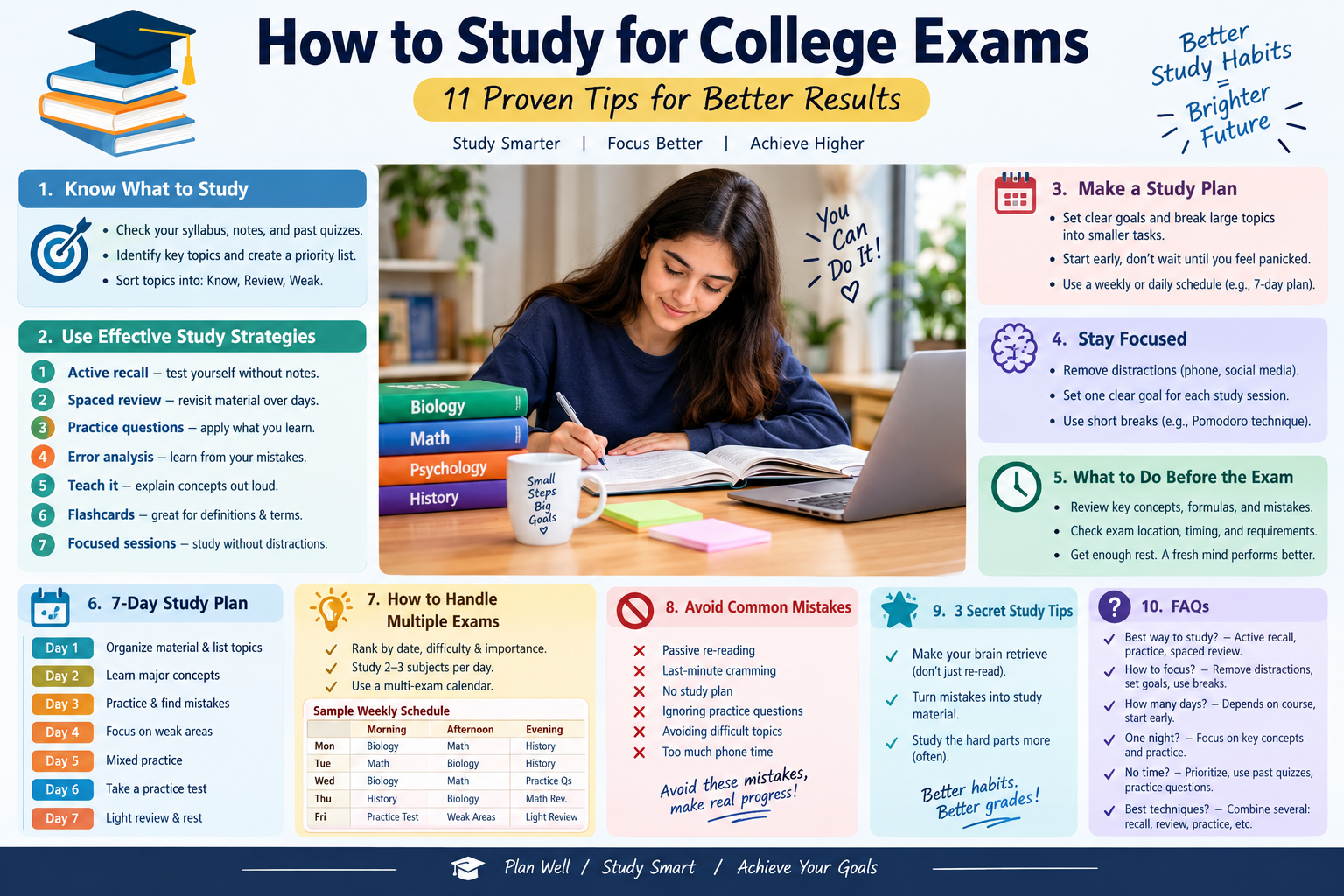
2. How to Study Better
A study plan helps you decide what to learn before you sit down. It can also reduce last-minute stress.
Prioritize Difficult Subjects
Start by identifying subjects or topics that require the most effort.
If mathematics is difficult for you but history is easier, give mathematics more frequent practice. Do not spend most of your study time reviewing material you already understand.
A simple priority system can help:
- High priority: difficult or upcoming topics
- Medium priority: topics that need practice
- Low priority: material you already understand
Use Time Management for Students
Good time management is one of the most useful academic skills.
Divide your available time between subjects instead of studying randomly. For example, a weekday schedule could include:
- 45 minutes of mathematics
- 15-minute break
- 45 minutes of science
- 15-minute break
- 30 minutes of review
Adjust the schedule according to your workload.
Plan Weekly, Not Just Daily
A daily plan tells you what to do today. A weekly plan gives you a bigger picture.
At the beginning of each week, list upcoming assignments, tests, projects, and difficult chapters. Then distribute the work across several days.
This approach prevents you from trying to learn everything the night before an exam.
3. Use Active Learning Techniques
Active learning requires you to interact with information instead of simply looking at it.
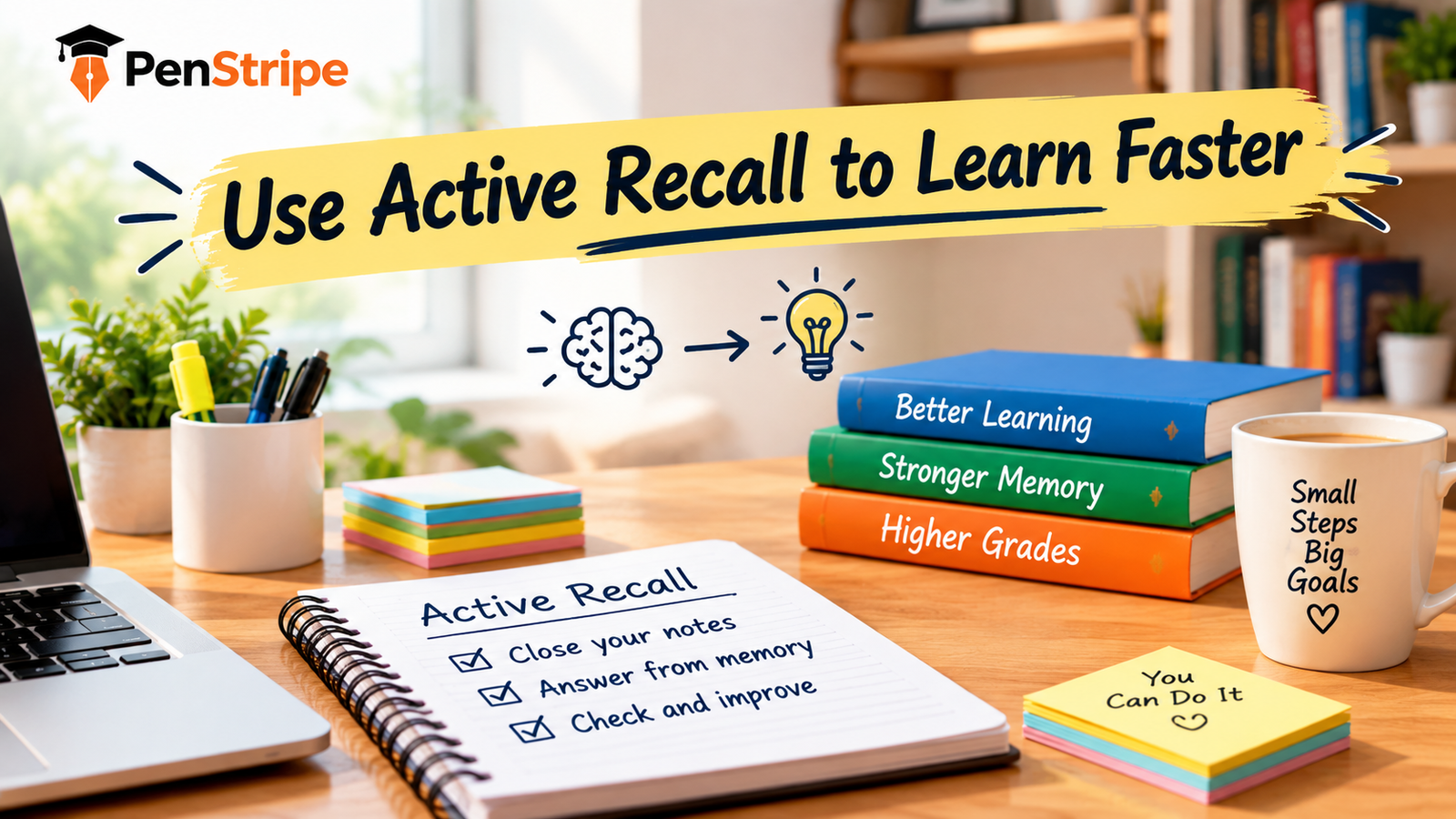
Practice Active Recall
Active recall means trying to remember information without looking at your notes.
Read a section, close the book, and write down everything you can remember. Then compare your answer with the original material.
You can also use flashcards or create questions from your notes.
For example:
Question: What are the main functions of the cell membrane?
Try answering before checking the back of the card.
Use the Feynman Technique
The Feynman Technique involves explaining a difficult concept in simple language.
Choose a topic and pretend you are teaching it to someone who has never studied it before. If you cannot explain a part clearly, return to your notes and review that section.
This method can reveal gaps in your understanding.
Practice With Questions
Questions force you to apply information.
After learning a chapter, complete practice problems, quizzes, or exam-style questions. When you make a mistake, study the reason behind it instead of simply memorizing the correct answer.
4. Improve Focus and Concentration

Even a good study plan will fail if distractions constantly interrupt your attention.
Remove Digital Distractions
Put your phone away or enable a focus mode while studying. Close unnecessary browser tabs and turn off non-essential notifications.
If you need your computer for schoolwork, keep only the resources related to your current task open.
Try the Pomodoro Technique
The Pomodoro Technique is a simple time-management method. A common version involves working for 25 minutes followed by a short break.
However, you do not have to follow 25-minute sessions exactly. Some students work better with 40 or 50-minute periods.
The important principle is to create a defined period of focused work followed by a short recovery break.
Create a Consistent Study Environment
Your environment can influence how easily you begin studying.
Choose a place with enough light, comfortable seating, and minimal distractions. Keep the materials you need nearby so you do not repeatedly leave your workspace.
If studying at home is difficult, a library or quiet study area may work better.
5. Strengthen Memory and Retention
Remembering information requires more than reading it once.
Use Spaced Repetition
Spaced repetition means reviewing information at increasing intervals instead of trying to memorize everything in one sitting.
For example, review a topic:
- The same day
- A day or two later
- Several days later
- The following week
This gives you repeated opportunities to retrieve information before you forget it.
Connect New Ideas to What You Know
New information becomes easier to remember when you connect it to existing knowledge.
For example, when learning a scientific concept, connect it to a real-world example. When learning a historical event, create a timeline showing what happened before and after it.
Meaningful connections are often more useful than isolated memorization.
Take Better Notes
Do not try to write down every sentence your teacher says.
Instead, capture key ideas, definitions, examples, formulas, and questions. After class, review your notes and fill in anything important that you missed.
Good notes should help you understand the topic later, not simply reproduce the textbook.
6. Prepare Better for Exams
Exam preparation should begin before the final night.
Start Early
Give yourself enough time to identify weak areas and practice them.
If an exam is two weeks away, create a revision schedule today. Divide the material into smaller sections and review them over multiple sessions.
Use Practice Tests
Practice tests can show what you actually remember.
After completing one, review every incorrect answer. Ask why you made the mistake. Was the concept unclear, did you forget a detail, or did you misunderstand the question?
This turns mistakes into learning opportunities.
Simulate Exam Conditions
When possible, complete some practice questions under conditions similar to the real exam.
Set a timer, put your notes away, and work without distractions. This helps you practice both knowledge and time management.
7. Build Better Daily Study Habits

Consistency is more important than occasional marathon sessions.
Study at a Regular Time
A consistent schedule makes studying easier to start.
You might study after school, in the morning, or during another period when your concentration is strongest. Choose a time you can realistically maintain.
Take Care of Your Body
Your brain depends on your overall physical condition.
Regular sleep, nutritious meals, hydration, movement, and breaks can support your ability to concentrate and learn.
Studying until extremely late every night may give you more hours at your desk, but it can also leave you tired and less focused the next day.
Track Your Progress
Keep a simple record of what you studied and what still needs work.
At the end of each week, ask:
- What did I learn?
- Which topics are still difficult?
- Which study method worked best?
- What should I change next week?
This turns studying into an ongoing improvement process.
8. Study Methods Compared
Different methods work better for different goals. Instead of relying on one technique, combine methods according to the task.
| Study Method | Best For | Main Benefit |
|---|---|---|
| Active Recall | Facts and concepts | Improves retrieval |
| Spaced Repetition | Long-term memory | Supports repeated review |
| Practice Tests | Exam preparation | Reveals knowledge gaps |
| Feynman Technique | Difficult concepts | Improves understanding |
| Pomodoro Technique | Focused sessions | Creates work and break periods |
| Note-Taking | Lectures and reading | Organizes information |
| Group Study | Discussion and review | Provides different perspectives |
For example, you could learn a chapter by taking concise notes, test yourself with active recall, review flashcards using spaced repetition, and finish with practice questions.
9. Common Study Mistakes to Avoid
Knowing what not to do is just as important as knowing what works.
Relying Only on Rereading
Rereading can make information look familiar without proving that you can recall it independently.
Add questions, practice exercises, or self-testing to your routine.
Studying Without a Plan
Opening a textbook without deciding what you want to accomplish can waste valuable time.
Set a specific target before every session.
Multitasking
Switching between studying, social media, messages, videos, and other tasks makes it harder to maintain attention.
Give your current subject your full attention for a defined period.
Cramming at the Last Minute
Cramming may help you remember some information temporarily, but it leaves little time for understanding and correcting mistakes.
Use spaced review whenever possible.
Ignoring Mistakes
Incorrect answers are useful signals. They tell you exactly where your understanding needs improvement.
Keep track of repeated mistakes and revisit those topics.
Frequently Asked Questions
What is the best method for studying?
There is no single best method for every student, but active recall, spaced repetition, practice questions, and focused study sessions are strong choices. The most effective routine usually combines several techniques rather than relying only on reading or highlighting.
How can I focus 100% on study?
Remove major distractions before starting, choose one specific task, and work for a defined period. Put your phone away, close unrelated tabs, and take short planned breaks. If your mind repeatedly wanders, reduce the size of the task and focus on completing one small step at a time.
How can I study better for exams?
Start early, divide the syllabus into smaller topics, use active recall, complete practice questions, and review your mistakes. In the final days, focus more on weak areas than material you already know. Practice under timed conditions when the real exam has a time limit.
How can I study better at home?
Create a dedicated study space, remove unnecessary distractions, prepare your materials before starting, and follow a realistic schedule. If noise or interruptions are a problem, use a quieter room, library, or another consistent study location.
How can I study fast without forgetting?
Focus on learning efficiently rather than simply increasing speed. Use active recall, practice questions, concise notes, and spaced repetition. These methods allow you to spend less time passively rereading while giving you more opportunities to retrieve and apply information.
How can I become a top 1% student?
Strong academic performance usually comes from consistent habits rather than one secret technique. Set clear goals, manage your time, attend to difficult subjects, practice actively, review mistakes, and maintain healthy routines. Measure progress over time instead of comparing yourself constantly with other students.
What are three secret study tips?
Three useful study strategies are active recall, spaced repetition, and distraction-free practice. Active recall tests what you remember, spaced repetition strengthens long-term retention, and focused practice helps you apply what you have learned.
What is the 9-8-7 rule for studying?
The “9-8-7 rule” is not a universally established evidence-based study method. Different sources may use the phrase to describe different routines. Rather than following a popular label blindly, choose techniques with a clear purpose, such as retrieval practice, spaced review, focused sessions, and practice questions.
Conclusion
Learning how to study better is less about studying for longer and more about studying with purpose. Start with clear goals, create a realistic schedule, remove distractions, and use active methods that make you retrieve and apply information.
Active recall, spaced repetition, practice tests, focused sessions, and regular review can make your study time more productive. At the same time, sleep, breaks, and a consistent routine help you maintain your focus over the long term.
You do not need to change everything at once. Choose two strategies from this guide and use them consistently for the next week. Then measure what improves and adjust your routine.
The goal is not to become someone who studies all day. The goal is to become a student who learns effectively with the time available penstripe