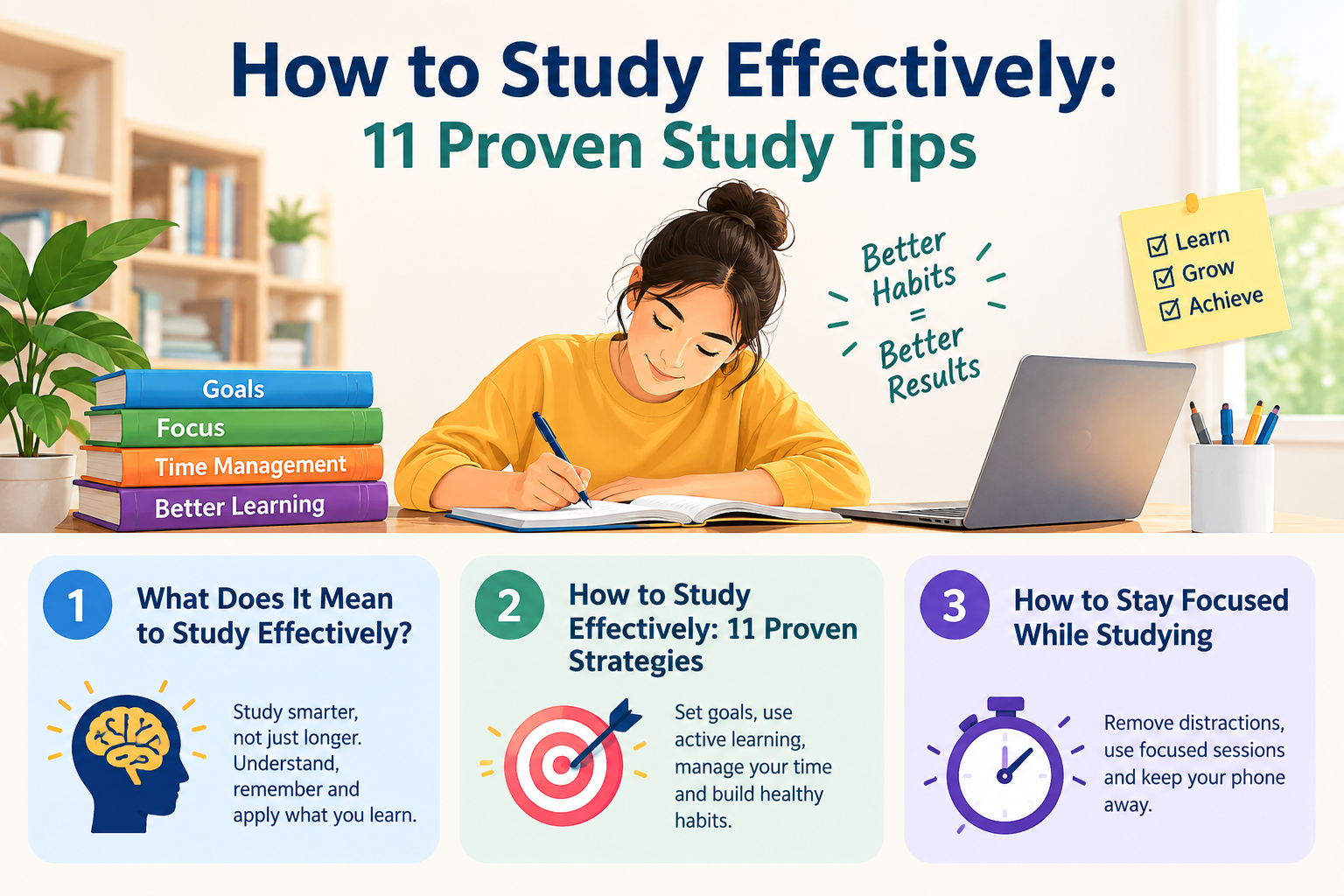



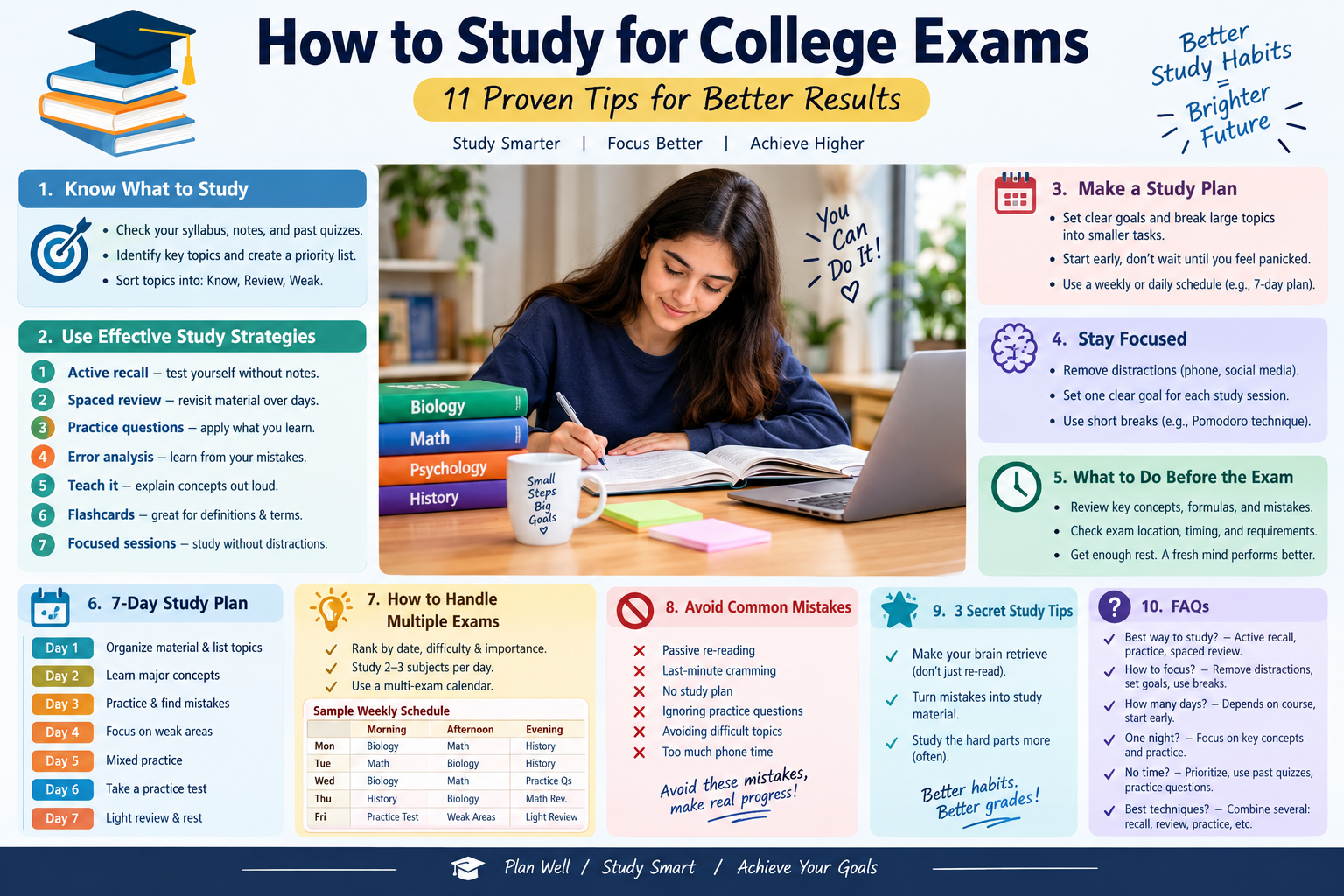
College exams can feel overwhelming because you are often responsible for learning large amounts of material on your own. A few lectures, textbook chapters, assignments, and practice problems can quickly turn into a long list of things to remember. The good news is that effective exam preparation does not require studying every waking hour.
Learning how to study for college exams means knowing what to study, when to study it, and which techniques help you actually remember and use the information. Instead of repeatedly reading the same notes, you can use active recall, practice questions, spaced review, focused study sessions, and a realistic schedule.
Your approach should also change depending on the subject. A biology exam may require diagrams and recall, while a mathematics exam demands repeated problem solving. A history exam may require connecting events, dates, causes, and consequences.
This guide gives you a practical system for preparing for college exams, whether you have several weeks, seven days, or only a short amount of time.
How to Study for College Exams?
Start With What the Exam Actually Covers
The best place to begin is not your textbook. Start by identifying the material your professor expects you to know.
Check your syllabus, lecture notes, learning objectives, assignments, review sheets, practice questions, and previous quizzes. Look for topics that have appeared repeatedly in class.
Create three categories:
Know: You can explain the topic without notes.
Review: You understand the basics but need more practice.
Weak: You cannot explain or apply the concept yet.
Spend most of your time on the second and third categories.
Use Active Learning
Active learning requires you to do something with the information.
Instead of reading a chapter repeatedly, close the book and explain the main idea from memory. Instead of looking at a solved math problem, attempt a similar problem yourself.
This makes studying more demanding, but that effort is useful because it shows whether you can actually retrieve and apply what you learned.
Match Your Technique to the Subject
Different courses require different forms of practice.
| Subject | Useful Approach |
| Mathematics | Practice problems and error analysis |
| Biology | Active recall, diagrams, practice questions |
| Chemistry | Problems, formulas, concepts, recall |
| History | Timelines, recall, cause-and-effect connections |
| Psychology | Definitions, examples, practice questions |
| Literature | Themes, evidence, interpretation, essay practice |
| Foreign Language | Vocabulary, listening, writing, speaking |
There is no single study technique that works equally well for every college course.
How to Prepare for College Exams
Make a Study Plan
A good study plan answers three questions:
- What do I need to learn?
- How much time do I have?
- Which topics need the most attention?
Suppose your exam is one week away. You could divide your preparation like this:
Day 1: Organize material and identify weak areas
Day 2: Review major concepts
Day 3: Practice difficult topics
Day 4: Complete practice questions
Day 5: Review mistakes
Day 6: Take a practice test
Day 7: Light review and preparation
The exact schedule can change depending on the subject and workload.
Break Large Topics Into Smaller Tasks
“Study chemistry” is too vague.
A better plan might say:
- Review atomic structure
- Practice balancing equations
- Review key formulas
- Complete 15 practice questions
- Check mistakes
- Explain difficult concepts from memory
Specific tasks reduce decision fatigue and make it easier to begin.
Study Before You Feel Panicked
Waiting until you feel pressure can make studying harder.
Starting early gives you time to discover what you do not understand. You can then ask your professor, attend office hours, use tutoring, or find additional explanations.
The goal is not to eliminate all pressure. It is to avoid making the night before an exam your only opportunity to learn the material.
How to Study for College Exams?
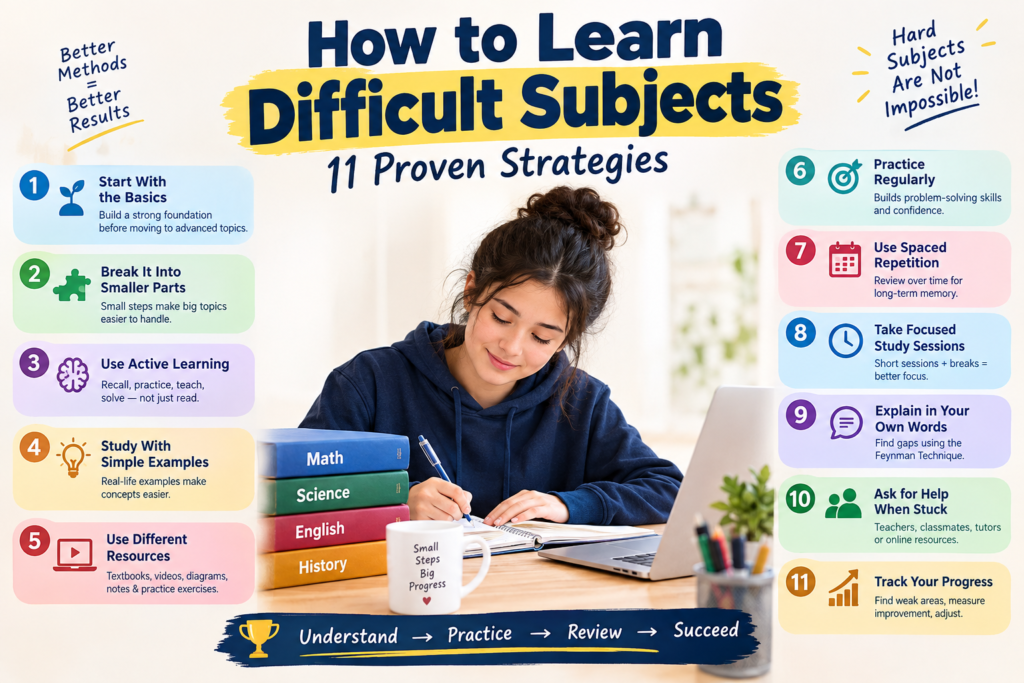
1. Review Your Lecture Notes
Your lecture notes can help identify what your professor emphasized.
Review them soon after class rather than allowing several weeks of material to accumulate.
Look for definitions, examples, concepts that received extra explanation, and topics connected to assignments or quizzes.
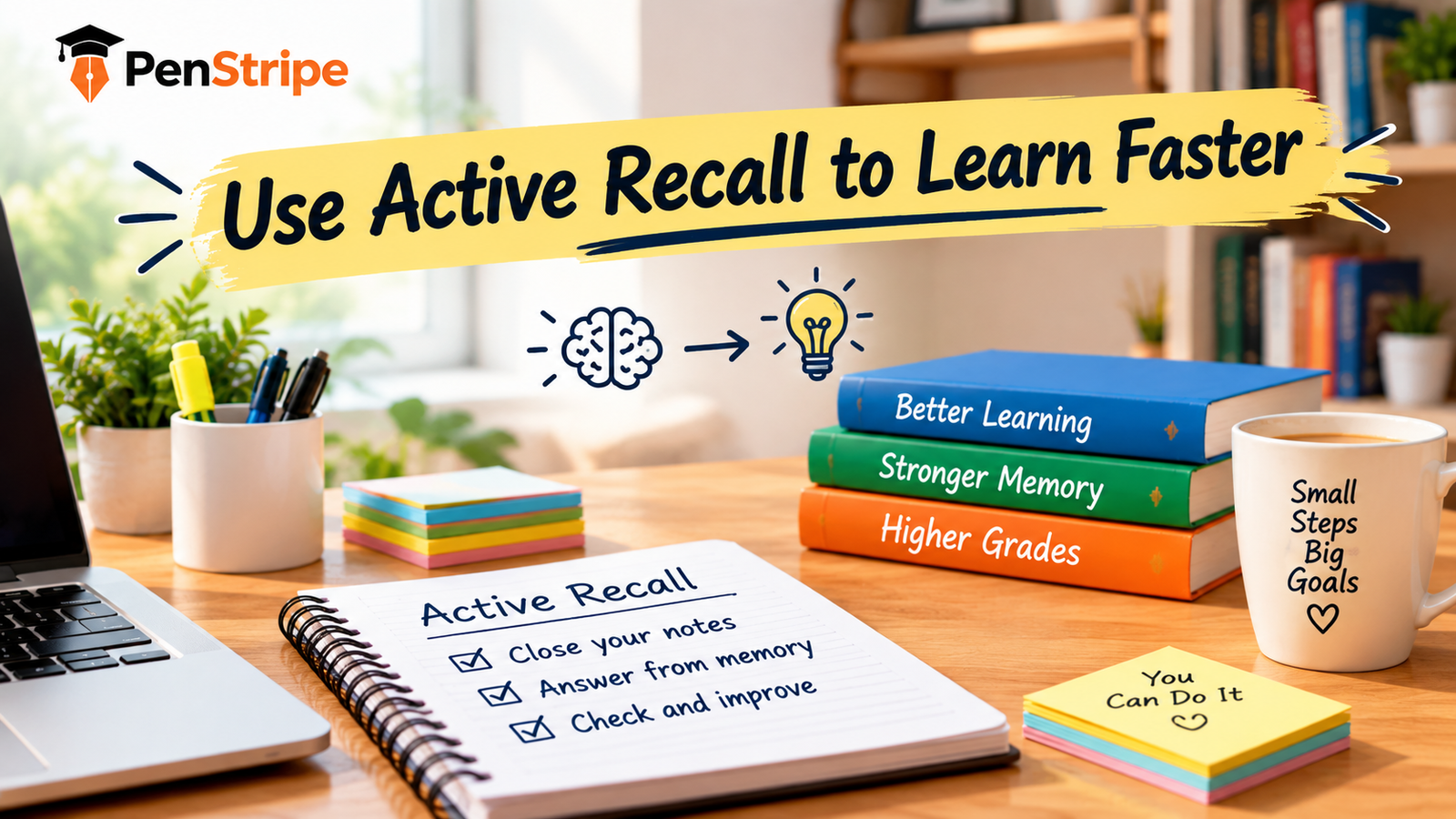
2. Use Active Recall
Active recall is one of the most useful study techniques for information that you need to remember.
Read a section, close your notes, and ask yourself what you can remember.
For example:
Question: What are the three main stages of this process?
Answer the question without looking.
Then check your notes and correct anything you missed.
3. Practice With Questions
Practice questions turn studying into retrieval and application.
Do not only check whether your final answer is correct. Ask why you made a mistake.
Was the concept unclear? Did you use the wrong formula? Did you misread the question? Did you forget an important step?
Understanding the reason behind a mistake makes your next practice session more useful.
4. Use Spaced Review
Instead of studying everything in one sitting, revisit important material several times.
For example:
Monday: Learn the concept
Wednesday: Recall it without notes
Friday: Practice questions
Sunday: Final review
Spacing gives you repeated opportunities to retrieve information.
5. Create a Mistake List
Keep track of questions and concepts you repeatedly get wrong.
A simple table works well:
| Problem | Mistake | Fix |
| Formula question | Used wrong formula | Compare formulas |
| Definition | Forgot key detail | Add recall question |
| Calculation | Arithmetic error | Slow down and check |
| Essay | Weak evidence | Review lecture examples |
Review this list before your next practice session.
6. Explain the Material Out Loud
Try explaining a difficult topic as if you were teaching it to another student.
If you can explain the idea clearly without looking at your notes, you probably understand it reasonably well.
If you become stuck, identify the exact point where your explanation breaks down.
That gives you a clear target for further study.
7. Use Flashcards Strategically
Flashcards are useful for definitions, vocabulary, formulas, dates, terminology, and other information that requires direct recall.
Keep each card focused.
Instead of putting an entire page of notes on one card, create several questions that test individual concepts.
8. Practice Under Test Conditions
A practice test should sometimes resemble the real exam.
Put away your notes, set a reasonable time limit, and answer questions without assistance.
Afterward, analyze your mistakes.
A practice test is not only a way to measure preparation. It is also a way to discover what you need to study next.
9. Study Your Weakest Areas First
Students often spend too much time reviewing information they already know.
That feels productive because the answers come easily.
Instead, spend a significant portion of your study time on topics where you hesitate, make repeated mistakes, or cannot explain the concept.
10. Use Focused Study Sessions
You do not need to sit at your desk for an entire day.
Try a structured session such as:
45 minutes: Focused study
10 minutes: Break
45 minutes: Practice
10 minutes: Break
30 minutes: Review mistakes
Adjust the timing to your concentration and schedule.
11. Ask for Help Before the Exam
If you still cannot understand a concept after reviewing it several times, get help.
Use professor office hours, tutoring services, study groups, academic support centers, or reliable course resources.
Bring specific questions. Knowing exactly what you do not understand makes help much more effective.
How Can I Focus 100% on Study?

Remove Obvious Distractions
You cannot always control every distraction, but you can control many of them.
Put your phone away, turn off unnecessary notifications, close unrelated tabs, and keep your study area simple.
If you need your phone for an educational resource, use a focus mode and avoid opening unrelated apps.
Give Yourself One Clear Goal
Before starting, write down exactly what you want to accomplish.
For example:
Weak goal: Study psychology.
Better goal: Complete 25 practice questions on memory and review every incorrect answer.
The second goal gives you a clear finish line.
Use Short Breaks
Focus is easier to maintain when you know a break is coming.
The Pomodoro technique is one possible structure, but you can adjust the timing to your needs. Some students prefer shorter sessions, while others work better for longer periods.
The important part is protecting the focused period from unnecessary interruptions.
How to Study for Exams in 7 Days
If you have only one week, avoid trying to learn everything randomly.
Day 1: Organize
Gather your notes, readings, assignments, quizzes, and professor-provided materials.
List every topic covered by the exam.
Day 2: Learn Major Concepts
Review the major ideas and identify areas where your understanding is weak.
Do not spend the entire day making perfect notes.
Day 3: Practice
Use practice questions, problems, flashcards, or other active methods.
Start identifying repeated mistakes.
Day 4: Focus on Weak Areas
Return to the concepts you struggled with on Day 3.
Explain them, practice them, and test yourself again.
Day 5: Mixed Practice
Mix different topics instead of studying only one chapter at a time.
This forces you to decide which concept or method applies to each question.
Day 6: Practice Test
Take a realistic practice test if possible.
Analyze the results and review your weakest areas.
Day 7: Light Review
Do not attempt to relearn the entire course.
Review important concepts, formulas, vocabulary, mistakes, and difficult areas. Prepare what you need for the exam and give yourself time to rest.
How to Study When You Have Multiple Exams

Rank Exams by Urgency and Difficulty
When several exams are approaching, consider:
- Exam date
- Amount of material
- Difficulty
- Your current preparation
- Importance of weak topics
Then divide your available study time accordingly.
Avoid Studying One Course All Day
If you have three exams, completely ignoring two subjects for several days can create unnecessary pressure.
A better schedule may include two or three subjects in the same day, with the most urgent or difficult course receiving the largest block.
Use a Multi-Exam Calendar
For example:
| Day | Morning | Afternoon | Evening |
| Monday | Biology | Math | History review |
| Tuesday | Math | Biology | History |
| Wednesday | Biology | Math | Practice questions |
| Thursday | History | Biology | Math review |
| Friday | Practice test | Weak areas | Light review |
Adjust the schedule according to your actual exam dates.
What Are 7 Secret Methods for Studying Effectively?
There are no magic study methods that guarantee a particular grade. However, seven practical methods can make preparation more active and organized:
- Active recall — retrieve information without notes.
- Spaced review — revisit material over multiple days.
- Practice testing — simulate exam questions.
- Error analysis — study why answers were wrong.
- Teaching — explain difficult concepts in simple language.
- Interleaving — mix related topics or problem types.
- Focused sessions — work on one clear task without distractions.
These methods are more useful when applied consistently rather than treated as shortcuts.
What Is the 9 8 7 Rule for Studying?
The phrase 9 8 7 rule for studying does not have one universally established academic definition. Different websites and study communities may use similar numbers to describe different study routines.
Because the term is not standardized, do not assume that a “9-8-7 rule” is a scientifically established formula for exam success.
Instead, use clearly defined techniques such as active recall, spaced review, practice testing, and focused study sessions. These methods can be adapted to your schedule without depending on an ambiguous numbered rule.
3 Secret Study Tips That Actually Help

Make Your Brain Retrieve
After reading, close the material and recall the main points.
Turn Mistakes Into Study Material
Do not throw away incorrect answers. Record them and review why they happened.
Study the Hard Parts More
Do not spend most of your time on topics that already feel easy.
These three habits can make study time more targeted and useful.
Study Techniques Compared
| Technique | Best Use | Strength | Common Problem |
| Active recall | Concepts and facts | Tests real retrieval | Feels harder |
| Spaced repetition | Long-term memory | Prevents one-time review | Requires planning |
| Practice testing | Exam preparation | Shows weaknesses | Needs good questions |
| Flashcards | Definitions | Quick recall practice | Can become passive |
| Teaching | Complex concepts | Reveals gaps | Takes preparation |
| Practice problems | Math/science | Builds application | Needs feedback |
| Group study | Discussion | Shared explanations | Can become social |
A strong exam plan often combines several of these rather than depending on one technique.
What to Do the Night Before a College Exam
Avoid Trying to Learn Everything
The night before should mainly be for targeted review.
Look at your mistake list, important concepts, formulas, vocabulary, and topics you still find difficult.
Prepare Your Materials
Check the exam location, time, required materials, calculator rules, identification requirements, or other instructions provided by your college or professor.
Give Yourself Time to Rest
Staying awake all night may give you more hours with your notes, but it also leaves less time for recovery.
If you have studied consistently, use the final evening to reinforce important information rather than attempting to learn an entire course from scratch.
Common College Exam Study Mistakes
Passive Re-Reading
Reading the same chapter several times can create familiarity without proving that you can recall the information.
Last-Minute Cramming
Cramming may feel unavoidable when preparation starts late, but it leaves less time for practice and correction.
Studying Without a Plan
Opening a textbook and asking “What should I do?” can waste valuable time.
Start each session with a specific task.
Ignoring Practice Questions
Knowing a concept when reading notes is different from applying it to a question.
Practice exposes that difference.
Avoiding Difficult Topics
Do not repeatedly study what feels comfortable.
Your weakest areas usually deserve more attention.
Using Your Phone During Every Break
A short break can easily become a long social-media session.
Use breaks intentionally and return to your planned task.
Frequently Asked Questions
What is the best way to study for a test in college?
The best approach combines active recall, practice questions, spaced review, and focused study sessions. Start by identifying what the exam covers, then prioritize topics you do not understand well. Use practice to test yourself rather than relying only on rereading. Adjust the method according to the subject.
How can I focus 100% on study?
You cannot guarantee perfect concentration, but you can make focused studying easier. Remove unnecessary notifications, put your phone away, choose one specific task, and use a defined study period. If concentration remains difficult, make the task smaller and start with a short session rather than waiting for perfect motivation.
How many days should I study before a college exam?
There is no universal number of days. Starting several days or weeks ahead gives you more time to review, practice, identify weak areas, and ask for help. The amount of preparation needed depends on the course difficulty, amount of material, your prior knowledge, and the type of exam.
How do I study for college exams in one night?
If you have only one night, prioritize the most important material instead of attempting to read everything. Review major concepts, use active recall, complete representative practice questions, and focus on repeated mistakes. Avoid spending the entire night passively rereading. A short, focused plan is more useful than studying randomly.
How do I study for college exams when I have no time?
Start by identifying the highest-priority material. Use your syllabus, lecture emphasis, assignments, practice questions, and previous quizzes to determine what deserves attention. Then use active recall and practice questions instead of spending most of your limited time making notes or rereading entire chapters.
What are the best study techniques for college exams?
Useful techniques include active recall, spaced review, practice testing, flashcards, explaining concepts, practice problems, and error analysis. The best combination depends on the course. For example, solving problems is essential in many quantitative courses, while recall and explanation may be especially useful for terminology-heavy subjects.
How can I study for multiple college exams at once?
Create a calendar containing every exam and divide your available study time across the subjects. Give more time to earlier exams and courses where you are less prepared. Avoid completely ignoring one subject for several days. Short, consistent sessions across multiple courses can make a crowded exam period easier to manage.
Is studying all night before an exam effective?
An all-night study session is generally not a good replacement for preparation spread across multiple days. When time is limited, prioritize important concepts and active practice rather than trying to cover everything. Give yourself an opportunity to rest before the exam instead of making exhaustion the final part of your preparation.
Conclusion
Knowing how to study for college exams is about more than spending extra hours with a textbook. Effective preparation starts with understanding what the exam covers, creating a realistic schedule, and choosing study methods that require you to retrieve and apply information.
Use active recall, spaced review, practice questions, error analysis, and focused study sessions. Give extra attention to weak areas instead of repeatedly reviewing material you already know.
If your exam is approaching, start today with one simple step: list the topics you need to know and mark each one as strong, uncertain, or weak. Then build your study sessions around that list.
You do not need a perfect routine. You need a consistent one that helps you learn, practice, and improve before exam day penstripe.blog