






Studying for hours does not guarantee that you will remember what you read. You may understand a chapter today and still struggle to recall it during an exam. The difference often comes down to how you practice remembering, not simply how long you study.
If you want to learn how to memorize what you study, the goal is to move beyond passive reading. Active recall, spaced repetition, practice testing, useful memory cues, focused study sessions, and healthy habits can make learning more effective.
This guide explains practical ways to remember what you study without relying on endless rereading. You will learn how to memorize things fast for a test tomorrow, how to retain information for longer, how to memorize notes in one night when necessary, and how to recover information you thought you had forgotten.
You will also learn which popular memorization methods are useful, which claims should be treated cautiously, and how to build a simple study routine that improves recall over time.
How to memorize what you study
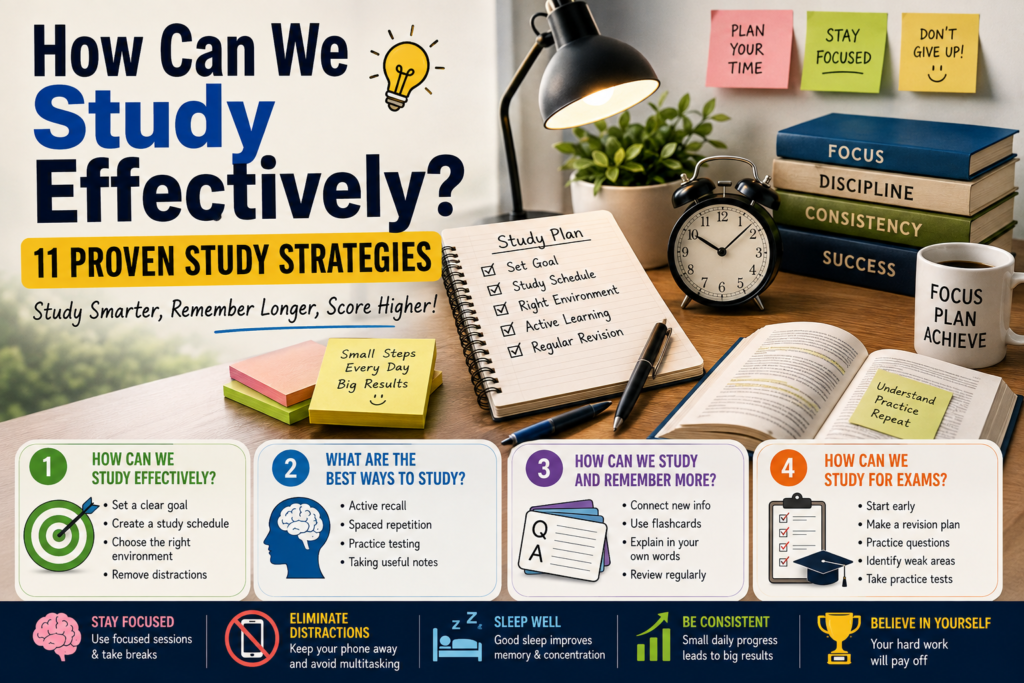
The best way to memorize study material is to actively retrieve it from memory, review it at spaced intervals, connect new information to what you already know, and test yourself regularly.
Simply reading the same page several times can make the material feel familiar without proving that you can recall it later.
A better process is:
Learn → Close the book → Recall → Check → Correct → Review later → Test again
For example, after studying the causes of the American Civil War, close your notes and write down as many causes as you can remember. Then compare your answer with your notes and correct anything missing.
This simple change turns studying from passive exposure into active learning.
Active Recall vs. Rereading
| Method | What You Do | Main Benefit |
|---|---|---|
| Rereading | Read the same material repeatedly | Builds familiarity |
| Highlighting | Mark important information | Helps identify key points |
| Active recall | Retrieve information without looking | Strengthens recall |
| Flashcards | Question yourself repeatedly | Useful for facts and definitions |
| Practice testing | Complete questions without notes | Combines recall and feedback |
| Spaced repetition | Review over increasing intervals | Supports long-term retention |
Active recall is particularly useful when preparing for exams because exams require you to retrieve information rather than simply recognize it on a page.
Why Retrieval Helps Memory
Memory becomes more useful when you practice retrieving information.
Suppose you read the definition of photosynthesis five times. You may recognize it immediately when you see it again. But if you close the book and explain photosynthesis from memory, you discover whether you can actually retrieve the concept.
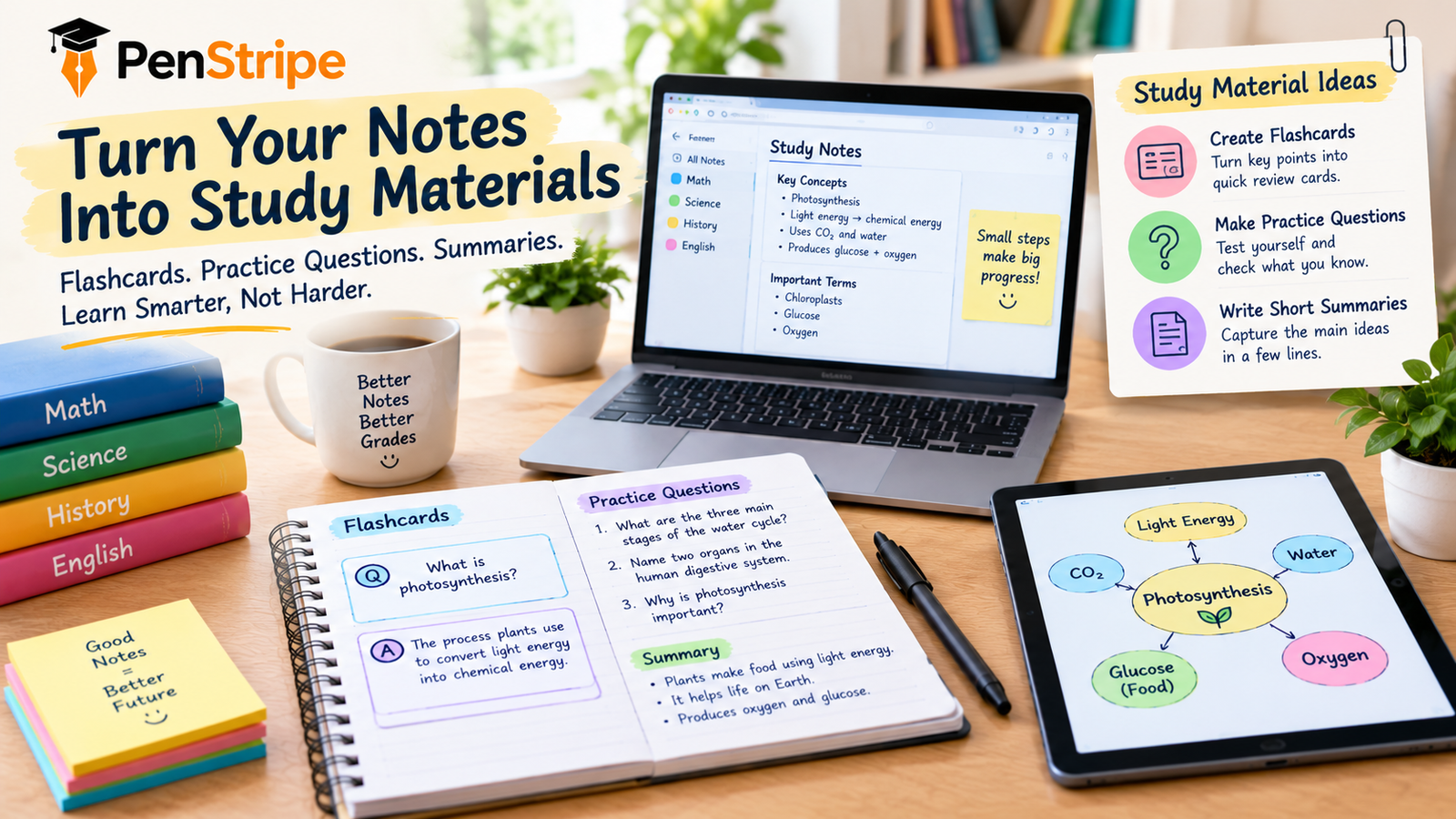
That is why practice questions, flashcards, self-quizzing, and explaining concepts aloud can be powerful parts of a study routine.
11 Effective Ways to Memorize What You Study
You do not need to use all 11 techniques at once. Start with two or three methods that match the material you are learning.
1.How to Memorize What You Study
After studying a small section, put your notes away and ask yourself questions.
Try questions such as:
- What were the three main ideas?
- Can I explain this without looking?
- Why does this process happen?
- What example can I give?
- How does this concept connect to the previous chapter?
Answer from memory first. Check your notes afterward.
This method also helps you identify weak areas before an exam.
2. Practice Spaced Repetition
Spaced repetition means reviewing information more than once with increasing gaps between sessions.
Instead of studying vocabulary for two hours on Monday and never seeing it again, you might review it:
- Monday
- Tuesday
- Thursday
- One week later
- Two weeks later
The exact schedule can vary. What matters is returning to information after some time has passed and attempting to retrieve it.
Spaced review is especially useful for vocabulary, formulas, definitions, dates, terminology, and other factual information.
3. Turn Notes Into Questions
Your notes should not remain a collection of sentences that you repeatedly read.
Convert important points into questions.
For example:
Note: The hippocampus plays an important role in forming and retrieving certain types of memories.
Question: What role does the hippocampus play in memory?
Now your notes become a study tool.
This technique is also useful when you need to memorize notes in one night because it makes your limited study time more active.
4. Explain the Topic in Simple Words
After studying a concept, pretend you are teaching it to someone who has never heard of it.
Explain:
- What it is
- Why it matters
- How it works
- One simple example
If you cannot explain an idea without looking at your notes, you probably need to study that part again.
This approach is particularly useful for difficult subjects because it exposes gaps in understanding.
5. Use Mnemonics and Memory Cues
Mnemonics help connect information to an easier-to-remember pattern.
You can use:
- Acronyms
- Rhymes
- Short stories
- Visual associations
- First-letter cues
- Familiar locations
For example, students sometimes create an acronym to remember a sequence of concepts.
The best mnemonic is one that makes sense to you. A complicated mnemonic can sometimes be harder to remember than the original material.
6. Use Flashcards Correctly
Flashcards can be excellent for memorization, but only when you use them actively.
Put a question on one side and the answer on the other.
Do not immediately flip the card. First try to answer.
For example:
Front: What is the process by which plants convert light energy into chemical energy?
Back: Photosynthesis.
Digital tools such as Quizlet can make organizing flashcards easier, but the tool itself does not replace active recall.
7. Break Large Topics Into Smaller Parts
Trying to memorize an entire chapter at once can overwhelm working memory.
Instead, divide the topic into manageable sections.
For a biology chapter, you might study:
Part 1: Cell structure
Part 2: Cell membrane
Part 3: Cellular transport
Part 4: Cell division
Master each part before connecting the sections together.
This is called chunking. It helps you organize information into meaningful groups rather than treating every fact as a separate item.
8. Connect New Information to What You Already Know
New information is easier to understand when you connect it with existing knowledge.
Suppose you are learning about inflation. Instead of memorizing a definition alone, connect it to a familiar example, such as how rising prices affect the amount of goods you can purchase with the same amount of money.
Ask:
“What does this remind me of?”
“How is this related to something I already understand?”
These connections can make abstract information easier to retrieve.
9. Use Practice Tests
Practice testing is one of the most useful ways to prepare for an exam.
Do not wait until the night before.
After finishing a topic, answer questions without looking at your notes. Mark the questions you missed and review those areas.
Practice tests also reveal a problem that rereading can hide: you may recognize the correct answer when you see it but struggle to produce it independently.
10. Study in Focused Sessions
Long study sessions are not automatically better.
Try a focused session such as:
25 minutes: Study actively
5 minutes: Take a break
25 minutes: Recall and practice
5 minutes: Break
25 minutes: Review weak areas
You can adjust the timing according to your needs.
During focused sessions, remove unnecessary distractions. Put your phone away, close unrelated browser tabs, and keep only the materials needed for the current task.
11. Sleep After Learning
Sleep is an important part of learning and memory.
Trying to replace sleep with an all-night study session can leave you tired and may make studying less effective the next day.
When possible, study earlier, review important material before bed, and give yourself enough time to sleep.
If you need to study late because an exam is tomorrow, prioritize the highest-value material instead of trying to memorize every sentence.
How to Memorize What You Study

When your test is tomorrow, you need a different strategy from long-term studying.
Do not attempt to reread every page from beginning to end.
Instead, use this emergency study plan.
Step 1: Identify the Highest-Priority Material
Look at:
- Teacher-provided study guides
- Previous quizzes
- Homework questions
- Learning objectives
- Key definitions
- Major concepts
- Topics emphasized in class
Start with material most likely to matter.
Step 2: Use Active Recall
Read a section briefly, close your notes, and recall the main ideas.
Spend more time answering questions than rereading explanations.
Step 3: Create a One-Page Review Sheet
Write only the most important information.
Include:
- Key terms
- Formulas
- Definitions
- Processes
- Dates
- Important examples
- Common mistakes
The purpose is not to copy your entire textbook.
Step 4: Test Yourself
Complete practice questions without your notes.
For every mistake, identify why you missed it.
Was it:
- A knowledge gap?
- Confusion between two concepts?
- A calculation error?
- A careless mistake?
- A problem understanding the question?
Fix the specific problem rather than simply rereading the chapter.
Step 5: Review Before Sleeping
Do one final short review of difficult material.
Then sleep rather than continuing indefinitely.
This approach is more realistic than trying to memorize an entire textbook overnight.
How to Remember What You Studied in One Day
If you have only one day, focus on understanding and retrieval rather than trying to memorize every detail.
A practical one-day schedule could look like this:
| Time | Task |
|---|---|
| 9:00–9:30 | Identify important topics |
| 9:30–10:30 | Study Topic 1 |
| 10:30–10:45 | Break |
| 10:45–11:45 | Study Topic 2 |
| 11:45–12:00 | Active recall |
| 1:00–2:00 | Study Topic 3 |
| 2:00–2:20 | Practice questions |
| 3:00–4:00 | Review weak areas |
| 5:00–5:30 | Full recall session |
| Evening | Short final review |
You should not expect to permanently memorize a large amount of complex information in a single day. However, you can significantly improve recall by focusing on the most important material and repeatedly retrieving it.
Can You Remember What You Study in Only 15 Minutes?
Fifteen minutes can be enough to learn or review a small amount of information, but there is no reliable method that guarantees you can memorize an entire topic in 15 minutes.
If you have only 15 minutes, use the time efficiently:
2 minutes: Scan the material
5 minutes: Learn the core idea
5 minutes: Close the notes and recall it
3 minutes: Check mistakes and repeat difficult points How to Memorize What You Study
The key is not the number 15. The important part is how actively you use those minutes.
How to Memorize Fast in 1 Hour
Use one hour as four focused stages:
15 minutes: Learn the essential concepts
15 minutes: Close your notes and recall them
15 minutes: Complete practice questions
15 minutes: Review mistakes and difficult information
This is generally more useful than spending the full hour highlighting or rereading.
How to Improve Focus and Long-Term Memory

Good memorization depends on more than techniques. Your study environment and daily habits also influence how effectively you learn.
How Can I Focus 100% on Studying?
You cannot guarantee 100% concentration for every minute, but you can create conditions that make focused studying easier.
Try this setup:
- Choose one specific task.
- Put your phone out of reach.
- Remove unnecessary tabs.
- Keep water nearby.
- Use a timer.
- Study in a quiet environment.
- Take short planned breaks.
- Return to the task after every break.
Avoid switching between studying, social media, messages, videos, and unrelated tasks.
Every interruption makes it harder to maintain a consistent train of thought.
Use the Method of Loci for Lists
The method of loci, sometimes called a memory palace, involves associating information with familiar locations.
Imagine walking through your home and placing different items at specific locations.
For example:
Front door: First concept
Sofa: Second concept
Kitchen: Third concept
Desk: Fourth concept
When you mentally walk through the locations, the associated information can become easier to retrieve.
This technique is particularly useful for lists, sequences, speeches, and ordered information.
What Is the 7-3-2-1 Method of Memorization?
The “7-3-2-1 method” is a study technique described online using repeated reviews across several intervals. However, it is not a universally established scientific law of memory, and you should not assume that the exact numbers work for everyone.
The useful principle behind schedules like this is repeated retrieval over time.
Rather than worrying about whether a specific number sequence is perfect, create a review schedule that brings the information back several times.
What Is the 2-7-30 Rule for Memory?
The “2-7-30 rule” is another popular online study framework that suggests reviewing information after specific time intervals.
It can be used as a simple reminder system, but it should not be treated as a guaranteed formula for memory. Different subjects, learners, and levels of difficulty require different review schedules.
A better approach is to review information, test yourself, and increase the gap when you can consistently recall it.
How to Remember Things You Forgot
Forgetting does not always mean that the information is permanently gone.
When you cannot remember something, use retrieval cues rather than immediately looking up the answer.
Try:
- Remembering where you learned it
- Recalling the surrounding topic
- Thinking of an example
- Writing down related words
- Reconstructing the sequence
- Trying to explain the concept from memory
Then check your notes.
This process can reveal exactly where your memory breaks down.
If you repeatedly forget the same information, turn it into a flashcard or practice question and review it again later.
Common Memorization Mistakes to Avoid
Reading the Same Notes Repeatedly
Rereading can create a feeling of familiarity. That feeling does not necessarily mean you can recall the information independently.
Replace some rereading with self-testing.
Trying to Memorize Everything
Not every sentence has equal importance.
Prioritize concepts, definitions, formulas, processes, examples, and information directly connected to your learning objectives.
Studying Without Breaks
Your attention can decline during long sessions.
Use reasonable study periods with short breaks so you can return with better focus.
Staying Up All Night
An all-nighter may give you additional study time, but sacrificing sleep is not a reliable long-term memorization strategy.
When possible, combine studying with adequate sleep.
Using Too Many Techniques
You do not need ten apps, five notebooks, and several complicated systems.
A simple combination can work well:
Active recall + spaced repetition + practice questions + focused study sessions
Consistency matters more than having a complicated system.
Frequently Asked Questions
What is the best way to memorize what you study?
The best general approach is active recall combined with spaced repetition. Study a concept, close your notes, retrieve the information from memory, check your answer, and review it again later. Practice questions and explaining the material in your own words can make this process even more effective.
How can I memorize things quickly for exams?
Focus on the most important material first. Use active recall, practice questions, short focused sessions, and repeated review. Instead of rereading everything, identify what you cannot recall and spend most of your remaining time fixing those weak areas.
How do I How to Memorize What You Study
Prioritize likely exam topics, learn the core concepts, create questions from your notes, and test yourself without looking at the answers. Review mistakes several times and avoid spending the entire night rereading. A short final review followed by adequate sleep can be more practical than continuous studying.
How can I remember what I read and study?
Turn reading into active learning. After each section, close the book and explain the main idea from memory. Write questions, answer them without notes, connect new concepts with things you already know, and review difficult material after increasing intervals.
How can I memorize notes in one night?
If you have only one night, avoid trying to memorize every sentence. Identify the most important concepts, convert them into questions, use active recall, practice the hardest material, and make a short review sheet. If possible, leave enough time for sleep rather than studying continuously until morning.
How can I remember things I forgot?
First try to retrieve the information using related clues. Think about the topic, context, examples, sequence, or location where you learned it. If you still cannot remember, check the answer and immediately try to recall it again. Later, test yourself on the same information.
Does the 7-3-2-1 method really work?
The 7-3-2-1 method is a popular memorization schedule, but the exact sequence should not be treated as a scientifically guaranteed formula. The broader idea of reviewing information repeatedly over time is useful. Your review schedule should depend on the difficulty of the material and how well you can recall it.
What is the fastest way to memorize a list of words?
Group related words, create memorable associations, use flashcards, and repeatedly retrieve the words without looking. For longer lists, mnemonics or the method of loci can help. Test yourself in both directions when appropriate so you can recognize and produce the information.
Conclusion
Learning how to memorize what you study is less about studying for longer and more about studying in a way that requires your brain to retrieve information.
Active recall, spaced repetition, practice testing, flashcards, mnemonics, focused sessions, and meaningful connections can all become part of an effective study routine. If you have an exam tomorrow, prioritize important concepts and use your limited time for retrieval and practice rather than endless rereading.
For long-term learning, review information across multiple sessions and give yourself enough sleep and recovery time.
Start with one simple change today: study a small section, close your notes, and explain everything you can remember. Then check what you missed and test yourself again later.
That simple habit can turn passive studying into a much more effective way to remember what you learn penstripe