






Studying for hours does not always mean you are learning more. You can spend an entire afternoon reading your notes and still struggle to remember the same information the next day.
The problem is often not a lack of effort. It is the way you study.
If you want to learn how to study faster and remember more, you need methods that make your brain actively process information. Reading the same page several times may feel productive, but testing yourself, explaining ideas in your own words, and reviewing information at the right time can make your study sessions much more effective.
The good news is that you do not need to completely change your routine. A few simple adjustments can make studying more focused, efficient, and easier to remember.
This guide explains 11 practical strategies you can use for school, college, exams, or everyday learning.
Set a Clear Study Goal

One of the easiest ways to waste study time is to start without knowing exactly what you want to accomplish.
Instead of saying, “I am going to study biology,” choose a specific goal.
For example:
“By the end of this session, I will understand the three stages of cellular respiration and answer 10 practice questions.”
A clear goal gives your study session direction.
How to Study Faster and Remember More
Large tasks can quickly become overwhelming. Divide them into smaller activities that you can complete one at a time.
For example, instead of trying to finish an entire chapter, you could:
- Learn five important terms
- Understand one difficult concept
- Complete 15 practice questions
- Review yesterday’s notes
Small tasks are easier to start and easier to measure.
Create a Simple Study Checklist
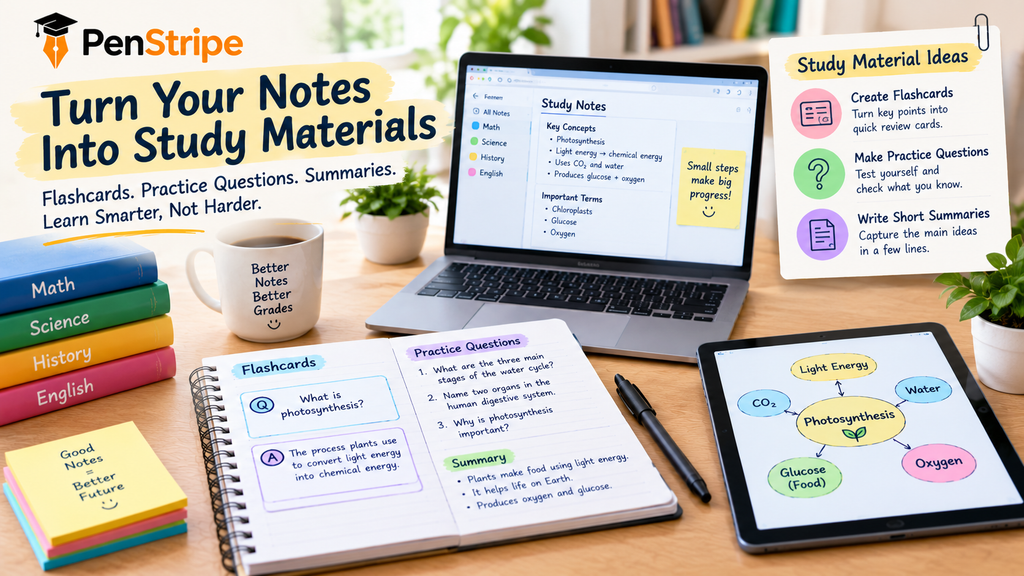
Before you begin, write down two or three things you want to finish.
Once those tasks are complete, you can stop or move to the next subject. This prevents you from spending unnecessary time reviewing information you already understand.
2. Remove Distractions Before Studying
You cannot expect your brain to concentrate deeply while your phone is constantly showing notifications.
If you want to know how to focus 100% on studying, start by controlling your environment.
Put your phone on silent or keep it somewhere out of reach. Close unrelated browser tabs and keep only the materials you actually need.
Create a Study-Friendly Environment

Your study space does not need to look perfect.
It simply needs to make studying easier.
Keep your desk reasonably organized, prepare your books before starting, and keep water nearby. The fewer reasons you have to leave your desk, the easier it becomes to stay focused.
Use Short Focused Sessions
You do not have to study continuously for several hours.
A focused 25 to 50-minute session can be more useful than hours of distracted studying.
The goal is not to sit at your desk for as long as possible. The goal is to spend that time actually learning.
3. Use Active Recall
Active recall is a study technique in which you try to retrieve information from memory instead of simply looking at your notes.
For example, after reading about photosynthesis, close your textbook and ask yourself:
“What is photosynthesis?”
“What does a plant need for photosynthesis?”
“What are the main products?”
Try to answer without looking at the page.
Turn Notes Into Questions
Your notes can become a personal quiz.
Instead of writing:
“Photosynthesis converts light energy into chemical energy.”
Turn it into:
“What does photosynthesis convert light energy into?”
Now you have a question that you can use during future study sessions.
Test Yourself Without Your Notes
After studying a section, close your book and write everything you remember.
Then compare your answer with your notes.
The information you missed becomes your next study target.
4. Use Spaced Repetition
Trying to memorize everything in one night may seem convenient, especially before an exam. However, information learned through cramming can be difficult to retain.
Spaced repetition means reviewing information several times over a period of time.
For example, you might review a topic:
- Later the same day
- The next day
- Three days later
- One week later
- Before the exam
The exact schedule can vary. The important part is returning to the material instead of learning it once and forgetting about it.
Combine Spaced Repetition With Active Recall

These techniques work well together.
During each review, avoid simply reading your notes again. Test yourself instead.
If you struggle to remember something, review that part and test yourself again later.
5. Break Difficult Topics Into Smaller Parts
A large chapter can feel impossible when you first open it.
Instead of trying to memorize everything at once, divide the material into smaller sections.
For example, a history chapter could be divided into:
- Important dates
- Major people
- Causes
- Important events
- Results and consequences
Now you have several smaller learning tasks instead of one huge chapter.
Learn the Main Idea First
Before memorizing details, understand what the topic is mainly about.
Ask yourself:
“What is the central idea?”
Once you understand the main idea, individual facts become easier to connect.
Study One Concept at a Time
Finish one small concept before moving to the next.
This reduces mental overload and makes it easier to notice which parts you understand and which parts need more work.
6. Use the Pomodoro Technique
The Pomodoro Technique is a simple time-management method often used for focused work.
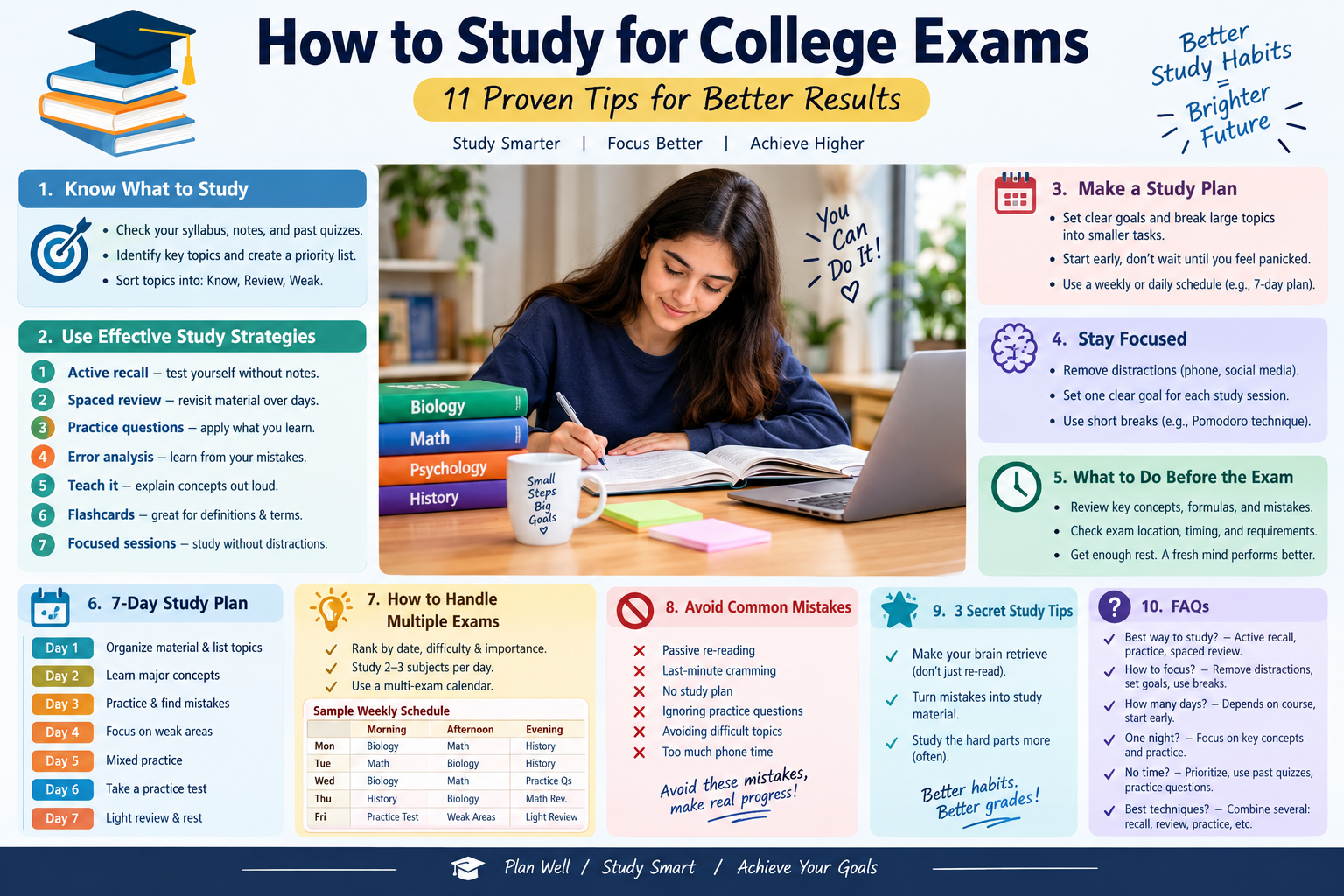
A common approach is to study for 25 minutes and then take a five-minute break.
After several sessions, take a longer break.
You can adjust the timing according to your attention span.
| Study Time | Break | Best For |
|---|---|---|
| 25 minutes | 5 minutes | Short focused sessions |
| 40 minutes | 10 minutes | Moderate study |
| 50 minutes | 10 minutes | Longer study sessions |
The technique is not magic. Its main benefit is giving your study session a clear structure.
Make Your Breaks Useful
A short break should help you reset.
Stand up, stretch, drink water, or walk around for a few minutes.
Try not to turn a five-minute break into an hour of social media.
7. Explain What You Learn
One of the easiest ways to check whether you understand something is to explain it.
Imagine that you are teaching the topic to someone who has never studied it before.
Use simple language.
If you cannot explain the idea without checking your notes, you may have a gap in your understanding.
Explain Difficult Ideas in Simple Words
Choose one concept and explain it as if you were teaching a younger student.
Avoid complicated words when simple ones work.
If your explanation becomes confusing, go back to the material and study the difficult part again.
Find the Gaps in Your Knowledge
Explaining a topic can reveal exactly where your understanding becomes weak.
That is useful because you can spend your study time on the areas that actually need attention.
8. Connect New Information to What You Already Know
New information becomes easier to understand when you connect it to something familiar.
Instead of memorizing every fact separately, look for relationships between ideas.
For example, when learning a scientific concept, connect it to something you have seen in everyday life.
Use Real Examples
If you are learning vocabulary, create your own sentences.
If you are studying history, connect events through causes and consequences.
If you are learning mathematics, understand what a formula represents instead of memorizing symbols without knowing what they mean.
Create Associations
You can connect difficult information with an image, story, example, or familiar idea.
The stronger the connection, the easier the information may be to recall later.
9. Use Memory Techniques
Memory techniques can make certain types of information easier to remember.
One simple method is creating an acronym or memorable phrase for a list.
You can also use images and associations to make abstract information more meaningful.
Try the Method of Loci
The method of loci, sometimes called a memory palace, involves connecting information to familiar locations.
Imagine walking through your home.
Assign a piece of information to each room or location. Later, mentally walk through those locations to recall the information.
This can be useful for lists, sequences, and other organized information.
Use Mnemonics Carefully
Mnemonics can help you remember information, but they should support understanding rather than replace it.
First understand the topic. Then use a memory technique when certain facts are difficult to recall.
10. Protect Your Energy and Focus
Your ability to study depends partly on your physical and mental energy.
When you are exhausted, hungry, dehydrated, or constantly distracted, concentrating can become harder.
You do not need a complicated routine. Basic habits can make a difference.
Get Enough Sleep
Sleep is important for learning and memory.
Instead of sacrificing an entire night to cram before an exam, try to spread your studying across several days.
A regular study routine can reduce the pressure of last-minute preparation.
Take Regular Breaks
Long periods of nonstop studying can become mentally tiring.
Short breaks give you an opportunity to reset before starting the next session.
The goal is to return to your work with enough attention to actually learn.
11. Test Yourself Before the Exam
Practice questions are useful because they show whether you can actually retrieve and apply information.
Reading your notes can make information look familiar. A practice test requires you to produce an answer.
Find Your Weak Areas
After completing practice questions, do not only look at your score.
Look at the questions you missed.
Ask yourself:
“Did I forget the information?”
“Did I misunderstand the concept?”
“Did I make a careless mistake?”
“Did I run out of time?”
Your mistakes can show you exactly what to study next.
Practice Under Realistic Conditions
If your exam is timed, occasionally practice with a timer.
If your exam uses multiple-choice questions, include multiple-choice practice.
The closer your practice is to the real situation, the more familiar the exam format can become.
How to Study and Memorize Faster
If you want to study and memorize faster, avoid trying to memorize every sentence.
Start by understanding the material.
Then follow this simple process:
Understand → Recall → Review → Practice → Repeat
First, understand the concept.
Next, close your notes and recall what you remember.
Review the parts you missed.
Practice with questions or examples.
Finally, return to the material later using spaced repetition.
This approach is more useful than repeatedly reading the same page without testing yourself.
How to Learn Faster Without Forgetting
There is no universal method that makes every person learn exactly ten times faster.
Learning speed depends on the subject, previous knowledge, attention, difficulty, and individual learning habits.
However, you can improve how efficiently you use your study time.
Active recall, spaced repetition, focused sessions, practice questions, and clear study goals can help you spend less time passively reviewing and more time actively learning.
How to Memorize Fast Before an Exam
If your exam is tomorrow, do not panic and try to memorize an entire textbook.
Start with the information that matters most.
Review important concepts, definitions, formulas, examples, and practice questions.
Then close your notes and test yourself.
Use Short Review Cycles
Study one small section.
Close the book.
Recall what you learned.
Check what you missed.
Then move to the next section.
This is more focused than repeatedly reading the entire chapter.
Avoid All-Night Cramming
Staying awake all night may give you more study hours, but it can also leave you exhausted.
Whenever possible, spread your preparation across several days and allow yourself enough time to rest.
Study Methods Compared
| Study Method | Main Benefit | Best Use |
|---|---|---|
| Active Recall | Practices information retrieval | Facts and concepts |
| Spaced Repetition | Supports repeated review | Long-term learning |
| Pomodoro | Structures study time | Focused sessions |
| Practice Tests | Builds exam practice | Test preparation |
| Explanation | Reveals knowledge gaps | Difficult concepts |
| Method of Loci | Builds memory associations | Lists and sequences |
| Rereading | Builds familiarity | Quick review |
No single technique works perfectly for every subject.
Combining two or three methods is often more practical.
Frequently Asked Questions
How can I study and memorize faster?
Use active recall, spaced repetition, and focused study sessions. Instead of repeatedly reading your notes, close the book and test yourself. Break large topics into smaller sections and review difficult information over several days.
How can I focus 100% on studying?
Remove distractions before starting. Put your phone away, close unnecessary browser tabs, choose one specific study goal, and work in a timed session. Take short breaks when needed so you can return to studying with better attention.
What is the 3-3-3 memorization rule?
The 3-3-3 rule is described differently by different sources and is not a single universally established scientific learning method. For reliable study practice, focus on techniques such as active recall, spaced repetition, and practice testing.
How can I memorize something fast for a test tomorrow?
Focus on the most important concepts first. Use active recall, practice questions, and short review sessions. Explain difficult ideas in your own words and return to information you cannot remember easily.
How can I remember what I study for a long time?
Use active recall and spaced repetition. Test yourself regularly and review information at increasing intervals. Understanding the material and connecting it with examples can also make it easier to remember.
Is studying for longer hours better?
Not necessarily. The quality of your study time matters too. A focused session using active recall and practice can be more productive than several hours of distracted rereading.
How can I study faster without forgetting everything?
Focus on efficient learning instead of simply studying for more hours. Understand the material, divide it into smaller sections, use active recall, review it over time, and practice applying what you learned.
Is the Pomodoro Technique good for studying?
The Pomodoro Technique can help organize study time and create clear periods of focused work. A common starting point is 25 minutes of studying followed by a five-minute break, although the timing can be adjusted.
Conclusion
Learning faster is not about forcing yourself to study for more hours. It is about making your study time more effective.
If you want to learn how to study faster and remember more, start with a few simple changes. Set a clear goal, remove distractions, use active recall, review information over time, and test yourself regularly.
You do not need to use every technique at once. Choose two or three methods and practice them consistently.
The biggest change comes from moving away from passive studying. Instead of simply reading the same information again and again, actively recall it, explain it, practice it, and review it later.
With the right approach, your study sessions can become more focused, organized, and productive penstripe

g kia hal ha