



Here’s a scenario that probably sounds familiar: your teacher pulls up a lesson plan that was clearly built with help from ChatGPT, then turns around and tells the class that using AI on an essay counts as cheating. Feels like a double standard, right? A lot of students think so, and honestly, it’s a fair question to ask.
But once you dig into it, the reasoning isn’t quite as hypocritical as it first looks. When a teacher uses AI, they’re still the one checking the work, editing it, and taking responsibility for whatever ends up in front of a class. When a student uses AI on an assignment, the tool can end up doing the exact thing school was supposed to teach them how to do think, write, and work through a problem on their own. That’s the real gap driving almost every AI policy you’ll come across.
This guide walks through why schools draw the line where they do, what the actual risks are, where policies are headed in 2026, and how you can use AI without getting flagged or, more importantly, without shortcutting your own learning.
The Real Reason Schools Use AI But Restrict Students
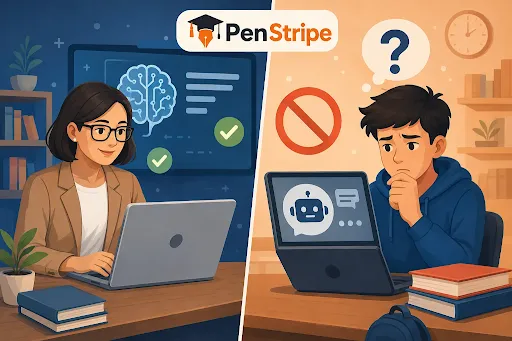
If you boil down why can schools use AI but students can’t use it into one word, it’s purpose. Teachers are already past the point where a tool can rob them of a skill they haven’t built yet they’ve got the training and the judgment. Students are still building that judgment, and that’s exactly what makes the situation different.
Think about it this way. When a teacher asks an AI tool to draft a rubric or spit out some practice problems, they’re not skipping years of training they’re using AI to save time on a task they already know how to do by hand. They still read it over, catch mistakes, and decide what actually makes it into the classroom.
A student handing a writing prompt to a chatbot is in a totally different spot. The whole point of that assignment was to build a skill maybe organizing an argument, maybe just learning to get thoughts onto a page. If AI does that part, the essay might look great, but the student walks away having learned nothing from it.
Teachers Are Accountable for the Output
Every lesson plan or quiz a teacher builds with AI still goes through a human filter before students ever see it. That’s not really optional teachers are professionally and legally on the hook for what they hand out. If AI gets something wrong, catching it is part of the job.
Students Are Still Being Assessed on Original Thought
Grades exist to show what a student can actually do. The moment AI starts doing meaningful chunks of the thinking or writing, that grade stops meaning what it’s supposed to mean. That’s really the whole reason schools separate “AI to check your work” from “AI to produce your work” one preserves the point of the assignment, the other quietly erases it.
It’s About Role, Not Fairness
This isn’t some special privilege adults get while kids get punished for the same thing. It’s the same logic behind letting an accountant use a calculator at work but taking it away during a basic arithmetic test the test exists to prove the skill is actually there, not to prove you can operate a tool.
Why Are Students Not Allowed to Use AI?
Type “why are students not allowed to use AI” into Google and you’ll notice the same few reasons pop up over and over, no matter which district you’re looking at.
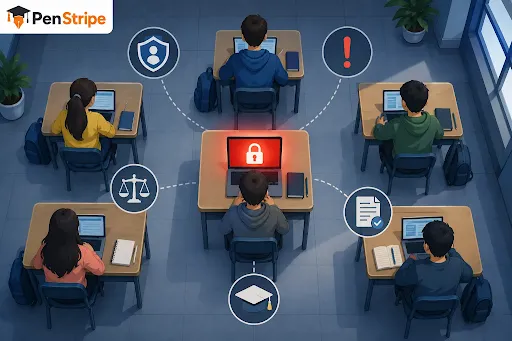
Academic Integrity Concerns
This one’s the obvious answer. Turning in AI-written text as your own work is still plagiarism it’s just wearing a new outfit. The honesty codes schools have used for decades weren’t written with chatbots in mind, but they apply just the same.
Assessment Accuracy
Teachers can only help you if they know where you’re actually struggling. If AI is quietly doing the heavy lifting, a teacher has no real way to spot a student who’s falling behind, and that student can slip through the cracks without anyone noticing until it’s too late.
Data Privacy and Safety
A lot of the popular AI chatbots weren’t really designed with kids in mind age limits, murky data collection, and inconsistent content filters are all real concerns. That’s a big part of why so many districts are pushing students toward school-approved AI tools instead of letting them loose on general consumer apps.
Skill Development
Writing, critical thinking, problem-solving these are use-it-or-lose-it skills. Cognitive research has said this for years: comprehension and reasoning grow through repeated, effortful practice, and that’s a lot harder to guarantee when AI can hand you the effortful part in two seconds.
Why Is It Bad for Students to Use AI in School?
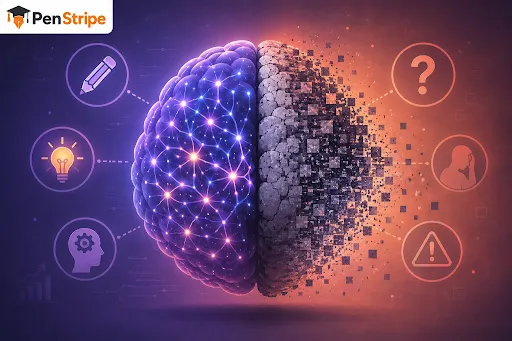
This is the natural follow-up question, and it deserves an honest answer rather than a scare tactic. AI use in school isn’t inherently bad but leaning on it without any guardrails absolutely comes with downsides.
Reduced Critical Thinking
Instant answers feel great in the moment, but they rob you of the struggle that actually builds understanding. This isn’t a new idea, either back in 1958, psychologist B.F. Skinner built a teaching machine around one simple rule: you couldn’t move to the next question until you produced the right answer yourself. The machine gave feedback, but it never did the thinking for you. That principle hasn’t changed just because the technology got smarter.
Overreliance and Skill Atrophy
Students who default to AI for every assignment often start doubting their own abilities over time. Plenty of teachers have noticed students increasingly can’t tell AI-written content apart from their own classmates’ work which is a pretty clear sign the line between “using a tool” and “letting the tool think for you” is getting blurry fast.
Misinformation and Hallucinations
AI can sound completely confident while being completely wrong this is usually called “hallucinating.” If you don’t already know enough about a topic to catch the mistake, it’s easy to walk away believing something false without realizing it.
Equity Gaps
Not every student has the same access to premium AI tools, solid internet, or someone at home who understands how to use this stuff responsibly. Left unchecked, that gap doesn’t shrink it grows, and it tends to hit the same students who were already behind.
Why Do Schools Not Like AI? The Institutional Side
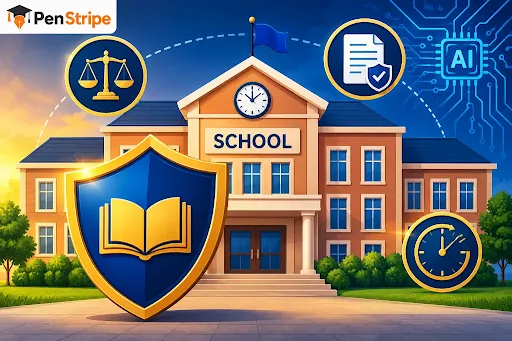
“Schools don’t like AI” isn’t really accurate most districts are pouring money into it right now. What administrators actually worry about are the practical headaches that come with it.
Liability and Legal Risk
Schools are legally responsible for keeping student data and student safety intact. If some third-party AI tool mishandles a kid’s information or exposes them to something inappropriate, the school is the one facing the lawsuit and the headlines.
Inconsistent Guidance
More than 30 states have put out some kind of AI guidance for K-12 schools, but it’s a patchwork. Some of it focuses on data privacy and teacher training and just… skips the harder question of how much AI use actually makes sense for a developing kid’s brain. That gap is exactly why classroom rules can feel confusing or even contradictory depending on which school, or even which teacher, you ask.
Pressure From Educators’ Unions
Teachers themselves aren’t all on board with rapid AI expansion. In 2026, the American Federation of Teachers publicly pushed for tighter limits on student AI use and screen time in classrooms a sign that plenty of educators are worried about attention spans and learning outcomes, not just cheating.
Fast-Moving Technology, Slow-Moving Policy
AI changes month to month. School board policy does not. A rule written in January 2026 can feel outdated by September, which is part of why a lot of districts now treat their AI policies as living documents instead of something they write once and forget.
AI in Schools: Pros and Cons
To get the full picture of AI in education for students, it helps to look at both sides honestly instead of picking one side to defend.
Advantages of AI in Education for Students
- Practice that adjusts to your actual pace and skill level, not a one-size-fits-all worksheet
- Instant feedback on drafts, math problems, or language practice
- Real support for students with learning differences or disabilities
- A place to brainstorm ideas before you start writing, without it writing the thing for you
- Early exposure to AI literacy, a skill you’ll probably need in whatever career comes next
AI in Schools Cons
- Higher risk of academic dishonesty and less original thinking
- Misinformation slipping in through AI hallucinations
- Privacy concerns tied to tools that weren’t built with kids in mind
- Uneven access between students, and between schools
- A slow erosion of core skills for students who lean on it too much
Positive and Negative Impact of Artificial Intelligence on Students
The upside of AI usually shows up fast personalized support, quicker feedback, better accessibility. The downside tends to show up later, quietly, in the form of weaker writing fundamentals, less patience for hard problems, and trouble telling reliable information apart from something AI just made up.
What Are the Limitations of Using AI in Education?
Even the best AI tools hit a wall pretty quickly in a school setting, and it’s worth knowing exactly where.
AI Can’t Replace Human Judgment
AI can flag a grammar mistake or suggest a lesson outline, but it has no idea what’s actually going on in a student’s home life, or why their grades suddenly dropped. A teacher can pick up on that. AI can’t.
AI Struggles With Nuance and Bias
AI models learn from existing data, and existing data has existing biases baked into it. Left unchecked, that can subtly shape what students are learning without anyone realizing it’s happening.
AI Can’t Replace Mental Health Support
This one gets stated pretty bluntly by education policy experts: AI should never stand in for a school counselor or a trusted adult. If a student is dealing with something serious emotionally, they need a real person, not a chatbot.
AI Requires Digital and Media Literacy Most Students Don’t Yet Have
A nationally representative 2026 survey found that 61% of elementary teachers say their students struggle a lot to tell AI-generated content apart from human-made content. That number drops with age 44% in middle school, 38% in high school but it never really disappears. Without formal media literacy instruction, most students are just figuring this out on their own, which isn’t ideal.
How Schools Are Changing Their AI Rules in 2026
AI policy in education isn’t standing still, and 2026 has genuinely been a turning-point year.
A Growing Push for National Standards
Earlier in 2026, high school students from all 50 states actually sat down and drafted a model policy called the Students First Act, aiming to give schools, teachers, and students one clearer, more consistent set of rules. Its stance is pretty direct: students at every grade level would be barred from using AI to generate graded written or artistic work, while older students could use it for brainstorming or editing, but only with a teacher’s permission and full disclosure.
Higher Education Is Tightening, Not Loosening, Its Rules
Some universities are actually moving toward stricter defaults, not looser ones. One major law school adopted a policy in 2026 that bans AI use for outlining, drafting, or revising any graded work by default exceptions only happen if an instructor grants one in writing. Part of what pushed that decision was a noticeable spike in AI-generated citation errors and shaky legal analysis showing up in student work.
School-Specific AI Tools Are Replacing Open Chatbots
Instead of banning AI outright, a lot of districts are steering students toward vetted, education-specific platforms with built-in safety features, rather than letting them loose on general-purpose chatbots that were never designed with a classroom in mind.
The Market Is Growing Fast
The K-12 AI education market has exploded since 2022 and shows no signs of slowing down. That growth basically guarantees more schools will be writing formal AI policies soon, instead of leaving the decision up to individual teachers.
How Students Can Use AI the Right Way
Knowing the rules is half the battle. Here’s the practical part how to actually use AI without crossing into cheating territory.
Checklist: AI Uses That Are Usually Safe
- Brainstorming ideas before you actually start writing
- Asking AI to explain something you didn’t fully get in class
- Quizzing yourself on material you’ve already studied
- Getting grammar or clarity feedback on a draft you wrote yourself
- Asking AI to summarize something you already read, just to check your own understanding
Checklist: AI Uses That Usually Cross the Line
- Having AI write part or all of a graded assignment
- Turning in AI-generated text without saying so, even if you edited it a bit
- Using AI during a closed-book test or quiz
- Letting AI solve a math problem you were supposed to work through
- Copying AI’s analysis into a paper without checking whether it’s even accurate
Step-by-Step: Using AI Responsibly on an Assignment
- Read the assignment instructions first. If your teacher hasn’t said anything about AI, ask before you assume it’s fine.
- Try the first draft or first attempt on your own, so you actually know what you understand and what you don’t.
- Use AI only for the parts your teacher has actually approved, like brainstorming or a grammar check.
- Double-check anything AI tells you before it makes it into your final work.
- Disclose your AI use if your school asks for it it’s a much smaller conversation than getting caught later.
Read more articles on Penstripe
Comparison Table: Teacher AI Use vs. Student AI Use
| Factor | Teacher AI Use | Student AI Use |
| Primary purpose | Support planning, grading, and feedback | Learn skills like writing and reasoning |
| Accountability | Teacher reviews and approves all output | Student’s own understanding is being assessed |
| Common tasks | Lesson plans, quizzes, feedback comments | Brainstorming, studying, editing (with permission) |
| Restricted tasks | None, as long as content is reviewed | Generating graded assignments, use during tests |
| Oversight | Professional and legal responsibility | Teacher permission and disclosure required |
| Risk if misused | Inaccurate materials reach students | Academic dishonesty, weaker skill development |
Frequently Asked Questions
Why can schools use AI but students can’t use it?
Schools let staff use AI because teachers are still the ones checking and approving whatever comes out of it. Students face tighter limits because their assignments exist to build and measure skills that AI can bypass entirely, so open access ends up undercutting both the learning and the grade.
Why are students not allowed to use AI?
It mostly comes down to academic honesty, giving teachers an accurate read on what students actually know, protecting minors’ data, and making sure core skills like writing and critical thinking still get built instead of skipped.
Why is it bad for students to use AI in school?
Why is it bad for students to use AI in school? It’s not always bad but unsupervised use can dull critical thinking, breed overreliance, spread misinformation through AI errors, and widen the gap between students who have solid access to good tools and instruction and those who don’t.
Why do schools not like AI?
Why do schools not like AI? It’s less “dislike” and more “managing risk.” Schools are dealing with liability, inconsistent state-by-state guidance, pushback from teachers’ unions, and a technology that’s evolving faster than any policy can keep pace with.
What are the limitations of using AI in education?
AI can’t replace a teacher’s judgment, it can carry hidden bias, it’s no substitute for real mental health support, and it demands media literacy skills a lot of students simply haven’t been taught yet.
What’s the biggest misuse of AI in education?
Far and away, it’s students turning in AI-generated writing or problem-solving as if it were their own, especially on graded assignments and take-home assessments.
Will AI rules in schools change again soon?
Almost certainly. With over 30 states already issuing guidance and student-written policy proposals gaining real traction in 2026, expect the rules to get clearer and more consistent over the next couple of school years.
Conclusion
So why can schools use AI but students can’t use it? Because the two groups are using it for completely different reasons. Teachers lean on AI to support decisions they’re already qualified to make. Students are still in the middle of building the skills those decisions depend on and unrestricted AI use can quietly get in the way of that process without anyone noticing until the damage is done.
The good news is this isn’t really an all-or-nothing situation. Used with clear boundaries, honest disclosure, and a teacher’s guidance, AI can genuinely support learning instead of replacing it. If you’re a student trying to navigate this, keep it simple: know your school’s actual policy, use AI to sharpen your own thinking rather than substitute for it, and when in doubt on graded work, just ask first.