






Ask ten people for a critical thinking definition, and you’ll likely get ten different answers. Some call it “smart thinking.” Others describe it as “questioning everything.” Neither is wrong, but neither is complete either. In simple terms, critical thinking is the ability to analyze information objectively, question assumptions, and form a reasoned judgment instead of accepting things at face value.
This skill matters far beyond the classroom. Students use it to evaluate sources for a research paper. Professionals use it to solve problems at work. Everyday people use it to spot misinformation online or make sound financial decisions. In a world flooded with information, the ability to think critically has become one of the most valuable skills a person can develop.
In this guide, you’ll get a clear, research-backed critical thinking definition, along with the core skills that make it up, real-world examples across different settings, and practical strategies to strengthen it. Whether you’re a student, an educator, or simply curious about how strong thinkers approach problems, this article covers everything you need to understand and apply critical thinking effectively.
What Is Critical Thinking?
Critical Thinking Definition in Simple Words
In the simplest terms, critical thinking is the process of thinking clearly, questioning what you’re told, and deciding what to believe or do based on evidence rather than assumption. It’s not about being negative or doubting everything. It’s about examining information carefully before accepting it as true.
For example, if a headline claims a new diet “cures” a disease overnight, a critical thinker doesn’t dismiss it outright or accept it blindly. Instead, they ask: Where did this claim come from? Is there scientific evidence behind it? Who benefits from me believing this?
Academic Definition of Critical Thinking
Educational and psychological researchers define critical thinking a bit more formally. One widely cited definition, developed by the Foundation for Critical Thinking, describes it as “the intellectually disciplined process of actively and skillfully conceptualizing, applying, analyzing, synthesizing, and evaluating information gathered from observation, experience, reflection, reasoning, or communication.”
This critical thinking definition in education emphasizes that it’s not a passive trait some people are simply born with. It’s a disciplined, learnable process, which is good news for anyone who wants to strengthen it.
Critical thinking definition in psychology typically frames it as a cognitive skill involving metacognition, meaning the ability to reflect on and evaluate your own thought processes. Psychologists often study how biases, emotions, and mental shortcuts (called heuristics) interfere with objective reasoning.
Critical thinking definition in nursing applies these same principles to a high-stakes, fast-moving environment. Nurses use critical thinking to assess patient symptoms, weigh treatment options, and make safe decisions quickly, often with incomplete information. In this field, critical thinking isn’t optional; it’s directly tied to patient safety.
Want a more detailed breakdown with simple examples? Read our full guide: [What Is Critical Thinking? Definition and Simple Examples].
Why Is Critical Thinking Important?
Better Decision-Making
Critical thinking helps you weigh options logically instead of reacting emotionally or impulsively. Whether it’s choosing a college major, evaluating a job offer, or deciding how to invest savings, structured thinking leads to more consistent, better-informed outcomes.
Improved Problem-Solving
Problems rarely have one obvious solution. Critical thinking allows you to break a complex issue into smaller parts, evaluate multiple possible solutions, and choose the most effective one based on evidence rather than guesswork.
Better Learning and Academic Performance
Students who think critically don’t just memorize facts; they understand why those facts matter and how they connect to other ideas. Research in educational psychology consistently links strong critical thinking skills to improved reading comprehension, essay writing, and problem-solving across subjects.
This is just an overview. For a deeper look at how this skill impacts students and everyday life, see our related article: [Why Is Critical Thinking Important for Students and Everyday Life?].
Key Critical Thinking Skills

Understanding a critical thinking definition is only useful once you know what skills actually make it up. Most experts agree on six core components.
Analysis
Analysis means breaking information down into smaller parts to understand how they relate to each other. For example, analyzing a news article means looking at its claims, sources, and any potential bias separately, rather than reacting to the headline alone.
Interpretation
Interpretation is about understanding the meaning or significance of information. Two people can look at the same data and interpret it differently depending on context, so strong critical thinkers consider multiple possible interpretations before settling on one.
Evaluation
Evaluation involves judging the credibility, relevance, and strength of evidence or arguments. This is the skill that helps you determine whether a source is trustworthy or whether an argument actually supports its conclusion.
Inference
Inference is drawing logical conclusions from available evidence, even when all the information isn’t stated directly. A doctor inferring a diagnosis from a set of symptoms is a clear real-world example of this skill in action.
Problem-Solving
Problem-solving applies the other skills toward a practical goal: identifying an issue, generating possible solutions, and choosing the most effective one based on evidence and reasoning.
Logical Reasoning
Logical reasoning is the ability to follow a clear line of thought from premise to conclusion without contradiction. It’s what allows you to spot flawed arguments, such as when a conclusion doesn’t actually follow from the evidence presented.
What are 5 critical thinking skills? If you’re looking for a shorter list, most educators point to analysis, evaluation, inference, problem-solving, and logical reasoning as the five most essential.
Want to go deeper into each of these? Check out our full breakdown: [10 Essential Critical Thinking Skills Every Student Should Develop].
Examples of Critical Thinking in Everyday Life
Examples for Students
A student researching a history essay doesn’t just accept the first source they find. They compare multiple sources, check publication dates, consider the author’s potential bias, and cross-reference facts before including them in their paper. That entire process is a critical thinking example in action.
Examples at Work
An employee notices a recurring error in a monthly report. Instead of simply fixing it once, they trace the problem back to its source, identify why it keeps happening, and propose a process change to prevent it going forward. This reflects analysis, inference, and problem-solving working together.
Examples in Daily Decision-Making
Someone sees a product advertised with the claim “clinically proven” but pauses before purchasing to ask what “clinically proven” actually means, whether the claim is backed by a real study, and whether that study was independent or funded by the company itself.
For 15 more real-world scenarios across school, work, and daily life, read: [15 Real-Life Examples of Critical Thinking for Students].
Critical Thinking vs. Creative Thinking
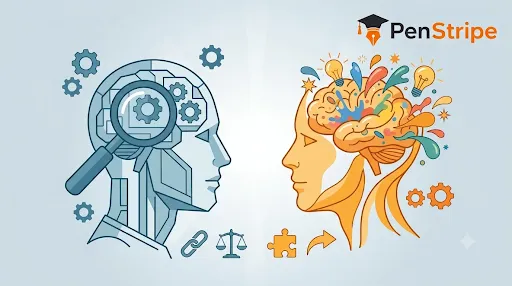
Critical thinking and creative thinking are often mentioned together, but they serve different purposes. Critical thinking is primarily about evaluating and judging existing information, while creative thinking is about generating new ideas and possibilities. Strong thinkers typically use both together: creativity to generate options, and critical thinking to evaluate which options are actually worth pursuing.
| Aspect | Critical Thinking | Creative Thinking |
| Primary Goal | Evaluate and judge information | Generate new ideas |
| Process Style | Logical, analytical, structured | Open-ended, exploratory |
| Common Use Case | Solving a defined problem | Brainstorming possible solutions |
| Key Question Asked | “Is this true or valid?” | “What else could this be?” |
| Risk if Overused Alone | Can become overly rigid or skeptical | Can generate impractical ideas |
| Best Used Together For | Innovation that’s both original and workable |
When to use each skill: Use creative thinking during brainstorming, early idea generation, or when a problem has no obvious solution. Switch to critical thinking once you have options on the table and need to evaluate which ones are realistic, evidence-based, or worth pursuing.
How to Improve Critical Thinking Skills

Ask Better Questions
Instead of accepting information at face value, get in the habit of asking: What’s the evidence for this? What’s the source? What am I missing? Strong questions are often the starting point of strong critical thinking.
Analyze Different Perspectives
Before forming an opinion, actively seek out viewpoints that differ from your own. This doesn’t mean you have to agree with them, but understanding opposing perspectives sharpens your ability to evaluate your own position more objectively.
Check Facts and Evidence
Make it a habit to verify claims, especially ones that confirm what you already believe. Confirmation bias, the tendency to favor information that supports existing beliefs, is one of the biggest obstacles to objective thinking.
Avoid Assumptions
Assumptions fill in gaps with guesses rather than facts. Strong critical thinkers pause to identify when they’re assuming something instead of actually knowing it, and they seek out the missing information before drawing conclusions.
Practice Problem-Solving
Like any skill, critical thinking improves with deliberate practice. Working through logic puzzles, debating structured topics, or analyzing case studies regularly builds the mental habits that make critical thinking feel more natural over time.
Ready for a complete action plan? See our detailed guide: [How to Improve Critical Thinking Skills: 12 Practical Strategies].
Common Barriers to Critical Thinking
Even people who understand critical thinking well can struggle to apply it consistently. Here are the most common obstacles.
Personal bias — Everyone has existing beliefs and experiences that shape how they interpret new information, often without realizing it.
Emotional thinking — Strong emotions like fear, anger, or excitement can override logical reasoning, leading to decisions based on feeling rather than evidence.
Assumptions — Treating unverified beliefs as facts skips the evaluation step entirely, which is the core of critical thinking.
Lack of information — Sometimes people form conclusions with incomplete data simply because gathering more information takes time and effort.
Misinformation — In an environment full of unverified claims, distinguishing credible information from false or misleading content has become an essential (and increasingly difficult) skill.
Expert insight: Recognizing these barriers in yourself is often harder than recognizing them in others. A useful habit is to pause before reacting strongly to information, especially information that confirms what you already believe, and ask whether you’d evaluate it the same way if it said the opposite.
Critical Thinking Activities for Students
Debates
Structured debates require students to research both sides of an issue, anticipate counterarguments, and defend a position using evidence. This builds analysis, evaluation, and logical reasoning simultaneously.
Problem-Solving Exercises
Activities like logic puzzles, riddles, or open-ended math problems push students to work through multiple possible approaches rather than applying a single memorized formula.
Case Studies
Reviewing real or hypothetical scenarios, such as a business decision or historical event, and asking students to evaluate what went right, what went wrong, and what they would do differently builds practical judgment.
Brainstorming Activities
While brainstorming leans more toward creative thinking, following it with a structured evaluation step (ranking ideas by feasibility or evidence) turns it into a complete critical thinking exercise.
Frequently Asked Questions
What is the simple definition of critical thinking?
Critical thinking is the ability to analyze information objectively, question assumptions, and form a reasoned conclusion based on evidence rather than accepting claims at face value. It’s a learnable skill, not a fixed personality trait, and it applies to everyday decisions as much as academic or professional ones.
What are the 7 steps of critical thinking?
A common seven-step model includes: identifying the problem, gathering information, evaluating evidence, identifying assumptions, considering alternative viewpoints, drawing a logical conclusion, and communicating that conclusion clearly. Different frameworks may word these steps differently, but the underlying process stays consistent
What are 5 critical thinking skills?
The five most commonly cited critical thinking skills are analysis, evaluation, inference, problem-solving, and logical reasoning. Some frameworks also include interpretation as a sixth core skill, since understanding meaning often precedes evaluation.
What are the three types of critical thinking?
Critical thinking is often grouped into three types: analytical thinking (breaking down information), evaluative thinking (judging credibility and validity), and inferential thinking (drawing logical conclusions from evidence). Together, these types cover the full process from understanding information to acting on it.
What is an example of critical thinking?
A clear example is fact-checking a claim before sharing it online: identifying the source, checking whether it’s credible, comparing it against other reliable sources, and deciding whether it holds up before accepting or repeating it. This process reflects analysis, evaluation, and inference working together.
Why is critical thinking important for students?
Critical thinking helps students move beyond memorization toward genuine understanding, which improves reading comprehension, writing quality, and problem-solving across every subject. It also prepares students to evaluate information responsibly, a skill that becomes increasingly important as they encounter more complex academic work and real-world decisions.
How can students improve critical thinking?
Students can improve critical thinking by regularly asking probing questions, analyzing different perspectives on a topic, verifying facts before accepting them, and practicing structured problem-solving activities like debates or case studies. Consistent practice, rather than occasional effort, is what builds this skill over time.
Conclusion
At its core, critical thinking definition boils down to one idea: thinking clearly and evaluating evidence before forming a conclusion, instead of accepting information automatically. It’s built from specific, learnable skills, including analysis, evaluation, inference, and logical reasoning, and it shows up everywhere from classroom research papers to everyday purchasing decisions.
The good news is that critical thinking isn’t a fixed trait some people simply have and others don’t. It’s a habit that strengthens with deliberate practice, whether that’s questioning a headline before sharing it, debating both sides of an issue, or pausing to check your own assumptions. Start small: the next time you encounter a claim, ask what evidence supports it. That single habit is where stronger critical thinking begins.
Stay in touch with Penstripe